Advertisement
Advertisement
January/February 2024
Mechanical Circulatory Support Use in Cardiogenic Shock and Complex PCI
An overview of mechanical circulatory support devices and simplified algorithms for their optimal use in cardiogenic shock and complex, high-risk interventions.
By Mahmoud Khalil, MD; Hossam Albeyoumi Mohammed, MD; Lindsey Cilia, MD; Khaldoon Alaswad, MD; and Michael Megaly, MD
Over the past few decades, temporary mechanical circulatory support (MCS) devices have been a cornerstone in the management of cardiogenic shock (CS) and an important contributor to further development of the complex, high-risk intervention (CHIP) field. Temporary MCS can be used to stop acute worsening shock and provide a bridge to recovery, durable ventricular assist device implantation, or heart transplant. Temporary MCS devices are also used to support complex, high-risk patients during percutaneous coronary intervention (PCI) and, more recently, valvular interventions.1
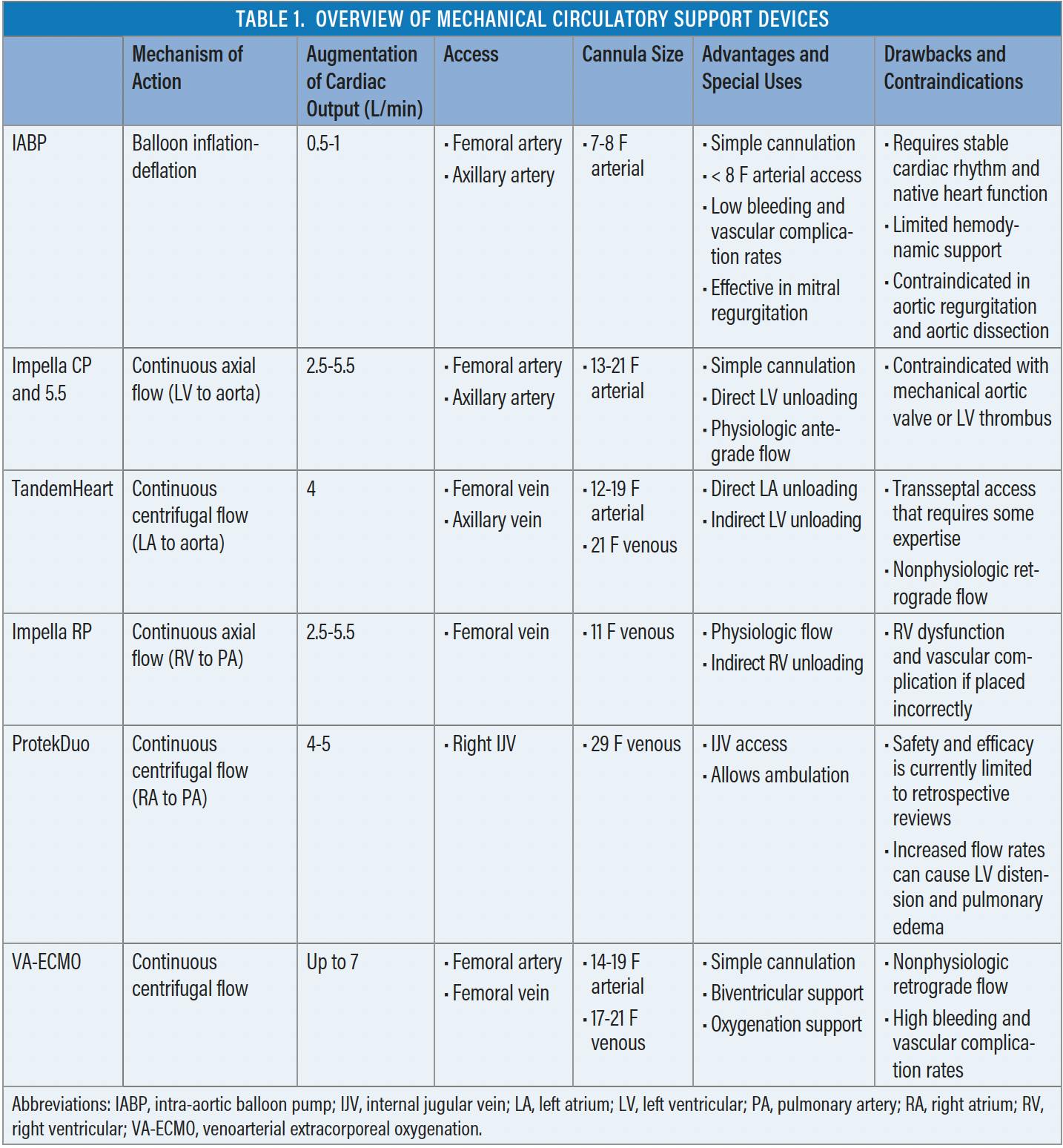
Temporary MCS can be divided into left ventricular (LV) (eg, intra-aortic balloon pump [IABP], Impella CP or 5.5 [Abiomed, Inc.], TandemHeart [LivaNova]), right ventricular (RV) (eg, Impella RP [Abiomed, Inc.], ProtekDuo [LivaNova]), or biventricular support devices (eg, venoarterial extracorporeal membrane oxygenation [VA-ECMO]). Table 1 summarizes the characteristics of these MCS devices. This article provides an overview of MCS devices and simplified algorithms for their optimal use in CS and CHIP.
LV SUPPORT DEVICES
IABP
IABP is widely available and can be inserted percutaneously through the femoral or axillary arteries. IABP size is chosen based on the patient’s height. The pump works by counterpulsation with inflation during diastole and deflation during systole. This leads to enhanced coronary perfusion during diastole, reduced afterload, and myocardial oxygen consumption, which results in enhanced cardiac output estimated from 0.5 to 1 L/min.2,3 Contraindications for IABP include aortic dissection, aortic valve regurgitation, and severe peripheral artery disease (PAD) if using femoral access. The use of IABP as an MCS in CS has declined after data from the IABP-SHOCK II trial demonstrated no reduction in 30-day mortality in patients with acute myocardial infarction (MI) complicated by CS.4 Six-year follow-up after the initial trial again failed to show mortality benefits.5
Impella CP or 5.5
The Impella systems work via an axial flow continuous pump. The use of Impella 2.5 and 5.0 has declined in real-world practice with the introduction of the Impella CP and the surgical Impella 5.5. The Impella 5.5 with SmartAssist is inserted surgically via a graft to the axillary artery, providing up to 6 L/min of flow. The Impella CP is widely used and placed mostly through the femoral artery but can also be placed through the axillary artery or, when indicated, through the transcaval approach. The system is advanced retrogradely through the aortic valve. It is contraindicated with mechanical aortic valves or LV thrombus. The Impella system allows for LV unloading, reducing end-diastolic pressures and, thus, myocardial oxygen consumption.6 These devices were evaluated in the PROTECT II trial in the context of high-risk PCI compared to IABP. Impella provides more cardiac support, but data did not show a difference in mortality at 30 days. However, there was a trend to superior outcomes at 90 days.7
TandemHeart
TandemHeart is a system consisting of an extracorporeal centrifugal impeller that pumps blood from the left atrium (LA) to the descending aorta through separate inflow and outflow cannulae. The inflow cannula is 21 F in size and is inserted percutaneously through the femoral into the LA after transseptal access. The outflow cannula is 15 to 17 F in size and is inserted into the femoral artery and advanced retrogradely to the descending aorta. It can provide up to 4 to 5 L/min of flow.6,8 TandemHeart can be converted to ECMO by pulling the inflow limb into the right atrium (RA) and using an interposed extracorporeal oxygenator similar to ECMO. TandemHeart allows the left ventricle to contribute to cardiac output and, by pulling blood from the LA, reduces left atrial and ventricular pressures, thus improving blood oxygenation.6 TandemHeart is contraindicated in severe PAD and atrial thrombi. Due to the transseptal approach, complications may include inflow cannula migration to the RA with subsequent hypoxia and right-to-left shunting in the absence of the oxygenator. Two studies comparing TandemHeart to IABP for circulatory support in CS reported higher cardiac indices and lower pulmonary capillary wedge pressures compared to IABP, with more complications in the TandemHeart arm.9,10 The use of TandemHeart in CS showed promising outcomes, with 30- and 180-day survival of 74% and 66%, respectively.11
RV SUPPORT DEVICES
Impella RP
The Impella RP works with the same mechanism as the left side Impella by axial flow continuous pump. The RP Impella is inserted percutaneously through the femoral vein using a 23-F introducer and advanced through tricuspid and pulmonary valves. It allows an average maximum flow of 4.4 L/min.12 FDA recently approved Impella RP Flex with SmartAssist with some advantages, including venous access through the internal jugular vein (IJV) that will allow patient mobility, providing advanced metrics through SmartAssist dual sensor technology with Impella connect.
ProtekDuo
The dual-lumen ProtekDuo 29-F cannula is inserted percutaneously through the right IJV. The inflow is in the RA, and the outflow is in the pulmonary artery. ProtekDuo was FDA approved in 2014 as a venovenous ECMO cannula for pulmonary support in acute respiratory distress syndrome as a bridge to recovery or lung transplant. It can provide up to 4.5 L/min. The ProtekDuo system is an attractive alternative to Impella RP as it allows ambulation due to utilizing an IJV insertion site instead of a femoral access.13 Data regarding safety and efficacy are currently limited to retrospective reviews. A systematic review reported that < 5% of patients experienced complications, including bleeding and catheter migration. Additionally, 62% of patients were successfully weaned from support; however, 20% required conversion to surgical RV assist device support.14
BIVENTRICULAR SUPPORT DEVICE
VA-ECMO
VA-ECMO consists of an extracorporeal centrifugal flow pump, a membrane oxygenator, and venous inflow and arterial outflow cannulas. Venous and arterial access are commonly established percutaneously through the femoral vein and artery, respectively. Blood flows from the venous to the arterial system, bypassing pulmonary circulation. VA-ECMO can provide up to 6 L/min of flow; however, it can increase LV afterload due to increased retrograde flow toward the aortic valve.6 This can be circumvented via an LV unloading strategy (for instance, by using Impella, IABP, or inotropes). VA-ECMO is contraindicated with significant aortic insufficiency, severe PAD, uncontrolled sepsis, and bleeding tendency. Complications include limb ischemia, bleeding, infection, Harlequin syndrome, and stroke (particularly with carotid artery cannulation).15
USE OF MCS IN CS
CS is a state of end-organ dysfunction caused by insufficient cardiac output secondary to LV, RV, or biventricular dysfunction. Multiorgan failure and systemic inflammatory response syndrome commonly ensue. Understanding the hemodynamics in CS is essential for management decisions and understanding the role of MCS.16 Acute MI has been identified as the leading cause of CS. Huge efforts have been exerted to study and improve the approach to managing acute MI complicated by CS, including the National Cardiogenic Shock Initiative (NCSI) and the SCAI (Society for Cardiovascular Angiography and Interventions) SHOCK staging system.17
Although CS mortality remained relatively high over the years with minimal improvement, using MCS through an algorithmic approach guided by a CS team has a promising potential to improve CS outcomes.18 Current literature lacks solid evidence of the impact of MCS on mortality in CS, and available trials have multiple drawbacks, including the inability to enroll samples representative of real-world patients.19
Multiple algorithms have been devised to guide the early use of MCS in CS, the most studied being the NCSI. The algorithm encompasses multiple steps, starting with early identification to prompt initiation of mechanical support to halt the vicious cycle of CS hemodynamic decline. After early identification, placement of MCS devices before PCI has been shown to improve outcomes.20 The initial MCS device should be an LV support device depending on the operator’s experience, with the Impella CP device currently being the most appropriate given the ease of use and adequate initial support of up to 4 L/min. After stabilization and PCI, reevaluation of hemodynamics and calculation of cardiac power output (CPO) and pulmonary artery pulsatility index (PAPI) are advised for possible escalation of support, especially if the patient remains on inotropes or pressors. If CPO is < 0.6 W and PAPI is > 0.9, escalation of LV support would be indicated, as the initial device is likely unable to stop shock. Options include upgrading to surgical Impella 5.5, TandemHeart, or ECMO. If PAPI is < 0.9, this indicates concomitant RV failure requiring RV support escalation with either an RV support device or ECMO. The MCS device choice should be evaluated with emphasis on the risk/benefit profile and the patient’s body habitus, comorbidities, and peripheral vasculature.
USE OF MCS IN COMPLEX, HIGH-RISK PCI
The development of CHIP procedures has been underscored by multiple enhancements, including innovative techniques pioneered by operators and advancements in equipment; however, another crucial aspect lies in the development and adoption of MCS devices. These devices enable operators to treat patients who, without MCS, might face life-threatening complications or mortality. A small number of studies attempting to evaluate the impact of MCS in high-risk PCI (protected PCI) failed to show solid evidence of outcome improvement in their primary analyses.21 However, similar to CS trials, these trials fail to enroll real-world high-risk patients, mostly because of the lack of equipoise by operators who would not perform unprotected PCI on patients who need support during their procedure. The ongoing PROTECT IV trial (NCT04763200) should help answer this question, especially with its parallel ongoing registry.
Although we still need evidence to support the current practice of protected PCI, the more difficult question is the selection of patients who really need MCS during their procedure. There is no current consensus among interventional cardiologists on the criteria for selection. One algorithm that has been proposed by Kearny et al met general acceptance among high-risk operators.22 However, it has not yet been prospectively validated. Different operators have their version of the algorithm according to their comfort level, expertise, and available resources.
CHIP procedures are divided into two general categories: the high-risk patient and the complex procedure, along with their associated risky features (Figure 1). The choice of using MCS depends on the combination of multiple risky features. To fully assess patients for their need for protected PCI, a careful evaluation of the patient should be performed. Risky features in medical history should be identified with the most important factors, including old age, frailty, and chronic kidney disease. Presentation with acute coronary syndrome significantly increases the risk of the procedure as well as surgical turndown status.23 An echocardiogram is crucial to evaluate LV ejection fraction and significant valvular abnormalities that would increase the risk of the procedure and identify contraindications to certain devices. An understanding of the procedure and complexity should be discussed among the CHIP team to identify the high risk of adverse events while treating the complex coronary anatomy (eg, PCI of the last remaining vessel or atherectomy of high calcium burden that might lead to stunning or no-reflow). Finally, if the decision remains equivocal, a right heart catheterization is indicated to identify further risky features that would necessitate using MCS (eg, low cardiac index or high LV end-diastolic pressure).
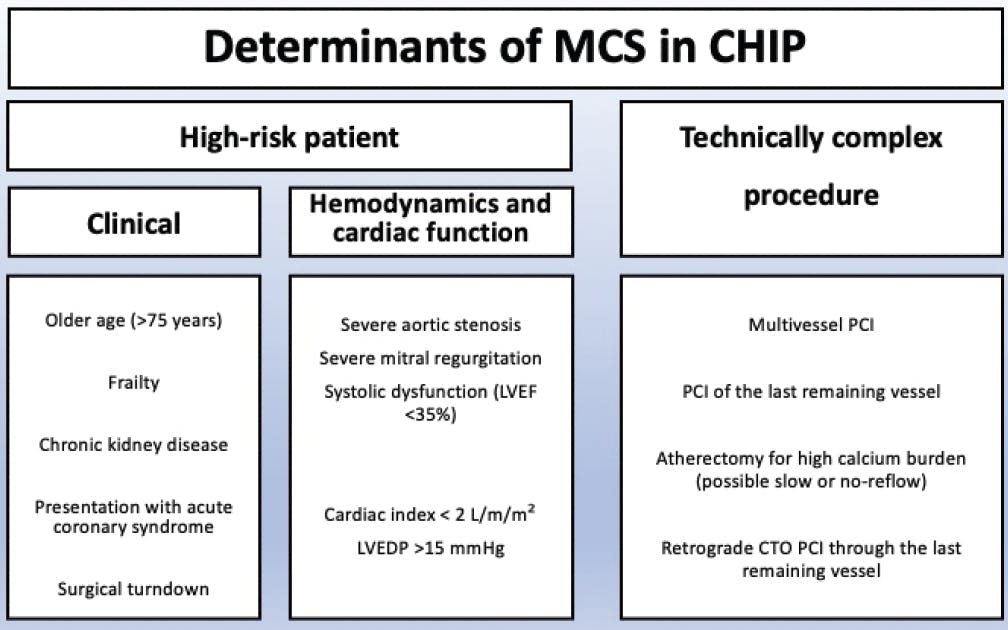
Figure 1. Clinical and technical indications of MCS use in complex and high-risk PCI. CTO, chronic total occlusion; LVEDP, left ventricular end-diastolic pressure; LVEF, left ventricular ejection fraction.
If the decision is made to proceed with protected PCI, an LV support device is used initially. Device choice again depends on the local expertise and availability. Impella CP is advised, given ease of use and adequate support. If there is a vascular contraindication to Impella, IABP can be used, although the actual hemodynamic benefit is limited.24 TandemHeart can also be used in certain cases where extra support is needed as well as in very risky patients, as it can be converted into VA-ECMO as long as an oxygenator is connected.
CONCLUSION
The use of MCS has revolutionized contemporary PCI and shock management. However, MCS devices should be used in the context of team-based algorithmic approaches for maximum clinical benefits. Although technology progress is crucial, efforts should be currently focused on streamlining the use of MCS in CS and CHIP procedures.
1. Basir MB, Kapur NK, Patel K et al. Improved outcomes associated with the use of shock protocols: updates from the National Cardiogenic Shock Initiative. Catheter Cardiovasc Interv. 2019;93:1173-1183. doi: 10.1002/ccd.28307
2. Telukuntla KS, Estep JD. Acute mechanical circulatory support for cardiogenic shock. Methodist Debakey Cardiovasc J. 2020;16:27-35. doi: 10.14797/mdcj-16-1-27
3. Parissis H, Graham V, Lampridis S, et al. IABP: history-evolution-pathophysiology-indications: what we need to know. J Cardiothorac Surg. 2016;11:122. doi: 10.1186/s13019-016-0513-0
4. Thiele H, Zeymer U, Neumann FJ et al. Intraaortic balloon support for myocardial infarction with cardiogenic shock. N Engl J Med. 2012;367:1287-1296. doi: 10.1056/NEJMoa1208410
5. Thiele H, Zeymer U, Thelemann N, et al. Intraaortic balloon pump in cardiogenic shock complicating acute myocardial infarction: long-term 6-year outcome of the randomized IABP-SHOCK II trial. Circulation. 2019;139:395-403. doi: 10.1161/CIRCULATIONAHA.118.038201
6. Burkhoff D, Sayer G, Doshi D, Uriel N. Hemodynamics of mechanical circulatory support. J Am Coll Cardiol. 2015;66:2663-2674. doi: 10.1016/j.jacc.2015.10.017
7. O’Neill WW, Kleiman NS, Moses J, et al. A prospective, randomized clinical trial of hemodynamic support with Impella 2.5 versus intra-aortic balloon pump in patients undergoing high-risk percutaneous coronary intervention: the PROTECT II study. Circulation. 2012;126:1717-1727. doi: 10.1161/CIRCULATIONAHA.112.098194
8. Kar B, Gregoric ID, Basra SS, et al. The percutaneous ventricular assist device in severe refractory cardiogenic shock. J Am Coll Cardiol. 2011;57:688-696. doi: 10.1161/CIRCULATIONAHA.112.098194
9. Burkhoff D, Cohen H, Brunckhorst C, O’Neill WW; TandemHeart Investigators Group. A randomized multicenter clinical study to evaluate the safety and efficacy of the TandemHeart percutaneous ventricular assist device versus conventional therapy with intraaortic balloon pumping for treatment of cardiogenic shock. Am J Med. 2006;152:469.e1-8. doi: 10.1016/j.ahj.2006.05.031
10. Thiele H, Sick P, Boudriot E, et al. Randomized comparison of intra-aortic balloon support with a percutaneous left ventricular assist device in patients with revascularized acute myocardial infarction complicated by cardiogenic shock. Eur Heart J. 2005;26:1276-1283. doi: 10.1093/eurheartj/ehi161
11. Megaly M, Gandolfo C, Zakhour S, et al. Utilization of TandemHeart in cardiogenic shock: insights from the THEME registry. Catheter Cardiovasc Interv. 2023;101:756-763. doi: 10.1002/ccd.30582
12. Zein R, Patel C, Mercado-Alamo A, et al. A review of the Impella Devices. Interv Cardiol. 2022;17:e05. doi: 10.15420/icr.2021.11
13. Maybauer MO, Koerner MM, Swol J, et al. The novel ProtekDuo ventricular assist device: configurations, technical aspects, and present evidence. Perfusion. 2023;38:887-893. doi: 10.1177/02676591221090607
14. Alam A, Baran DA, Doshi H, et al. Safety and efficacy of ProtekDuo right ventricular assist device: a systemic review. Artif Organs. 2023;47:1094-1103. doi: 10.1111/aor.14525
15. Guglin M, Zucker MJ, Bazan VM, et al. Venoarterial ECMO for adults: JACC scientific expert panel. J Am Coll Cardiol. 2019;73:698-716. doi: 10.1016/j.jacc.2018.11.038
16. Jones TL, Nakamura K, McCabe JM. Cardiogenic shock: evolving definitions and future directions in management. Open Heart. 2019;6:e000960. doi: 10.1136/openhrt-2018-000960
17. Basir MB, Lemor A, Gorgis S, et al. Early utilization of mechanical circulatory support in acute myocardial infarction complicated by cardiogenic shock: The National Cardiogenic Shock Initiative. J Am Heart Assoc. 2023;12:e031401. doi: 10.1161/JAHA.123.031401
18. Khalil M, Maraey A, Wahadneh OA, et al. Use of a multidisciplinary shock team and inhospital mortality in patients with cardiogenic shock. Am J Cardiol. 2023;206:200-201. doi: 10.1016/j.amjcard.2023.08.087
19. Megaly M, Buda K, Alaswad K, et al. Comparative analysis of patient characteristics in cardiogenic shock studies: differences between trials and registries. JACC Cardiovasc Interv. 2022;15:297-304. doi: 10.1016/j.jcin.2021.11.036
20. Basir MB, Schreiber TL, Grines CL, et al. Effect of early initiation of mechanical circulatory support on survival in cardiogenic shock. Am J Cardiol. 2017;119:845-851. doi: 10.1016/j.amjcard.2016.11.037
21. Dangas GD, Kini AS, Sharma SK, et al. Impact of hemodynamic support with Impella 2.5 versus intra-aortic balloon pump on prognostically important clinical outcomes in patients undergoing high-risk percutaneous coronary intervention (from the PROTECT II randomized trial). Am J Cardiol. 2014;113:222-228. doi: 10.1016/j.amjcard.2013.09.008
22. Kearney KE, McCabe JM, Filey RF. Hemodynamic support for high-risk PCI. Cardiac Interv Today. 2019;13:44-46, 48. https://assets.bmctoday.net/citoday/pdfs/cit0119_SF1_Riley.pdf
23. Waldo SW, Secemsky EA, O’Brien C, et al. Surgical ineligibility and mortality among patients with unprotected left main or multivessel coronary artery disease undergoing percutaneous coronary intervention. Circulation. 2014;130:2295-2301. doi: 10.1161/CIRCULATIONAHA.114.011541
24. Perera D, Stables R, Thomas M, et al. Elective intra-aortic balloon counterpulsation during high-risk percutaneous coronary intervention: a randomized controlled trial. JAMA. 2010;304:867-874. doi: 10.1001/jama.2010.1190
Advertisement
Advertisement