Advertisement
Advertisement
January/February 2024
Hemodynamic Collapse in the Cardiac Catheterization Laboratory: Prevent, Prepare, Manage, and Recover
Successful management of hemodynamic collapse in the cardiac catheterization laboratory relies on advance preparation, prevention, anticipation, awareness, and teamwork.
By Alexander G. Truesdell, MD; Ilan Vavilin, MD; Jonathan Boeddiker, RT(R), NRP, FP-C; Brittany Steinmetz, RT(R), RCIS; Megan Terek, MD; and Eric Rothstein, MD
“Never walk into a room you don’t know how to walk out of.” Hemodynamic collapse is one of the most catastrophic and feared complications of elective and nonelective percutaneous coronary intervention (PCI), and it is the final common pathway for multiple emergency scenarios in the cardiac catheterization laboratory (CCL). Patient survival, procedural success, and recovery depend on appropriate patient selection, preprocedural medical optimization, effective advance preparation, constant vigilance, a strong after-action review and quality improvement process, and collaborative multispecialty and multidisciplinary teamwork among technologists, nurses, physicians, and leadership.
At one time, regardless of complexity, all PCI was considered high risk, with success rates < 60% and emergency bypass surgery rates > 6%.1 In the decades since, despite improvements in procedural success, the extension of PCI to increasingly comorbid, complex, and high-risk patients and lesion subsets has resulted in parallel increases in procedural complications and mortality among higher-risk cohorts.2,3 Although multiple contemporary large international registries note < 1% procedural mortality among all-comer elective PCI, this increases significantly to 2% to > 8% among patients with the highest constellation of comorbidity and procedural factors—with > 30% of patients with intraprocedural cardiovascular collapse dying in the CCL and > 50% dying in the cardiac intensive care unit (CICU) in some reports.4-6
PREVENTION
Recognition of at-risk complex and/or high-risk patients and procedures is paramount.2,3,6,7 Anatomically or procedurally complex interventions may include, but are not limited to, PCI involving the distal left main coronary artery, bifurcation disease, heavy lesion calcification, or chronic total occlusions, and may or may not be high risk.2 A procedure may be considered high risk (regardless of procedural complexity) in the presence of anatomic features and patient comorbidities, including but not limited to last remaining vessel or left dominant left main bifurcation disease, severe valvular disease, severely reduced ejection fraction, decompensated heart failure, clinical frailty, or any other factor that may limit a patient’s ability to tolerate intraprocedural hemodynamic insults.3,7 The highest-complexity and highest-risk procedures may also not be appropriate for all patients with all operators at all institutions at all times.
Integrating a multidisciplinary heart team into institutional practice may provide a more structured and less biased approach to identifying the clinical, anatomic, and procedural factors most favorable or unfavorable for medical therapy, PCI with or without adjunctive mechanical circulatory support (MCS), surgical coronary artery bypass grafting, or advanced therapies such as durable left ventricular assist device or orthotopic heart transplantation. Heart teams can also help standardize decision-making and management and best align physician objectives and patient desires, as well as their understanding of short-, medium-, and long-term risks and anticipated health benefits.8
All nonemergent high-risk and/or complex PCI should occur on a background of optimized disease-modifying, guideline-directed medical therapy. Intraprocedurally, use of a Swan-Ganz catheter in addition to standard CCL hemodynamic and rhythm monitoring may be beneficial. Peri-interventional changes in heart rate, rhythm, arterial pressure and waveform, and right heart catheterization parameters (pulmonary arterial pressure and oxygen saturation, right atrial pressure, pulmonary capillary wedge pressure) may provide early signs of patient deterioration prior to overt hemodynamic collapse.9 In the future, artificial intelligence technologies integrating these comprehensive hemodynamic data may facilitate more effective early warning systems in the CCL.
Other simple interventions for pre- and intraprocedural prevention are holding antihypertensive medications in advance, ensuring appropriate levels of patient sedation, and optimizing both patient comfort (eg, table padding and other orthopedic support, external urinary catheters) and operator ergonomics (eg, table height, monitor and equipment position and visibility, floor padding). “Pilot and copilot” double-scrub arrangements with senior and junior operators of different experience, training, and/or skill sets may also be beneficial for higher-complexity and higher-risk interventions to collaboratively perform (and teach and learn) different cognitive, technical, and physical tasks.
PREPARATION
A recent survey examined higher-volume United States interventional cardiologists, with > 60% of respondents performing > 100 PCIs annually, > 35% performing > 200 PCIs annually, and > 15% performing > 300 PCIs annually. On a scale from 1 to 10, median comfort levels performing emergency procedures ranged from > 8 for MCS placement to < 4 for coil embolization of distal vessel perforations.10 These comfort levels and the associated technical competencies are likely far lower for the nearly 50% of United States interventionalists who currently perform < 50 PCIs per year, with higher observed rates of PCI mortality compared to their higher-volume peers.11 Especially for the management of low-frequency but high-mortality events, purposeful practice is thus critical for all practicing interventional cardiologists.
Detailed, focused, user-friendly, and facility-specific pathways and protocols for the management of hemodynamic collapse should be prepared and rehearsed in advance (Figure 1). These should include notification and activation of anesthesia, critical care, surgical, and/or ambulance support for intubation, mechanical ventilation, massive blood transfusion, emergent cardiac or vascular surgery, extracorporeal life support, or interfacility patient transfer. Emergency support phone numbers should be posted in every CCL and updated regularly. For patients predetermined to be at higher risk, preprocedural advance notification of relevant individuals and teams may be considered, along with possible prestaging of a primed extracorporeal membrane oxygenation (ECMO) circuit and cannulation equipment where available and preassessment of ECMO candidacy.
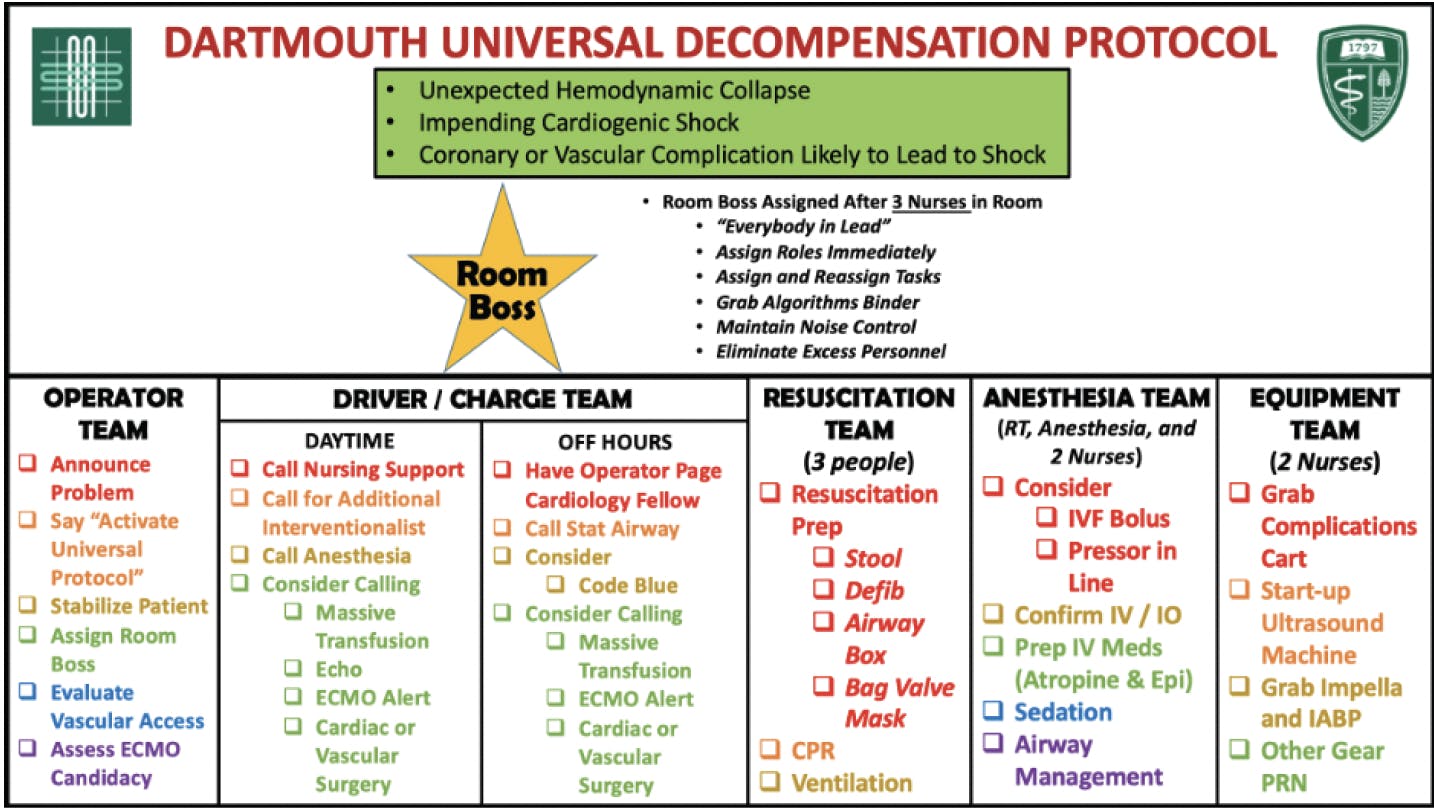
Figure 1. Hemodynamic collapse management algorithm: Protocols, personnel, and pathways for management of cardiopulmonary and cardiovascular decompensation in the CCL. Defib, defibrillator; echo, echocardiogram; epi, epinephrine; IO, intraosseous; IABP, intra-aortic balloon pump; IV, intravenous; IVF, intravenous fluids; PRN, pro re nata (“as necessary”). Courtesy of Dartmouth-Hitchcock Medical Center Heart and Vascular Institute Cardiac Catheterization Laboratory.
In addition to standard CCL protocols, immediate preprocedural considerations for higher-risk interventions should include placement of defibrillator pads and central venous access and preparation of vasopressor therapies, preconnected to central venous access and with intravenous tubing primed for immediate drug delivery. Standard “code” or “crash” carts with emergency resuscitative airway, breathing, and circulation medications and equipment should be available in every CCL.12 Temporary pacemaker and pericardiocentesis kits, integrated vascular access and echocardiography ultrasound machines, and other more specialized emergency equipment (eg, MCS devices and advanced airway equipment)—if not present in every CCL—should at least reside in a near, known, and very easily and rapidly accessible location. Equipment types should ideally be standardized across ambulances, emergency departments, CCLs, operating rooms, ICUs, and other areas of the hospital for interoperability and ease of use by all team members at all times during emergency situations.
Focused preprocedural time-outs and checklist reviews that address procedural goals, key equipment, technical approaches, unique patient vulnerabilities, anticipated procedural challenges, and team member roles and responsibilities should always be performed. Time-outs may also be repeated as necessary intraintervention, postintervention, prior to CCL departure, and after team member exchanges.
CCL leaders should train relevant mental attributes to enhance procedural performance, learn team member strengths and weaknesses, and promote camaraderie and psychologic safety to encourage colleagues to voice concerns that may prevent, speed identification of, or resolve impending emergencies.13 Regularly scheduled mock drills, rehearsals, and, when available, simulation training may also help develop and maintain staff and team preparation and cognitive and technical skills, as well as identify knowledge and process gaps on an ongoing basis.14
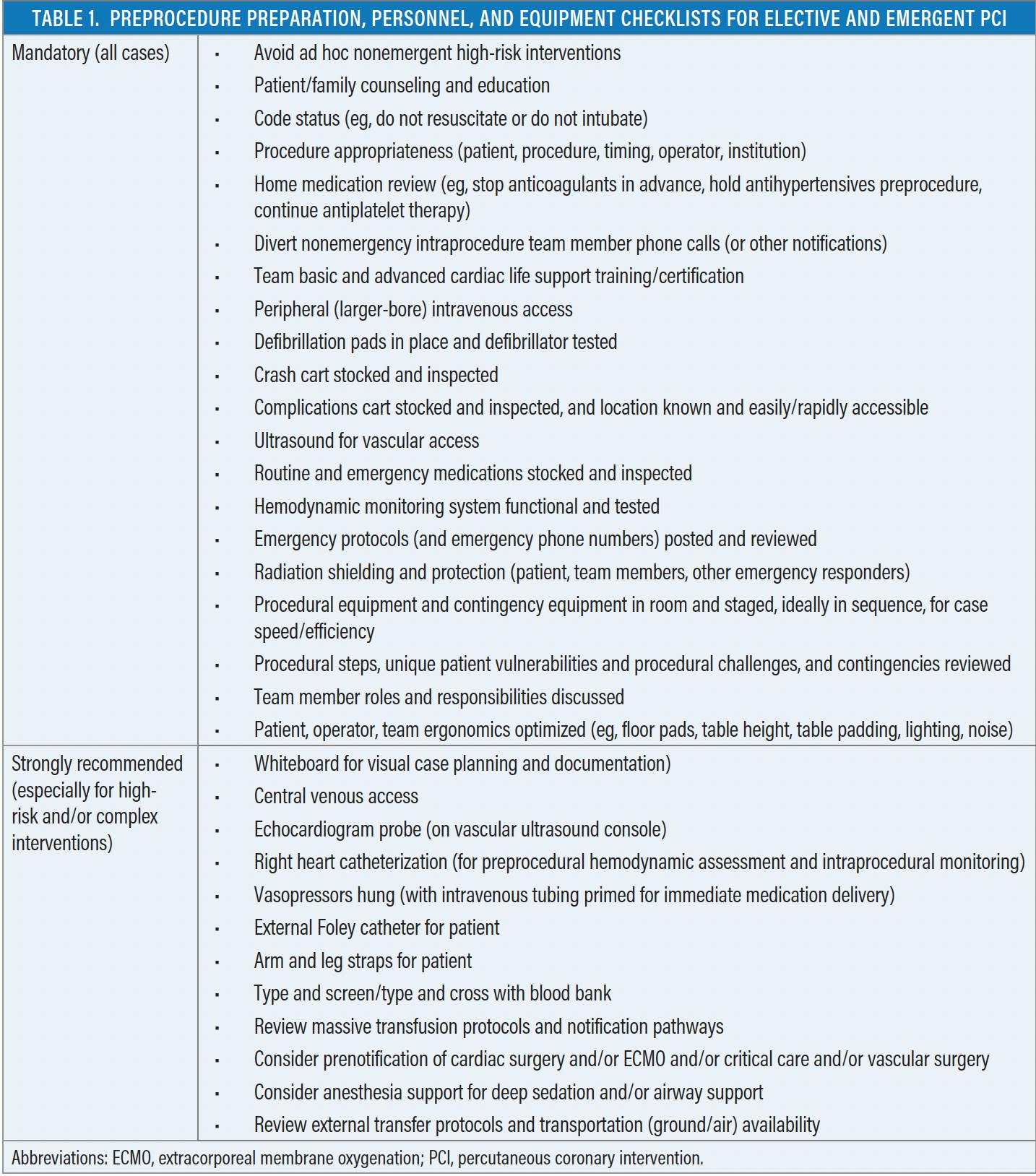
Lessons drawn from high-risk and complex military and aviation team-based tasks are germane to the prevention and management of hemodynamic collapse in the CCL. Particularly relevant is military and aviation crew resource management, which refers to the effective combined use of human resources, hardware, and information. Crew resource management principles include timely and effective communication, use of task and equipment checklists, prioritization and coordination of planned actions and unexpected events, attention to workload distribution, continuous situational awareness, recurrent practice and rehearsal (to standard), and continuous behavior and task reinforcement (Table 1).15
MANAGEMENT
Although many complications may not be preventable, all must be managed. During hemodynamic collapse in the CCL, there exist three immediate and simultaneous goals: (1) maintain systemic perfusion to prevent immediate death and preserve brain and other organ function, (2) address the underlying causes (without which hemodynamic recovery is unlikely to occur), and (3) communicate effectively to coordinate ongoing resuscitative efforts and activate additional medical resources.
The multiple diverse etiologies of hemodynamic collapse in the CCL are thoroughly reviewed in a 2020 manuscript by Doll et al and the annual in-person Seattle Interventional Complications Course curriculum from which the manuscript originates.16 As highlighted in both the course and document, with all CCL emergencies and, particularly, complete hemodynamic collapse, the very first order of business is to determine whether to pause and assess the situation or to act immediately.16
Unexpected or adverse events such as hemodynamic collapse can contribute to cognitive overload that may impair an operator’s ability to effectively manage emergency situations.17 In these physically, mentally, and emotionally intense, highly time-sensitive situations, “active unfreezing” is critical.18 Delegating the responsibility for leading CPR and other associated emergency efforts to someone other than the primary PCI operator is also preferred to allow ongoing lifesaving coronary, cardiac, and/or vascular interventions to continue.
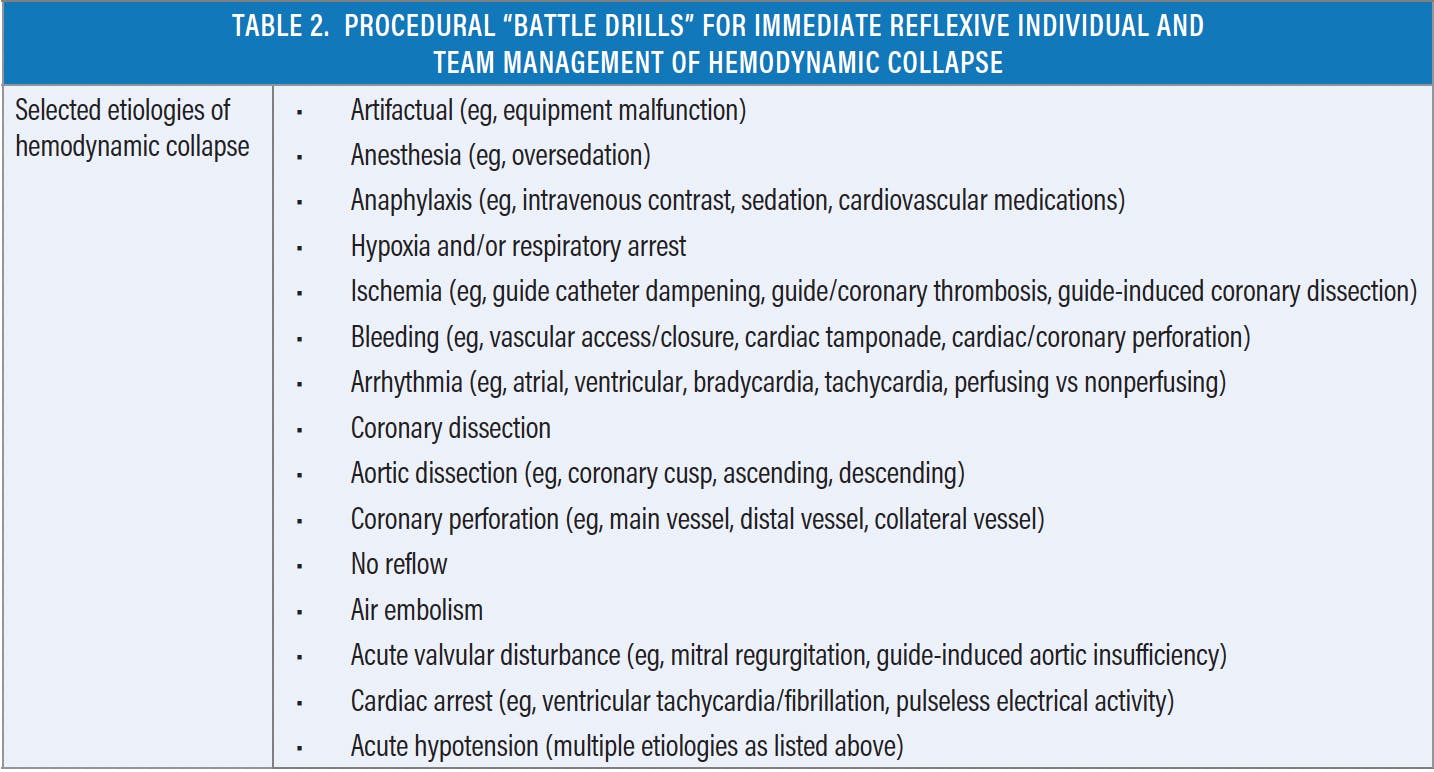
With advanced preparation and individual and collective training, emergency responses should become faster and more automatic over time. The ultimate goal for managing hemodynamic collapse and its multiple underlying etiologies is to react to each scenario in a “battle drill” fashion, whereby individual and collective actions are rapidly and reflexively executed to standard by each team member independently and together, without applying deliberate decision-making processes (Table 2).19
Hemodynamic collapse and/or cardiac arrest in the CCL often involves mechanical CPR, prolonged resuscitation, drug infusions, and ongoing interventional procedures (sometimes percutaneous MCS insertion), in addition to other aspects of care commonly encountered in non-CCL CICU scenarios. All team members should wear lead aprons for radiation safety while lifesaving procedures continue. Arterial access sheaths should be connected to pressure monitoring to ensure appropriate mean arterial pressure during CPR efforts. Use of mechanical compression devices may importantly permit ongoing CPR during intervention, limit interruptions in CPR caused by rotation of rescuers, deliver consistent high-quality compression, reduce team radiation exposure, and free team members to perform other critical resuscitation tasks.20 The primary disadvantage is the delay inherent in applying the device, which can be minimized with training and rehearsal.
Percutaneous MCS devices such as an intra-aortic balloon pump, Impella (Abiomed, Inc.), TandemHeart (LivaNova), or ECMO may also be preemptively considered pre-PCI to reduce the likelihood of cardiovascular collapse or mitigate its immediate consequences. Whether used preemptively or emergently, device selection may vary by patient, procedure, operator, and institution.3 The potential benefits of MCS must be weighed against known device-specific bleeding and vascular complication risks and the complexity of insertion and management.21 There are limited randomized data overall, but ECMO is typically the preferred device for refractory cardiac arrest when available and should be considered very early in the resuscitation process.22
RECOVERY
Learning and improvement are essential after adverse events such as hemodynamic collapse. Postprocedure debriefs provide an open forum for team members to discuss clinical, interpersonal, and systems-level issues to become better as individuals, a team, and an institution in the immediate, short, medium, and long term.23 One simple validated debrief model is the military after-action review, which is designed to critique training and combat events and answer four key questions: What was planned? What really happened? Why did it happen? What can we do better next time?24
Clear, caring, immediate, and frequent communication with patients and family members is essential after both successful and unsuccessful resuscitations.25 Clear handoff communication with CICU or other receiving team members is similarly critical. The mental, emotional, and physical recovery of the team are also important aspects of postprocedure care. Routinely, operators and team members must temporarily compartmentalize, reset, and move ahead mentally, physically, emotionally, and often immediately in preparation for follow-on patients and procedures. Full mental, physical, and emotional recovery may thus be delayed and would benefit from thoughtful self-reflection and open and honest discussion with friends, family members, and colleagues over time.26
CONCLUSION
Adverse events like hemodynamic collapse are high with complex and high-risk procedures compared to noncomplex and non–high-risk interventions. Despite significant technical and procedural improvements in PCI over the past several decades, hemodynamic collapse in the CCL may paradoxically become more frequent as increasing numbers of high-risk patients are offered treatment and more high-risk procedures are performed. Successful management involves team-based efforts to immediately restore vital organ perfusion and correct underlying causes, which only occurs through prior individual and team training, rehearsal, preparation, and planning. None of us should ever walk into our CCLs with our patients without a plan for all to walk back out again together, alive and well.
1. Kent KM, Bentivoglio LG, Block PC, et al. Percutaneous transluminal coronary angioplasty: report from the registry of the National Heart, Lung, and Blood Institute. Am J Cardiol. 1982;49:2011-2020. doi: 10.1016/0002-9149(82)90223-5
2. Riley RF, Henry TD, Mahmud E, et al. SCAI position statement on optimal percutaneous coronary interventional therapy for complex coronary artery disease. Catheter Cardiovasc Interv. 2020;96:346-362. doi: 10.1002/ccd.28994
3. Truesdell AG, Davies RE, Eltelbany M, et al. Mechanical circulatory support for complex high-risk percutaneous coronary intervention. US Cardiol Rev. 2023;17:e03. https://doi.org/10.15420/usc.2022.26
4. Ameloot K, Van Mieghem N. Cardiac arrest and death during elective PCI: a European multicenter registry. Presented at: EuroPCR; May 21–24, 2019; Paris, France.
5. Mohamed MO, Polad J, Hildick-Smith D, et al. Impact of coronary lesion complexity in percutaneous coronary intervention: one-year outcomes from the large, multicentre e-Ultimaster registry. EuroIntervention. 2020;16:603-612. doi: 10.4244/EIJ-D-20-00361
6. Protty M, Sharp ASP, Gallagher S, et al. Defining percutaneous coronary intervention complexity and risk: an analysis of the United Kingdom BCIS database 2006-2016. JACC Cardiovasc Interv. 2022;15:39-49. doi: 10.1016/j.jcin.2021.09.039
7. Kirtane AJ, Doshi D, Leon MB, et al. Treatment of higher-risk patients with an indication for revascularization: evolution within the field of contemporary percutaneous coronary intervention. Circulation. 2016;134:422-431. doi: 10.1161/CIRCULATIONAHA.116.022061
8. Luckraz H, Norell M, Buch M, et al. Structure and functioning of a multidisciplinary ‘Heart Team’ for patients with coronary artery disease: rationale and recommendations from a joint BCS/BCIS/SCTS working group. Eur J Cardiothorac Surg. 2015;48:524-529. doi: 10.1093/ejcts/ezv083
9. Ibrahim K, Tongers J, Mangner N, et al. Handling high-risk patients in the catheterization laboratory. Eur Heart J Suppl. 2022;24(suppl J):J30-J36. doi: 10.1093/eurheartjsupp/suac063
10. Simsek B, Kostantinis S, Karacsonyi J, et al. International percutaneous coronary intervention complication survey. Catheter Cardiovasc Interv. 2022;99:1733-1740. doi: 10.1002/ccd.30173
11. Fanaroff AC, Zakroysky P, Dai D, et al. Outcomes of PCI in relation to procedural characteristics and operator volumes in the United States. J Am Coll Cardiol. 2017;69:2913-2924. doi: 10.1016/j.jacc.2017.04.032
12. Naidu SS, Abbott JD, Bagai J, et al. SCAI expert consensus update on best practices in the cardiac catheterization laboratory. Catheter Cardiovasc Interv. 2021;98:255-276. doi: 10.1002/ccd.29744
13. Spoon DB, Vickers KS, Alkhouli M. Mental skills training in cardiology. J Am Coll Cardiol. 2020;76:1905-1909. doi: 10.1016/j.jacc.2020.09.530
14. Bagai J, Gasperetti C. Management of cardiac arrest in the cardiac catheterization laboratory. July 29, 2020. Society for Cardiovascular Angiography & Interventions. Accessed December 13, 2023. https://scai.org/management-cardiac-arrest-cardiac-catheterization-laboratory
15. United States Helicopter Safety Team. Recommended practice: U.S. Army. Aircrew coordination training. September 23, 2020. Accessed December 13, 2023. https://vast.aero/Safety_Toolbox/Recommended_Practices/USHST-H-SE-22A-Recommended-Practice-US-Army-Aircrew-Coordination-Training.pdf
16. Doll JA, Hira RS, Kearney KE, et al. Management of percutaneous coronary intervention complications: algorithms from the 2018 and 2019 Seattle percutaneous coronary intervention complications conference. Circ Cardiovasc Interv. 2020;13:e008962. doi: 10.1161/CIRCINTERVENTIONS.120.008962
17. Bruckel J, Hannon M, Boudoulas KD. Cognitive workload and task saturation. Society for Cardiovascular Angiography & Interventions. November 8, 2023. Accessed December 13, 2023. https://scai.org/cognitive-workload-and-task-saturation
18. Schulte L. Coping with complications in cardiothoracic surgery: how do we grow as trainees? The Society of Thoracic Surgeons. July 25, 2022. Accessed December 13, 2023. https://www.sts.org/blog/coping-complications-cardiothoracic-surgery-how-do-we-grow-trainees
19. U.S. Army. Army training publication (ATP) 3-21.8: infantry platoon and squad. April 1, 2016. Accessed December 13, 2023. https://www.moore.army.mil/Infantry/DoctrineSupplement/ATP3-21.8/
20. William P, Rao P, Kanakadandi UB, et al. Mechanical cardiopulmonary resuscitation in and on the way to the cardiac catheterization laboratory. Circ J. 2016;80:1292-1299. doi: 10.1253/circj.CJ-16-0330
21. Sandoval Y, Basir MB, Lemor A, et al. Optimal large-bore femoral access, indwelling device management, and vascular closure for percutaneous mechanical circulatory support. Am J Cardiol. 2023;206:262-276. doi: 10.1016/j.amjcard.2023.08.024
22. Yadav K, Truong HT. Cardiac arrest in the catheterization laboratory. Curr Cardiol Rev. 2018;14:115-120. doi: 10.2174/1573403X14666180509144512
23. Bagai J, Beavers CJ. Systems process to prepare you and your staff for the management of cath lab disasters. Society for Cardiovascular Angiography & Interventions. September 20, 2016. Accessed December 13, 2023. https://scai.org/systems-process-prepare-you-and-your-staff-management-cath-lab-disasters
24. Blankenship JC, Doll JA, Latif F, et al. Best practices for cardiac catheterization laboratory morbidity and mortality conferences. JACC Cardiovasc Interv. 2023;16:503-514. doi: 10.1016/j.jcin.2022.10.017
25. Liukka M, Steven A, Moreno MFV, et al. Action after adverse events in healthcare: an integrative literature review. Int J Environ Res Public Health. 2020;17:4717. doi: 10.3390/ijerph17134717
26. Kalra S. Critical appraisal of complications: how to get (and allow yourself to feel) better. Presented at: Transcatheter Cardiovascular Therapeutics (TCT); November 4-6, 2021; Orlando, Florida.
Advertisement
Advertisement