Advertisement
Advertisement
January/February 2024
Atherectomy and Intravascular Lithotripsy for Calcium Modification
Pros, cons, and situations when one technology might be better than another.
By Kathleen Kearney, MD, and Taishi Hirai, MD
In an era of increasing complexity in percutaneous coronary intervention, calcium modification has become paramount to the long-term benefit of stent placement, with stent expansion and apposition remaining the main, modifiable factors in lesion failure. Rotational atherectomy is widely available, but uptake remains limited 2 decades after commercial release. Orbital atherectomy is additive and has been adopted by some for ease of use and by others as a supplement to rotational atherectomy based on lesion attributes. Most recently introduced, intravascular lithotripsy (IVL) offers the advantage of balloon-deliverable technology without the need for exchanging guidewires but has other limitations such as crossing severe calcification.
MECHANISMS AND THEORY
The mechanisms of action for each device correlate with their theoretical advantages for a particular lesion subset. For example, rotational atherectomy is most reliable in a nearly occlusive calcified lesion when a microcatheter or low-profile balloon does not cross easily, as it has the diamond tip at the distal edge.1 The crown of the orbital atherectomy system (OAS) is offset from the nose of the device such that it may not engage certain subtotal or total occlusions. Still, the low profile of the crown allows it to pass through many severe stenoses with use of glide assist or slow advancement during atherectomy. Because the OAS possesses bidirectional modification capabilities, crown entrapment is very rare in practice. On the other hand, energy delivery for IVL is completely dependent on balloon crossing and, as such, is least favorable in these tightest lesions. Although crossing may be facilitated by serial balloon predilation, this may be time-consuming, and, importantly, risks of bailout atherectomy increase if significant dissections are encountered. Therefore, up-front use of atherectomy is generally recommended unless anatomic concerns leave atherectomy contraindicated.
ADVANTAGES AND DISADVANTAGES
Rotational atherectomy operates via a tapered, diamond-coated burr that rotates at high speed, relying on differential cutting to modify poorly compliant fibrotic and calcified tissue. Although the process is often referred to as debulking, it essentially involves shaving down the tissue using a burr less than approximately one-half the vessel diameter in size; even small ratios may modify calcium if engaging with the lesion. This calcium modification relies on the size of the lesion lumen diameter, wire bias, and differential cutting to engage the diseased area.2 Even though significant plaque burden remains, calcium modification facilitates (1) balloon crossing, (2) calcium fracture, and (3) lesion compliance. Large vessels with intermediate lesions may not see adequate burr engagement and may require more aggressive burr sizing (eg, a 2-mm burr) to achieve better modification. However, risk of dissections and no reflow may increase in this instance, and careful technique to prevent complication becomes especially important. Thermal energy generated at higher speeds is less likely to cause no reflow in the setting of dual antiplatelet therapy as long as significant decelerations > 5,000 to 10,000 rpm are avoided. Because the leading edge is the effective area of atherectomy, angulated areas requiring prolonged engagement are at risk of fracturing the wire, which can result in catastrophic perforation. As such, adequate wire purchase to move the wire in those circumstances is best practice, along with careful advancement using the pecking motion to avoid burr entrapment. In tight lesions, a serial increase in burr size may be best to avoid entrapment.
Orbital atherectomy does not rely on burr size but rather slow speed of advancement. The speed of the crown motion allows for engagement of the small crown with larger vessel size. Because the crown is offset from the nose of the device, it may not cross extremely tight lesions; however, in the most severe lesions, it may still engage the lesion and slowly work through it, or glide assist may allow it to cross and work in a retrograde fashion. This bidirectional nature prevents entrapment in most cases, but OAS is not intended for use within stents due to this risk of entanglement. Furthermore, OAS is not recommended for use if a significant dissection exists or if the wire course is in a subintimal segment due to an increased risk of extending the dissection and risk of perforation. Although dissections may be seen postatherectomy, particularly at high speeds or in angulated segments of the vessel, these are usually managed simply with stenting across that segment. Continuous slow movement of the crown, avoiding abrupt jumps, and completion with a lower speed (80,000 rpm) can avoid significant dissections or perforations.
IVL has proven to be a disruptive technology in calcium management; its main benefits include ease of use, thus requiring little training and use over any coronary guidewire. In selected patients meeting inclusion criteria for clinical trials, no episodes of no reflow were observed, and comfort of operators is more uniformly high as compared to atherectomy.3 Because the crossing profile of the lithotripsy balloon is lower, crossing heavily calcified segments can be challenging. Serial balloon inflation with prolonged use of guide extensions can add to ischemic burden. The premise of IVL requires a significant arc of calcification to deliver energy to areas of calcium and allow for fracture and increased vessel compliance.
COMPLICATIONS
The common complications that can occur with any atherectomy device are dissection, perforation, and no reflow/slow flow. Although the reported rate for these complications is highest with rotational atherectomy, differences in inclusion/exclusion criteria among published studies must be noted.3 As such, recent prospective studies for rotational atherectomy include all patients with severe calcification,4 as compared to the very selective inclusion criteria in the pivotal DISRUPT studies, which does not allow for direct comparison.5 As stated previously, rotational atherectomy is used more commonly for most severe calcified lesions. Regardless of the atherectomy device used, operators should use measures to prevent complications and be ready to treat them if they occur.
CLINICAL APPLICATIONS
We propose an algorithm for device selection in calcium management (Figure 1). First, we recommend having a low threshold for atherectomy if there is severe calcification (calcium on both sides of the vessel as determined by coronary angiography or > 270° calcium as determined by intravascular imaging), or if the imaging device does not cross. If there is severe calcification preventing device crossing of a low-profile balloon or intravascular imaging, we recommend prioritizing rotational atherectomy. When large vessel size or size mismatch across the lesion is a concern, orbital atherectomy may be favorable, especially when using smaller-profile guides from radial access. In cases in which balloons easily cross but adequate calcium management is uncertain with noncompliant or specialty balloons, IVL can be an important tool. Calcified nodules present a special case; although the use of IVL for calcium nodules has been reported, data remain limited to a focused population in the DISRUPT studies, and in clinical practice, we still recommend rotational or orbital atherectomy for many calcium nodules as it may allow for better sanding and reduction of the nodule. In fact, we believe a multimodality approach is often warranted to treat severe calcific nodules and find atherectomy, cutting balloons, and IVL to be complementary as part of an image-based strategy. If atherectomy is required in the extra plaque or subintimal space, we propose prioritizing rotational atherectomy until further data for IVL are available as well.
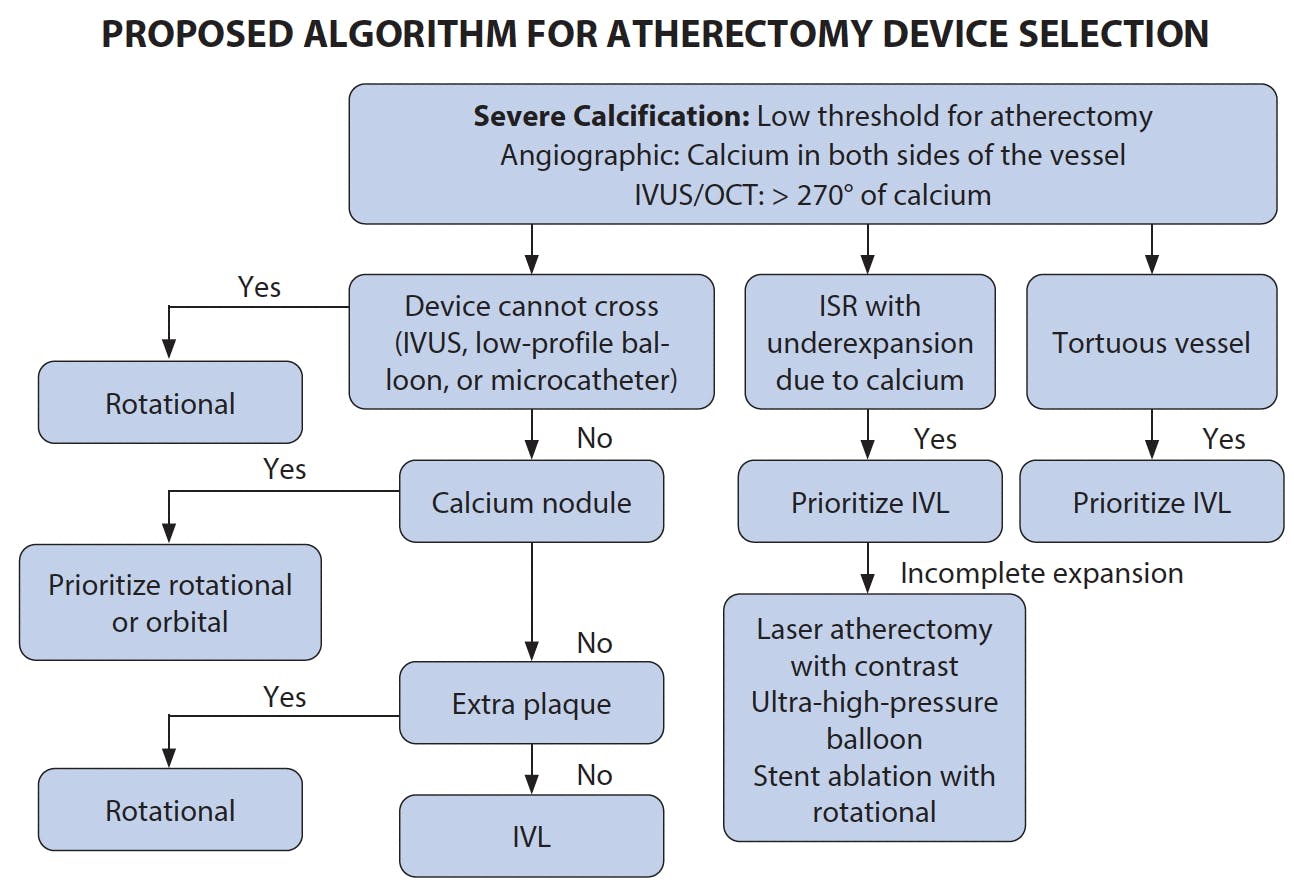
Figure 1. Flow chart of decision tree: proposed algorithm for IVL and rotational, orbital, and laser atherectomy. ISR, in-stent restenosis; IVUS, intravascular ultrasound; OCT, optical coherence tomography.
IVL may improve stent expansion in cases of in-stent restenosis with underlying stent underexpansion due to external calcium, particularly with a single layer. In our experience, this appears less effective with two layers of stent, possibly due to additional fibrosis, and off-label use of laser atherectomy with contrast infusion may have a role when IVL fails to facilitate adequate lumen area.6 Both modalities are followed by additional percutaneous transluminal coronary angioplasty and image guidance to achieve an acceptable result. In very tortuous vessels that can be at high risk for dissection with rotational/orbital atherectomy, we recommend IVL also be prioritized if balloon deliverability is feasible.
Finally, use of Rotaglide solution (Boston Scientific Corporation) is contraindicated in patients with severe egg or olive oil allergy but may be replaced with a heparinized saline solution to complete rotational atherectomy.7,8 Egg or soy allergy is a contraindication to Viperslide (Abbott) use and, thus, orbital atherectomy because no alternative solution has been reported to date.
CONCLUSION
It is important to understand the different characteristics of each atherectomy device, and as stated previously, its selection should be based on lesion and patient characteristics. Regardless of the device selected, adequate calcium modification to allow for proper stent expansion must be achieved. Finally, when performing atherectomy, proper technique is imperative to avoid complications, but operator must be prepared to manage dissections, no reflow, and perforations when treating calcific disease.
1. Sharma SK, Tomey MI, Teirstein PS, et al. North American expert review of rotational atherectomy. Circ Cardiovasc Interv. 2019;12:e007448. doi: 10.1161/CIRCINTERVENTIONS.118.007448
2. Sakakura K, Ito Y, Shibata Y, et al. Clinical expert consensus document on rotational atherectomy from the Japanese association of cardiovascular intervention and therapeutics. Cardiovasc Interv Ther. 2021;36:1-18. doi: 10.1007/s12928-020-00715-w
3. Kereiakes DJ, Virmani R, Hokama JY, et al. Principles of intravascular lithotripsy for calcific plaque modification. JACC Cardiovasc Interv. 2021;14:1275-1292. doi: 10.1016/j.jcin.2021.03.036
4. Abdel-Wahab M, Toelg R, Byrne RA, et al. High-speed rotational atherectomy versus modified balloons prior to drug-eluting stent implantation in severely calcified coronary lesions. Circ Cardiovasc Interv. 2018;11:e007415. doi: 10.1161/CIRCINTERVENTIONS.118.007415
5. Hill JM, Kereiakes DJ, Shlofmitz RA, et al. Intravascular lithotripsy for treatment of severely calcified coronary artery disease. J Am Coll Cardiol. 2020;76:2635-2646. doi: 10.1016/j.jacc.2020.09.603
6. Lee T, Shlofmitz RA, Song L, et al. The effectiveness of excimer laser angioplasty to treat coronary in-stent restenosis with peri-stent calcium as assessed by optical coherence tomography. EuroIntervention. 2019;15:e279-e288. doi: 10.4244/EIJ-D-18-00139
7. Whiteside HL, Ratanapo S, Sey A, et al. Efficacy of a heparin based rota-flush solution in patients undergoing rotational atherectomy. Cardiovasc Revasc Med. 2018;19:333-337. doi: 10.1016/j.carrev.2017.08.013
8. Lee MS, Kim MH, Rha SW. Alternative Rota-Flush solution for patients with severe coronary artery calcification who undergo rotational atherectomy. J Invasive Cardiol. 2017;29:25-28.
Advertisement
Advertisement