Advertisement
Advertisement
January/February 2024
Provisional Versus Two-Stent Bifurcation PCI: Types of Bifurcation Stenting Techniques
A review of approaches to treat complex bifurcation lesions, including provisional stenting, T stent, TAP, crush techniques, and the culotte technique.
By Moemen Eltelbany, MD; Charlene L. Rohm, MD; Lindsey Cilia, MD; and Leah Raj, MD
Percutaneous coronary intervention (PCI) of bifurcation lesions is challenging and associated with higher rates of in-stent restenosis (ISR), with the ostial side branch (SB) the most common site of ISR.1 Early clinical trial data favored a provisional stenting approach, demonstrating improved clinical outcomes with provisional stenting compared with a routine two-stent approach.1,2 However, contemporary randomized trial data have suggested improved outcomes with certain two-stent techniques, where the double-kiss (DK) crush technique is superior to provisional stenting for selected true bifurcation lesions.3,4
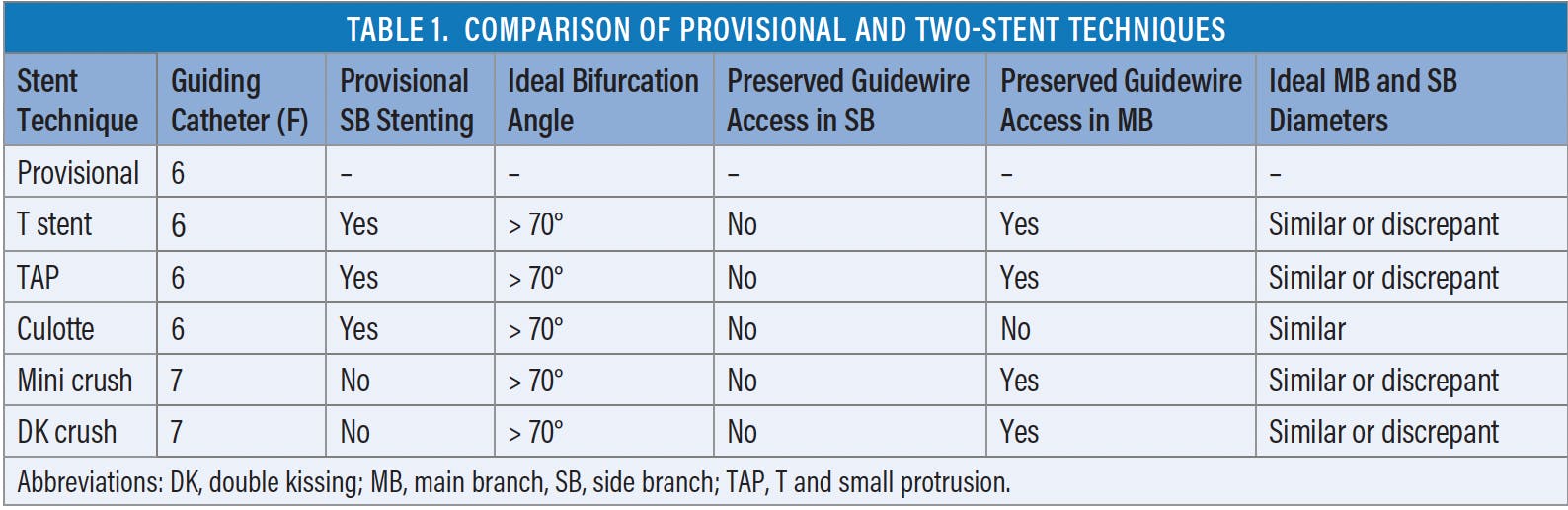
Bifurcation lesions are defined as Medina 1,1,1 or 0,1,1 with the SB ≥ 2.5 mm in diameter.3 The DEFINITION study further defined a bifurcation lesion as complex if it met one major criterion plus any two minor criteria, where major criteria included either left main (LM) lesion with SB ≥ 70% and ≥ 10 mm in length or non-LM lesion with SB ≥ 90% and ≥ 10 mm in length. Minor criteria included moderate to severe calcification, multiple lesions, active thrombus, bifurcation angle < 45°, main branch (MB) reference diameter < 2.5 mm, and MB lesion length > 25 mm.3 This article reviews provisional versus two-stent techniques for bifurcation lesions, including T stent, T and small protrusion (TAP), culotte, mini crush, and DK crush techniques. Table 1 outlines a side-by-side comparison of the techniques.
PROVISIONAL STENTING
Provisional stenting involves stent implantation in the main vessel (MV) across the SB ostium with stenting of the SB only in case of suboptimal results of the SB. As the first step in bifurcation PCI, it is advisable to wire both the MV and SB with two 0.014-inch coronary guidewires. The MV is predilated and adequate lesion preparation is performed at the operator’s discretion. Intracoronary imaging is advised to evaluate the bifurcation anatomy to ascertain plaque morphology and the distribution and extent of disease, which informs stent selection. Routine balloon dilation of the SB is not advised to reduce risk of dissection, which would then necessitate SB stenting; however, the use of a small balloon for predilation of the SB ostium may be considered if difficulty in rewiring the SB is anticipated or if the ostium is heavily calcified. Then, based on the diameter of the distal MV, the appropriate size stent is deployed at nominal pressure in the MV across the SB ostium. Nominal pressure deployment reduces the risk of SB ostium deterioration and prevents damage to the trapped wire in the SB. A mandatory proximal optimization technique (POT) is performed in the proximal MV with a balloon of the same diameter as the proximal MV diameter and above the bifurcation of the MV and SB. Removal of the SB wire should be done prior to POT to avoid trapping the wire behind the stent. At this point, the results are evaluated using angiography and intracoronary imaging. If the MV stent is not satisfactory, then high-pressure dilations should be performed. If the SB is satisfactory (not having any of the following: > 75% residual stenosis, dissection, thrombolysis in myocardial infarction [TIMI] flow grade < 3 in an SB ≥ 2.5 mm, or fractional flow reserve [FFR] < 0.80), then the procedure is complete.
If the SB is not satisfactory, then a kissing balloon inflation (KBI) is performed next. The SB is rewired via the distal stent strut (either with a new wire or with the MV wire via “pullback” technique). If KBI is performed, then final POT of the proximal MV is necessary. If the SB is unsatisfactory (> 75% residual stenosis, dissection, TIMI flow grade < 3 in an SB ≥ 2.5 mm, or FFR < 0.80) and a stent is needed, then T stent, TAP, or a culotte technique may be performed at this point.5
The decision to treat the SB (whether with balloon angioplasty or stent) is challenging, especially because many SBs supply only a small amount of myocardium and many moderate stenoses are not flow-limiting. Discordance between lesion severity by angiography and functional lesion significance often leads to overtreatment of the SB in angiography-guided intervention. FFR-guided SB stenting has been described and may improve outcomes. The DKCRUSH-VI study compared angiography- and FFR-guided provisional SB stenting in 320 patients undergoing bifurcation PCI with provisional SB stenting.6 There was a trend toward less frequent SB intervention (balloon or stent) in the FFR-guided group (56.3% vs 63.1%; P = .07), although there was no difference in 1-year major adverse cardiac events. Criteria have been proposed to define lesions that require final KBI: > 75% residual stenosis at the SB, TIMI flow grade < 3, or FFR < 0.80. Therefore, either technique (FFR-guided provisional SB stenting or performing final KBI of all angiographically significant ostial SB lesions) is acceptable.
Provisional stenting may be performed with a 6-F system, although there is a low threshold to use a 7-F or greater system to accommodate simultaneous use of two stents or balloons or if rotational atherectomy with a ≥ 1.75-mm burr is necessary. The key technical aspects in provisional stenting to achieve optimal results include POT, optimal distal strut SB rewiring, and KBI. POT is necessary to optimize stent expansion and apposition at the proximal MV and has been shown to improve clinical outcomes.7 Positioning of the POT balloon markedly affects procedural outcome and should be placed immediately proximal to the carina, and dilation should cover to the proximal stent edge.8
If the stent is underexpanded (which should be assessed with intracoronary imaging), a noncompliant balloon is preferred. When the SB is rewired, either a new wire can be placed in the SB or the MV wire can be switched and pulled back and placed into the SB. If the MV wire is used, the “pullback rewiring” technique is performed aiming at the distal strut, which allows better strut clearance from the SB ostia. Leaving the jailed wire in place during SB rewiring can assist as a marker for the SB.
KBI is optional in provisional stenting; however, KBI is necessary to correct MV stent deformation if any SB ballooning across the stent struts was performed. There is no adverse effect of routine KBI in MV stenting of bifurcation lesions, as demonstrated by the Nordic III study.9 Two noncompliant balloons sized according to the distal reference diameters of the MV and SB are positioned across the carina with a short overlap. During KBI, both balloons are simultaneously inflated and subsequently simultaneously deflated. An additional KBI technique involves sequentially inflating each balloon in each of the MV and SB at high pressure, and then both balloons are simultaneously inflated at low pressure (8 atm) then simultaneously deflated. KBI can cause proximal MV stent deformation, especially with longer balloon overlap. This deformation must be corrected with a final POT.
TWO-STENT APPROACHES
There are various two-stent techniques with different levels of complexity and indications, including the T-stent, TAP, culotte, mini crush, and DK crush techniques, as described herein.
T-Stent Technique
The T-stent technique is favored for its simplicity but is reserved for bifurcation lesions with angles close to 90°. Provisional T stenting is used as a bailout method when the SB is deemed unsatisfactory after MV stenting. Following KBI during provisional stenting as described previously, both balloons are removed, and a stent is advanced down the SB wire and positioned at the SB ostium, ensuring that it does not protrude into the MV. The stent is deployed at nominal pressure, and then KBI is performed. Although this technique is simple and less laborious than crush techniques, the primary disadvantage is inadequate coverage of the ostium of the SB, leaving a gap between the stent implanted in the MB and the stent in the SB, which increases the risk for ostial restenosis at the SB.
TAP Technique
The TAP technique evolved to ensure complete stent coverage at the SB ostium. This technique is versatile and can be used in bifurcation lesions with more acute angles (70°-90°). Provisional TAP is a bailout method when the SB is deemed unsatisfactory after MV stenting. Following KBI as previously described in provisional stenting, both balloons are removed, and a stent is advanced down the SB wire and positioned just across the ostium of the SB with 1- to 2-mm stent protrusion into the MV. The stent is deployed at nominal pressure, and KBI is performed. Although this technique ensures complete stent coverage at the SB ostium, the primary disadvantage is the formation of a neocarina at the bifurcation, which increases the risk for in-stent restenosis and stent thrombosis. Simultaneous inflation and deflation of the balloons is especially critical to avoid carinal shift.10
Classic Crush and Mini Crush Techniques
The crush techniques for stenting bifurcation lesions have evolved since its introduction in 2003 by Colombo et al,11 with multiple variations in the technique having been described thereafter, including DK crush, mini crush, and nano crush. Significant ISR has been observed in about one-quarter of patients receiving bifurcation stenting, mostly due to SB stenting challenges, leading the investigators to develop the crushing technique to minimize the incomplete coverage of SB ostium.1 In the classic crush technique, both the MB and SB are wired and predilated. The first stent is advanced into the SB but left undeployed, and then the second stent is passed into the MB. The SB stent is retracted so that the proximal marker is seen protruding 4 to 5 mm from the carina into the main proximal vessel to ensure complete coverage of the SB ostium. The SB stent is then deployed, and the stent balloon is removed followed by the SB wire. Afterward, the MB stent is deployed, crushing the SB stent against the wall, leaving three layers of stents in the proximal portion of the MV and the SB ostium.
The classic crush technique provides a simple approach that enables complete coverage of the SB ostium and avoids the challenging delivery of an SB stent through the MB stent. However, some disadvantages have been reported, including the difficulty of using 6-F guide catheters to accommodate delivering two stents simultaneously. Another disadvantage is missing the final KBI as a standard part of the procedure, which would require wiring the SB through the MB stent. ISR was noted in 37.9% of the patients without KBI compared to 11.1% with KBI.12
Three years after the introduction of classic crush technique, a modified version was proposed by Galassi and colleagues called mini crush.13 In this technique, the two major differences from the classic crush technique were minimal protrusion of the SB stent into the MV, extending only 1 to 2 mm instead of 4 to 5 mm, and jailing the SB wire. They proposed positioning the SB stent about 1 to 2 mm into the MB, deploying the SB stent, and then crushing that stent using a balloon in the MB while jailing the SB wire. Afterward, an MB stent is delivered and then deployed, followed by rewiring the SB and removing the jailed wire, followed by final KBI. In that study by Galassi et al, the restenosis rate was only 2% in the SB and 12.2% in the MB.13 One of the major advantages with minimal protrusion of the SB stenting is reducing the distortion of SB stenting and minimizing the number of stent layers at the SB ostium, facilitating the rewiring of the SB again while keeping a jailed SB wire to maintain an access to the SB.
DK Crush Technique
The challenges seen with the SB rewiring in the classic crush technique have led to the development of a modified approach to increase the success of SB rewiring for KBI and subsequently correct for any SB stent distortion. The DK crush technique was first described by Chen et al and Jim et al.14,15 In this technique, after wiring both the SB and MB, a stent is delivered to the SB and positioned about 3 to 5 mm into the MV while a balloon is delivered to the MB. The stent in the SB is deployed, then the SB stent balloon and wire are removed first, and then the MB balloon is inflated to crush the SB stent. After crushing the SB stent, a wire is delivered into the SB and the first KBI is performed, and then the wire and the balloon from the SB are withdrawn. Next, the stent is delivered to the MB and deployed across the bifurcation. The second SB rewiring is performed and then another KBI. Eventually, another variation was recommended by applying POT to the MB stent before and after KBI to optimize stent geometry and facilitate wiring of the SB through the stent struts.16 The DK crush technique is characterized by higher rates of success of SB wiring compared to classic crush techniques and subsequently lower rates of SB stent restenosis or thrombosis.12,14,15,17 On the other hand, the major drawback of the DK crush technique is the need to rewire the SB twice.
Culotte Technique
Culotte stenting is one of the modified techniques for two-stent bifurcations, especially when the angle between the MB and SB is < 70° and there is no significant size mismatch between the MB and the SB.18,19 Compared to crush techniques, stent distortion and the risk of missing parts of the lesion is minimized by the culotte technique. One downside associated with this technique is the need for two layers of stent in the proximal segment of the MB, which increases the risk of ISR.20
The technique starts with wiring both the SB and the MB, then predilation of the SB is performed first, followed by delivering a stent to the SB and positioning the stent about 5 mm back into the MB. After deploying the SB stent, poststenting balloon dilation is performed, and the wire from the MB is removed. The MB is rewired again through the struts of the SB stent, followed by serial balloon dilations of the MB to open the SB stent struts more; the MB stent is delivered while maintaining the overlap between the two stents in the proximal MB. Prior to deploying the MB stent, it is important to remove the SB wire to avoid jailing a wire between two stents. After removing the stent balloon from the MB, POT is performed, followed by rewiring of the SB through the distal stent strut, KBI, and then final POT to ensure more optimization of the proximal segments where the two stents overlap.21
CONCLUSION
With increasing complexity of coronary interventions, bifurcation stenting techniques have become crucial in the management of complex bifurcation coronary lesions. There is a wide array of options and approaches when it comes to treating such lesions, including provisional stenting, TAP, crush techniques, and the culotte technique. The key in management lies in tailoring the technique based on the patient’s anatomy and the clinical scenario.
1. Colombo A, Moses JW, Morice MC, et al. Randomized study to evaluate sirolimus-eluting stents implanted at coronary bifurcation lesions. Circulation. 2004;109:1244-1249. doi: 10.1161/01.CIR.0000118474.71662.E3
2. Steigen TK, Maeng M, Wiseth R, et al. Randomized study on simple versus complex stenting of coronary artery bifurcation lesions: the Nordic bifurcation study. Circulation. 2006;114:1955-1961. doi: 10.1161/CIRCULATIONAHA.106.664920
3. Chen SL, Sheiban I, Xu B, et al. Impact of the complexity of bifurcation lesions treated with drug-eluting stents: the DEFINITION study (Definitions and impact of complEx biFurcation lesIons on clinical outcomes after percutaNeous coronary IntervenTIOn using drug-eluting steNts). JACC Cardiovasc Interv. 2014;7:1266-1276. doi: 10.1016/j.jcin.2014.04.026
4. Zhang JJ, Ye F, Xu K, et al. Multicentre, randomized comparison of two-stent and provisional stenting techniques in patients with complex coronary bifurcation lesions: the DEFINITION II trial. Eur Heart J. 2020;41:2523-2536. doi: 10.1093/eurheartj/ehaa543
5. Burzotta F, Lassen JF, Lefévre T, et al. Percutaneous coronary intervention for bifurcation coronary lesions: the 15(th) consensus document from the European Bifurcation Club. EuroIntervention. 2021;16:1307-1317. doi: 10.4244/EIJ-D-20-00169
6. Chen SL, Xu B, Han YL, et al. Clinical outcome after DK crush versus culotte stenting of distal left main bifurcation lesions: the 3-year follow-up results of the DKCRUSH-III study. JACC Cardiovasc Interv. 2015;8:1335-1342. doi: 10.1016/j.jcin.2015.05.017
7. Yang JH, Lee JM, Park TK, et al. The proximal optimization technique improves clinical outcomes when treated without kissing ballooning in patients with a bifurcation lesion. Korean Circ J. 2019;49:485-494. doi: 10.4070/kcj.2018.0352
8. Dérimay F, Rioufol G, Nishi T, et al. Optimal balloon positioning for the proximal optimization technique? An experimental bench study. Int J Cardiol. 2019;292:95-97. doi: 10.1016/j.ijcard.2019.05.041
9. Niemelä M, Kervinen K, Erglis A, et al. Randomized comparison of final kissing balloon dilatation versus no final kissing balloon dilatation in patients with coronary bifurcation lesions treated with main vessel stenting: the Nordic-Baltic Bifurcation study III. Circulation. 2011;123:79-86. doi: 10.1161/CIRCULATIONAHA.110.966879
10. Mortier P, Hikichi Y, Foin N, et al. Provisional stenting of coronary bifurcations: insights into final kissing balloon post-dilation and stent design by computational modeling. JACC Cardiovasc Interv. 2014;7:325-333. doi: 10.1016/j.jcin.2013.09.012
11. Colombo A, Stankovic G, Orlic D, et al. Modified T-stenting technique with crushing for bifurcation lesions: immediate results and 30-day outcome. Catheter Cardiovasc Interv. 2003;60:145-151. doi: 10.1002/ccd.10622
12. Ge L, Airoldi F, Iakovou I, et al. Clinical and angiographic outcome after implantation of drug-eluting stents in bifurcation lesions with the crush stent technique: importance of final kissing balloon post-dilation. J Am Coll Cardiol. 2005;46:613-620. doi: 10.1016/j.jacc.2005.05.032
13. Galassi AR, Colombo A, Buchbinder M, et al. Long-term outcomes of bifurcation lesions after implantation of drug-eluting stents with the “mini-crush technique.” Catheter Cardiovasc Interv. 2007;69:976-983. doi: 10.1002/ccd.21047
14. Chen SL, Ye F, Zhang JJ, et al. DK crush technique: modified treatment of bifurcation lesions in coronary artery. Chin Med J (Engl). 2005;118:1746-1750.
15. Jim MH, Ho HH, Miu R, Chow WH. Modified crush technique with double kissing balloon inflation (sleeve technique): a novel technique for coronary bifurcation lesions. Catheter Cardiovasc Interv. 2006;67:403-409. doi: 10.1002/ccd.20645
16. Chen SL, Santoso T, Zhang JJ, et al. Clinical outcome of double kissing crush versus provisional stenting of coronary artery bifurcation lesions: the 5-year follow-up results from a randomized and multicenter DKCRUSH-II study (randomized study on double kissing crush technique versus provisional stenting technique for coronary artery bifurcation lesions). Circ Cardiovasc Interv. 2017;10:e004497. doi: 10.1161/CIRCINTERVENTIONS.116.004497
17. Chen SL, Zhang JJ, Chen YD, et al. Study comparing the double kissing (DK) crush with classical crush for the treatment of coronary bifurcation lesions: the DKCRUSH-1 Bifurcation study with drug-eluting stents. Eur J Clin Invest. 2008;38:361-371. doi: 10.1111/j.1365-2362.2008.01949.x
18. Chevalier B, Glatt B, Royer T, Guyon P. Placement of coronary stents in bifurcation lesions by the “culotte” technique. Am J Cardiol. 1998;82:943-949. doi: 10.1016/s0002-9149(98)00510-4
19. Erglis A, Kumsars I, Niemelä M, et al. Randomized comparison of coronary bifurcation stenting with the crush versus the culotte technique using sirolimus eluting stents: the Nordic stent technique study. Circ Cardiovasc Interv. 2009;2:27-34. doi: 10.1161/CIRCINTERVENTIONS.108.804658
20. Chen SL, Xu B, Han YL, et al. Comparison of double kissing crush versus Culotte stenting for unprotected distal left main bifurcation lesions: results from a multicenter, randomized, prospective DKCRUSH-III study. J Am Coll Cardiol. 2013;61:1482-1488. doi: 10.1016/j.jacc.2013.01.023
21. Walsh SJ, Hanratty CG, Watkins S, et al. Culotte stenting for coronary bifurcation lesions with 2nd and 3rd generation everolimus-eluting stents: the CELTIC Bifurcation study. EuroIntervention. 2018;14:e318-e324. doi: 10.4244/EIJ-D-18-00346
Advertisement
Advertisement