Advertisement
Advertisement
January/February 2024
Perforation Management
An assessment of balloon tamponade, Ringer balloon, covered stents, coils, and thrombin.
By Molly Silkowski, DO, PGY6, and Anbukarasi Maran, MBBS, MD
Percutaneous coronary intervention (PCI) is the most common procedure for revascularization of coronary artery disease. Since the first PCI in 1977, advances and innovations in technology have led to interventionalists treating patients with increasingly complex coronary anatomy, such as left main disease, multivessel and heavily calcified disease, and chronic total occlusion (CTO). Consequently, the physicians face an infrequent, yet potentially life-threatening complication of coronary perforation. While the incidence of coronary perforation is low, it can lead to severe consequences, such as cardiac tamponade, myocardial infarction, or even death. This article aims to provide an in-depth exploration of coronary perforation, encompassing its epidemiology, pathophysiology, clinical presentation, management, prevention, and future directions.
DEFINITION/EPIDEMIOLOGY/RISK FACTORS
Coronary artery perforation (CAP) is reported to be directly proportional to the complexity of coronary artery disease. The incidence of CAP is 0.43% with PCI but rises to 2.9% in CTO interventions. Once tamponade occurs, the in-hospital mortality increases to more than 5%, even if pericardiocentesis is performed. There are several patient and procedural risk factors of coronary perforation. Patient factors include older age, previous coronary artery bypass graft anatomy, and female gender. One study suggested that female gender is more associated with CAP due to anatomic tortuosity, smaller arteries, and hormonal estrogen levels influencing coagulation factors and inflammatory parameters.1
Procedural risk factors include complex coronary lesions (American College of Cardiology/American Heart Association-defined type B2 and C), CTOs, heavily calcified lesions, angulated tortuous lesions, and narrow coronary arteries. Furthermore, the use of oversized balloons or stents, atheroablative devices, hydrophilic guidewires, excessive postdilation, lack of intravascular imaging, have been associated with coronary perforation.2-5
Large-vessel perforations are normally caused by oversized balloons and stents, particularly when the balloon:artery ratio is > 1.2:1, and high atmospheric inflations, especially in highly calcified lesions that are not pre-emptively remodeled by rotational atherectomy prior to stenting. Distal perforations typically occur due to wire migration and several authors have clearly pin-pointed hydrophilic wires as a common culprit of distal perforations. Epicardial vessel collateral perforation typically happens during retrograde approach for CTO PCI. It was reported that CAP occurred in 15% of total retrograde cases.6-8
DIAGNOSIS
The sudden onset of acute and sharp chest pain and/or hemodynamic instability during balloon inflation or stent deployment should raise the suspicion of coronary perforation. Although most CAP are diagnosed by coronary angiography during PCI, distal vessel perforations can go easily unrecognized initially if they are subtle, especially if the shutters are used. Thus, longer image acquisition and panning to the distal vessels is necessary when there is a suspicion of perforation. Echocardiography should also be performed emergently and serially up to 48 hours afterward to assess for pericardial effusion and/or cardiac tamponade.
CLASSIFICATION
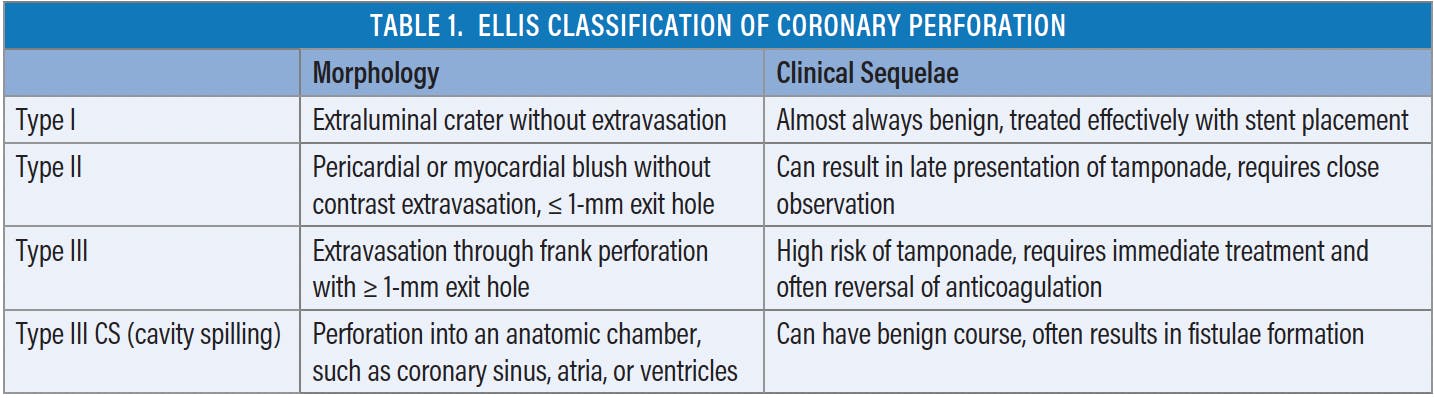
Coronary perforations can also be categorized based on severity of perforation. The Ellis classification was originally developed by Dr. Stephen G. Ellis in 1994 and is now a widely utilized system for categorizing coronary perforations based on their severity and clinical implications. The Ellis classification divides coronary perforations into three main classes (Table 1).9
TREATMENT
The treatment of coronary perforations depends on the perforation type, site, vessel size, and mechanism of perforation. Universally, regardless of location or size, initial treatment includes measures to stop extravasation and support the patient hemodynamically, if warranted. Echocardiography sonographers should be called to perform urgent bedside imaging to assess for pericardial effusion and tamponade, and cardiac surgeons should be notified immediately in case percutaneous measures are not successful and emergency cardiac surgery may be required.
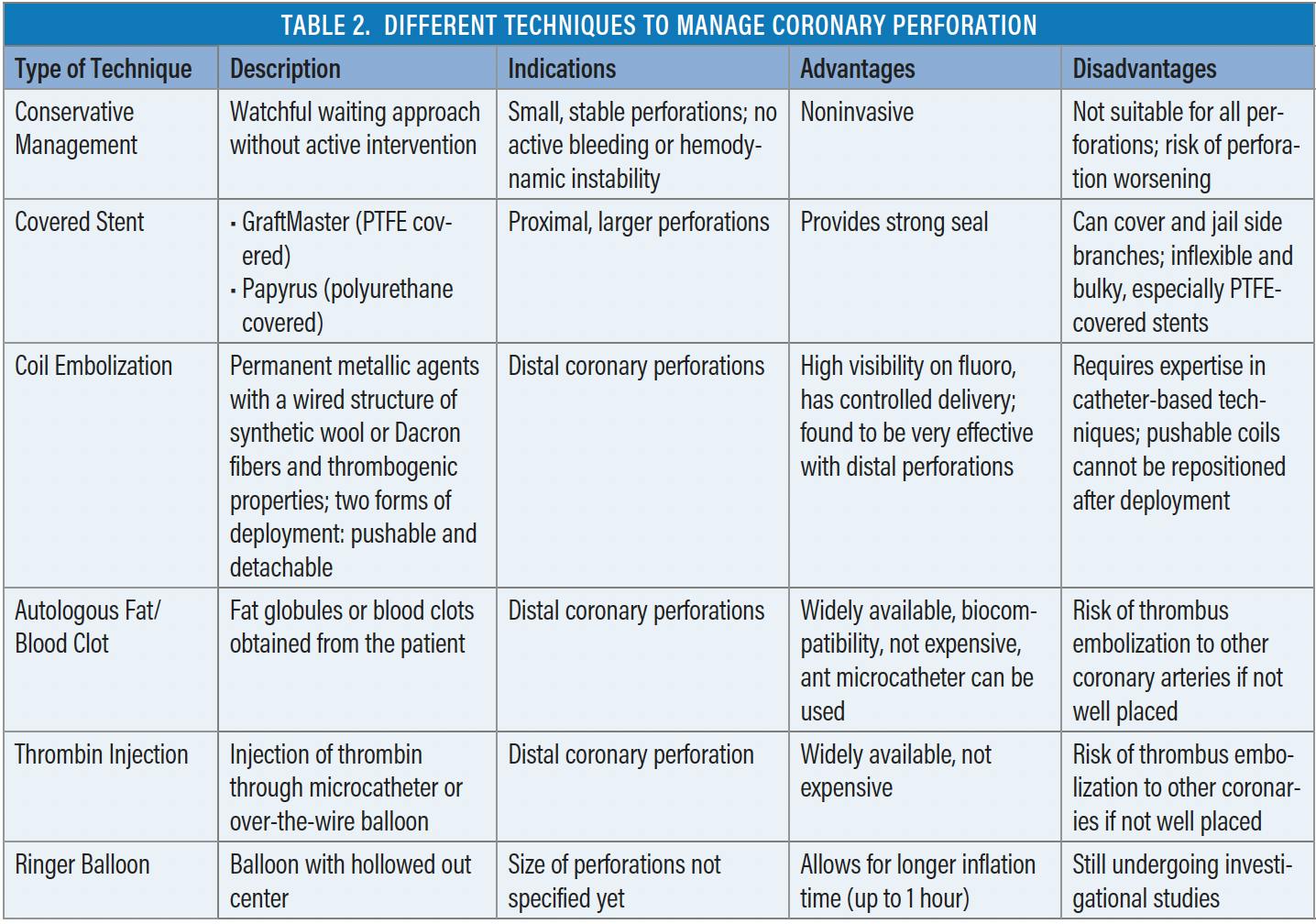
To stop extravasation, prolonged balloon inflation (1:1 balloon:vessel size) proximal or at the site for up to 10 minutes at a low pressure (maximum 8 atmospheres) could be attempted. The maximum tolerated time a coronary can occluded without causing significant myocardial damage is approximately 20 minutes; therefore, repeated 5- to 10-minute inflations can be done until there is successful sealing of the perforation. If intermittent, complete occlusion does not resolve the perforation, then partial occlusion to yield thrombolysis in myocardial infarction grade 2 flow can be held longer. However, a definite treatment such as coiling, covered stent, or embolization should be utilized (Table 2).10
With extensive perforation (Ellis type III), as little as 100 mL of blood in the pericardial sac can lead to cardiac tamponade if it accumulates rapidly. Cardiac tamponade is a clinical emergency that can be diagnosed in the cardiac catheterization laboratory by echocardiography or by fluoroscopy with the extravasation of blood into the pericardium and hemodynamic instability. Along with adequate fluid resuscitation and use of vasopressors, urgent pericardiocentesis is warranted to rapidly decompress the cardiac compression from the pericardial effusion. Often, reinfusion of the aspirated pericardial blood into a central line may decrease the need for blood transfusion. Reinfusion utilizes a closed circuit composed of a pig tail catheter in the pericardiac sac that is connected to central venous access. After successful sealing of the perforation, the pigtail catheter is left in place for at least 24 hours. It should be taken out if less than 50 mL of blood accumulates in less than 12 hours.11
In some cases, patients can develop dry tamponade, which is tamponade physiology without free fluid in the pericardium. In the setting of coronary perforations, dry tamponade is frequently caused by a hematoma (whether myocardial or intramyocardial) that leads to compression and collapse of a cardiac structure. Because it is caused by a hematoma or the pericardial fluid may be loculated and difficult to drain, typical pericardiocentesis for dry tamponade may not be useful. Hemodynamic support with intravenous fluid resuscitation and vasopressors is of utmost priority while further steps, such as anticoagulation reversal or cardiac surgery, are considered.
Covered Stents
Originally designed for in-stent restenosis, covered stents now play a major role in CAP, especially in large-vessel perforations. Typically covered with polytetrafluoroethylene (PTFE), the main objective of a covered stent is to seal the perforation with a layer impermeable to blood. Deployment of a covered stent at the site of perforation can provide definitive treatment of large-vessel perforations, especially in vessels with a diameter > 2.5 mm (Figure 1). Since covered stents have been used to treat CAP, the need for emergency surgery has decreased and survival has increased. However, covered stents have some limitations. Covered stents should be used for perforations of vessels without sizable side branches as they carry the risk of side branch occlusion and periprocedural myocardial infarction. Also, thrombogenicity is of concern with covered stents, especially those covered with PTFE. Newer-generation covered stents contain graft material from autologous veins or equine pericardium to decrease thrombogenicity. Covered stents successfully provide hemostasis in approximately 85% of grade III coronary perforations.2,5
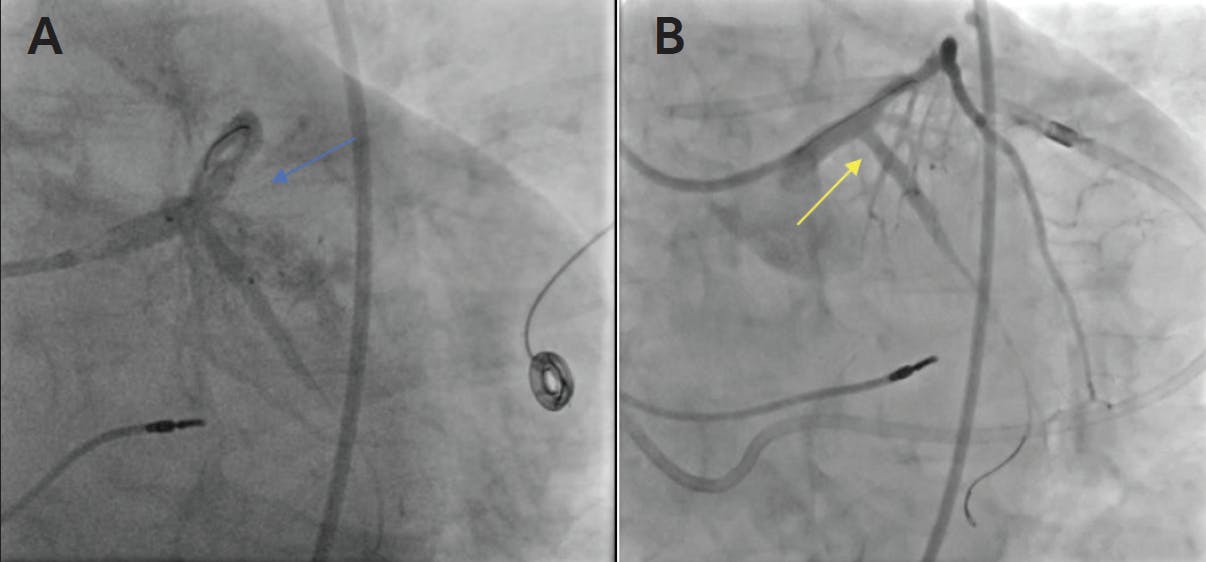
Figure 1. Ellis type III perforation of the proximal circumflex artery (A; blue arrow) successfully treated with 3- X 15-mm Papyrus covered stent (B; yellow arrow).
Currently, there are two types of covered stents used in the United States, GraftMaster (Abbott) and the PK Papyrus (Biotronik) single-layered stent. The GraftMaster is a PTFE-covered stent that is constructed using a sandwich technique in which a layer of PTFE is placed between two stainless steel stents. A 6-F guide can be used to deliver up to a 4-mm stent and a 7-F guide is needed for 4.5- to 4.8-mm stents. The PK Papyrus is a newer-generation covered stent that is made of a single layer electrospun polyurethane-covered cobalt chromium stent. It uses either a 5- or 6-F guide to deploy stents up to 5 mm.
The CRACK-II Registry recently compared GraftMaster and Papyrus with regard to 30-day and 1-year clinical outcomes in a total of 106 patients (51 patients GraftMaster, 55 patients Papyrus) who experienced coronary perforation during PCI. The primary endpoint was occurrence of major adverse cardiac events (MACE), defined as the composite of cardiac death, target lesion revascularization, and myocardial infarction. In summary, it was found that the Papyrus covered stent was associated with lower rates of target lesion revascularization compared to GraftMaster at 30-day follow-up (3.6% vs 17.6%; P = .02) and there were no significant differences in MACE or re-PCI between GraftMaster and Papyrus at 1-year follow-up.12
Thrombin Injection
Thrombin is an enzyme that converts fibrinogen into fibrin in the final step of the clotting cascade. Often delivered through a microcatheter or over-the-wire balloon, local and precise administration of thrombin can be used to seal distal perforations.13,14
Autologous Fat/Blood Clot Embolization
Autologous subcutaneous fat harvested from local subcutaneous tissue, either from the patient’s abdomen or thigh near the arteriotomy site or autologous blood clots, can be used to seal distal perforations. Like thrombin injection, fat globules and blood clots are delivered through a microcatheter or over-the-wire balloon near the perforation. The fat globules or blood clots can be dipped in contrast for a minute to render it radiopaque. Selective engagement of the microcatheter is necessary to avoid fat or clot entry into major coronary branches. Specific to the fat particles, the fat forms a physical barrier to seal the perforation, but also activates the coagulation pathway, thereby further sealing the coronary perforation. The advantages of autologous fat or blood clot embolization include accessibility, biocompatibility, low cost, and easy delivery through any coronary microcatheter.15-17
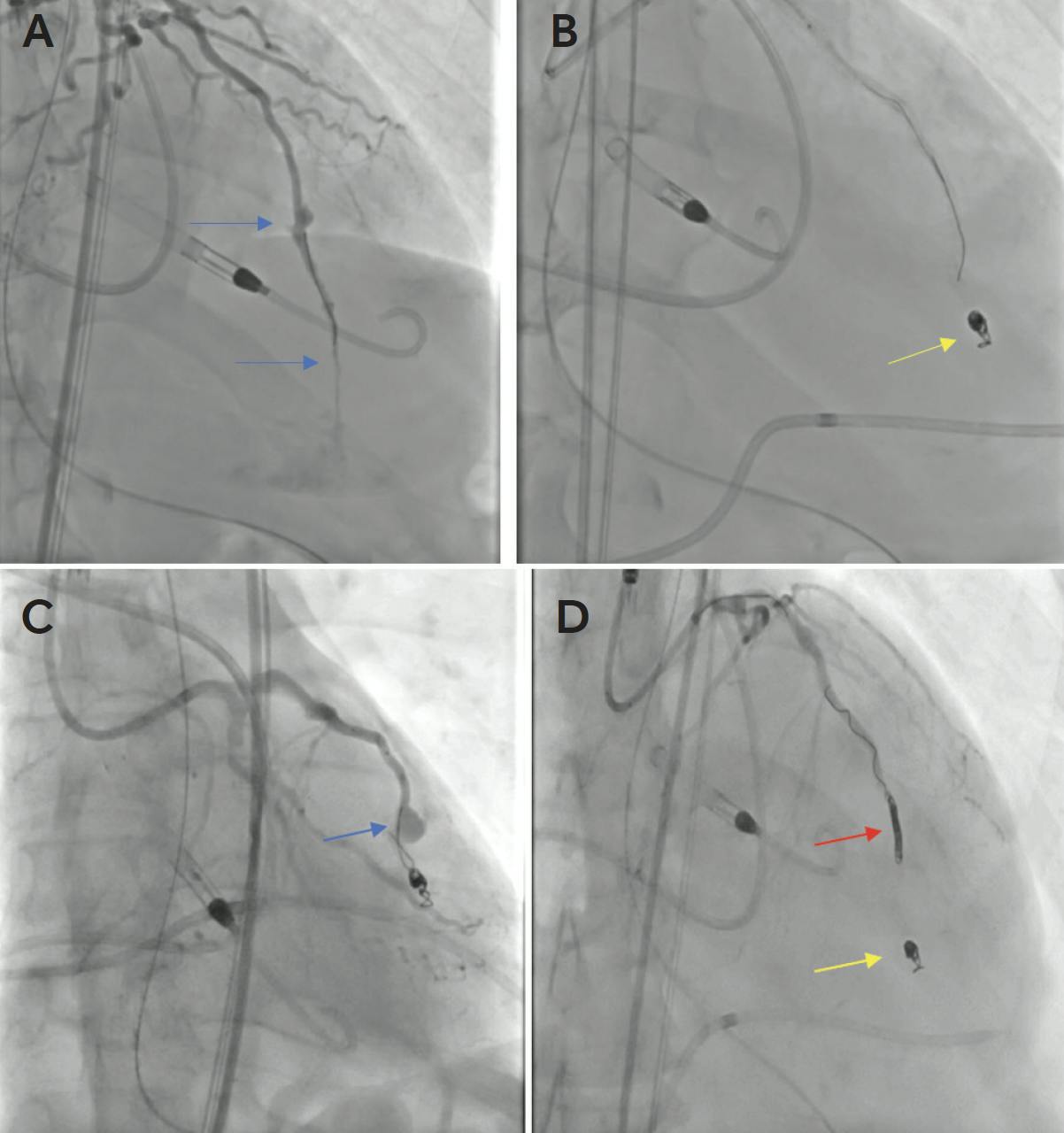
Figure 2. Ellis type III perforation of the mid and distal left anterior descending (LAD) artery (blue arrows, A and C) successfully treated with 4.0- X 13-mm coils in the distal LAD (yellow arrows, B and D) and 6.0- X 20-mm coils in the mid LAD (red arrow, D).
Coils
Coils are permanent metallic (stainless steel or platinum) agents with a wired structure of synthetic wool or Dacron fibers and thrombogenic properties. Coils are delivered through microcatheters and the choice of coil size is important to ensure compatibility with the inner diameter of the delivery catheter to prevent the coil from being stuck and damaged. The currently available microcatheters have a wide range of internal diameter, with the smallest having an internal diameter of 0.015 inch at the tip. The narrowest internal diameter of the microcatheter determines the smallest diameter of guidewire, coils, or any other equipment that can be delivered through it. As a result, < 0.014 inch is the largest coil diameter that can be delivered through coronary microcatheters, such as the Axium coil (Medtronic) that has an outer diameter of 0.0108 to 0.0125 inch.18
Coils can be classified by delivery method: detachable or pushable. Detachable coils are attached to a wire that allows the coil to be delivered to the target area but not released. If the position is not satisfactory, the coil can be retracted and repositioned. Once the desired position of the coil is achieved, the detachable coil can be released. This allows for a higher precision and accurate position of coils compared to the pushable coils.
Pushable coils can be deployed by one of two methods. The first method uses a guidewire or designated pusher wire to advance and deploy the coil past the catheter tip. The second method uses a Luer lock syringe to forcefully flush saline through the delivery catheter and expel the coil out of the catheter. Unlike detachable coils, pushable coils cannot be easily retrieved and repositioned once deployed.19
Most coils are considered magnetic resonance imaging (MRI) conditional, meaning that patients can be safely scanned if placed under specific MRI conditions. Most coils can be scanned with a static magnetic field between 1.5 and 3.0 Tesla, with a maximum spatial gradient field of 5000 Gauss/cm. There is also a certain amount of MRI-related heating of the coils; however, this is minimal, ranging from a minimum of 0.6°C to a maximum of 3.1°C.
Like any metal, coils can cause a certain degree of artefact and compromise to the image obtained. Image artifacts can extend between a diameter of 5.7−41.3 mm from the coil depending on individual products; therefore, optimization of MR imaging parameters to compensate for the presence of the coil may be necessary.18
Ringer Balloon
The Ringer perfusional balloon catheter (Teleflex) is a new balloon that can be used for coronary perforation. It controls bleeding in the same way as a standard balloon catheter; however, the balloon has a hollow center that is designed to allow blood flow through the vessel while simultaneously prohibiting blood from exiting the perforation site. The allows for prolonged inflation up to 1 hour while the permanent treatment for perforation is determined. It is currently in the investigational stage; the Ringer Perfusion Balloon Catheter Clinical Investigation is a prospective, multicenter, single-arm, clinical investigation intended to evaluate the safety and efficacy of the Ringer perfusion balloon catheter.20
Anticoagulation Reversal
Anticoagulation reversal is only recommended after removal of all intracoronary equipment, including wire and balloons, to avoid acute intracoronary thrombosis. Unfractionated heparin can be neutralized with intravenous administration of protamine: the recommended dose is 1 mg protamine intravenously for each 100 units of unfractionated heparin used to achieve an activated clotting time of < 150 seconds. The maximum amount of protamine that should be used is 50 mg. If bivalirudin is used, infusion of fresh frozen plasma can be used to partially reverse anticoagulation. The relatively short life of bivalirudin is advantageous and may facilitate a more rapid hemostasis after cessation of the infusion.3
CONCLUSION
Coronary perforation is an infrequent, yet life-threatening complication of PCI that can be associated with high morbidity and mortality. For larger vessels, it is imperative to avoid oversized balloons or stents and high atmospheric inflations. Covered stents can be used to seal a perforation in a larger vessel.
For distal vessels, changing to a nonhydrophilic wire after crossing the primary lesion and emphasizing the importance of holding onto the coronary guidewire during forceful injections to prevent distal movement of the guidewire tip can reduce the risk of perforation. If a perforation occurs, embolic materials, thrombin injections, and coils can be used to cease active extravasation.
Although coronary perforations are associated with high morbidity and mortality, prompt recognition and appropriate interventions are vital to successful outcomes.
1. Harnek J, James S, Lagerqvist B. Coronary artery perforation and tamponade - incidence, risk factors, predictors and outcomes from 12 years' data of the SCAAR registry. Circ J. 2019;84:43-53. doi: 10.1253/circj.CJ-19-0757
2. Al-Lamee R, Ielasi A, Latib A, et al. Incidence, predictors, management, immediate and long-term outcomes following grade III coronary perforation. JACC Cardiovasc Interv. 2011;4:87-95. doi: 10.1016/j.jcin.2010.08.026
3. Giannini F, Candilio L, Mitomo S, et al. A practical approach to the management of complications during percutaneous coronary intervention. JACC Cardiovasc Interv. 2018;11:1797-1810. doi: 10.1016/j.jcin.2018.05.052
4. Vennela Avula B, Karacsonyi J, Kostantinis S, et al. Incidence, treatment, and outcomes of coronary artery perforation during percutaneous coronary intervention. J Invasive Cardiol. 2022;34:E499–E504.
5. Lemmert ME, van Bommel RJ, Diletti R, et al. Clinical characteristics and management of coronary artery perforations: a single-center 11-year experience and practical overview. J Am Heart Assoc. 2017;6:e007049. doi: 10.1161/JAHA.117.007049
6. Witzke CF, Martin-Herrero F, Clarke SC, et al. The changing pattern of coronary perforation during percutaneous coronary intervention in the new device era. J Invasive Cardiol. 2004;16:257-301.
7. Javaid A, Buch AN, Satler LF, et al. Management and outcomes of coronary artery perforation during percutaneous coronary intervention. Am J Cardiol. 2006;98:911-914. doi: 10.1016/j.amjcard.2006.04.032
8. Ramana RK, Arab D, Joyal D, et al. Coronary artery perforation during percutaneous coronary intervention: incidence and outcomes in the new interventional era. J Invasive Cardiol. 2005;17:603-605.
9. Ellis SG, Ajluni S, Arnold AZ, et al. Increased coronary perforation in the new device era. Incidence, classification, management, and outcome. Circulation. 1994;90:2725-2730. doi: 10.1161/01.cir.90.6.2725
10. Abdalwahab A, Farag M, Brilakis ES, et al. Management of coronary artery perforation. Cardiovasc Revasc Med. 2021;26:55-60. doi: 10.1016/j.carrev.2020.11.013
11. Adamczyk M, Wasilewski J, Niedziela J, et al. Pericardial tamponade as a complication of invasive cardiac procedures: a review of the literature. Postepy Kardiol Interwencyjnej. 2019;15:394-403. doi: 10.5114/aic.2019.90213
12. Bartuś J, Januszek R, Hudziak D, et al. Clinical outcomes following large vessel coronary artery perforation treated with covered stent implantation: comparison between polytetrafluoroethylene- and polyurethane-covered stents (CRACK-II Registry). J Clin Med. 2021;10:5441. doi: 10.3390/jcm10225441
13. Fischell TA, Korban EH, Lauer MA. Successful treatment of distal coronary guidewire‐induced perforation with balloon catheter delivery of intracoronary thrombin. Catheter Cardiovasc Interv. 2003;58:370-374. doi: 10.1002/ccd.10440
14. Goel PK. Delayed and repeated cardiac tamponade following microleak in RCA successfully treated with intra arterial sterile glue injection. Catheter Cardiovasc Interv. 2009; 73:797-800. doi: 10.1002/ccd.21924
15. Cordero H, Gupta N, Underwood PL, et al. Intracoronary autologous blood to seal a coronary perforation. Herz. 2001;26:157-160. doi: 10.1007/pl00002016
16. George S, Cotton J, Wrigley B. Guidewire‐induced coronary perforation successfully treated with subcutaneous fat embolisation: a simple technique available to all. Catheter Cardiovasc Interv. 2015;86:1186-1188. doi: 10.1002/ccd.26003
17. Shemisa K, Karatasakis A, Brilakis ES. Management of guidewire‐induced distal coronary perforation using autologous fat particles versus coil embolization. Catheter Cardiovasc Interv. 2017;89:253-258. doi: 10.1002/ccd.26542
18. Hachinohe D, Kashima Y, Okada Y, et al. Coil embolization for coronary artery perforation: a retrospective analysis of 110 patients. J Interv Cardiol. 2021;2021:9022326. doi: 10.1155/2021/9022326
19. Loh SX, Brilakis E, Gasparini G, et al. Coils embolization use for coronary procedures: basics, indications, and techniques. Catheter Cardiovasc Interv. 2023;102:900-911. doi: 10.1002/ccd.30821
20. Medical Device Network. Barrie R. Teleflex completes enrollment for Ringer perfusion balloon catheter trial. https://www.medicaldevice-network.com/news/teleflex-completes-enrolment-ringer-perfusion-balloon-catheter-trial. Accessed February 4, 2024.
Advertisement
Advertisement