Advertisement
Advertisement
September/October 2023
An Interview With Geoffrey D. Barnes, MD, MSc
The University of Michigan vascular cardiologist discusses PERT research needs, implementation science in practice, anticoagulation stewardship, and collaborative patient care.

Implementation science in cardiovascular care is a key part of your work. How does this type of research help improve care, and can you share some examples of how you have applied this in practice?
Implementation science is the scientific study of methods and strategies that facilitate the uptake of evidence-based practices into regular use by clinicians. In other words, it’s the study of how we get clinicians and clinical teams to do the things they are supposed to do. In cardiovascular care, we have a lot of opportunities to use implementation science for two key reasons. First, a wide range of evidence-based therapies have been established through rigorous research efforts. Second, there are several key areas in which clinical practice does not match up with class 1 guideline recommendations.
For patients who take antithrombotic medications, there are clear guidelines about when these medications should be held before a surgical procedure. Yet, these medications are frequently not managed appropriately before a surgical procedure, often leading to canceled procedures. Using implementation science principles, we implemented a new care pathway that standardized care delivery using evidence-based protocols for when to hold antithrombotic medications before elective gastrointestinal endoscopic procedures. That effort led to reductions in canceled procedures, fewer incorrect medication management decisions, improved patient satisfaction, and overall cost savings.1
More recently, we’ve been working to reduce the number of patients with low-risk acute pulmonary embolism (PE) who are admitted to the hospital when they could safely be discharged to home from the emergency department (ED). Our team used key implementation strategies to educate emergency medicine clinicians, develop clinical nudges, obtain clinician precommitment, and ensure reliable medication access and clinic follow-up. This effort increased the percentage of eligible patients being discharged from the ED from 2% to 27%. We strive to continue making improvements at our hospital while helping disseminate these findings across the state of Michigan.
Through your work with the Anticoagulation Forum and at University of Michigan, you’ve been involved in the advancement of “anticoagulation stewardship.” What does this look like, and how does it differ from a typical approach to anticoagulation management?
Anticoagulants are the leading cause of adverse drug events in United States EDs.2 This reflects both the growth of anticoagulant medication use over the past decade and the high rate of inappropriate medication prescribing—estimated as high as 25% of all direct oral anticoagulant (DOAC) prescriptions. Addressing this public health crisis requires an intentional and coordinated nationwide effort. Anticoagulation stewardship involves intentional, efficient, and sustainable system-wide initiatives that are designed to achieve optimal outcomes for patients taking anticoagulant medications.3 In many hospitals and outpatient clinics, there is no support to ensure that patients are receiving evidence-based anticoagulant medications. For instance, up to one in four patients receive an inappropriate dose of DOACs, increasing their risk of bleeding, stroke, and hospitalization. Additionally, inappropriate use of aspirin therapy along with oral anticoagulation increases the risk of bleeding complications.
Anticoagulation stewardship also involves deliberate efforts to improve the safe use of anticoagulant medications. Examples include use of population health dashboards by pharmacy specialists to fix off-label DOAC prescribing, coordinated efforts by anticoagulation clinic nurses to identify and deprescribe aspirin among warfarin-treated patients, and use of electronic health record tools to ensure that patients with anticoagulant-related bleeding receive evidence-based reversal therapies.
These examples are different from routine clinical care, which rarely leverages technology tools or specialist nurses and pharmacists to support patients and their prescribing clinicians. Anticoagulation stewardship is modeled after antimicrobial stewardship, the highly effective, nationwide effort to rightsize antimicrobial medication use such that adverse drug events and drug-resistant infectious agents are reduced. I believe that anticoagulation stewardship is essential to addressing the underrecognized public health crisis of anticoagulant-related adverse drug events.
On the topic of anticoagulation, you are Co-Director of the Michigan Anticoagulation Quality Improvement Initiative (MAQI2). What insights do you hope to glean from the collaborative? What impacts have you seen on patients and their care so far, and what long-standing results do you hope for?
The MAQI2 collaborative is an absolute gem of a program. MAQI2 brings together front-line clinicians (nurses and pharmacists) running anticoagulation clinics with physicians across the state of Michigan. We all learn from each other through shared best practices, and we collaboratively work to improve the care of patients across our state. In response to collaborative-wide efforts, we have seen reductions in ED visits for anticoagulant-related nosebleed and a marked reduction in unnecessary aspirin use that has resulted in fewer bleeding events. The collaborative continues to work together to develop and implement best practices for patients taking oral anticoagulant medications.
You are also Co-Director of the Michigan Program on Value Enhancement (MPrOVE). Can you tell us a bit about the background for this program and what unmet need it addresses? What are some of the MPrOVE’s core projects and how they tie into the program’s fundamental principles?
MPrOVE aims to link health services research experts at the University of Michigan Institute for Healthcare Policy and Innovation with the clinical care team at Michigan Medicine, the health system of the University of Michigan. MPrOVE projects focus on those that increase value for patients and the health care system, often through deimplementing unnecessary clinical practices. Recently, MPrOVE has implemented care pathways that have reduced the number of hospital admissions for patients with low-risk acute PE. We have also developed and implemented a tool that helps surgeons quickly determine which patients can undergo surgery in an ambulatory surgical center and which patients should undergo surgery in a hospital setting. In each of these cases, we identified practices that were being overused (hospital admission for PE, manual review of surgical cases leading to delays in scheduling) and implemented care pathways that improved value for patients and the health system.
Also at University of Michigan, you direct the Vascular Medicine Fellowship. What traits do you think define the next generation of vascular medicine fellows? Are there any unique skills or characteristics that this group of physicians will need to possess or develop as the vascular field embraces more artificial intelligence (AI) and machine learning (ML)?
Vascular medicine clinicians love to solve challenging clinical problems, often working at the intersection of several disciplines, including internal medicine, cardiovascular medicine, vascular surgery, and interventional radiology. The most successful vascular medicine clinicians (and fellows as well) are very collaborative and pay close attention to details. Vascular medicine clinicians are highly skilled at integrating multiple data sources (eg, patient history, physical examination, laboratory studies, radiographic imaging) to make a diagnosis for a patient. Those same skills will be valuable as AI and ML play a more prominent role in clinical care.
As the Principal Investigator of the prescriber-pharmacist collaborative study (NCT05351749), can you give us a snapshot of the study and its goals?
My colleague and I are very interested in testing different methods for improving the safe use of DOACs in the outpatient setting. In this study, we’re testing two specific strategies for improving safe prescribing. First, we’ve worked closely with front-line clinicians to develop informative and useful medication alerts that appear anytime an inappropriate DOAC medication is ordered. Second, we’re trying to identify which clinical settings benefit most from having a clinical pharmacist involved in the care of these patients to help select the most appropriate oral anticoagulant and dose and when prescriber clinicians (ie, physicians, physician assistants, nurse practitioners) can make these changes on their own.
Along with your work as a leader in anticoagulation care, you are also interested in the treatment of venous thromboembolism (VTE) and other vascular disorders and recently published a paper on the cause of unprovoked VTE.4 What is your decision-making process for determining to approach unprovoked VTE? What testing and/or risk prediction models do you follow?
Whenever I meet with a patient who has developed a VTE, one of the most important elements is the history taking. I spend time asking the patient about any features that could have contributed to the risk of developing VTE. These include common elements like a surgical procedure or immobilization but also any change in medication, illnesses, and family history. Then, I spend time reviewing the medications and past medical history in detail. Things like history of a rheumatologic condition or obesity can be important provoking risk factors for VTE. After this exhaustive review, if I’m unable to identify any provoking risk factors, then I’ll consider a patient to have experienced an unprovoked VTE.
For any patient with unprovoked VTE, as well as those who have persistent provoking risk factors (eg, obesity, male sex, comorbid rheumatologic condition), I generally recommend long-term courses of anticoagulation that extend beyond the initial 3- to 6-month period. While I used to rely on risk scores such as Men and HERDOO2 to identify which patients should receive shorter versus longer courses of anticoagulation, I have been defaulting to longer courses of treatment for most patients, unless they are at high risk of bleeding or have a clearly reversible risk factor for developing the VTE event.
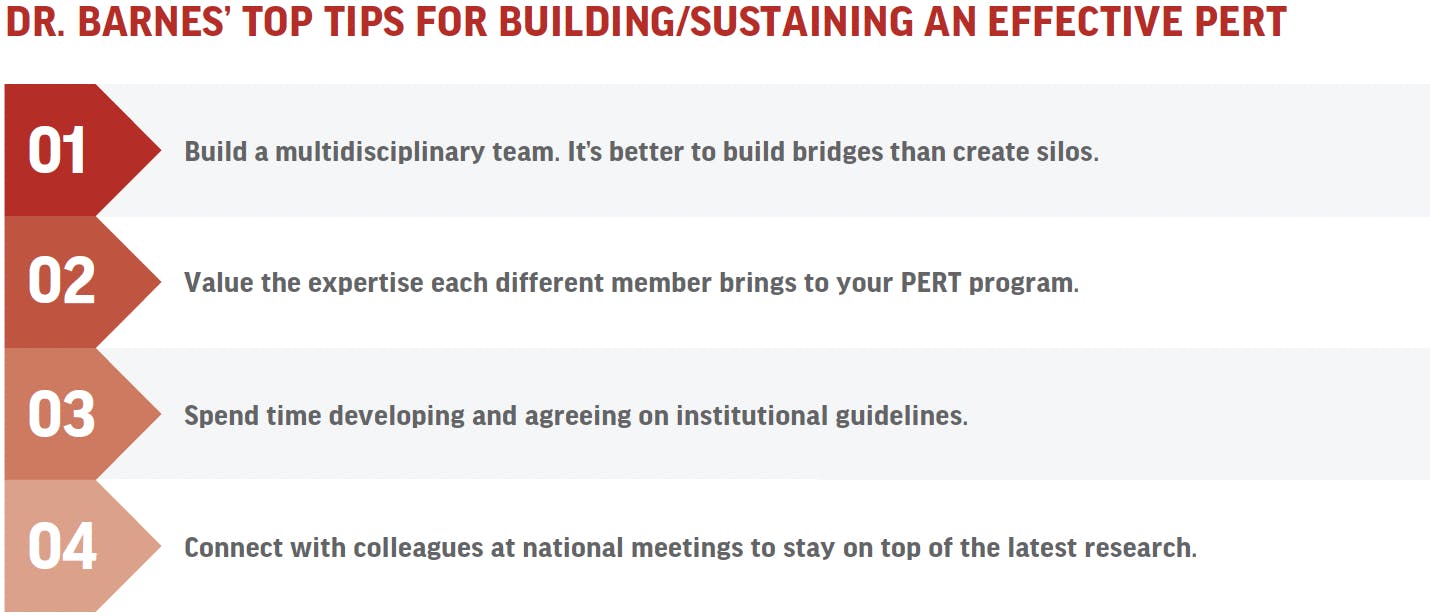
Earlier this year, you and colleagues published your experience with the PE response team (PERT) for advanced therapies, noting a need for study of PERT on a broader level.5 What are some areas related to PERT that would benefit from pursuing further research?
I’m a strong proponent of the PERT care model—anytime we bring thoughtful clinicians together with unique and complementary areas of expertise, patients will benefit! Although it would be great to show that PERT care models lead to improved patient care, the PERT care model is based on the different therapies that can be offered. So, research that focuses on clarifying the benefits and risks of these therapies is most likely to influence the outcomes associated with the PERT care model.
Clearly, there is a strong evidence base for anticoagulation care. More research that helps define the benefits of different anticoagulation strategies (eg, low-molecular-weight heparin vs unfractionated heparin) would be beneficial. However, much of the PERT care model hinges on the decision-making for advanced therapies, such as catheter-based thrombolysis or thrombectomy. There is currently a dearth of published randomized trials comparing these treatment modalities to each other or to anticoagulation alone. Furthermore, few of the published studies have focused on patient-valued outcome measures, such as need for intubation, hospital length of stay, or functional outcomes. Thankfully, there are several randomized trials currently ongoing or soon to be started that compare these different treatment modalities and focus on patient-relevant outcome measures.
From societal and institutional leadership to clinical work and a robust research practice, you have a packed schedule—what aspect of your work are you most excited about at the moment?
I get most excited when I’m working with teams to improve care for patients with thrombotic conditions or for patients who use anticoagulant medications. I love how a diverse team can come together, brainstorm different ways to tackle a problem, and then work together to develop and implement a process better than any one of us would have done on our own.
What do you consider to be your proudest professional achievement?
My most proud professional moments are when a nurse, pharmacist, or other clinician tells me how they implemented a new care pathway in their hospital or clinic based on one of my team’s publications. For instance, I was recently approached by a pharmacist working in an anticoagulation clinic who convinced her medical director to allow their team to identify patients taking both warfarin and aspirin without a clear indication for dual therapy. Inspired by work that the MAQI2 has been doing for the past several years, they implemented a process for deprescribing aspirin with the goal of reducing the risk of bleeding. I’m extremely proud of the impact that our MAQI2 team is having in health system across the United States. Even my 7-year-old daughter knows how excited I am when nurses and pharmacists help make blood thinners safer for patients!
1. Barnes GD, Spranger E, Sippola E, et al. Assessment of a best practice alert and referral process for preprocedure antithrombotic medication management for patients undergoing gastrointestinal endoscopic procedures. JAMA Netw Open. 2020;3:e1920548. doi: 10.1001/jamanetworkopen.2019.20548
2. Budnitz DS, Shehab N, Lovegrove MC, et al. US Emergency department visits attributed to medication harms, 2017-2019. JAMA. 2021;326:1299-1309. doi: 10.1001/jama.2021.13844
3. Burnett AE, Barnes GD. A call to action for anticoagulation stewardship. Res Pract Thromb Haemost. 2022;6:e12757. doi: 10.1002/rth2.12757
4. Mwansa H, Zghouzi M, Barnes GD. Unprovoked venous thromboembolism: the search for the cause. Med Clin North Am. 2023;107:861-882. doi: 10.1016/j.mcna.2023.05.006
5. Ardeshna NS, Song M, Hyder SN, et al. Effect of pulmonary embolism response team on advanced therapies administered: the University of Michigan experience. Thromb Res. 2023;221:73-78. doi: 10.1016/j.thromres.2022.11.017
Advertisement
Advertisement
Interested in reading more interviews?
To read more interviews with thought leaders in the interventional cardiology field, check out our Profiles & Perspectives hub.
Read More