Advertisement
Advertisement
March/April 2023
Surgical Explantation of Transcatheter Valves
A technical guide and data review of surgical TAVR explantation and the SURPLUS technique, both options for patients with transcatheter heart valve failure in whom traditional transcatheter strategies are not feasible.
By Luigi Pirelli, MD; Derek R. Brinster, MD; and Gilbert Tang, MD, MSc, MBA
Based on favorable results of two randomized controlled trials, transcatheter aortic valve replacement (TAVR) has become an option for patients at “low surgical risk.”1,2 As the volume of TAVR in low-risk patients continues to increase, it is anticipated that transcatheter heart valve (THV) failure will precede life expectancy in a considerable proportion of patients.3 Therapeutic options for patients with degenerated THVs include open surgery (TAVR explantation) and redo TAVR (transcatheter aortic valve [TAV]–in-TAV).
As data accumulate, we continue to learn more about these reintervention options for a TAVR-first strategy. The choice of the first THV type and depth of implantation will affect options for future therapies. THVs that interact with the sinotubular junction (STJ) and have a higher-risk plane may not be amenable to TAV-in-TAV due to the risk of sinus sequestration and coronary obstruction.4 Not only can the valve degenerate over time but patients can present with infective endocarditis, severe paravalvular regurgitation, or prosthesis-patient mismatch. Transcatheter strategies are not an option in these cases, and the index THV has to be removed. Surgery still remains an invasive but valid possibility, with THV explantation followed by replacement of the aortic valve and/or reconstruction of the aortic root and ascending aorta.5
The EXPLANT-TAVR registry has given us insight into the surgical management and outcomes of patients with failed transcatheter THVs.6 The procedure requires long cardiopulmonary bypass (CPB) and cross-clamp times. In-hospital and 1-year mortality are high, as are average hospital length of stay and risk of stroke. Although TAV-in-TAV remains an enticing option to potentially avoid the need for open heart procedure, surgery should be considered in a select cohort of patients in whom no other minimally invasive transcatheter intervention can be offered.
This article aims to describe the technical details of THV extraction and reviews the data on surgical explantation of THVs.
PREOPERATIVE IMAGING: HOW TO PLAN A PROCEDURE
Preoperative assessment of the THV and cardiac anatomy plays a crucial role in assessing options and planning for the appropriate procedure. Multimodality imaging using transthoracic echocardiography (TTE), transesophageal echocardiography (TEE), and multislice CT (MSCT) is used to define the etiology of THV failure and evaluate options for potential treatment. Echocardiography is used to identify appropriate patients for THV replacement and assess postprocedural success. TTE is used for routine surveillance to detect structural valve deterioration (SVD) and also provides important information on other valvular pathologies, left ventricular outflow tract (LVOT), and aortic root anatomy. Although the THV leaflets may be difficult to assess due to artifact created by the THV frame, clinical suspicion of SVD can be appreciated on TTE. Additionally, identification of paravalvular leak (PVL) and comparison of prior THV transvalvular gradients are essential in the surveillance process. If there is suspicion of SVD, TEE can be performed to quantify the degree of PVL, THV leaflet pathology, and degree of aortic insufficiency. The identification of leaflet pathology may be important as some cases of TAV-in-TAV yield high risk for coronary obstruction, and leaflet thickness and calcification may limit the option for leaflet laceration.
Echocardiography is a staple in identifying prosthetic valve abnormalities, but MSCT has become the most important tool for determining the appropriate procedural steps for valve-in-valve cases. MSCT helps identify the best type of valve for determining anatomic risks, such as coronary obstruction. The size of the annulus, diameters of LVOT and sinuses of Valsalva, size of the STJ, valve-to-coronary (VTC) and valve-to-aorta (VTA) distances, and coronary heights are all parameters that are measured for appropriate planning. Coronary obstruction can occur at the STJ level, resulting in sinus sequestration. A VTC distance of < 4 mm or a VTA < 2 mm is known to increase risk of coronary obstruction in the TAV-in–surgical aortic valve population. Smaller aortic roots (especially in combination with larger THVs) are typically the anatomy that poses risk of coronary obstruction. Newer CT prototypes allow for virtual THV implantation and accurate measures of VTC and VTA distances, thus predicting the patients at high risk for sinus sequestration. Studies have estimated that up to one of five patients with a balloon-expandable valve and four of five patients with self-expandable valve have an elevated risk for coronary obstruction with TAV-in-TAV.7 Sinus sequestration remains the major concern for TAV-in-TAV procedures. Patients with a high risk of coronary obstruction should be considered for surgery, as sinus sequestration is one of the main determinants of poor outcome with TAV-in-degenerated TAV.
In instances of THV deterioration with significant risk of sinus sequestration with TAV-in-TAV, infective endocarditis, severe PVL, or prosthesis-patient mismatch, surgery remains the only option available.
SURGERY: TAVR EXPLANTATION AND SURGICAL AORTIC VALVE/ROOT REPLACEMENT
Surgical explantation of a THV valve is not an easy intervention. As the THV ages, the valve is more likely to be endothelialized, making explantation and reconstruction more radical and difficult. Moreover, THVs with a more extensive frame (eg, self-expandable) extending from the LVOT to the ascending aorta pose some challenges due to extension of the tissues that need to be replaced.
OPERATION: VALVE EXPLANTATION
The pericardium is usually accessed via median sternotomy, and the patient is placed on CPB directly cannulating the ascending aorta and the right atrium. More experienced surgeons adopt a less invasive approach via an upper ministernotomy or right anterior thoracotomy and peripheral cannulation. Myocardial protection is achieved via infusion of antegrade and/or retrograde cardioplegia depending on the presence of aortic insufficiency. The aorta is opened with an oblique or transverse incision. If a self-expandable THV is in place, the aortotomy must be about 1.5 cm proximal to the distal edge of the valve, which in turn can be palpated through the aortic tissue before opening.
Fresh THVs implanted < 6 months before do not present the same grade of endothelialization as older valves. Maneuvers that deform the cage, implying the application of concentric forces, are typically successful in releasing the valve without disrupting either the aortic root or the STJ. If more aortic tissue is embedded in the cage and covering most of the surface of the THV, the explantation process becomes more complicated. A plane must be found between the THV frame and the intima of the aortic wall, and a freer elevator is used to circumferentially liberate the valve, carefully avoiding perforations, ruptures, or dissections of the aortic tissue. Some THVs with a deeper implant into the LVOT require attention to the anterior mitral leaflet, which can also be damaged on deeper dissection.
When injury to the surrounding tissues is inevitable, a root or aortic valve replacement with repair of ascending aorta is performed in the usual fashion. If the root remains intact after removal of the THV, an isolated aortic valve replacement can be performed. Of note, if the reason for explantation is prosthesis-patient mismatch, a root enlargement with a patch of bovine pericardium should be considered to allow a larger prosthesis to be sewn in. Alternatively, a root replacement could be performed. In case of infected endocarditis, the aortic root and aortomitral continuity must be careful inspected. Aortic root replacement is inevitable when there is evidence of severe infection (Figure 1 and Figure 2) and root abscess; extensive debridement and reconstruction are performed when the infectious process is spread to other cardiac chambers and valves. Compared to isolated aortic valve replacement, both root enlargement and root replacement add time and surgical risk to the procedure and should be performed by expert aortic surgeons.
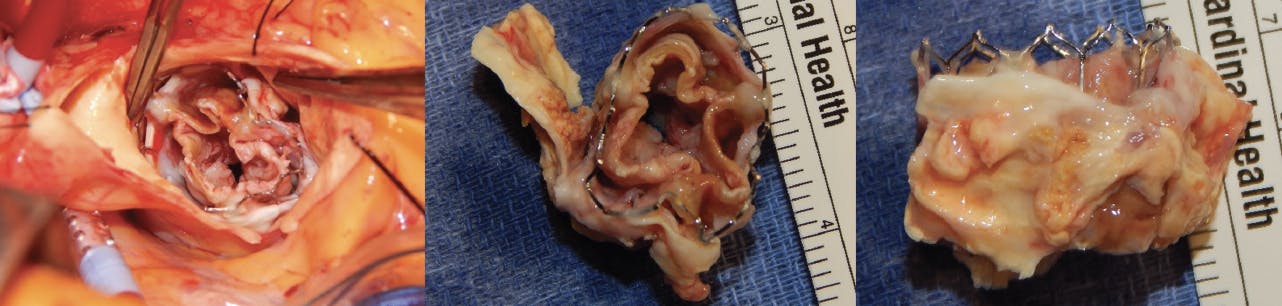
Figure 1. Infective endocarditis of a Sapien 3 THV.
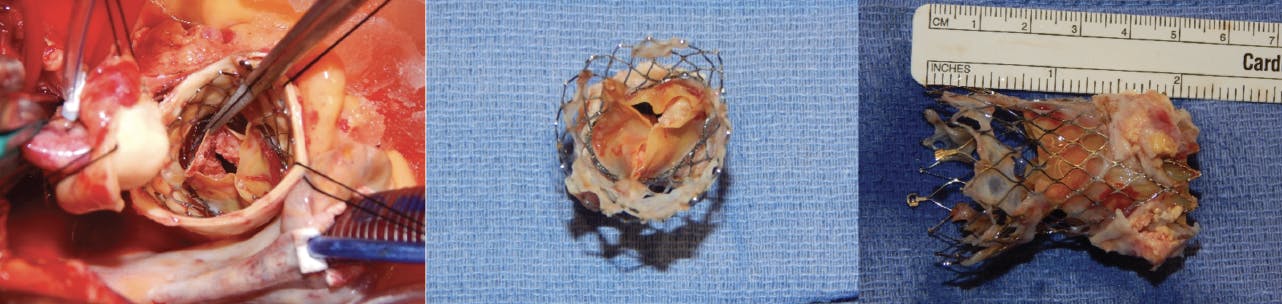
Figure 2. Infective endocarditis of an Evolut THV (Medtronic).
HYBRID TECHNIQUE: SURPLUS
SURPLUS (surgical resection of prosthetic valve leaflets under direct vision) is a hybrid surgical-interventional technique involving surgical resection of the THV leaflets and implantation of a balloon-expandable valve through an aortotomy under direct vision and fluoroscopic guidance (Figure 3).8 SURPLUS is usually performed in patients with degenerated self-expandable THVs who can tolerate open heart surgery.
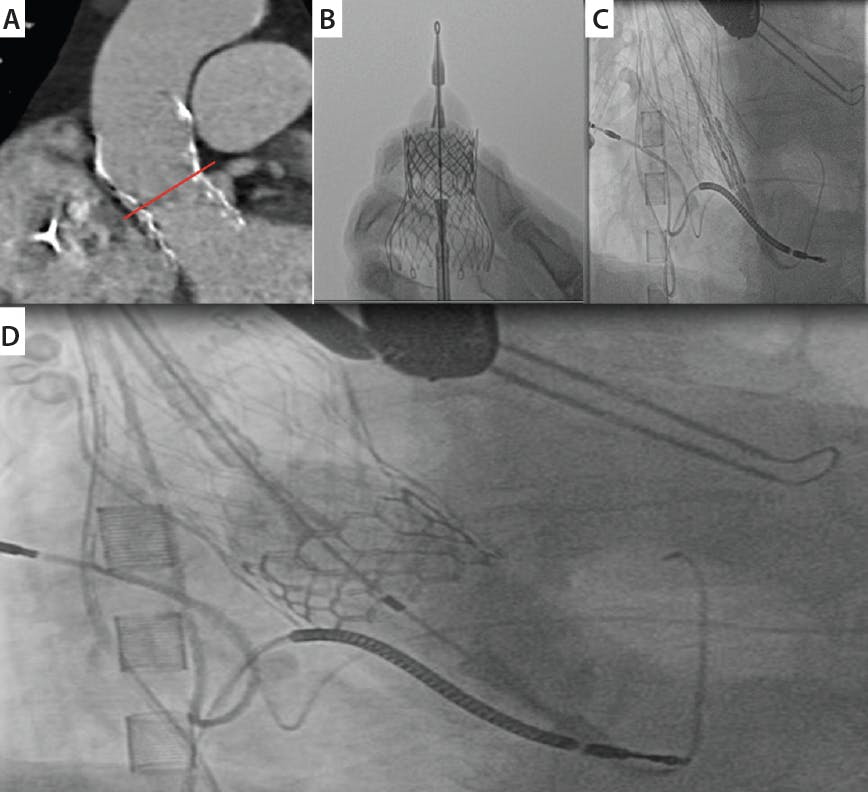
Figure 3. The SURPLUS technique. CT showing the risk plane of a CoreValve at 26 mm (red line), above the ostia of the left coronary artery (A). Fluoroscopic simulation of deployment of a Sapien 3 Ultra in a CoreValve with alignment of the inflows (B). Intraprocedural positioning of a Sapien 3 Ultra inside a CoreValve under fluoroscopic guidance (C). Postimplantation balloon valvuloplasty to ensure optimal apposition of the two THVs (D).
Via routine upper ministernotomy, peripheral cannulation, and cardioplegic arrest of the heart, an oblique aortotomy is performed 2 cm cranial to the self-expandable THV frame. The THV is exposed and the leaflets resected. The cage is left intact.
Under fluoroscopic guidance and direct vision, a balloon-expandable THV is positioned through the aortotomy across the annulus of the first THV. Both the commissures and the inflow of the balloon-expandable THV are aligned with the commissures and the inflow of the CoreValve (Medtronic). A Sapien 3 (Edwards Lifesciences) is deployed; the balloon is advanced and reinflated to ensure proper apposition of the two THVs and minimize PVL. The aortotomy site is then closed in the standard fashion, the aorta is unclamped, and the patient is weaned off CPB.
SURPLUS is a hybrid procedure with several advantages. Because the THV frame does not need to be removed, the complex dissection usually required to extract an embedded THV is no longer needed. This makes the procedure easier and faster, shortening CPB and ischemia times. Considering that two important factors associated with 30-day and 1-year mortality post-TAVR explantation are CPB and cross-clamp times,6 SURPLUS should theoretically improve outcomes.
SURPLUS is a technique that can be used in case of THV degeneration and high risk of sinus sequestration if percutaneous TAV-in-TAV is not feasible for anatomic reasons. This technique loses its value if the reason for explantation is infective endocarditis (in which case even the frame of the infected THV must be removed), severe PVL, and prosthesis-patient mismatch.
The preliminary results of SURPLUS are promising, but more data and validation of long-term outcomes are required.
DISCUSSION
TAVR is becoming the first line of treatment for patients with calcific aortic valve stenosis across all levels of surgical risk. TAVR provides an easier, faster, less invasive, and more reproducible approach to aortic valve disease than surgery. Redo TAVRs will become more frequent in our daily practice due to the growing number of transcatheter procedures performed—particularly in patients with longer life expectancy—and the fact that all biological tissues are prone to degeneration.
Indications for replacement of a THV are SVD (according to Valve Academic Research Consortium-3 criteria), infective endocarditis, severe PVL, and prosthesis-patient mismatch. Percutaneous TAV-in-TAV is the preferred strategy in instances of leaflet deterioration and severe prosthetic aortic stenosis/insufficiency. Nevertheless, a transcatheter approach is not always possible due to anatomic reasons such as sinus sequestration and risk of coronary obstruction. TAV-in-TAV is also not a valid option when there is evidence of valve infection, if there is severe regurgitation around the THV, or if the THV is too small for the patient’s body surface area (prosthesis-patient mismatch). In these instances, surgery is the only strategy available. Surgical explantation of a THV is frequently challenging and technically difficult, and surgeons are still trying to establish a standardized approach to perform it and limit potential complications.
An insight from the EXPLANT-TAVR retrospective registry6 shows that the median Society of Thoracic Surgeons (STS) risk score was higher at the time of explantation compared to index TAVR (5.6% vs 3.2%). The median time to explantation was 11.5 months; in > 40% of patients, the indication for explantation was endocarditis, and almost 50% of the surgical procedures were urgent. Aortic root replacement was required in 13% of patients, there were 54.6% concomitant procedures, and CPB and aortic cross-clamp times were 150 and 109 minutes, respectively. Despite a low intraoperative mortality (0.7%), in-hospital and 30-day mortality were high (11.9% and 13.1%, respectively). Two main determinants of poor outcome were CPB and aortic cross-clamp times.
These data describe a morbid cohort of patients requiring a challenging, time-consuming surgical intervention with high mortality and overall poor outcomes. For this reason, percutaneous TAV-in-TAV, when feasible, should be the first line of treatment in the case of THV degeneration with no risk of sinus sequestration. If a surgical explantation is needed, the conduction and result of the procedure depend on three main factors: time of index TAVR, type of THV, and surgeon experience.
Time Interval Since Index TAVR
As the time since the TAVR was performed increases, the process of endothelization becomes more pronounced and the explantation becomes more difficult.9 A true aortic endarterectomy is frequently required if the TAVR is older than 12 months, leading to more extensive reconstruction and ascending aortic repair.
Type of THV
Explantation of self-expandable valves results more frequently than balloon-expandable prosthesis in ascending aortic replacement, while aortic root replacement is required in similar proportion between the two THVs.10 Moreover, deeper implantation of the THV that impinges the anterior mitral leaflet may result in damage of the aortomitral continuity and require repair of the mitral valve. To mitigate the risks of TAVR explantation and aortic reconstruction, more conservative hybrid techniques that preserve the aortic root anatomy are becoming increasingly popular in patients presenting with SVD in whom percutaneous TAV-in-TAV is not an option. The SURPLUS technique is faster, easier, and less technically challenging than endarterectomy, explantation, and root/aortic valve replacement. It allows alignment of the commissures of the two THVs, facilitating future coronary access. Data on SURPLUS are preliminary, and no conclusions can be made regarding its comparison to standard surgical techniques.
Surgeon Experience
These surgical interventions are technically challenging, require a lot of expertise, and are performed on patients who are sicker and older than in the index procedure. Although numbers are trending up, TAVR explantation is not a common intervention even in busy structural/surgical programs. Fukuhara et al reported that valve explantation post-TAVR had a frequency of 1% in 8 years.9 These patients had a higher STS score compared to index TAVR, and the procedure was extremely challenging when the THV valve was older than 1 year. Even in expert hands, hospital mortality remained high (11.8%), and midterm outcomes were poor (3-year survival, 68%).
CONCLUSION
Due to the expanding field of TAVR, a growing number of patients will require THV replacement. When transcatheter strategies are not indicated or feasible, TAVR explantation and surgical aortic valve replacement or root reconstruction will need to be considered. TAVR extraction is a challenging procedure that carries a high mortality and morbidity. As the THV is endothelialized more, its explantation is more difficult, tissue dissection deeper, and reconstruction more extensive. Surgeons are maturing experience to standardize technical aspects of the procedure and improve operative outcomes.
1. Mack MJ, Leon MB, Thourani VH, et al. Transcatheter aortic-valve replacement with a balloon-expandable valve in low-risk patients. N Engl J Med. 2019;380:1695-1705. doi: 10.1056/NEJMoa1814052
2. Popma JJ, Deeb GM, Yakubov SJ, et al. Transcatheter aortic-valve replacement with a self-expanding valve in low-risk patients. N Engl J Med. 2019;380:1706-1715. doi: 10.1056/NEJMoa1816885
3. Carroll JD, Mack MJ, Vemulapalli S, et al. STS-ACC TVT registry of transcatheter aortic valve replacement. J Am Coll Cardiol. 2020;76:2492-2516. doi: 10.1016/j.jacc.2020.09.595
4. Ochiai T, Oakley L, Sekhon N, et al. Risk of coronary obstruction due to sinus sequestration in redo transcatheter aortic valve replacement. JACC Cardiovasc Interv. 2020;13:2617-2627. doi: 10.1016/j.jcin.2020.09.022
5. Brescia AA, Deeb GM, Wai Sang SL, et al. Surgical explantation of transcatheter aortic valve bioprosthesis: a statewide experience. Circ Cardiovasc Interv. 2021;14:e009927. doi: 10.1161/CIRCINTERVENTIONS.120.009927
6. Bapat VN, Zaid S, Fukuhara S, et al. Surgical explantation after TAVR failure: mid-term outcomes from the EXPLANT-TAVR international registry. JACC Cadiovasc Interv. 2021;14:1978-1991. doi: 10.1016/j.jcin.2021.07.015
7. Medranda GA, Jimenez CES, Torguson R, et al. Lifetime management of patients with symptomatic severe aortic stenosis: a computed tomography simulation study. Eurointervention. 2022;18:e407-e416. doi: 10.4244/EIJ-D-21-01091
8. Pirelli L, Basman CL, Brinster DR, et al. Surgical resection of prosthetic valve leaflets under direct vision (SURPLUS) for redo TAVR. JACC Cardiovasc Interv. 2021;14:1036-1037. doi: 10.1016/j.jcin.2021.02.026
9. Fukuhara S, Brescia A, Shiomi S, et al. Surgical explantation of transcatheter aortic bioprostheses: results and clinical implications. J Thorac Cardiovasc Surg. 2021;162:539-547. doi: 10.1016/j.jtcvs.2019.11.139
10. Fukuhara S, Nguyen CT, Yang B, et al. Surgical explantation of transcatheter aortic bioprostheses: balloon vs self-expandable devices. Ann Thorac Surg. 2022;113:138-145. doi: 10.1016/j.athoracsur.2021.01.041
Advertisement
Advertisement