Advertisement
Advertisement
July/August 2023
Ultrasound-Guided Deployment of Suture-Based Vascular Closure Devices
A strategy proposal for the use of ultrasound imaging to deploy a suture-based VCD prior to transfemoral TAVR.
Ultrasound (US) guidance for arterial femoral access may be beneficial when vascular closure devices (VCDs) are used. Indeed, in patients receiving a VCD after coronary procedures, US-guided femoral access was associated with fewer bleeding and vascular complications compared to femoral access without US guidance.1 Nonetheless, US guidance for cardiac procedures does not usually include VCD suture deployment.2
Transcatheter aortic valve replacement (TAVR) is currently the most common procedure performed for patients with symptomatic severe aortic stenosis, and transfemoral access is commonly adopted for valve delivery. Although delivery of newer valve iterations via lower profile sheaths enhanced safety of the procedure,3 vascular complications do still occur, and their incidence plateaued to single digit values. Considering that failure of VCDs contributes to a significant portion of such complications, the opportunity to visualize VCD deployment to ascertain its correct performance might help mitigating the risk of complications. Among others, single or multiple suture-based VCD are widely adopted for large-bore access closure after TAVR.
We recently proposed an US-guided strategy to achieve predictable deployment of dual suture-based VCDs (Perclose Prostyle, Abbott) for preclosure during transfemoral TAVR.4 This strategy might be particularly beneficial in two scenarios:
1. Patients with atherosclerotic disease in the common femoral artery (CFA) close to the puncture site, as plaque capture upon the footplate opening may lead to iatrogenic vessel dissection/stenosis or posterior wall delivery of the suture with subsequent occlusion of the artery.
2. Patients undergoing TAVR via unilateral access.5 Ipsilateral superficial femoral artery (SFA) sheath insertion as additional access during TAVR allows the pigtail to function both for aortic root angiography and as protection for main CFA access, facilitating peripheral bailout should complications ensue.3 Given that SFA sheath insertion could be followed by CFA to avoid maneuvering and kinking of the large bore sheath, entanglement of the footplate and SFA sheath in this setting might yield VCD failure.
DEPLOYMENT APPROACH
We propose the following strategy (Figure 1 and Video 1) to facilitate predictable, safe, and effective dual Perclose Prostyle deployment before transfemoral TAVR, including US guidance for:
- Femoral arterial axis interrogation
- CFA wall puncture
- Insertion of Perclose Prostyle in arterial lumen
- Opening of the footplate away from atherosclerotic plaque or SFA sheath
- Footplate pull up onto the anterior vessel wall ensuring atherosclerotic plaque capture or SFA sheath entanglement
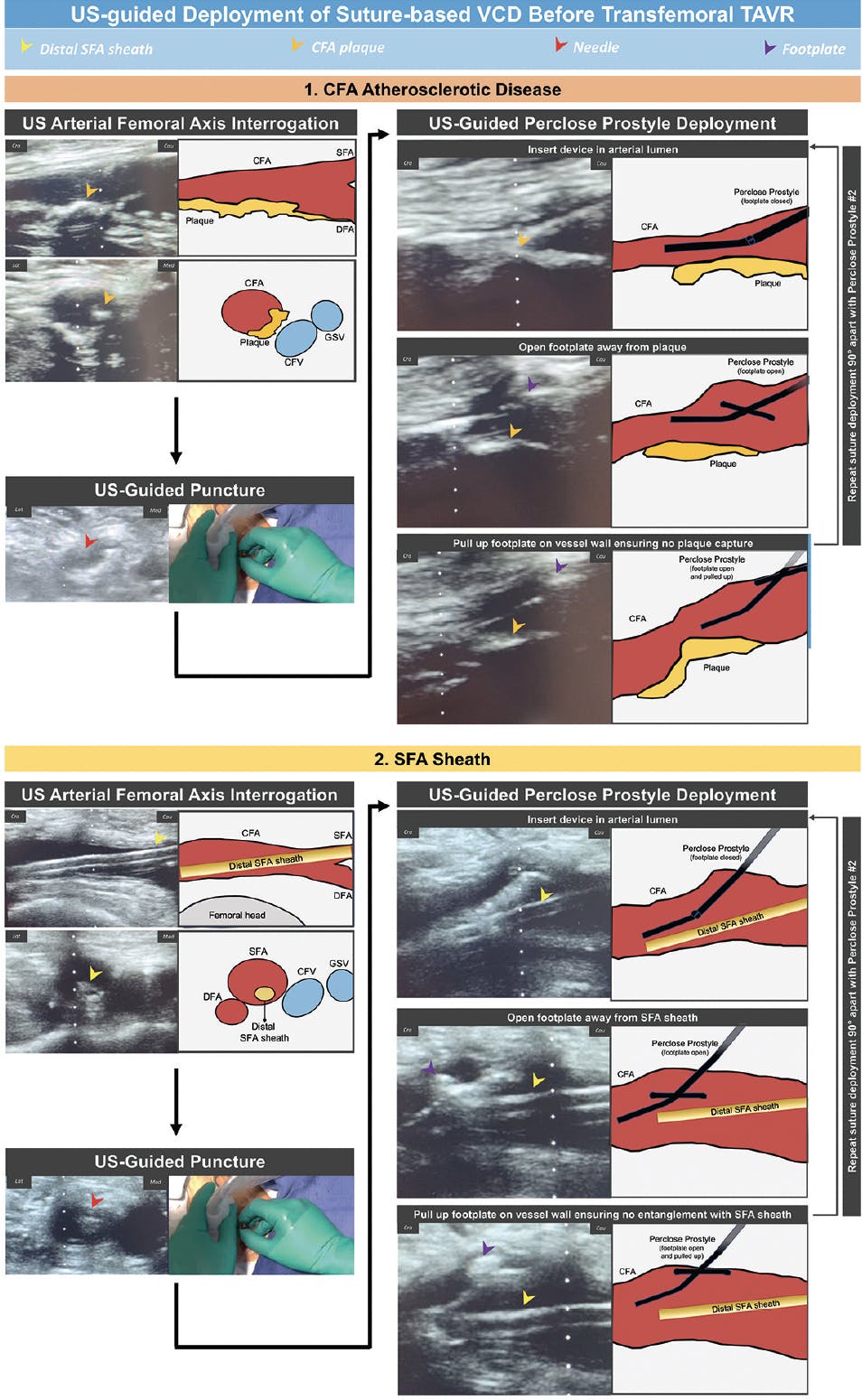
Figure 1. US-guided strategy for predictable deployment of Perclose Prostyle VCD before transfemoral TAVR. Scenarios include CFA atherosclerotic disease and presence of SFA sheath. US interrogation of the CFA on long and short axis is followed by US-guided arterial wall puncture with a micropuncture needle on short axis. Accurate visualization of VCD on long axis allows opening and pull-up of the footplate avoiding interaction with SFA sheath or atherosclerotic plaque. Abbreviations: CFV, common femoral vein; DFA, deep femoral artery; GSV, great saphenous vein.
CONCLUSION
Although lacking an omnicomprehensive three-dimensional appreciation of the suture-based VCD deployment process, implementation of such strategy might be beneficial in reducing ischemic or bleeding complications related to suboptimal suture-based VCD adoption. It is reasonable to believe such an approach could be of benefit when deploying suture-based VCD in the setting of other cardiac procedures as well. However, whether this technique might be extrapolated for deployment of other suture and non-suture–based VCDs remains to be assessed.
1. d’Entremont MA, Alrashidi S, Alansari O, et al. Ultrasound-guided femoral access in patients with vascular closure devices: a prespecified analysis of the randomised UNIVERSAL trial. EuroIntervention. 2023;19:73-79. doi: 10.4244/EIJ-D-22-01130
2. Jolly SS, AlRashidi S, d’Entremont MA, et al. Routine ultrasonography guidance for femoral vascular access for cardiac procedures: the UNIVERSAL randomized clinical trial. JAMA Cardiol. 2022;7:1110-1118. doi: 10.1001/jamacardio.2022.3399
3. Barbanti M, Binder RK, Freeman M, et al. Impact of low-profile sheaths on vascular complications during transfemoral transcatheter aortic valve replacement. EuroIntervention. 2013;9:929-935. doi: 10.4244/EIJV9I8A156
4. Leone PP, Scotti A, Ludwig S, et al. Predictable deployment of suture-based vascular closure device before transfemoral transcatheter aortic valve replacement. JACC Cardiovasc Interv. 2023;16:485-486. doi: 10.1016/j.jcin.2022.11.021
5. Khubber S, Bazarbashi N, Mohananey D, et al. Unilateral access is safe and facilitates peripheral bailout during transfemoral-approach transcatheter aortic valve replacement. JACC Cardiovasc Interv. 2019;12:2210-2220. doi: 10.1016/j.jcin.2019.06.050
Advertisement
Advertisement