Advertisement
Advertisement
July/August 2023
Current Treatment Options for Femoral Pseudoaneurysms
Early detection, monitoring, and appropriate treatment for femoral pseudoaneurysms are important to reduce morbidity.
By Sareena George, MD; Ari J. Mintz, DO; Sanjum Sethi, MD, MPH; and Sahil A. Parikh, MD
Femoral pseudoaneurysms are an important vascular complication after percutaneous or endovascular procedures. Studies over the years have indicated that femoral pseudoaneurysms occur in up to 2% of diagnostic angiograms and 8% of interventional procedures.1,2 Although endovascular therapies are evolving to use less invasive techniques and smaller equipment, femoral artery access is still necessary for large-bore access and complex interventions. As our patients with multiple comorbidities grow older and undergo endovascular procedures, vascular injuries are a major source of morbidity and mortality.
Pseudoaneurysms form due to inadequate hemostasis at the arteriotomy site, leading to bleeding into the surrounding tissue. Indications for the presence of a pseudoaneurysm include an expanding pulsatile mass, tenderness over the arteriotomy site, and a bruit heard over the femoral artery. Different imaging modalities can be used to diagnose the presence of a pseudoaneurysm, such as CT, MRI, and invasive angiography. However, ultrasonography with pulsed and color flow Doppler is the preferred technique for diagnosing pseudoaneurysms, with 94% sensitivity and 97% specificity.1,3,4
Pseudoaneurysms can form due to several patient- and/or procedure-related factors. Patient-related factors associated with increased risk are hypertension, renal dysfunction, older age (> 65 years), obesity (body mass index > 28 kg/m2), female sex, peripheral artery disease (PAD), use of antiplatelets and anticoagulation, and coagulopathy. Periprocedural and procedural risk factors include location of the arteriotomy (puncture at the bifurcation or profunda), larger-sized sheaths (> 6 F), longer duration and urgency of the procedure, ineffective manual compression during sheath removal, and periprocedural antiplatelet and anticoagulant use. Although some of these risk factors are modifiable, most are not. Therefore, early detection and appropriate management of pseudoaneurysms are necessary.5-8
Complications of femoral pseudoaneurysms include localized pain, skin ischemia, compression leading to neuropathy or claudication, critical limb ischemia (CLI), and rupture. The aim of treatment is to cause thrombosis of the pseudoaneurysm and prevent recurrence. Stable, small (< 2 cm in diameter), asymptomatic pseudoaneurysms can be managed conservatively with adequate blood pressure control, halting anticoagulant use, and monitoring with weekly ultrasounds for spontaneous closure. Large (> 2 cm) symptomatic pseudoaneurysms have a higher risk of rupture and bleeding if left untreated. In these cases, intervention is usually required. Current treatment options include ultrasound-guided compression and thrombin injection, open surgical repair, and endovascular repair.1-3,7
ULTRASOUND-GUIDED COMPRESSION
Ultrasound-guided compression is effective and is the initial mode of treatment for femoral pseudoaneurysms. It is a simple procedure that can be done at the bedside with an ultrasound probe. The probe is positioned above the neck of the pseudoaneurysm, and pressure is applied for 10 to 20 minutes at a time. The compression causes stasis of the blood in the cavity and leads to thrombosis. Patients usually require analgesia and sedation to tolerate the significant compression pain.1-3,5 Figure 1 illustrates the case of a pseudoaneurysm found after percutaneous coronary intervention that was successfully thrombosed with ultrasound-guided compression.
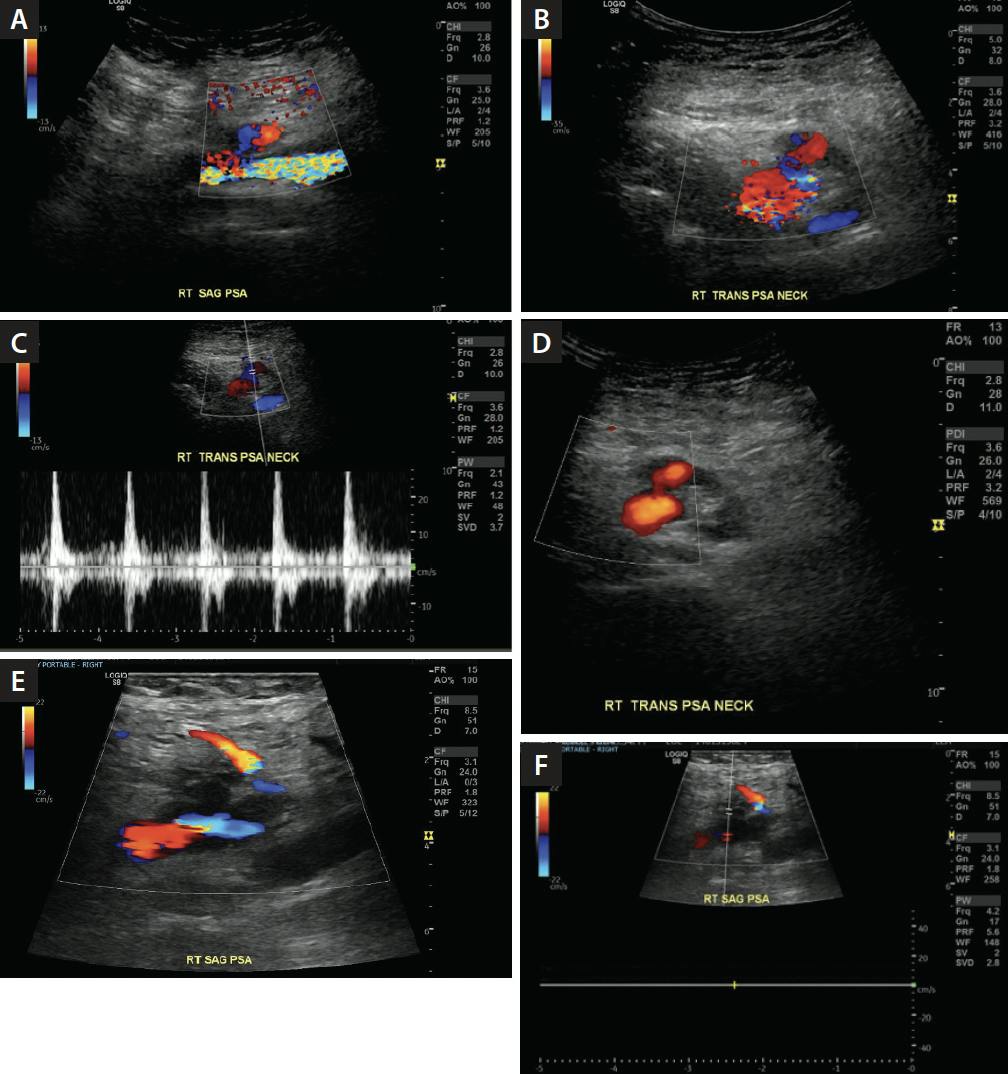
Figure 1. Ultrasound-guided compression. Color flow Doppler demonstrating flow in the right CFA through the neck and into the pseudoaneurysm with “to-and-fro” flow on duplex ultrasound (A-C). Follow-up ultrasound imaging of the pseudoaneurysm, with thrombus noted in the sac and no flow on Doppler imaging (D-F).
This treatment modality has a good success rate, but the time to achieve thrombosis varies and may require repeated compression over a few days or weeks. A drawback is the high recurrence rate; studies have shown a recurrence rate of 30% and as high as 41% to 89% in patients receiving anticoagulation therapy.1,5 Other disadvantages include patient discomfort and prolonged procedure time. Ultrasound-guided compression has been shown to be less successful in patients with large femoral pseudoaneurysms (> 3 cm in diameter) and who require anticoagulation therapy.1-3,5,7
ULTRASOUND-GUIDED THROMBIN INJECTION
Currently, ultrasound-guided thrombin injection is the primary treatment option for femoral pseudoaneurysms. First described by Cope and Ziet in 1986 and subsequently by Walker et al in 1987, this technique became very popular in the late 1990s due to procedural ease and a great success rate.1,2 It is typically performed at the bedside and only requires local anesthetics. However, success relies heavily on adequate visualization under ultrasound and suitable pseudoaneurysm anatomy. Ultrasound-guided thrombin injections are appropriate to consider for pseudoaneurysms 1.5 to 6.5 cm in diameter and with neck widths < 1 cm. When evaluating a pseudoaneurysm for treatment, the overall size, neck length and width, depth of the arterial vasculature, and depth to the pseudoaneurysm sac need to be assessed. Good ultrasound imaging of the soft tissue and vasculature is essential for this treatment modality. Patients with a large body habitus and increased adiposity can be difficult to image. Adipose tissue can cause attenuation of the ultrasound beams, degrading the image quality and impeding assessment.5
The simplicity and efficacy of thrombin injections have made it an appealing treatment for pseudoaneurysms. It needs only a short treatment time, can be performed under local anesthesia, is less expensive than most other options, can be used for noncompressible pseudoaneurysms, and is effective in patients receiving anticoagulation. Several studies have shown the improved efficacy and decreased rate of recurrence with ultrasound-guided thrombin injections when compared with compression.1 Although different concentrations of thrombin are used, the standard concentration is 1,000 U/mL. For the procedure, the pseudoaneurysm sac is visualized along with the native vessel. A 22- or 25-gauge needle is attached to a syringe containing thrombin. The needle is advanced into the pseudoaneurysm cavity under ultrasound guidance. An initial saline injection is advised to confirm entry into the pseudoaneurysm. This is then followed by thrombin injection. Color flow Doppler assesses flow into the pseudoaneurysm during the procedure. Thrombin is injected (0.1-0.2 mL at a time) with subsequent evaluation via color duplex ultrasound to assess persistent flow. If there is evidence of blood flow in the pseudoaneurysm sac, additional thrombin is injected until there is obliteration of the cavity. Taking into consideration the size, pseudoaneurysms on average thrombose within 5 seconds when using a thrombin dose ranging from 20 to 6,000 U.3,5,9 Figure 2 depicts the successful thrombin injection of a large common femoral artery (CFA) pseudoaneurysm that arose after peripheral intervention for CLI in a patient with end-stage renal disease and severe calcific peripheral vascular disease.
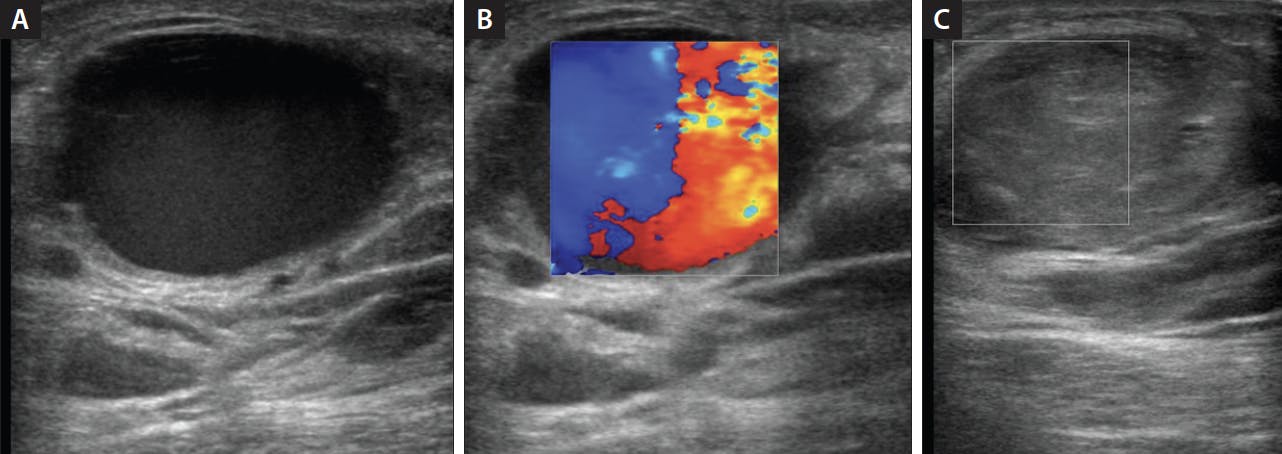
Figure 2. Ultrasound-guided thrombin injection. B-mode imaging of the pseudoaneurysm sac (A). Color duplex imaging of the pseudoaneurysm sac demonstrating turbulent flow (B). Complete thrombosis of the pseudoaneurysm sac after successful thrombin injection (C).
Ultrasound-guided thrombin injections have a 91% to 100% success rate.10 Although relatively benign, there are still some risks associated with this procedure. Complications can include thrombosis of the native artery due to embolization of the thrombin (0.8%), venous thrombosis (0.2%), and delayed reperfusion of the pseudoaneurysm (6%). A rare complication that has been reported is an immunologic or anaphylactic reaction to the thrombin used, which is commonly a bovine derivative. However, alternatives to bovine thrombin have been developed, including various glues. Also, a technique to prepare autologous thrombin from a patient’s blood has been developed for treatment of pseudoaneurysms.1,5,6
Precautions should be taken in several situations when considering this treatment modality. Pseudoaneurysms with a short and wide neck (> 1 cm) are at higher risk for embolization. A concomitant arteriovenous fistula is at higher risk for venous thrombosis if thrombin injections are used. Multilobed pseudoaneurysms may be difficult to obliterate. Caution should be taken when treating a pseudoaneurysm with an overlying local infection.7
SURGICAL REPAIR
Surgical repair has traditionally been the gold standard for treatment of femoral pseudoaneurysms. It is an effective treatment option with a high success rate; however, with the advancement of less invasive techniques, surgical repair is not as readily used currently.
The surgery is safe, requiring evacuation of the hematoma and a simple suture of the defect in the artery or repair with a patch angioplasty. Treatment is associated with a longer recovery time and higher risk of complications, including wound infections, bleeding, and longer hospitalizations. General anesthesia is routinely used in this procedure and markedly increases the risk in patients who usually have significant comorbid medical and cardiac conditions; however, surgical repair is necessary in certain clinical scenarios to obtain expedient and optimal results. This treatment option should be used if the pseudoaneurysm is associated with a wide neck, rapid expansion causing hemodynamic compromise, concomitant arteriovenous fistula, infection, skin necrosis, compression leading to neuropathy or claudication, and CLI. Surgical repair should also be considered when other treatments have failed.1,3,6,11
ENDOVASCULAR REPAIR
Endovascular management of femoral pseudoaneurysms is a safe and feasible option. The most common treatment methods are covered stent placement and coil embolization. Endovascular repair is an effective treatment in patients with multiple comorbid conditions and high surgical risk. These procedures can be done under local anesthesia and/or minimal sedation. An endovascular approach is associated with less bleeding and fewer days in the hospital compared to a surgical procedure. A covered stent can be used to exclude a pseudoaneurysm from the vasculature. It should be considered in wide neck and/or multilobed pseudoaneurysms.3,11
The videos below demonstrate a large multilobed pseudoaneurysm that was successfully treated with a covered stent. This patient was an obese man in his early 60s with multiple comorbid conditions, including severe coronary artery disease requiring a coronary artery bypass graft, ischemic cardiomyopathy with severely reduced ejection fraction, PAD necessitating a left below-the-knee amputation, and atrial fibrillation on therapeutic anticoagulation. The patient presented with cardiogenic shock requiring intra-aortic balloon pump placement via the left CFA. After his hemodynamics improved, the balloon pump was removed via manual compression. However, upon evaluation due to left groin swelling, pain, and ecchymosis, the patient was found to have a large multilobed pseudoaneurysm. Despite initial treatment with compression and ultrasound-guided thrombin injections, ultrasound showed a persistent large pseudoaneurysm. The patient was considered high risk for surgical intervention due to numerous comorbidities and recent cardiogenic shock. He therefore underwent endovascular intervention with placement of a covered stent along the left CFA. Repeat imaging showed complete thrombosis of the pseudoaneurysm, and the patient was discharged 2 days after the procedure after resumption of anticoagulation.
Endovascular repair with covered stent placement. Digital subtraction angiography showing a large multilobed pseudoaneurysm arising from the left CFA.
Intravascular ultrasound imaging of the proximal left superficial femoral artery to the CFA with visualization of the pseudoaneurysm and neck; this helped localize the neck of the pseudoaneurysm and approximate the size and length of the stent.
Digital subtraction imaging of the left CFA after successful placement of a Viabahn VBX 8- X 29-mm covered stent (Gore & Associates) and exclusion of the pseudoaneurysm.
Stent placement at the site of the CFA should be done with prudence as it is an area subject to flexion and compressive forces. Self-expanding stents have high elasticity, whereas balloon-expandable stents have high radial force and allow for precise placement. Currently, placement of covered stents will require at least a 7-F sheath, usually necessitating contralateral groin access. It is also necessary to size the stent graft adequately (at least 1:1) to prevent an endoleak. Intravascular ultrasound imaging may be very helpful in this setting to size appropriately. Coil embolization is more suitable for narrow-neck pseudoaneurysms. During this strategy, a catheter is positioned in the pseudoaneurysm and coils are placed in the sac to encourage thrombosis. These endovascular options can be used in patients with advanced cardiovascular disease who develop vascular complications as an alternative to surgical repair. Precautions should be taken when intervening on smaller arteries due to thrombosis risk. The location of the pseudoaneurysm and distance from the bifurcation are important factors when considering an endovascular treatment. A stent graft is not ideal if it requires placement across the bifurcation due to compromising the profunda femoris artery. A few techniques have employed balloon tamponade of the artery and do not require placement of an intraluminal scaffold. These hybrid approaches will simultaneously make use of extravascular ultrasound imaging to percutaneously place coils or inject thrombin into the pseudoaneurysm. The long-term efficacy and patency of these endovascular treatments are significantly understudied.1-3,7,12,13
CONCLUSION
Early detection, monitoring, and appropriate treatment for femoral pseudoaneurysms after an endovascular procedure are important to reduce the morbidity associated with this vascular injury. Surgical repair was the gold standard of treatment, but it is now reserved for unstable patients with complex anatomy. The advancement and innovation of less invasive techniques have not only decreased the risk of treatment but also are readily accessible and expedient while still maintaining efficacy. Ultrasound-guided compression is an appropriate initial treatment option; however, ultrasound-guided thrombin injections are comparatively more effective and have become the first-line treatment in most institutions. Endovascular treatment options can be considered in patients with refractory pseudoaneurysms who are at elevated surgical risk. Regardless of treatment modality, patients need close follow-up with imaging and risk factor modification.
1. Alexandre K. Endovascular management of a large femoral pseudoaneurysm: a case report and literary review. Cureus. 2022;14:e23045. doi: 10.7759/cureus.23045
2. Lenartova M, Tak T. Iatrogenic pseudoaneurysm of femoral artery: case report and literature review. Clin Med Res. 2003;1:243-247. doi: 10.3121/cmr.1.3.243
3. Tisi PV, Callam MJ. Treatment for femoral pseudoaneurysms. Cochrane Database Syst Rev. 2013;CD004981. doi: 10.1002/14651858.CD004981.pub4
4. Erol F, Arslan Ş, Yüksel İÖ, et al. Determinants of iatrogenic femoral pseudoaneurysm after cardiac catheterization or percutaneous coronary intervention via the femoral artery. Turk Kardiyol Dern Ars. 2015;43:513-519. doi: 10.5543/tkda.2015.30356
5. Yoo T, Starr JE, Go MR, et al. Ultrasound-guided thrombin injection is a safe and effective treatment for femoral artery pseudoaneurysm in the morbidly obese. Vasc Endovasc Surg. 2017;51:368-372. doi: 10.1177/1538574417708727
6. Wu H, Zhang L, Zhang C, et al. Non-surgical treatment versus surgery for iatrogenic femoral artery pseudoaneurysms: systematic review and meta-analysis. Front Surg. 2022;9:905701. doi: 10.3389/fsurg.2022.905701
7. Gupta PN, Salam Basheer A, Sukumaran GG, et al. Femoral artery pseudoaneurysm as a complication of angioplasty. How can it be prevented?. Heart Asia. 2013;5:144-147. doi: 10.1136/heartasia-2013-010297
8. Stone PA, Campbell JE, AbuRahma AF. Femoral pseudoaneurysms after percutaneous access. J Vasc Surg. 2014;60:1359-1366. doi: 10.1016/j.jvs.2014.07.035
9. Kuma S, Morisaki K, Kodama A, et al. Ultrasound-guided percutaneous thrombin injection for post-catheterization pseudoaneurysm. Circ J. 2015;79:1277-1281. doi: 10.1253/circj.CJ-14-1119
10. Webber GW, Jang J, Gustavson S, Olin JW. Contemporary management of postcatheterization pseudoaneurysms. Circulation. 2007;115:2666-2674. doi: 10.1161/CIRCULATIONAHA.106.681973
11. Schahab N, Kavsur R, Mahn T, et al. Endovascular management of femoral access-site and access-related vascular complications following percutaneous coronary interventions (PCI). PLoS One. 2020;15:e0230535. doi: 10.1371/journal.pone.0230535
12. Patel R, Tripathy TP, Debbarma R, et al. Percutaneous thrombin injection with balloon protection for a large iatrogenic femoral artery pseudoaneurysm: a case report with review of literature. Acta Medica Lituanica. 2023;30:9. doi: 10.15388/Amed.2023.30.1.9
13. Kobeiter H, Lapeyre M, Becquemin JP, et al. Percutaneous coil embolization of postcatheterization arterial femoral pseudoaneurysms. J Vasc Surg. 2002;36:127-131. doi: 10.1067/mva.2002.124372
Advertisement
Advertisement