Advertisement
Advertisement
July/August 2023
A Step-by-Step Approach to Antegrade Dissection and Reentry
Tips on devices, techniques, and troubleshooting.
By Jasleen Tiwana, MD; Jesse A. Kane, MD; and Lorenzo Azzalini, MD, PhD, MSc
Successful chronic total occlusion (CTO) recanalization requires operators to be facile with all crossing strategies, including antegrade and retrograde wire and dissection-based techniques. With higher complexity lesions, approximately 28% of CTOs will require antegrade dissection and reentry (ADR) to recanalize the vessel.1 The wire-based LAST (limited antegrade subintimal tracking) technique is less reproducible and is associated with lower procedural success.2 STAR (subintimal tracking and reentry) involves uncontrolled reentry and is currently used as a bailout technique to facilitate a two-step recanalization (“investment procedure” followed by deferred stenting). Of the ADR techniques, device-based reentry allows for targeted and predictable reentry.
EQUIPMENT
There are two commercially available devices to perform device-based ADR: the Stingray LP system (Boston Scientific Corporation) and the ReCross microcatheter (Biotronik). Both systems are 6-F–guide catheter compatible and use over-the-wire technology. Therefore, they must be trapped or delivered over 300-cm wires. If using guide extensions and trapping, a 6-F TrapLiner (Teleflex) or a 6-F LiquID (Seigla Medical) allow for delivery of the systems.
The Stingray LP system has two exit ports that are 180° opposed to one another in addition to the exit port at the tip. The ReCross microcatheter is a dual-lumen catheter with three exit ports, one at the tip and two that are 180° opposed. The white hub of the ReCross catheter is linked to the exit hole at the tip and the proximal exit port on the side of the microcatheter. The blue hub is connected to the distal port on the side of the microcatheter.
HOW I DO IT
Device-based ADR requires good distal visualization to guide reentry. Therefore, dual angiography is often required unless ipsilateral collaterals provide sufficient visualization. If relying on ipsilateral collaterals, operators should avoid disrupting the collaterals or else visualization will be jeopardized.
Appropriate preparation of the Stingray LP system is critical for successful ADR. The following steps result in an optimal preparation:
1. Remove the balloon protector and stylet.
2. Flush the lumen port with heparinized saline.
3. Connect a three-way stopcock to the side port of the Stingray system and attach an empty 20-mL syringe to it. Perform a negative preparation X2 with the 20-mL syringe and leave the stopcock closed to the Stingray system at the end.
4. Attach a 3-mL syringe filled with undiluted contrast to the stopcock and push forward to remove all air from the syringe out of the empty port of the three-way stopcock.
5. Once all air is removed from the syringe, open the stopcock to allow the contrast from the 3-mL syringe to enter the system. Leave this syringe attached until the Stingray system has been delivered to its desired position in the coronary. This ensures that contrast continues to fill the system for a longer period, which allows for better visualization of the balloon.
6. Once the system is advanced to the desired coronary position for reentry, close the three-way stopcock to the Stingray system and remove the 3-mL syringe. In its place, attach a balloon indeflator, which is prepared with a standard 50/50 mixture of contrast and heparinized saline.
7. Push forward to remove all air from the indeflator out of the empty port of the three-way stopcock.
8. Finally, open the stopcock to the Stingray system and inflate the balloon to 4 atm (without pulling negative).
Step-by-Step ADR With Stingray LP
1. Create an antegrade dissection plane.
2. Advance a knuckled polymer-jacketed wire through the dissection plane to the desired position of reentry. In lieu of a knuckled polymer-jacketed wire to traverse the dissection plane, the CrossBoss catheter (Boston Scientific Corporation) can also be used, although its use has been decreasing due to its tendency to track into small side branches and after the introduction of dedicated knuckling wires (eg, Gladius Mongo, Asahi Intecc USA, Inc.).
3. After appropriate preparation of the Stingray LP system, advance the system over the knuckled wire to the desired coronary position (usually near the tip of the knuckle).
4. Inflate the Stingray LP system to 4 atm and remove the knuckled wire.
5. Adjust the angle of visualization until the Stingray system is visualized optimally as a straight line (Figure 1).
6. Perform retrograde angiography to guide the direction in which reentry must occur.
7. Use a stiff penetrative wire (eg, Astato XS 20 or Gaia Next 3 [Asahi Intecc USA, Inc.]) with a 45°, 1-mm bend to puncture the side port of the Stingray LP balloon toward the vessel lumen.
8. Once outward puncture occurs, rotate the wire so that the tip is parallel to the vessel and advance the wire in the direction of the distal vessel. If no resistance is met, perform retrograde angiography to confirm wire position.
9. If the wire is in the lumen of the distal vessel, trap out the Stingray LP system and exchange for a microcatheter, which will allow for further wire de-escalation.
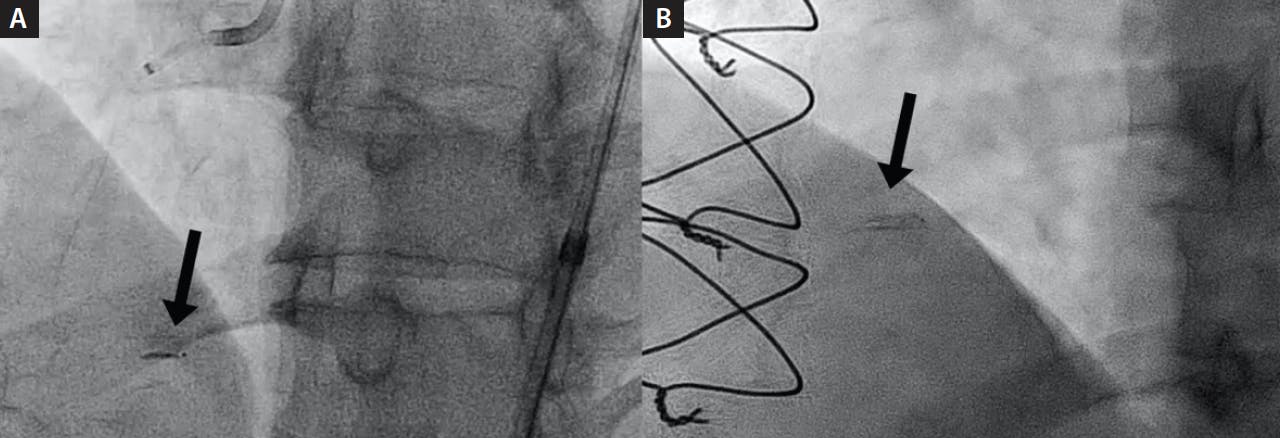
Figure 1. Optimal Stingray LP orientation: the device appears as a single line with two exit ports (one exiting up and the other down) (A). Least optimal Stingray orientation: the device is en face with the exit ports pointing toward or away and thus it is impossible to decipher their relation to the vessel lumen (B).
Troubleshooting difficult reentry. If the wire does not reenter the vessel, further punctures can be made with the stiff penetrative wire through both ports as needed. Once a few punctures are made, the operator can choose to exchange for a polymer-jacketed wire (double-blind stick-and-swap technique). The polymer-jacketed wire is directed out of the same Stingray ports, with repeated attempts to rotate and advance the wire toward the distal vessel, similar to the Seldinger technique. Additionally, the Stingray balloon can also be deflated and advanced or retracted to a different position in the coronary artery (“bobsledding”), with puncture reattempted after reinflating. This facilitates reentry by altering the orientation of the exit ports in relation to vessel calcium or fibrosis.
Step-by-Step ADR With ReCross
1. Prepare the ReCross catheter by flushing both lumens. The stylet must be removed from the blue port to allow for flushing and should be replaced prior to advancing the system over the wire into the body. The stylet allows for greater pushability when advancing the microcatheter.
2. Create an antegrade dissection plane.
3. Advance a knuckled polymer-jacketed wire through the dissection plane to the desired position of reentry.
4. Load the ReCross microcatheter via the port at the tip of the microcatheter and advance to the desired reentry position.
5. Once in position, remove the blue stylet.
6. A stiff penetrative wire is used to puncture toward the vessel lumen, similar to steps 7 and 8 of ADR with Stingray. Retrograde angiography can be performed to orient the direction of the puncture.
7. The ReCross microcatheter can be gently rotated to adjust the position of the exit ports relative to the vessel lumen with repeated attempts made at reentry through both hubs as needed. The microcatheter can also be retracted to adjust the position of the exit ports in relation to vessel calcium or fibrosis.
8. Once vessel reentry is achieved, the system is exchanged for a microcatheter, which can be used to deescalate the wire.
NEW DEVICES
The Triumph microcatheter (Teleflex) is a new device that assists in reentry and is not yet commercially available. This microcatheter has a 3-F outer diameter and is 6-F–guide compatible. It has six exit ports oriented along the 360° arc of the microcatheter, allowing for wire puncture along this range. Additionally, the six exit ports allow for a superior ability to aspirate hematoma, up to 0.6 mL in 10 seconds.
TIPS AND TRICKS
Keep the Hematoma Small
Large hematomas can be difficult to traverse and thus decrease the success of reentry. Hematomas can be minimized by plugging inflow with guide extensions when performing antegrade dissection. When using a knuckled wire for dissection, a polymer-jacketed wire that creates a small knuckle (such as the Gladius Mongo) can also help keep hematomas small. Lastly, the STRAW (subintimal transcatheter withdrawal) technique can be performed by placing the Stingray LP or ReCross microcatheter wire ports to negative suction with a 20-mL syringe prior to reentry attempts. This allows for aspiration of the hematoma.
Delivering the Device
Delivery of both the Stingray LP system and the ReCross microcatheter may be hampered by proximal vessel tortuosity and calcification. In addition to plugging inflow and reducing hematoma, the use of guide extensions can be helpful to overcome tortuosity. Proximal vessel calcification may need to be predilated with small balloons (1.5-2 mm) to facilitate delivery of the device. Notably, using large balloons near the desired site of reentry will create a large hematoma and thus should be avoided.
CONCLUSIONS
Device-based ADR provides a more reliable and targeted method of reentry for CTO recanalization compared to wire-based reentry or uncontrolled knuckle-based reentry. Currently, there are two systems available on the market for device-based reentry: Stingray LP and ReCross microcatheter. The Triumph microcatheter is a new device and is expected to be available soon. Successful ADR requires good distal visualization, minimal hematoma, proper device preparation, and appropriate technique. To maximize recanalization success, facility with device-based ADR should be a part of the armamentarium for all CTO operators.
1. Tajti P, Karmpaliotis D, Alaswad K, et al. The hybrid approach to chronic total occlusion percutaneous coronary intervention: update from the PROGRESS CTO Registry. JACC Cardiovasc Interv. 2018;11:1325-1335. doi: 10.1016/j.jcin.2018.02.036
2. Karacsonyi J, Kostantinis S, Simsek B, et al. Use of the limited antegrade subintimal tracking technique in chronic total occlusion percutaneous coronary intervention. JACC Cardiovasc Interv. 2022;15:2284-2293. doi: 10.1016/j.jcin.2022.08.052
Advertisement
Advertisement