Advertisement
Advertisement
January/February 2023
Sponsored by Abbott
Navitor With NaviSeal™ Cuff
With Serge Rousselle, DVM, ACVP; Keith High; Michael J. Reardon, MD; Xi Wang, MD; Lars Sondergaard, MD, DMSc; Rutger-Jan Nuis, MD, PhD; and Nicolas Van Mieghem, MD, PhD
Navitor™ NaviSeal™ Cuff Design
A look at design considerations and preclinical evaluation of the Navitor NaviSeal™ Cuff.
By Serge Rousselle, DVM, ACVP, and Keith High
NAVISEAL™ CUFF DESIGN
The NaviSeal™ Cuff (Abbott) is attached at the inflow edge of the Navitor™ valve (Abbott) and is designed to actively seal around complex anatomies to reduce or eliminate paravalvular leakage. The cuff has freedom to expand where needed to fill gaps caused by calcium nodules until the healing process is complete and the cuff heals in. The NaviSeal™ Cuff is 9 mm or 10 mm tall depending on valve size (9mm for 23/25mm valves and 10mm for 27/29mm valves) to provide sealing along the entire valve landing zone. The oversized design of the cuff also allows for 360° sealing in various annulus geometries. To promote healing, the NaviSeal™ Cuff is made of woven polyethylene fibers that have extensive clinical history showing excellent biocompatibility and healing profile.
NAVISEAL™ CUFF PRECLINICAL EVALUATION
The Navitor™ valve design and NaviSeal™ Cuff have been evaluated in both pre-GLP (Good Laboratory Practice) and GLP chronic preclinical studies in the ovine model and have demonstrated very favorable healing.
Gross pathology (Figure 1) indicated there was no evidence of excessive neointima growth (no pannus formation) along the cusps or conduit, no macroscopic evidence of calcification in either cusps or conduit, and there was no active or evidence of prior thrombus deposition. The cusps were flexible and showed optimal apposition and no structural defects in all test implants. The implants were well tolerated locally (ie, no adverse inflammatory response and no necrosis). Overall, the implants showed optimal healing and no adverse calcification or thrombosis altering cusp motion in the ovine model.
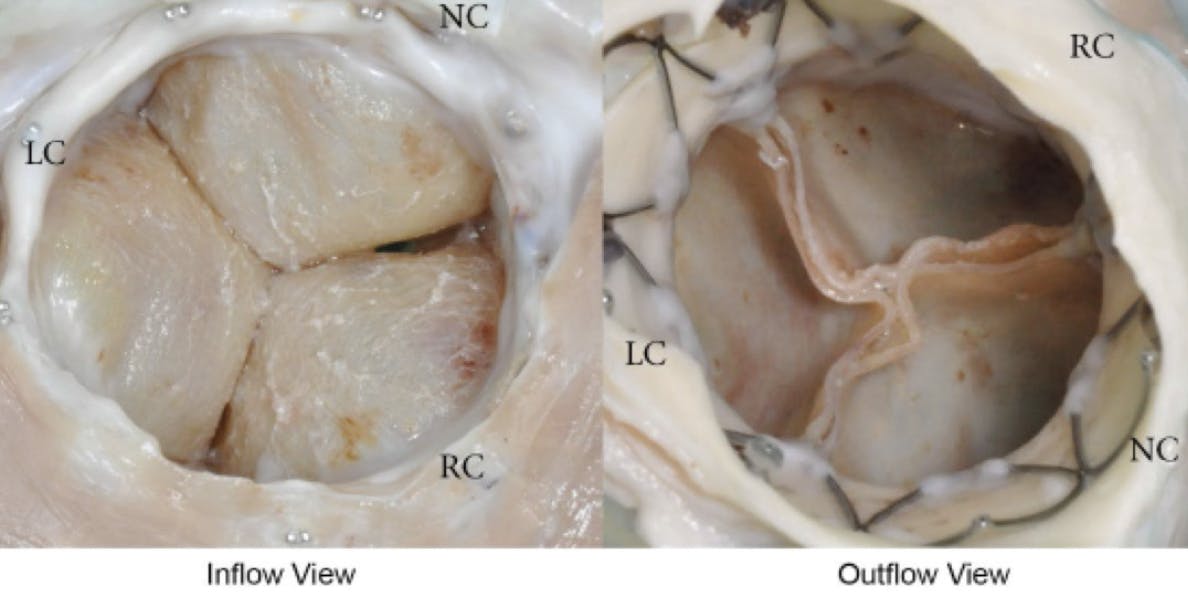
Figure 1. Gross pathology inflow and outflow views (91 days after implantation). LC, left coronary cusp; NC, noncoronary cusp; RC, right coronary cusp.
Histopathologic sections (Figure 2) through the fabric layers of the NaviSeal™ Cuff section showed complete or near complete fibrocellular integration and coverage by endothelialized neointima. There was fibrocellular tissue between fabric layers that cohesively united the layers.
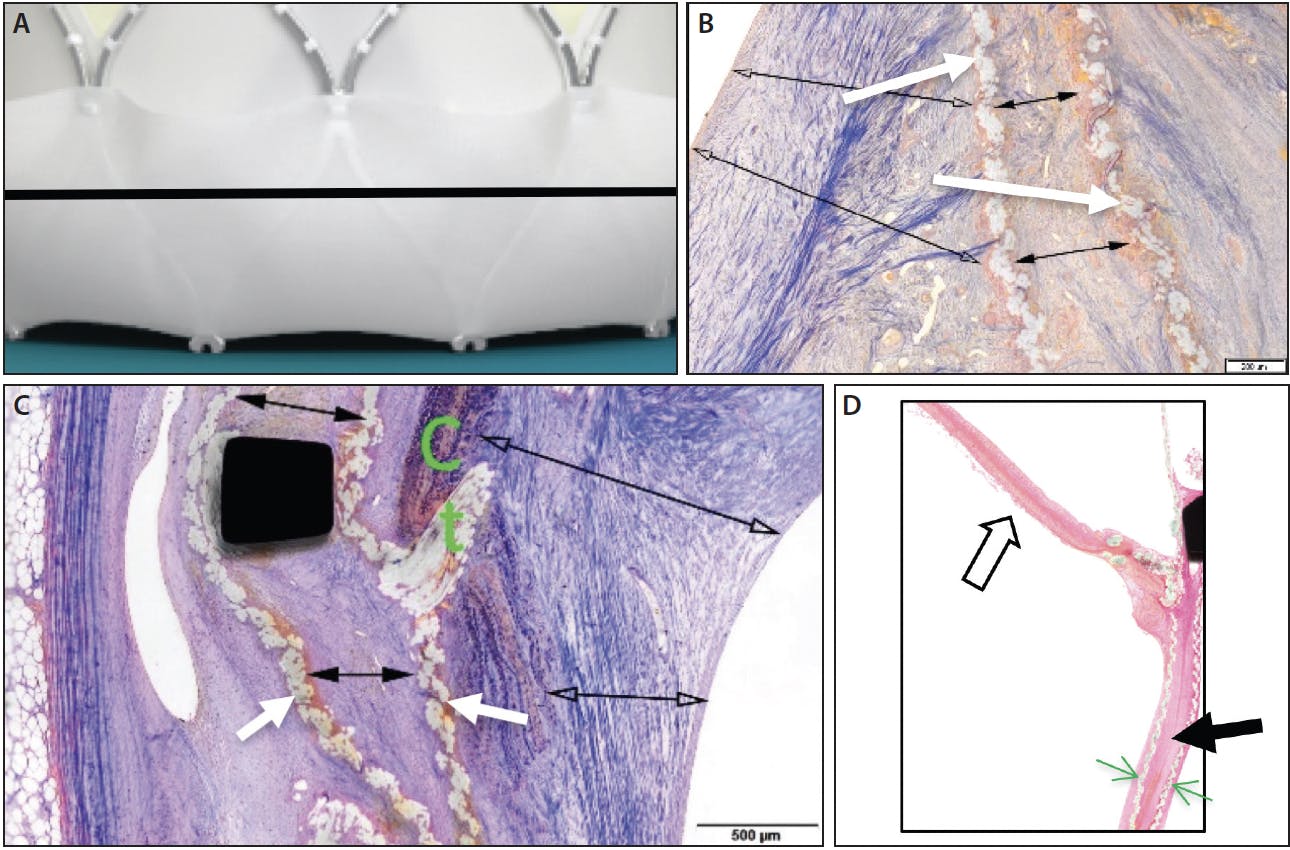
Figure 2. Histopathology sectioning diagram (black line) for cross-section through NaviSeal™ Cuff (A). Magnified short axis valve section (elastin trichrome stain) shows fibrocellular tissue (solid black arrows) and fibrocellular neointima (clear double arrows) between valve cuff fabric layers (solid white arrows) (B, C). C, collagenous bioprosthetic layers; t, tie securing the collagenous layer to the fabric layer. Magnified long axis valve section (hematoxylin & eosin stain) shows fibrocellular tissue (solid black arrow) between fabric layers (green arrows). The valve cusp is shown in the long-axis view (white arrow) (D).
Based on the results of the chronic preclinical testing, the NaviSeal™ Cuff is expected to demonstrate a normal healing response.
The Navitor™ Valve Uses NaviSeal™ Cuff to Achieve Active PVL Reduction Synchronized to the Cardiac Cycle
Engineering advances in active PVL reduction move the field a step closer to the goal of mimicking surgery PVL results.
By Michael J. Reardon, MD
Since the initial successful transcatheter aortic valve implantation (TAVI) procedure in 2002, TAVI has rapidly progressed due to refinements in device technology, as well as to the implantation procedure itself. A series of randomized trials has supported the safety and efficacy of TAVI compared to surgical aortic valve replacement (SAVR). The American Heart Association/American College of Cardiology guidelines no longer have risk as a standalone criterion for TAVI, leading to the use of more TAVI procedures than all surgical aortic procedures combined. The growing dispersion of TAVI is now seeing an increase in the number of younger, low-risk patients who, until recently, were considered only for SAVR. For this trend to continue and be in the best interest of our patients, it is important for TAVI to develop comparable or better outcomes than SAVR for several areas. Mortality, stroke, renal failure, arrhythmia, and more rapid return to improved quality of life have all met this need for TAVI. Durability appears similar in the short- and mid-term, but longer-term data are needed if the acceptable age and life expectancy for TAVI use continue to decrease. Only time will tell us and, fortunately, both randomized intermediate- and low-risk trials will be followed for 10 years and will eventually help shed light on this.
One area in which SAVR has consistently had superior results, and which cardiac surgeons have highlighted, is paravalvular leak (PVL). SAVR allows for removal of the diseased leaflets, debridement of annular and left ventricular outflow tract calcification, and secure sewing or fixation of the valve, thus resulting in only rare PVL. Severe and moderate PVL have been shown to have both a short- and mid-term negative effect on patient outcomes. How severe the PVL must be to have a detrimental outcome is not fully known.
HISTORY OF PVL
PVL is the result of incomplete sealing between the valve and the native aortic tissues. This can relate to an inappropriate size match between the TAVI valve and the aortic root, complex patient anatomy, and valve design. No matter the cause of the PVL, it has been shown that moderate or severe PVL is an independent predictor of mortality.1,2 The moderate or severe PVL rate in the early PARTNER IB trial was 11.8% at 30 days,3 and it was 4.2% at 12 months in the CoreValve Extreme Risk trial.4 Fortunately, the rate of moderate or severe PVL has decreased substantially based on better procedure planning, patient selection, and device iterations. Mild PVL continues to be an issue for TAVI and the focus of intense efforts to eliminate even this level of PVL. These efforts currently fall into three broad categories—mechanical, passive, and active PVL reduction.
MECHANICAL PVL REDUCTION
The early TAVI procedures were often complicated by moderate or greater PVL and poor outcomes.3 These initial procedures were done with two-dimensional (2D) echocardiography sizing of the annulus. The anatomy of the aortic cusps and root limits the ability of 2D echocardiography to give an accurate size for the TAVI valve. The largest diameter bisects a commissure on one side and a cusp on the other. The introduction of three-dimensional (3D) CTA sizing for the self-expanding valve randomized trials led to the understanding that 2D echocardiography sizing was frequently incorrect, resulting in over- or undersizing of the TAVI valve in the initial balloon-expandable valve trials. Oversizing of the annulus can lead to placement of too large a valve and annular injury. Undersizing to a valve that is too small can lead to PVL. The adoption of 3D CTA sizing (or other 3D methods) as a standard has helped limit this mechanical cause of PVL and is currently the recommended method for sizing.5 The use of 3D CTA was initially adopted as the standard in the CoreValve trials and has subsequently been adopted by all current trials as the gold standard for sizing. This has markedly decreased the rate of moderate or severe PVL across the field. However, PVL still remains substantially higher than with SAVR, and further methods of reduction are being sought.
PASSIVE PVL REDUCTION
SAVR has the advantage of removing the diseased leaflets and full debridement of annular and subannular calcium, allowing the valve to sit against a smooth surface. However, TAVI retains the native leaflets with a variable amount of annular and subannular calcification, leading to a potentially very uneven surface for sealing. Some, but not all, of this irregularity can be flattened by the radial force of the implanted TAVI valve. To attempt to fill these gaps, engineers designed the placement of an external material (eg, a skirt or wrap) to sit between the TAVI valve and the sealing zone and hopefully fill the remaining gaps. Currently, all TAVI valves available in the United States, either commercially or in trials, have some external material to attempt to passively mitigate PVL. These materials have ranged from polyethylene terephthalate to pericardium fixed to the outer frame where sealing is intended. The concept was to allow pliable material to be pushed into any remaining spaces to mitigate any remaining PVL. This approach further reduced PVL, but rates remained above those achieved by surgery.
ACTIVE PVL REDUCTION
To become more comparable with SAVR outcomes, engineers have designed ways to achieve an active rather than passive approach to PVL elimination. The Navitor™ valve (Abbott) has adopted this active sealing approach with a material cuff (NaviSeal™; Abbott) that is fixed at the nitinol struts but free in-between the struts. This facilitates the creation of a parachute or windsock effect that allows these areas to fill during diastole and mold to any remaining gaps (Figure 1). If there are no gaps, the material lays flat and conforms to the shape of other gaps, making the valve responsive to the cardiac cycle. Over time and as the healing process takes place, mature fibrocellular neointima develops between the fabric layers, as well as between the cuff and anatomy. Preclinical pathologic analysis showed optimal healing, no adverse calcium or thrombus, and no excessive neointimal growth. The early clinical results with this technology showed that 80% of patients had no or trace PVL.6
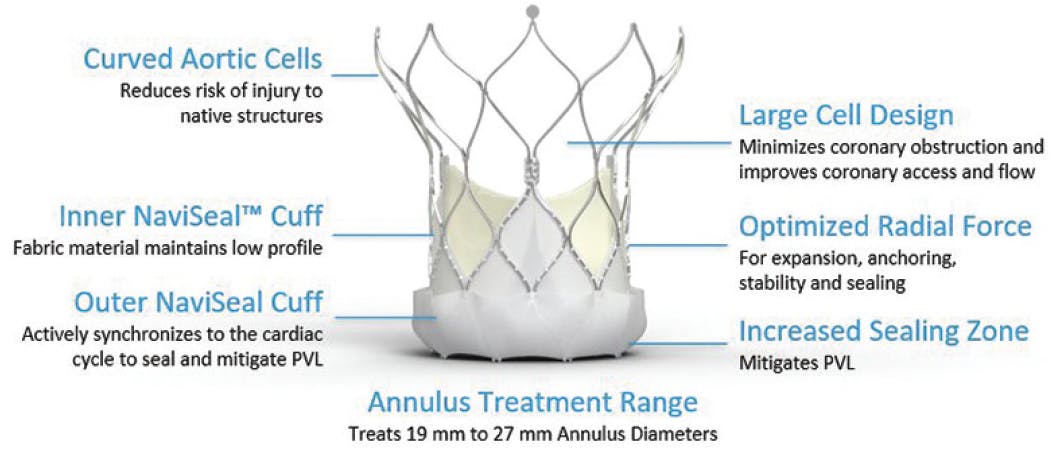
Figure 1. Navitor™ valve with major features labeled. The Navitor valve is indicated for transcatheter delivery in patients with symptomatic severe aortic stenosis who are considered high or extreme surgical risk.
CONCLUSION
The continued expansion of TAVI into the younger, low-risk population demands outcomes comparable to SAVR. Improvements in patient selection, procedural planning, and device iteration have enabled this progress to continue. Any PVL above trace can have a potential longer-term negative impact on patient outcomes and is not competitive with PVL results associated with surgery. This engineering advance in active PVL reduction moves the field a step closer to the goal of mimicking surgical PVL results and data that would support the continued move for TAVI use in the increasingly younger, low-risk patient.
1. Kodali S, Pibarot P, Douglas PS, et al. Paravalvular regurgitation after transcatheter aortic valve replacement with the Edwards Sapien valve in the PARTNER trial: characterizing patients and impact on outcomes. Eur Heart J. 2015;36:449-456. doi: 10.1093/eurheartj/ehu384
2. Gleason TG, Reardon MJ, Popma JJ, et al. 5-year outcomes of self-expanding transcatheter versus surgical aortic valve replacement in high-risk patients. J Am Coll Cardiol. 2018;72:2687-2696. doi: 10.1016/j.jacc.2018.08.2146
3. Makkar RR, Fontana GP, Jilaihawi H, et al. Transcatheter aortic-valve replacement for inoperable severe aortic stenosis. N Engl J Med. 2012;366:1696-1704. doi: 10.1056/NEJMoa1202277
4. Popma JJ, Adams DH, Reardon MJ, et al. Transcatheter aortic valve replacement using a self-expanding bioprosthesis in patients with severe aortic stenosis at extreme risk for surgery. J Am Coll Cardiol. 2014;63:1972-1981. doi: 10.1016/j.jacc.2014.02.556
5. Otto CM, Kumbhani DJ, Alexander KP, et al. 2017 ACC expert consensus decision pathway for transcatheter aortic valve replacement in the management of adults with aortic stenosis: a report of the American College of Cardiology Task Force on clinical expert consensus documents. J Am Coll Cardiol. 2017;69:1313-1346. doi: 10.1016/j.jacc.2016.12.006
6. Navitor Instructions for Use.
Transcatheter Aortic Valve Implantation in a Severely Calcified Aortic Valve Using the Navitor™ THV and FlexNav™ Delivery System
A case example of severe aortic valve and LVOT calcification.
By Xi Wang, MD, and Lars Sondergaard, MD, DMSc
A patient in his late 70s was referred due to severe, symptomatic aortic stenosis (AS). He was previously diagnosed with systemic hypertension, diabetes, and impaired renal function with an estimated glomerular filtration rate of 36 mL/min/1.73 m2. During the last few months, he had experienced increasing exertional dyspnea (New York Heart Association class II).
A transthoracic echocardiogram (TTE) confirmed severe AS with an aortic valve area (AVA) of 0.5 cm2 and a peak/mean transvalvular gradient of 140/92 mm Hg. Multislice CT (MSCT) revealed a tricuspid aortic valve with severe leaflet calcification (calcification quantification: 1,722 mm3) that protruded into the left ventricular outflow tract (LVOT). The aortic annulus perimeter was measured as 78.6 mm (Figure 1A-C). As for the peripheral arteries, there was only mild calcification on both iliofemoral arteries. An electrocardiogram (ECG) showed sinus rhythm without conduction abnormality.
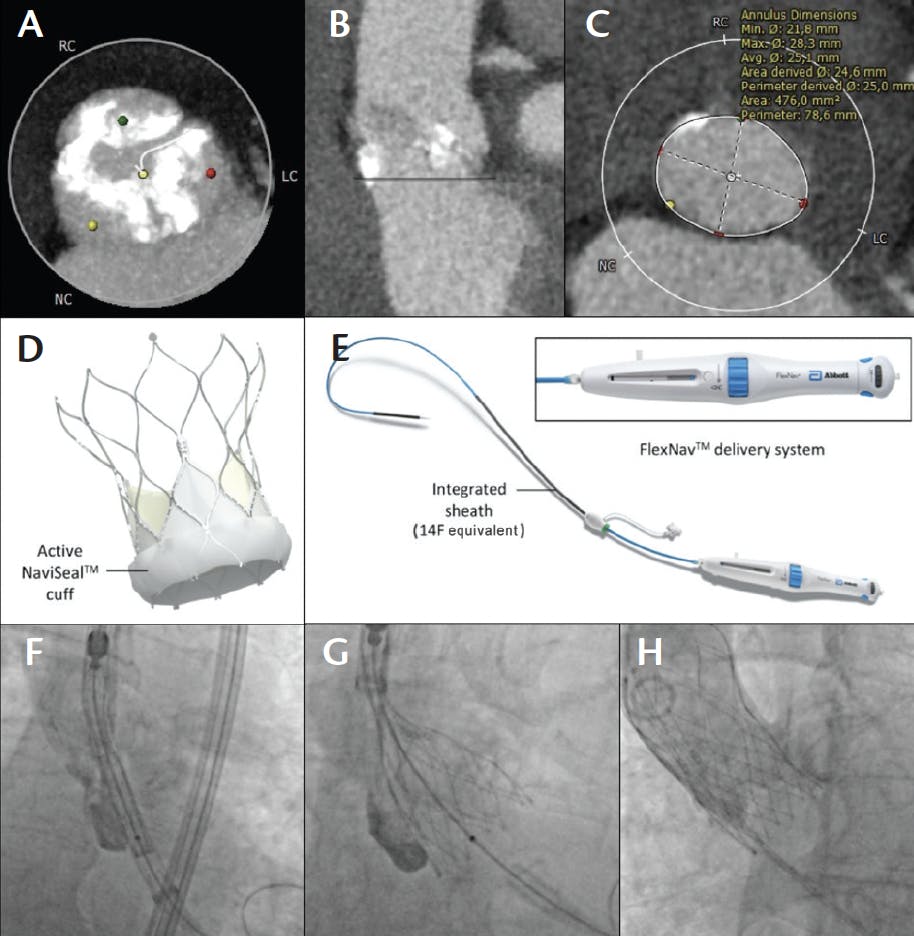
Figure 1. TAVI with Navitor. A tricuspid aortic valve with heavy leaflet and annulus calcification protruding into the LVOT—the annulus perimeter was measured as 78.6 mm (A-C). The design of Navitor™ transcatheter aortic valve with new active outer NaviSeal™ Cuff at the inflow part (D). The FlexNav™ delivery system (E). The Navitor was initially deployed in the cusp overlap view, where both the annulus and the delivery catheter were aligned with the imaging plane (F). An angiogram from a left anterior oblique projection before full release (G). Final position of the Navitor™ valve with trivial paravalvular leak (H).
Considering the patient’s advanced age and comorbidities, transfemoral transcatheter aortic valve implantation (TAVI) with the Navitor™ transcatheter heart valve (THV) and FlexNav™ delivery system (Abbott) (Figure 1D and 1E) was suggested by the heart team and accepted by the patient.
The TAVI procedure was performed under local anesthesia. A 14-F sheath was inserted in the right common femoral artery, and after crossing the aortic valve, predilation with a 22-mm True‡ balloon (BD Interventional) was performed. The sheath was then exchanged for a FlexNav delivery system hosting a 27-mm Navitor THV. The THV was initially deployed in the right coronary cusp (RCC)–left coronary cusp (LCC) overlap view as determined from preprocedural MSCT, which was right anterior oblique (RAO) 19 and caudal 22 (Figure 1F). The position of the Navitor THV remained stable during the entire deployment with no need for pacing. A single angiogram in the left anterior oblique view was obtained to check the THV position at the LCC side before full release (Figure 1G). After THV deployment, postdilation using the 24-mm True‡ balloon was conducted to achieve better THV expansion. The final implantation depth was 4 mm both at the noncoronary cusp (NCC) and LCC side, with trivial paravalvular leak (PVL) observed on angiography (Figure 1H). The femoral access was closed successfully with two ProGlide™ devices (Abbott). Postprocedural ECG showed new-onset first-degree atrioventricular block (AVB) with a PR interval of 238 ms with no other conduction abnormalities; therefore, no temporary pace lead was required.
The patient was transferred directly back to the general ward after the procedure and was discharged the next day. Predischarge TTE demonstrated an AVA of 1.8 cm2, a mean gradient of 7.5 mm Hg, and no PVL. At 1-year follow-up, the patient was asymptomatic and TTE demonstrated an AVA of 2.0 cm2, a mean gradient of 5.4 mm Hg, and no PVL. There was still first-degree AVB on ECG (PR interval: 216 ms).
DISCUSSION
In patients with severe calcification of the aortic valve and LVOT, TAVI is associated with increased risk of PVL, annulus rupture, and conduction abnormalities. Both leaflet and LVOT calcification may lead to THV underexpansion and significant PVL. Compared to the earlier-generation Portico™ TAVI system (Abbott), the Navitor™ THV has an active outer NaviSeal™ Cuff to mitigate PVL, as well as an optimized radial force across all THV sizes. As demonstrated in this case, these design improvements have made the Navitor THV suitable for patients with severe calcification of the aortic valve complex. Furthermore, the use of a self-expanding THV system also reduces the risk of annulus rupture in case of severe LVOT calcification.
Nowadays, the cusp overlap technique (COT) has been gaining popularity in the TAVI community to reduce the risk of conduction abnormalities. The C-arm angulation is determined by overlapping the hinge points of the RCC and LCC on preprocedural MSCT images. The advantages of the COT, which is typically a RAO/caudal fluoroscopic projection, include eliminating the parallax of the delivery system, providing maximal elongation of the LVOT, as well as better visualization of the NCC, and thereby allowing for an accurate visualization of the implantation depth with a potentially lower risk of conduction disturbances.1,2
Previous studies have found that LVOT calcification beneath the NCC is a risk factor for conduction abnormalities after TAVI because the THV frame may push calcium toward the membranous septum, under which runs the bundle of His.3 To decrease the risk of conduction disturbances in this situation, the THV should be deployed in a relatively higher position, and avoiding a deep position of the balloon in LVOT if postdilation is needed.
SUMMARY
In this case with severe aortic valve and LVOT calcification, the new Navitor THV and FlexNav™ delivery system provided accurate deployment with favorable hemodynamics and no PVL or other procedure-related complications.
‡ Indicates a third-party trademark, which is property of its respective owner.
1. Ben-Shoshan J, Alosaimi H, Lauzier PT, et al. Double S-curve versus cusp-overlap technique: defining the optimal fluoroscopic projection for TAVR with a self-expanding device. JACC Cardiovasc Interv. 2021;14:185-194. doi: 10.1016/j.jcin.2020.10.033
2. Tang GHL, Zaid S, Michev I, et al. “Cusp-Overlap” view simplifies fluoroscopy-guided implantation of self-expanding valve in transcatheter aortic valve replacement. JACC Cardiovasc Interv. 2018;11:1663-1665. doi: 10.1016/j.jcin.2018.03.018
3. Pollari F, Großmann I, Vogt F, et al. Risk factors for atrioventricular block after transcatheter aortic valve implantation: a single-centre analysis including assessment of aortic calcifications and follow-up. Europace. 2019;21:787-795. doi: 10.1093/europace/euy316
Unilateral Access TAVI in Small Peripheral Anatomy: Performance of the Navitor™ FlexNav Delivery System
A case study demonstrating the feasibility of unilateral access TAVI with the 15 F equivalent Navitor™ system in a patient with small-caliber peripheral arteries.
By Rutger-Jan Nuis, MD, PhD, and Nicolas Van Mieghem, MD, PhD
A patient in his mid 70s was admitted because of decompensated heart failure with a reduced ejection fraction and severe aortic valve stenosis. The patient’s clinical history revealed atrial fibrillation, type 2 diabetes, and chronic renal failure. Electrocardiography demonstrated a normal sinus rhythm with an incomplete left bundle branch block. Cardiac ultrasound showed an ejection fraction of 45% and severe aortic stenosis with a peak velocity of 4 m/s, an aortic valve area of 0.62 cm2, and a velocity time index ratio of 0.23. There was no aortic regurgitation. Multislice CT revealed a stent graft with mild in-stent stenosis in the right iliac artery. The left iliofemoral tract showed minimal disease but small luminal dimensions (6 mm). CT interrogation of the aortic valve demonstrated a tricuspid valve morphology with anatomic dimensions suitable for implantation of a Navitor™ bioprosthesis (Abbott).
Geriatric assessment revealed mild cognitive disorder and frailty; the Society of Thoracic Surgeons risk score was 2.8%. The patient was motivated for valve replacement therapy but was deemed by heart team consensus to be inoperable because of frailty (remitting hypoglycemic unawareness, severe sarcopenia, immobilization because of NYHA class III-IV symptoms secondary to deconditioning and aortic stenosis, and cognitive dysfunction [MMSE 14/30]). The patient was accepted for transcatheter aortic valve implantation (TAVI) using a 27-mm Navitor™ valve with the new FlexNav™ delivery system (Abbott) via unilateral left femoral approach.
PROCEDURAL OVERVIEW
The patient was transferred to the Erasmus Medical Center for elective TAVI under local anesthesia. Using real-time ultrasound visualization of the left iliofemoral tract, arterial access (15 F) in the common femoral artery (CFA) was achieved proximal to the bifurcation and distal to the origin of the inferior epigastric artery. A second arterial access (6 F) was achieved in the ipsilateral superficial femoral artery (SFA; 3 cm distal to the 15-F arteriotomy). Right radial access was used for cerebral embolic protection device placement in the brachiocephalic trunk and left carotid artery. Under left ventricular guidewire-driven rapid pacing, balloon aortic valvuloplasty using a 21-mm True balloon (BD Interventional) was performed. Subsequent advancement of the FlexNav™ delivery system through the small-caliber iliofemoral tract alongside the pigtail catheter went smoothly and without interruption (Figure 1). Deployment of a 27-mm Navitor™ valve was successful on the first attempt and positioned at 2- and 4-mm depth relative to the non and left coronary cusp, respectively (Figure 2). There was complete resolution of the transvalvular gradient and no residual regurgitation or new conduction abnormality. The 15-F arteriotomy was closed with an 18-F, plug-based closure device (Manta, Teleflex; Figure 1C); hemostasis at the 6-F arteriotomy site was achieved with a vascular suture device (Perclose™ ProStyle™, Abbott). The patient was discharged 4 days later without serious complications during his stay.
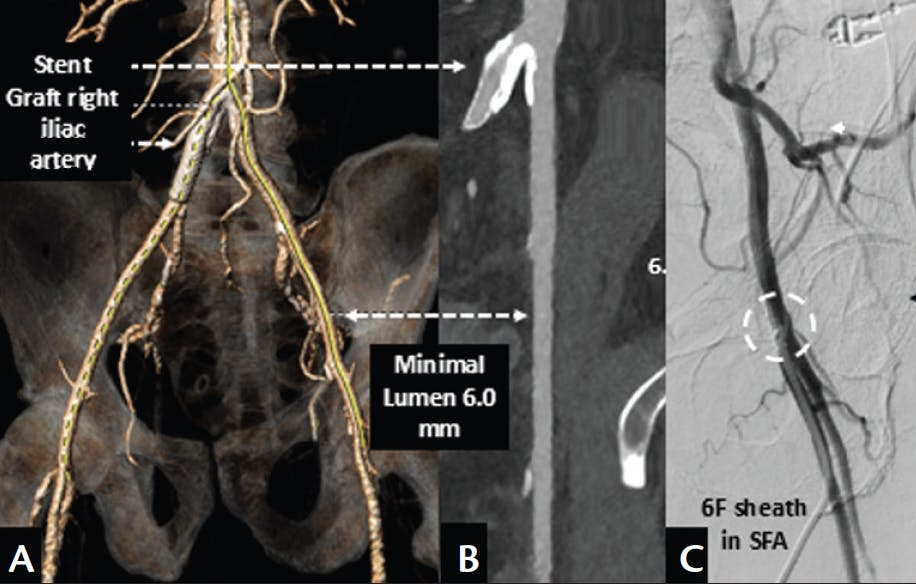
Figure 1. Multislice CT images of the iliofemoral tract demonstrated a stent graft in the right iliac artery (A) and minimal disease but small luminal dimensions (6 mm) in the left iliac artery (B). Digital subtraction imaging demonstrated hemostasis and vessel patency at the 15-F arteriotomy site after plug-based closure with an 18-F Manta vascular closure device (dotted circle, C).
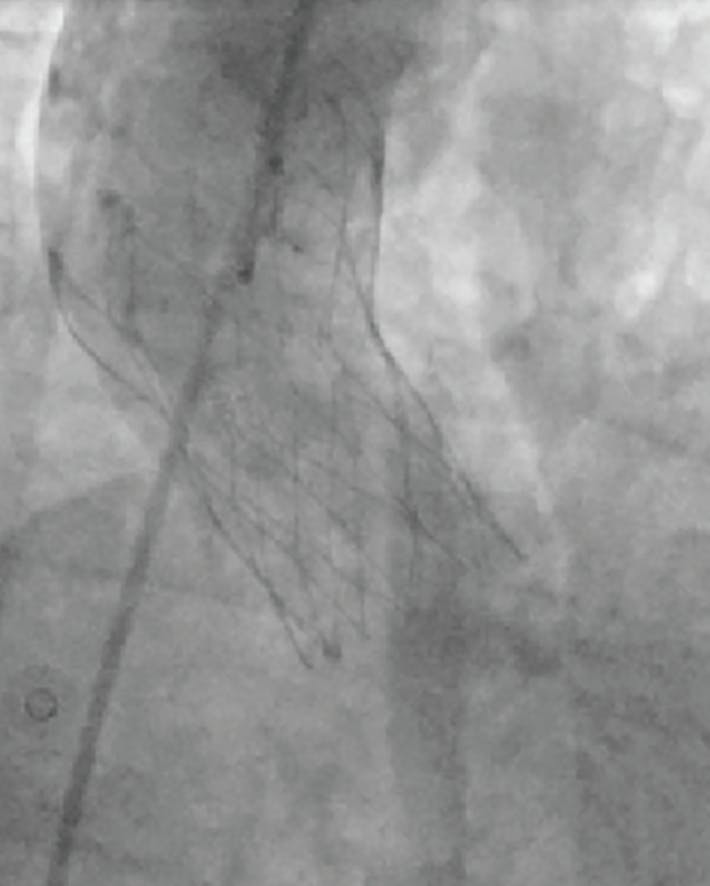
Figure 2. Aortic angiographic image demonstrating correct positioning of a 27-mm Navitor™ valve without residual regurgitation.
DISCUSSION
The Navitor™ TAVI system is a novel transcatheter heart valve technology featuring advancements in valve performance and delivery. The FlexNav™ delivery system is a low-profile, 14-F equivalent (for 23- and 25-mm valves) or 15-F equivalent (for 27- and 29-mm valves) system compatible with vessel dimensions of > 5 mm for the 14-F equivalent and > 5.5 mm for the 15-F equivalent delivery system. Our case illustrates the feasibility of unilateral access TAVI in a small-caliber (6 mm) femoral vessel. Unilateral access TAVI entails the use of two arterial access sites at the ipsilateral CFA (valve delivery catheter) and SFA (pigtail catheter), which has the advantage of a more accessible approach for managing access site–related complications in addition to better patient satisfaction.1 However, small arterial anatomy often hinders the advancement of both a TAVI delivery system and a 6-F pigtail catheter in the unilateral iliofemoral tract. In our case, we experienced very smooth deliverability of a 27-mm Navitor™ valve in parallel to a 6-F pigtail catheter through a very small-caliber iliofemoral tract, which demonstrates a key advantage of the low-profile FlexNav™ delivery system with integrated sheath and hydrophilic coating.
CONCLUSION
The novel Navitor™ TAVI system with its redesigned FlexNav™ delivery system significantly advances valve deliverability, which will benefit TAVI outcomes, especially in patients with challenging peripheral anatomies.
MAT-2213042 v2.0 I Item approved for U.S. use only.
1. Khubber S, Bazarbashi N, Mohananey D, et al. Unilateral access is safe and facilitates peripheral bailout during transfemoral-approach transcatheter aortic valve replacement. JACC Cardiovasc Interv. 2019;12:2210-2220. doi: 10.1016/j.jcin.2019.06.050
IMPORTANT SAFETY INFORMATION
NAVITOR™ TRANSCATHETER
AORTIC VALVE IMPLANTATION SYSTEM
Indications
The Navitor™ Transcatheter Aortic Valve Implantation System is indicated for relief of aortic stenosis in patients with symptomatic heart disease due to severe native calcific aortic stenosis who are judged by a heart team, including a cardiac surgeon, to be high or greater risk for open surgical therapy (i.e., predicted risk of surgical mortality ≥ 8% at 30 days, based on the Society of Thoracic Surgeons (STS) risk score and other clinical comorbidities unmeasured by the STS risk calculator).
Contraindications
The valve is contraindicated for patients with inability to tolerate antiplatelet/anticoagulant therapy or nitinol alloy (nickel and titanium), or who have active infections, including endocarditis.
Potential Adverse Events
Adverse events potentially associated with the use of transcatheter bioprosthetic heart valves include but are not limited to: access site complications (e.g., pain, bleeding, infection, hematoma, pseudoaneurysm, etc.); acute coronary obstruction; acute myocardial infarction; allergic reaction to antiplatelet agents, contrast medium, or valve components; aortic rupture; ascending aorta trauma; atrio-ventricular node block; cardiac arrhythmias; conduction system injury; conversion to open surgical procedure; death; dissection; embolism; emergent balloon valvuloplasty; emergent percutaneous coronary intervention (PCI); emergent surgery (i.e., coronary artery bypass, heart valve replacement); endocarditis; explantation; heart failure; hemodynamic compromise; hemolysis; hemolytic anemia; hemorrhage; hypotension or hypertension; infection; myocardial ischemia; mitral valve insufficiency; multi-organ failure; non-structural dysfunction (i.e., entrapment by pannus, paravalvular leak, inappropriate sizing or positioning); pannus; pericardial effusion; perforation of the myocardium, ventricle, or a blood vessel; permanent disability; permanent pacemaker; regurgitation; renal insufficiency or renal failure; reoperation; respiratory failure; sepsis; stroke; structural deterioration (i.e., calcification, leaflet tear); thrombosis; tamponade; transfusion; valve embolization or migration; vessel dissection or spasm.
CAUTION: This product is intended for use by or under the direction of a physician. Prior to use, reference the Instructions for Use provided inside the product carton (when available) or at eifu.abbottvascular.com or at medical.abbott/manuals for more detailed information on Indications, Contraindications, Warnings, Precautions and Adverse Events.
Illustrations are artist’s representations only and should not be considered as engineering drawings or photographs.
Abbott
3200 Lakeside Dr., Santa Clara, CA 95054 USA, Tel: 1.800.227.9902
www.structuralheart.abbott
™ Indicates a trademark of the Abbott group of companies.
©2023 Abbott. All rights reserved. MAT-2213042 v2.0 | Item approved for U.S. use only.
Advertisement
Advertisement