Advertisement
Advertisement

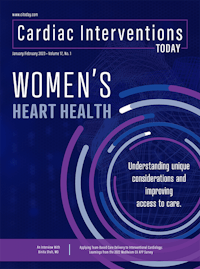
Although awareness of women’s cardiovascular health has improved in the last decade, only 56% of women are aware that heart disease remains the leading cause of death worldwide.1 Unfortunately, to date, the scientific community hasn’t adequately addressed gaps in knowledge that directly impact management and outcomes of women presenting with different cardiovascular illnesses. The Lancet Women and Cardiovascular Disease Commission reported that cardiovascular diseases in women continue to be understudied, underdiagnosed, and hence undertreated.2 The objective of this special edition of Cardiac Interventions Today is to explore the body of evidence of cardiovascular diseases and procedures ranging from peripheral vascular, structural heart, and coronary artery disease.
We begin our coverage of Women’s Heart Health with Tara L. Jones, MD, and Valeria Paradies, MD, who review the current data and female representation in clinical trials evaluating left main coronary artery disease and bifurcation lesion revascularization.
Next, Lina Ya’Qoub, MD; Nadeen N. Faza, MD; Islam Y. Elgendy, MD; and Vaikom S. Mahadevan, MD, highlight the current data and future directions of transcatheter structural heart disease interventions by focusing on sex-specific differences in patients undergoing transcatheter aortic valve replacement, transcatheter edge-to-edge repair, and left atrial appendage occlusion.
Mansi Oberoi, MD; M. Chadi Alraies, MD; and Poonam Velagapudi, MD, focus on STEMI care and shock in female patients in a review of measures to adopt for advancement of primary and secondary prevention strategies that directly target women.
We then turn our focus to renal denervation and enlist the help of Zainab Dakhil, MD, and Sara Al Raisi, MD, who shed some light on the question of whether there is a sex-related difference in response to renal denervation. Ashwini Kerkar, MD; Stephane Manzo-Silberman, MD; Nadia R. Sutton, MD; and Shrilla Banerjee, MD, help us recognize nonatherosclerotic cardiovascular diseases in women, specifically focusing on myocardial infarction with nonobstructive coronary arteries, spontaneous coronary artery dissection, and microvascular dysfunction.
F. Aaysha Cader, MD; Rudaynah Amein Alali, MD; and Mirvat Alasnag, MD, consider whether there is a sex difference with regard to coronary imaging (CT, OCT, IVUS, and NIRS) when it comes to plaque volume and consistency. We end our cover focus on Women’s Heart Health with a discussion on clinical trial equity. Nicola Ryan, MB, and Vinoda Sharma, FRCP, tell us how a multipronged approach is required to improve gender inclusivity in clinical trials and increase female representation in academia and senior clinical roles.
In our Today’s Practice department, Ginger Biesbrock, DSC, shares about the 2022 MedAxiom Cardiovascular Advanced Practice Provider Compensation and Utilization Report, which shows how a team-based care model that incorporates advanced practice providers ensures superior use of physician time and a program’s patient capacity. We wrap this issue by interviewing Binita Shah, MD, who discusses the benefit of colchicine in cardiovascular disease; the role of diet after coronary intervention; diversity, equity, and inclusion efforts in interventional cardiology, and more.
Women undergoing structural interventions tend to be older with a higher Society of Thoracic Surgeons score. They also have higher bleeding/vascular complication and minor stroke rates; however, their overall 1-year survival is better, suggesting we should refine our access management risk stratification for cerebrovascular events in women. With regard to coronary artery disease, women with an ST-segment elevation myocardial infarction often present late, have more comorbidities, and are less likely to undergo early revascularization or receive mechanical circulatory support. Centers should adopt pathways that streamline access to primary revascularization and advanced therapies. Although women undergoing revascularization (surgical or percutaneous) experience higher rates of complication, recurrent myocardial infarctions (MIs), and repeat revascularization, complete revascularization should remain a central goal for left main and multivessel disease. Adequate risk stratification using intracoronary imaging and physiology is necessary and is key in the management of ischemia and/or MI in nonobstructive coronary artery disease.
Finally, similar to studies on the management of coronary disease, randomized trials for peripheral vascular disease care, including renal vascular procedures, have been fraught by enrollment of heterogeneous populations with small numbers of women, making it difficult to capture their response to procedures such as renal denervation. Overall, this edition on women’s cardiovascular health provides a roadmap for the interventional community moving forward. Perhaps in the coming years, we can register tangible updates to our care plans and generate sex-specific outcome data for the different interventional procedures currently offered to our patients.
Guest Chief Medical Editor
Mirvat Alasnag, MD, FACP, FACC, FSCAI, FSCCT
1. Mosca L, Hammond G, Mochari-Greenberger H, et al; American Heart Association Cardiovascular Disease and Stroke in Women and Special Populations Committee of the Council on Clinical Cardiology, Council on Epidemiology and Prevention, Council on Cardiovascular Nursing, Council on High Blood Pressure Research, and Council on Nutrition, Physical Activity and Metabolism. Fifteen-year trends in awareness of heart disease in women: results of a 2012 American Heart Association national survey. Circulation. 2013;127:1254-63, e1-29. doi: 10.1161/CIR.0b013e318287cf2f
2. Vogel B, Acevedo M, Appelman Y, et al. The Lancet women and cardiovascular disease commission: reducing the global burden by 2030. Lancet. 2021;397:2385-2438. doi: 10.1016/S0140-6736(21)00684-X
Advertisement
Advertisement