Advertisement
Advertisement
2023 Digital Exclusive No. 1
Essential Strategies to Optimizing Radiation Safety Training for Fellows and Cath Lab Staff
A guide to radiation safety terminology, best practices, and tips for training new members of the cardiac cath lab.
The occupational hazards of interventional cardiology are well described, with ionizing radiation posing a health risk to medical personnel in the catheterization lab. Although improvements in protocols and equipment over the years have reduced operator exposure, radiation safety remains a central concern and core tenet of training for all cath lab staff members. This article outlines key aspects of radiation safety training, emphasizing strategies to reduce exposure and promote a safe environment for patients and providers alike.
FUNDAMENTALS OF RADIATION SAFETY
Radiation exposure has been linked to a variety of diseases including brain tumors, cataracts, hematologic malignancy, skin injury, thyroid disease, reproductive injury, and cardiovascular abnormalities. Radiation-associated adverse outcomes can be categorized as either deterministic or stochastic events. A deterministic event requires a specific level of radiation exposure before it occurs, known as a threshold (eg, radiation skin injury). Stochastic effects, on the other hand, have no known threshold. The probability of a stochastic event increases with the dose received. Radiation-related malignancy is a stochastic event.
To understand and minimize such risks, a thorough grasp of radiation terminology is essential. Trainees should become familiar with pertinent definitions before rotating through the cath lab; many hospitals provide online training modules to introduce fundamental vocabulary. Dose exposure is a particularly important concept for trainees and is typically described in the following terms:
- Air kerma (kinetic energy released in matter, Gy). X-ray energy delivered to the air, measured 15 cm from the isocenter (the point at which the primary x-ray beam intersects with the rotational axis of the C-arm gantry).
- Dose-area product (DAP, Gy*cm2). Cumulative sum of the instantaneous air kerma and the x-ray field area.
- Effective dose (mSv). Whole-body dose, independent of where the radiation is delivered.
- Fluoroscopic time (min). The time during a procedure that fluoroscopy is used; notably, this does not include cine acquisition imaging and therefore underestimates the total radiation dose received.
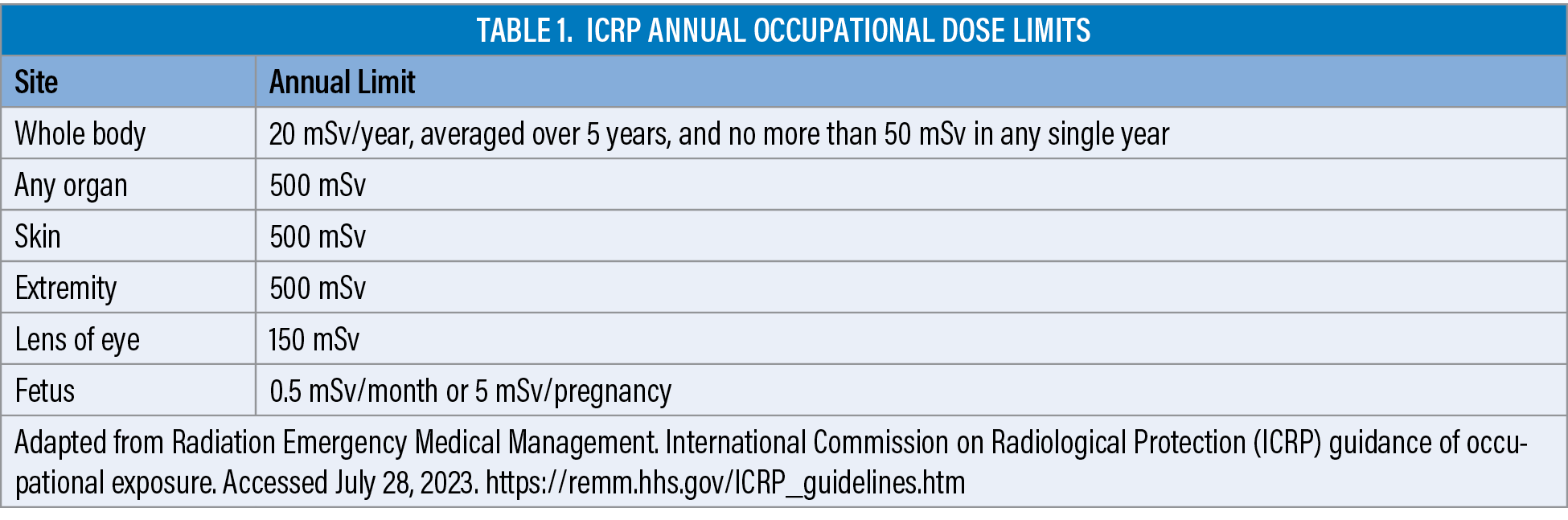
Patient exposure is reflected by air kerma and DAP. Air kerma has been linked to deterministic effects, including skin injury, hair loss, and eye lens injury, whereas DAP has been associated with stochastic effects.1 The effective dose is useful for comparisons among exposed individuals and can be estimated by multiplying the DAP by a coefficient, depending on the irradiated portion of the body.2 Annual occupational dose limits are established for whole-body exposure and organ-specific exposure by the International Commission on Radiological Protection (ICRP) and Nuclear Regulatory Commission (NRC) (Table 1).
SAFE: Key Principles of Radiation Safety
Step back. The intensity of radiation is inversely proportional to the square of the distance. Stepping back from the table can significantly reduce radiation exposure to the operator.
Adhere to ALARA. Focus on keeping radiation “as low as reasonably achievable” in every procedure.
Fluoroscopy over cine. Minimize the use of cine, which generates significantly higher radiation than fluoroscopy. Fluoro-save when possible.
Employ a team-based approach. All cath lab personnel should actively monitor radiation exposure during the procedure, feel empowered to speak up to promote safe behaviors, participate in quality assurance reviews, and participate in continuing education.
GENERAL PRINCIPLES TO REDUCE RADIATION
Promoting radiation safety requires a team-based approach and is rooted in the well-known “as low as reasonably achievable” (ALARA) principle.3 Studies have shown that trainees who feel their attendings adhere to ALARA strategies are more likely to practice ALARA themselves, highlighting the importance of modeling safe behaviors.4
What steps can be taken to ensure radiation exposure is minimized and the level of protection maximized? Each facet of the cath lab, from design to equipment to operator technique, has a critical role.
Cath Lab Configuration and Equipment
Prior to the start of any procedure, the position of the patient and equipment should be optimized to minimize radiation (Figure 1). This can be achieved through a stepwise approach, as outlined below. Early in the academic year, the operator should not only model these behaviors but articulate them for new trainees. These steps are not intuitive to newcomers in the cath lab, who should be assumed to have minimal, if any, prior knowledge of radiation safety.
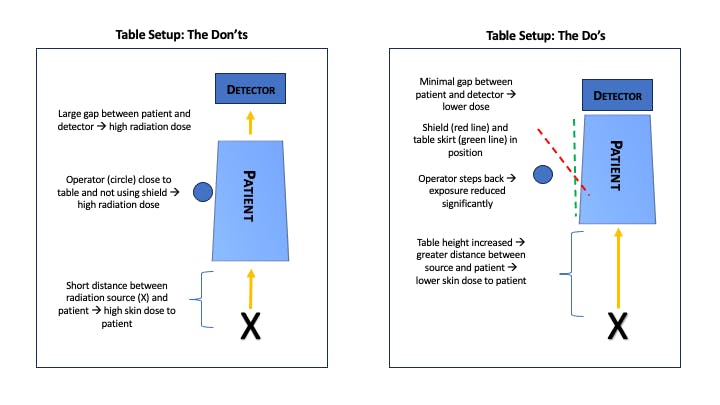
Figure 1. Basic principles of table setup to minimize radiation dose.
- Evaluate the table and the image receptor. The table should be raised to the maximum workable height to decrease the patient skin dose, and the detector should be lowered as close to the patient as possible to reduce scatter radiation and optimize image quality.
- Position shields appropriately. The ceiling-suspended shield should be placed between the patient and operator, with adjustment throughout the case as needed. The position of table-suspended drapes should be confirmed. Supplemental rolling leaded shields should be positioned as needed to protect staff.
- Verify appropriate personal protective equipment (PPE) for all team members prior to enabling fluoroscopy. Radiation-specific PPE includes lead aprons, thyroid shields, and leaded eyeglasses with side panels. Importantly, lead aprons must be properly stored to maintain protective effect. Folding or dropping the apron may result in structural damage, conferring a loss of protection.
- Check x-ray settings. Utilize a fluoroscopy rate of 7.5 frames per second rather than the standard 15 frames per second whenever possible. This simple modification can yield a substantial decrease in radiation exposure.
In addition to the standard PPE described above, novel equipment has emerged to enhance protection without increasing the orthopedic burden on the operator. Sterile, disposable protective pads (such as RadPad, Worldwide Innovations & Technologies, Inc) are now widely available and efficacious. The pad is placed on the patient between the image intensifier and the operator, reducing scatter radiation received by the operator. In a double-blind, sham-controlled trial comparing RadPad, standard protection (no pad), or a sham pad during 766 consecutive coronary procedures, RadPad was associated with a 20% reduction in relative operator exposure versus standard protection (P = .01) and 44% relative exposure reduction versus the sham pad (P = .001).5 Use of the RadPad should not be viewed as a substitute for standard behavioral modifications to minimize radiation dose but rather as a complement.
Many other complementary technologies are available, including systems that can attach directly to existing cath lab gantry for enhanced protection. The Radiaction System (Radiaction Ltd.), for example, connects to the C-arm and provides a dynamic barrier from scatter radiation. In a real-world first-in-human study, mean radiation was significantly reduced at all sensor locations.6 Another compelling option is the EggNest Radiation Protection System (Egg Medical), consisting of a platform with modular shielding components that reduce scatter without compromising C-arm mobility or image quality.7
Additional devices have been designed to offer enhanced protection while obviating the need to don heavy lead aprons. The Zero-Gravity system (Biotronik) is a suspended radiation-protection apparatus that provides shielding from the top of the operator’s head to the feet. It has been shown to significantly reduce radiation to the upper body while simultaneously reducing risk of orthopedic injury.8 Rampart M1128 (Rampart ic) is a portable shielding system offering full-body protection, such that operators behind the shield do not need to wear any lead. The height and orientation of the shielding panels can be readily adjusted to accommodate various access sites, patient sizes, and operator heights. With proper positioning, Rampart may reduce radiation to the primary operator by approximately 60%.9 In a similar vein, Protego (Image Diagnostics) functions as a protective wall between the source and the operator. Personnel appropriately positioned behind the wall can practice without wearing lead. In a single-center study comparing radiation exposure to operators using standard techniques versus the Protego system, the operators in the Protego cohort received significantly lower radiation. Remarkably, zero radiation exposure was recorded in 68% of cases with the Protego system.10
Operator Behavior
Once appropriate setup is ensured, the operator and staff must remain conscientious of radiation throughout the procedure. The operator should consider the following strategies, with clear communication to the trainee regarding how each modification impacts exposure.
- Judicious use of fluoroscopy and cineangiography. Employ radiation only when necessary. When introducing new fellows to the cath lab, teach the trainee to step on the pedal only when actively looking at and reacting to the image. Employ fluoro-save over cineangiography as much as possible; fluoroscopy generates about one-fifth the exposure of cine.
- Minimize steep angulation. Scatter increases when the angle of the tube is set obliquely. Avoidance of left anterior oblique (LAO) and steep cranial or caudal angles can significantly reduce exposure. In highly oblique projections, the photons must travel through a thicker section of the patient’s body. Consequently, fluoroscopic exposure parameters are increased to maintain image quality. The LAO cranial view is particularly radiation-intensive due to the proximity of the x-ray source to the operator, higher air kerma values required for image generation, and high amount of scatter.
- Change the beam angle. During percutaneous coronary intervention (PCI), avoid working in the same view for > 30 minutes to limit exposure to any specific area of skin.
- Monitor the distance of the image receptor from the patient. Each time the C-arm is repositioned, confirm that the image receptor is placed as close to the patient as possible.
- Be mindful of metallic objects in the field. In patients with metal implants, select views that keep these objects out of the field when possible. Similarly, ensure that any jewelry around the neck and upper torso has been removed. In doing so, the dose required to attain appropriate contrast between objects in the frame will be minimized.
- Use adjunctive imaging. During PCI, employ intravascular ultrasound (IVUS) or optical coherence tomography (OCT) to limit fluoroscopy for stent optimization. One consideration with OCT is the need for cineangiography during the imaging run, whereas the IVUS pullback can be performed without (or with minimal) radiation. In structural interventions, incorporate transesophageal echocardiography or intracardiac ultrasound to minimize fluoroscopy as practical.
- Avoid magnification. The image receptor’s dose requirements increase with zoom, such that high magnification should only be employed when necessary.
- Step back. According to the inverse square law, the intensity of radiation is inversely proportional to the square of the distance. For example, doubling distance from the source reduces the intensity of radiation by a factor of four. Therefore, even a single step back from the table—especially during cineangiography—substantially reduces exposure, particularly during lengthy procedures.
Monitoring
The radiation dose should be monitored in real time throughout the procedure. Staff should alert the operator to substantial radiation exposure, after which the operator should consider concluding the procedure when safely possible and staging further interventions. In addition to real-time monitoring, all personnel in the cath lab must wear personal dose monitors. Furthermore, quality assurance programs should be in place to track patient and personnel doses, review high-radiation events, and review practices of staff with high exposures.
TRAINING
Radiation training is essential for all team members in the cath lab and as part of continuing medical education. Studies have identified considerable gaps in radiation safety knowledge among attending interventional cardiologists, drawing attention to the importance of ongoing education beyond fellowship. In one online survey of interventional cardiologists, < 50% knew which view was associated with the highest radiation.11 Such statistics can be improved by formal educational programs; dedicated training has been clearly shown to increase operator awareness and reduce overall exposure. In addition to didactics, some institutions offer simulator training to model changes in radiation exposure with various behaviors.12 Such novel techniques may help trainees visualize the otherwise intangible risks of radiation.
Supplementary to institution-based education, numerous educational resources are available online. Below is a sampling of resources covering wide-ranging topics, from basic radiation terminology to practical tips for safety in the cath lab.
- “2018 ACC/HRS/NASCI/SCAI/SCCT Expert Consensus Document on Optimal Use of Ionizing Radiation in Cardiovascular Imaging: Best Practices for Safety and Effectiveness”13: a comprehensive discussion of radiation risks, measurements, and practices for a safe environment
- “SCAI Consensus Document on Occupational Radiation Exposure to the Pregnant Cardiologist and Technical Personnel”14: a detailed resource on occupational safety in pregnancy
- The United States Nuclear Regulatory Commission (www.nrc.gov): a wealth of information for radiation workers, including radiation basics, dose limits, and protective strategies
- Radiation Safety Training from Women as One (www.rad.womenasone.org): an interactive, web-based, four-part radiation safety training course
CONCLUSION
Radiation safety training is not a one-time event but rather a continuous process, with regular reinforcement required across all stages of one’s career. Efforts to minimize radiation should begin before fluoroscopy is enabled and continue actively throughout each procedure, with collaboration between all members of the cath lab team.
1. Christopoulos G, Makke L, Christakopoulos G, et al. Optimizing radiation safety in the cardiac catheterization laboratory: a practical approach. Catheter Cardiovasc Interv. 2016;87:291-301. doi: 10.1002/ccd.25959
2. Abbott JD. Controlling radiation exposure in interventional cardiology. Circ Cardiovasc Interv. 2014;7:425-428. doi: 10.1161/CIRCINTERVENTIONS.114.001815
3. American College of Cardiology. Kumar G, Rab ST. Radiation safety for the interventional cardiologist – a practical approach to protecting ourselves from the dangers of ionizing radiation. Accessed July 28, 2023. https://www.acc.org/latest-in-cardiology/articles/2015/12/31/10/12/radiation-safety-for-the-interventional-cardiologist
4. Bordoli SJ, Carsten CG 3rd, Cull DL, et al. Radiation safety education in vascular surgery training. J Vasc Surg. 2014;59:860-864. doi: 10.1016/j.jvs.2013.10.085
5. Vlastra W, Delewi R, Sjauw KD, et al. Efficacy of the RADPAD protection drape in reducing operators' radiation exposure in the catheterization laboratory: a sham-controlled randomized trial. Circ Cardiovasc Interv. 2017;10:e006058. doi: 10.1161/CIRCINTERVENTIONS.117.006058
6. Laish-Farkash A, Harari E, Finkelstein A, et al. A novel robotic radiation shielding device for interventional cardiology procedures. EuroIntervention. 2022;18:262-266. doi: 10.4244/EIJ-D-21-00577
7. Wilson RF, Gainor JP, Valeti US, et al. A new device to markedly reduce cardiac cath lab radiation levels. Presented at: Transcatheter Cardiovascular Therapeutics (TCT); September 21-25, 2018; San Diego, California.
8. Zanca F, Dabin J, Collard C, et al. Evaluation of a suspended radiation protection system to reduce operator exposure in cardiology interventional procedures. Catheter Cardiovasc Interv. 2021;98:E687-E694. doi: 10.1002/ccd.29894
9. Scott H, Gallagher S, Abbott W, Talboys M. Assessment of occupational dose reduction with the use of a floor mounted mobile lead radiation protection shield. J Radiol Prot. 2022;42. doi: 10.1088/1361-6498/ac8203
10. Rizik D, Riley R, Burke R, et al. Comprehensive radiation shield minimizes operator radiation exposure and obviates need for lead aprons. J Soc Cardiovasc Angiogr Interv. 2023;2:100603. doi: 0.1016/j.jscai.2023.100603
11. Uthirapathy I, Dorairaj P, Ravi S, et al. Knowledge and practice of radiation safety in the catheterization laboratory among interventional cardiologists - an online survey. Indian Heart J. 2022;74:420-423. doi: 10.1016/j.ihj.2022.08.001
12. Katz A, Shtub A, Solomonica A, et al. Simulator training to minimize ionizing radiation exposure in the catheterization laboratory. Int J Cardiovasc Imaging. 2017;33:303-310. doi: 10.1007/s10554-016-1009-7
13. Hirshfeld JW Jr, Ferrari VA, Bengel FM, et al. 2018 ACC/HRS/NASCI/SCAI/SCCT expert consensus document on optimal use of ionizing radiation in cardiovascular imaging: best practices for safety and effectiveness: a report of the American College of Cardiology Task Force on Expert Consensus Decision Pathways. J Am Coll Cardiol. 2018;71:e283-e351. doi: 10.1016/j.jacc.2018.02.016
14. Best PJ, Skelding KA, Mehran R, et al; Society for Cardiovascular Angiography & Interventions’ Women in Innovations (WIN) group. SCAI consensus document on occupational radiation exposure to the pregnant cardiologist and technical personnel. Catheter Cardiovasc Interv. 2011;77:232-241. doi: 10.1002/ccd.22877
Advertisement
Advertisement
Latest Digital Exclusives