Advertisement
Advertisement
September/October 2022
A Decade in Review: Cardiology and Interventional Cardiology Trends
The 10th annual MedAxiom Cardiovascular Provider Compensation and Production Report reveals year-over-year comparisons and decade trends.
This year marks the 10th anniversary of MedAxiom’s Cardiovascular Provider Compensation and Production Survey Report, which has become the gold standard for the industry. This annual survey is based on the voluntary responses from hundreds of MedAxiom member organizations, representing thousands of cardiology providers. Given the significant publishing milestone, the 2022 report features a special section on 10-year trends that provides an interesting look back at how the cardiovascular specialty has weathered challenges such as hospital integration, regulatory changes, and a global pandemic. This article highlights some of the more prominent changes that have occurred over the last decade, both within cardiology generally and for the interventional subspecialty.
GENERAL CARDIOLOGY TRENDS
The most dramatic development over the last decade has been the change in cardiology ownership models. In the first year of the survey’s publication, there was a nearly equal ownership split between private cardiology programs and those integrated with a hospital or health system (collectively referred to as “integrated”), with a slight majority (52%) found in private practices. Each year since, the ownership chasm has widened, with the 2022 survey reporting nearly nine out of 10 programs (89%) in the integrated model (Figure 1).
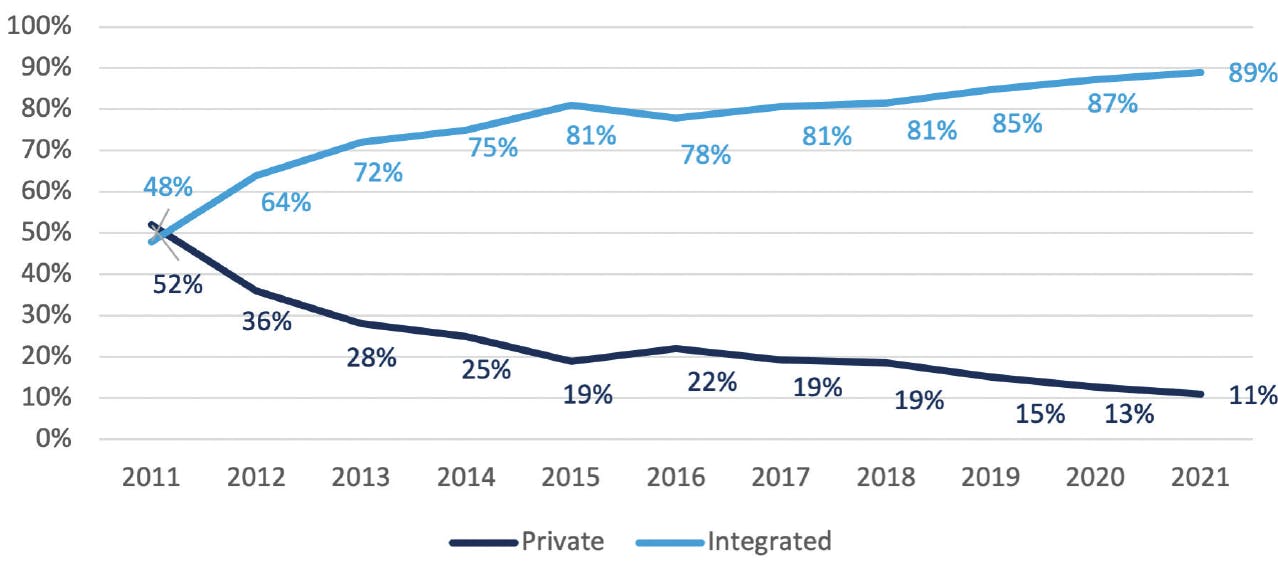
Figure 1. Cardiology program ownership trend.
Another dramatic change that occurred in cardiology over the past decade was an explosion in the use of advanced imaging technologies—including coronary CTA (CCTA), cardiac magnetic resonance, and cardiac positron emission tomography—which collectively increased by 311% from 2011 to 2021. Granted, these numbers are still relatively low, particularly compared with other staple imaging services, but considering recent changes to clinical guidelines and the continued transition to more risk-based reimbursement models, the expectation is that these trends will continue.
The past 10 years were not as friendly to some imaging modalities, as shown in Figure 2. Nuclear single-photon emission CT (SPECT) has been a historical clinical and financial staple for many cardiology practices, but we saw median volumes decrease by 32% since 2011. This volume decline was the continuation of a trend that started several years earlier when reimbursement for nuclear SPECT was precipitously cut by Medicare and other payers. The more recent decline is likely driven, at least in part, by the rise of advanced imaging technologies, especially CCTA.
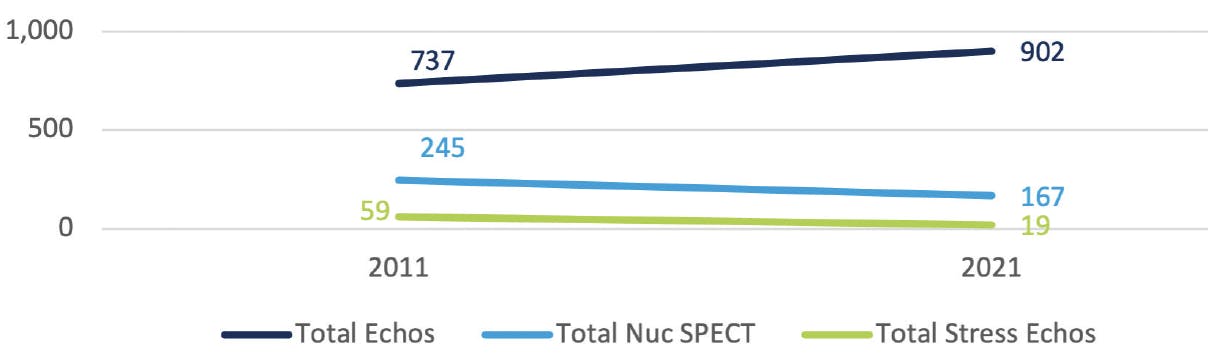
Figure 2. Median imaging volumes per FTE cardiologist.
Echocardiography has nearly become as ubiquitous as the stethoscope, with median studies per full-time equivalent (FTE) cardiologist jumping up by 22% over the last decade to > 900 annual studies per cardiologist (Figure 2). By contrast, stress echocardiography volumes plummeted during that same time period, dropping by 68% from just under 60 studies per cardiologist to < 20.
Another significant clinical change that occurred since the inaugural survey publication was cardiologist coverage of the hospital. In 2011, each FTE cardiologist performed a median 73 hospital discharges per year. By 2021, that number fell 75% to only 18 discharges per cardiologist. This trend represents the intentional shift by cardiologists from an admitting service to a more consultative role. This is partly a survival strategy because of the shortages of cardiologists nationally and was aided, or perhaps sparked, by the mushrooming of hospitalist services in the United States.
Overall median compensation per FTE cardiologist increased by 32% in the past 10 years, rising to a median of $621,596 in 2021 (Figure 3). Although both ownership cohorts saw gains during this decade, private cardiologists made the greatest strides. In 2011, the delta between these ownership cohorts was nearly $100,000 per FTE in favor of the integrated physicians. By 2021, that gap narrowed to just $16,944.
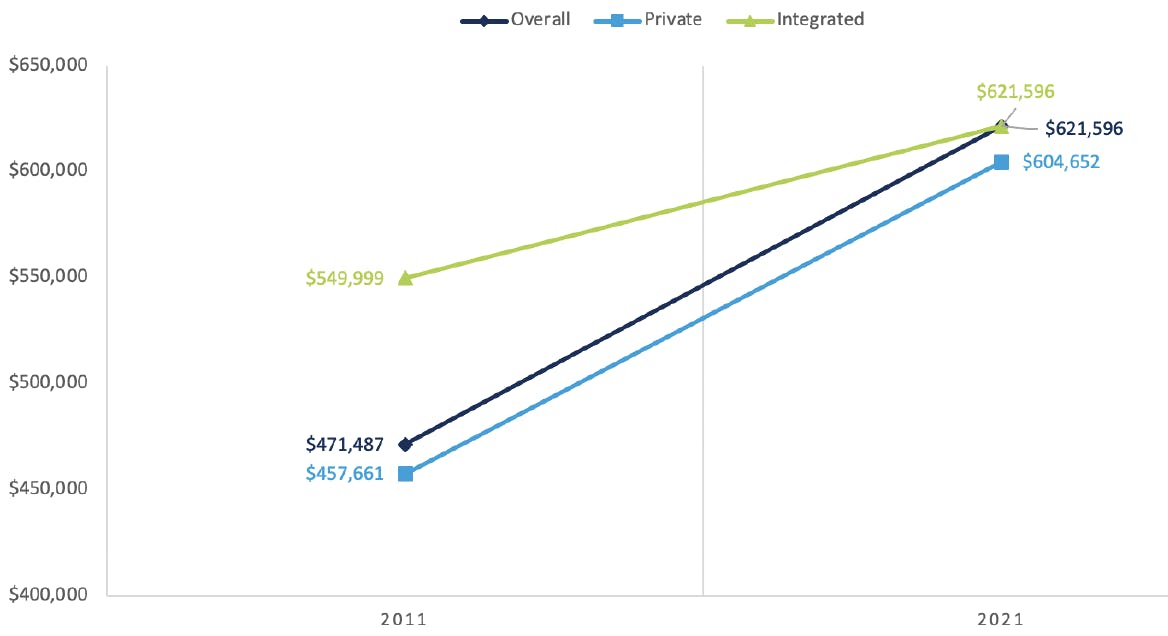
Figure 3. Median total compensation per FTE cardiologist.
Although these gains seem significant—and may be when compared to other professions, at least for integrated physicians—compensation has failed to keep up with overall cost of living, as measured by the Consumer Price Index (CPI). Granted, many variables can impact compensation, particularly over such a long time period, including the annual changes to the work relative value unit (wRVU) schedule and reimbursement. Additionally, Medicare significantly increased the value for evaluation and management (E/M) services in 2020, mainly as a way to bolster reimbursement for primary care activities. However, these changes alone had a net overall impact of a positive 7% for cardiologists.
On average, the United States CPI has increased 2.36% per year over the past decade. Thus, all things being equal, this would mean that the “average” integrated physician earning $549,999 in 2011 would need to top $695,000 in total compensation in 2021 to keep pace with inflation. The reported median of $621,596 is well below this threshold. Faring better, a private physician earning the median of $457,661 in 2011 would need to earn $578,000 in 2021 to have the equivalent spending power, and this was exceeded by approximately $25,000 per cardiologist for 2021 ($604,652).
To make these 10-year gains, private cardiologists widened the production gap with their integrated analogs, as median per-FTE cardiologist wRVU production expanded by 16% to 11,998. This compares to gains of only 4% for integrated cardiologists, from a median of 9,678 in 2011 to a median of 10,083 per FTE in 2021. Therefore, the wRVU gap between these ownership models has changed from 658 per FTE to 1,915, a nearly 20% spread.
When analyzing these data, it is important to point out that, as noted above, the mix of integrated and private cardiologists widened dramatically in favor of integrated programs. Thus, the sample size of private cardiologists has declined proportionally, to the point that only 383 total physicians are represented in the 2021 data, which is a decline of more than half over the 10 years. By contrast, there are > 1,700 physicians in the integrated cohort.
INTERVENTIONAL CARDIOLOGY TRENDS
Focusing on interventional cardiology, two dramatic compensation and production changes occurred over the last 10 years. First, private interventionalists surpassed their integrated analogs in median total compensation, increasing by 154% since 2011 to $741,189 per FTE (Table 1). Integrated interventionalists added just 22% in that time frame to a median of $688,042 per FTE. Invasive and interventional physicians in private programs are the only two subspecialties that out-earn their peers in integrated practices at the medians.
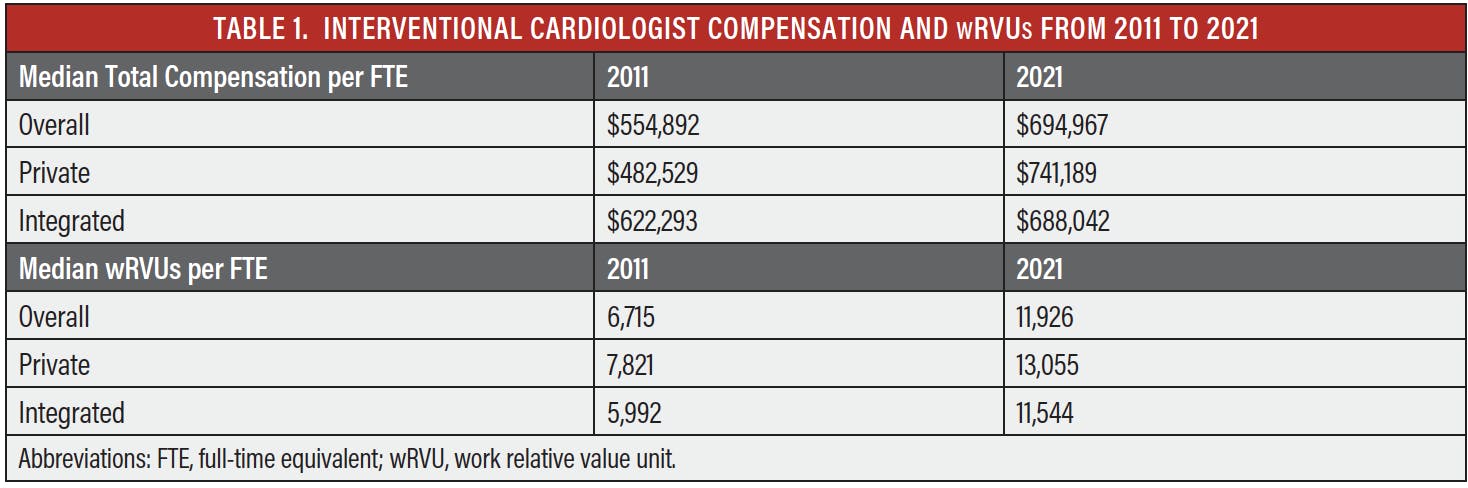
Second, median wRVU production for interventional cardiologists soared over the past decade, gaining 78% for private physicians and 93% for integrated. Despite nearly doubling the median wRVU production since 2011, integrated interventional cardiologists still produce > 1,500 fewer median wRVUs per year than their private peers.
Of note in these comparisons, as the population of private programs has dwindled to now around 10% of the participants, the total number of interventional physicians in that cohort has also dropped as well. This smaller sample size makes survey results more volatile and thus must be considered when drawing conclusions.
Throughout the past decade, cardiology has become more deeply subspecialized, as witnessed by the advent of advanced heart failure cardiologists, advanced imaging physicians and, in the interventional world, structural heart cardiologists. Perhaps as a strong reflection of this transition, nearly three-quarters (73%) of an interventional cardiologist’s wRVU production in 2011 came from E/M services (ie, seeing patients in the exam room or bedside in the hospital). As of 2021, this ratio fell to less than half (47%), likely due to these physicians spending more time in the cath lab and less time in the office.
This said, the median number of catheterizations performed annually by interventional physicians has not changed dramatically since 2011, increasing only slightly from 245 per FTE to 254 (Figure 4). More notably, the median volume of catheterizations per invasive cardiologist has dropped from 111 to 70 in that time span. A likely reason that the interventional change in volumes has not been more dramatic is that the population of these physicians has also dropped. In 2011, nearly four in 10 (37%) cardiologists were classified as interventional. In 2021, that percentage dropped to just over 30%. Invasive cardiologists once represented one in four members of a program and are now just 12% of the total complement.
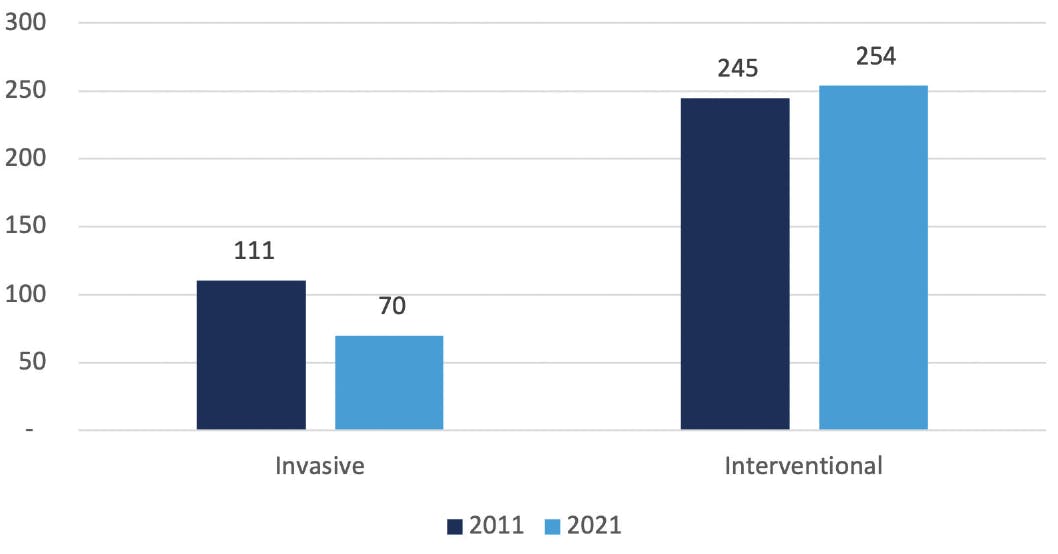
Figure 4. Median invasive volumes per FTE.
The volume of percutaneous coronary intervention (PCIs) has remained stable over the last 10 years, with the median volume of 112 per interventional cardiologist in 2011 decreasing slightly to a median of 105 in 2021. MedAxiom did not start tracking acute myocardial infarction–only (ST-segment elevation myocardial infarction) PCI procedures until 2015, but these volumes have also remained largely static, from a median of 21 procedures per interventional cardiologist in 2015 down to 18 in 2021.
Transcatheter aortic valve replacement (TAVR) volumes notched up sixfold in the 2011 to 2021 period, from a median of only six procedures per FTE interventional cardiologist to 36 (Figure 5). Meanwhile, chronic total occlusion median volumes doubled but only from one to two per FTE interventional physician per year.
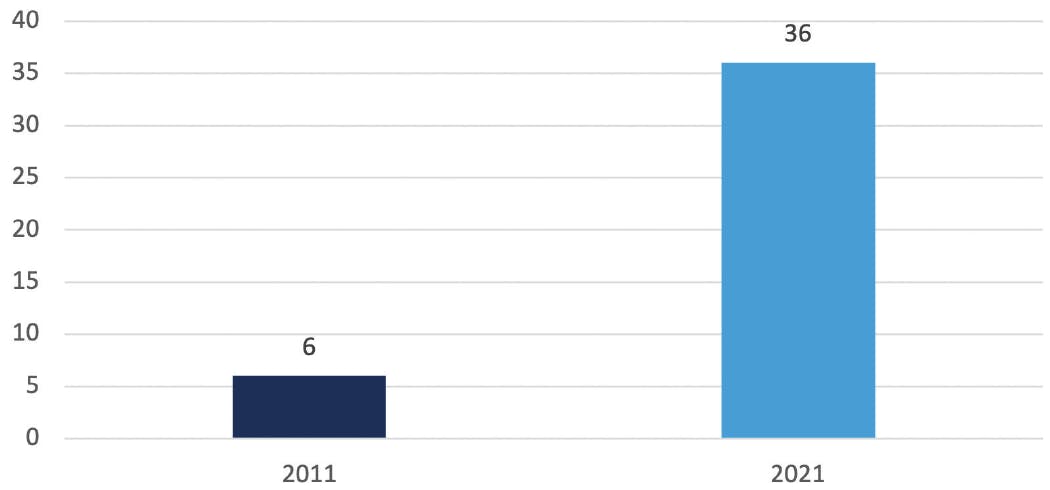
Figure 5. Median TAVR volumes per FTE interventional cardiologist.
KEY TAKEAWAYS
The past decade has brought many interesting and revealing changes to the practice of cardiology. From procedure shifts to the mix of cardiologists and then to the production and compensation alterations that result, it has been a dynamic 10 years. The data show that cardiologists continue to be extremely valuable in the health care market, even as they move into more specialized roles. This subspecialization leads to some significant migration of procedure and other production volumes, which then leads to changes in wRVU production.
No doubt, the next decade will also provide profound changes to cardiovascular medicine, with some surprises along the way. One often-pondered future trend is whether cardiologists will move away from hospital/health system employment, where nearly 90% currently reside, and back into private practice, perhaps bolstered by private equity or other investment. There have been isolated instances of this, but it has yet to become a trend.
No one can predict the future, but the beauty of surveys is their ability to measure the past. MedAxiom is looking forward to the next 10 years of industry-leading surveys to provide the cardiovascular community with invaluable peer comparisons. After all, care transformation starts with data.
Download the full 2022 report at medaxiom.com/compsurvey.
Advertisement
Advertisement