Advertisement
Advertisement
May/June 2022
Implantable Sensors for Hemodynamic Monitoring
An updated overview on the currently available technologies and their mechanism of action, advantages and pitfalls, and supporting clinical evidence.
By Simone Fezzi, MD; Mattia Lunardi, MD, MSc; and Faisal Sharif, MD, PhD
Chronic heart failure (HF) represents a progressive disease with an increasing prevalence worldwide, leading to a rapid escalation of cardiovascular mortality and morbidity with consequent significant health economic burden. It is estimated that by 2030, the overall increase of HF incidence, morbidity, and mortality will lead to a rise in total direct medical costs for HF from $21 billion to $53 billion yearly.1,2 The biggest impact of the increasing prevalence of HF is seen by its detrimental impact on patient quality of life.2
Pulmonary artery (PA) and right ventricular (RV) pressures have been shown to increase early in the process of acute decompensation, before clinical signs and symptoms of HF develop. Therefore, longitudinal monitoring of these pressures may provide a prompt and tailored treatment for patients with HF, aiming to avoid acute cardiac decompensation and hospitalizations.
Although routine PA catheterization aiming to detect and relieve congestion is not recommended, the continuous monitoring of invasive hemodynamic and filling pressure can be potentially useful to support decision-making in patients with congestive HF (CHF). The clinical management of HF, beyond seeking to counteract negative remodeling with disease-modifying drugs, relies on maintaining an adequate volume filling to avoid congestion and consequently worsening symptoms and HF-related hospitalizations. Although clinical examination, laboratory blood values, and echocardiography provide crucial information on the filling status of the patient, their sensitivity is far suboptimal as compared to the invasive right heart catheterization. In patients with refractory symptoms despite an adequate dose of diuretics, those who develop worsening renal impairment with increasing doses of diuretic agents, or those with repeated hospitalization for pulmonary and peripheral congestion, the measurement of filling pressures allows for precise tailoring of treatment and the required follow-up. Moreover, these pressures may also guide in the selection of candidates for advanced HF therapies (ie, heart transplantation or long-term mechanical circulatory support). The evidence in support of invasive pulmonary pressure monitoring in HF is growing, and thus it may be considered in symptomatic patients to improve clinical outcomes according to the American and European Society of Cardiology guidelines.2,3
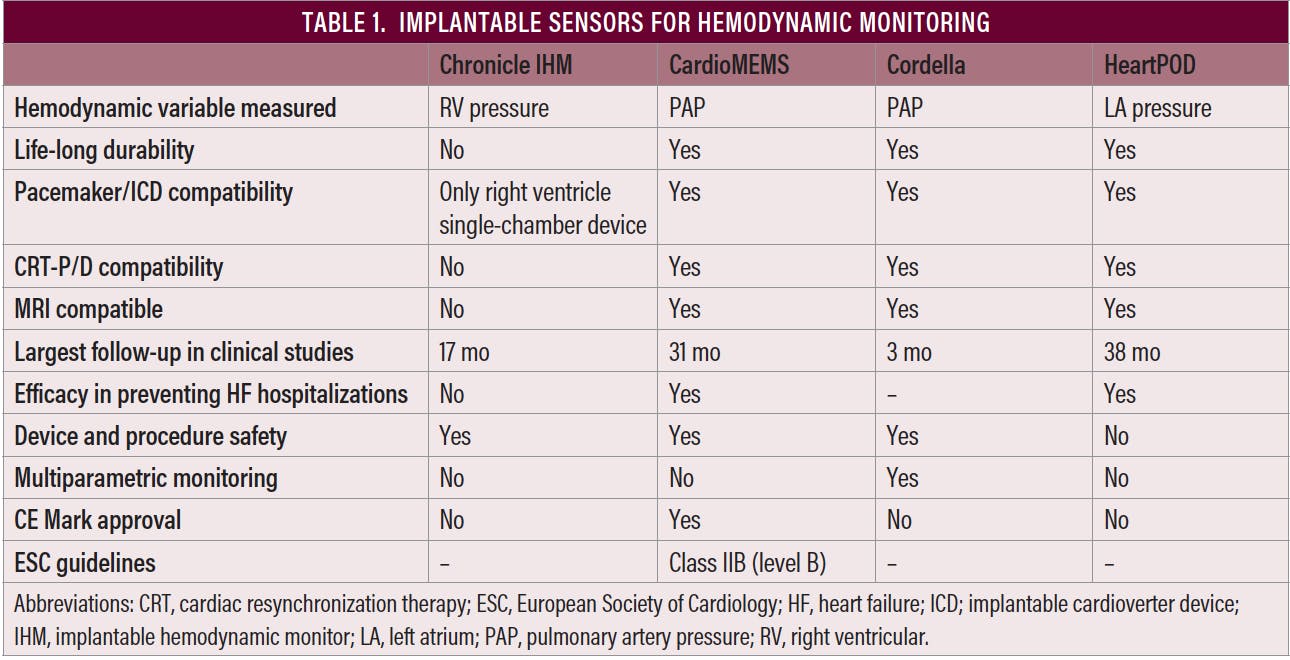
This article provides an updated overview on the currently available technologies for hemodynamic monitoring (Figure 1; Table 1), their mechanism of action and advantages and pitfalls, together with the supporting clinical evidence.
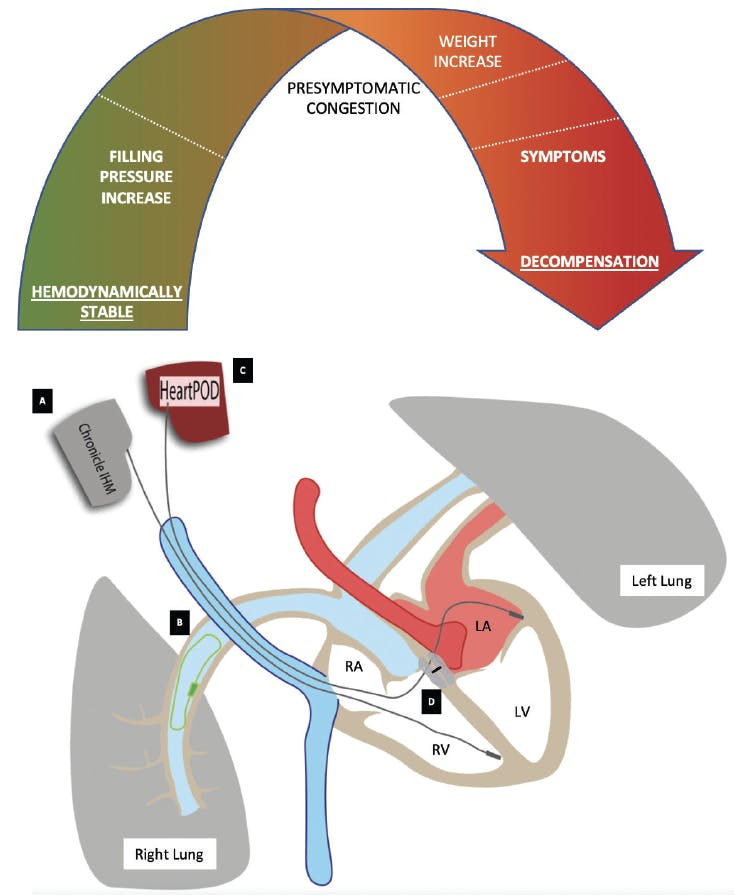
Figure 1. Implantable sensors for hemodynamic monitoring and pathophysiology of congestion. The progressive accumulation of fluid retention is responsible for the occurrence of acute HF and hospitalization. The increase of pulmonary and RV blood pressures significantly precedes the insurgence of clinical signs and symptoms. Several sensors have been developed and can be classified according to the district of assessment: right ventricle (Chronicle HCM) (A), PA (CardioMEMS, Cordella) (B), left atrium (HeartPod) (C), and V-LAP (D). The continuous monitoring of invasive hemodynamic and filling pressure could guide the decision-making in patients with CHF, with the target to maintain an adequate volume filling to avoid congestion and consequently worsening symptoms and HF-related hospitalizations. An increase of the invasive measured blood pressure can suggest the need for an up-titration of the diuretic dose, while their decrease can support the clinician in the down-titration of the diuretic therapy in favor of optimal disease-modifying drugs, such as angiotensin-converting enzyme inhibitors, angiotensin receptor-neprilysin inhibitor, or aldosterone antagonists. LA, left atrium; RA, right atrium.
RV PRESSURE MONITORING
The continuous measurement of RV systolic and diastolic pressures allows for the estimation of the diastolic PA pressure (PAP) during the opening of the pulmonary valve. PAP provides an indirect estimation of the pulmonary capillary wedge (PCW) and left ventricular (LV) diastolic filling pressures, with a discrete correlation with invasive catheterization measurements.4,5
Chronicle Implantable Hemodynamic Monitor
The Chronicle implantable hemodynamic monitor (Medtronic), similar to an implantable pacemaker, consists of a transvenous lead with a pressure sensor at the distal tip. The lead is inserted transvenously and located toward the RV outflow tract or septum, whereas the device is implanted subcutaneously inside the pectoral muscle. The device allows for the recording of RV pressure and heart rate. It is equipped with an internal power source and can be implanted together with a single-chamber implantable device. However, the incompatibility with atrial pacing or resynchronization therapy devices and MRI were the main potential drawbacks of the technology that limited its clinical applicability in the HF population.6
The feasibility of Chronicle device monitoring was first assessed in a small prospective, multicenter, nonrandomized trial. The aim was to evaluate the reliability of long-term hemodynamic monitoring and how this information related to meaningful clinical events. Thirty-two patients with New York Heart Association (NYHA) class II to III CHF underwent Chronicle implantation and were followed for up to 17 months. In total, 36 volume-overload events occurred, leading to 12 hospitalizations. In all these events, both diastolic and systolic pressures increased immediately before (P < .05 for all pressure changes). Data monitoring allowed for the reduction of the rate of yearly hospitalization per patient compared to the 21 months before implantation (from 1.08 to 0.47 hospitalizations per patient-year; 57% reduction; P < .01). Moreover, in nine out of 12 hospitalizations, the increase in pressures occurred with some advance compared to the acute event (up to 4 days before).7
The COMPASS-HF trial was a randomized, single-blind, parallel-controlled trial that assessed the clinical impact of hemodynamic monitoring in patients with advanced HF on optimal medical therapy (OMT). Overall, 247 NYHA class III to IV CHF patients underwent Chronicle implantation and were further randomized either to active monitoring (Chronicle group) or the control group. During the randomization phase, hemodynamic information was available only for the Chronicle group. The primary endpoint of the trial, the reduction of HF-related adverse events, including hospitalizations and emergency or urgent visits requiring intravenous diuretic therapy, was not met, as the reduction of HF-related events in the Chronicle group did not reach statistical significance (−21%; P = .33; prespecified expected reduction of 30%). Such findings were confirmed even in the subgroup of patients with preserved LV ejection fraction (LVEF). The procedure was confirmed to be safe, with a reported complication rate of 8.5%. However, the frequent medical care–contact rate probably reduced the incidence of adverse events more than expected, which might affect the statistical power of the sample analyzed. The Chronicle group had a 28% higher rate of therapy adjustments during the randomization period.8
Although it did not meet its primary endpoint and did not receive FDA approval, COMPASS-HF paved the way for further development of invasive pressure monitoring devices; supporting hemodynamic monitoring might provide added value on top of routine care in the management of HF patients.9
PAP SENSORS
This family of devices contains two types of sensors that directly assess PAP.
CardioMEMS
The CardioMEMS HF system (Abbott) is a sensor that is implanted into a branch of the left PA, allowing for the detection of systolic, diastolic, and mean PAPs. CardioMEMS is implanted via the femoral vein and is calibrated during contextual right heart catheterization.
The device is not equipped with internal battery and is recharged from outside the body during the daily measurement performed by the patient, allowing for lifelong durability. CardioMEMS is compatible with MRI, implantable cardioverter defibrillator (ICD), and cardiac resynchronization therapy (CRT). After implantation in the PA, patients are required to take 1 month of dual antiplatelet and subsequent lifelong aspirin therapy to allow adequate endothelization of the implanted sensor.10
The United States CHAMPION trial provided strong evidence in support of this technology.10,11 CHAMPION was a randomized controlled trial (RCT) that enrolled 550 NYHA class III patients who experienced a previous hospitalization due to CHF and underwent device implantation. Pressure monitoring information was not available in the control group for the initial 6 months after randomization, whereas in the intervention group the clinical decision-making was based on PAP data. The trial confirmed the safety and feasibility of the device, with a rate of adverse events below 0.02 events/patient-year and no sensor failures at up to 31 months of follow-up. Conversely, the trial demonstrated the efficacy of the device-based management in reducing HF-related adverse events at 6-month follow-up (primary endpoint). The HF-related hospitalization rate was significantly lower in the intervention group compared to the control group (hazard ratio [HR], 0.63; 95% CI, 0.52-0.77; P < .0001) during the randomization period, whereas its rate was significantly reduced in the control group in the subsequent open-access period (HR, 0.52; 95% CI, 0.40-0.69; P < .0001). No significant effect on all-cause mortality rates was detected. CardioMEMS-based management even led to a more frequent change in HF medications as compared to the standard of care treatment for HF.10
Further large observational real-world experiences confirmed the initial findings, providing support for CardioMEMS-based management and suggesting a significant reduction in the incidence of HF hospitalization (25%-45%) and improvement in quality of life.12-14 Consequently, CardioMEMS has been proven clinically effective in reducing HF-related adverse events and safe in terms of device- and procedure-related adverse events. Therefore, monitoring of PAP using the CardioMEMS wireless implantable hemodynamic monitoring system has received FDA approval and CE Mark approval for clinical application and has been included in the 2016 European Society of Cardiology guidelines for the management of HF. It may be considered in symptomatic HF patients with previous HF hospitalization to reduce the risk of recurrent HF hospitalization and improve clinical outcomes (class of recommendation IIB; level of evidence B).15
The GUIDE-HF trial is a large, multicenter, single-blind, observational RCT that aimed to confirm the safety and efficacy of CardioMEMS implantation in a wide range of HF patients (including NYHA classes II-IV), as well as patients with recent HF hospitalization or elevated natriuretic peptides.16 Overall, 1,000 patients underwent CardioMEMS device implantation and were randomly assigned (1:1) either to hemodynamic-guided HF management or to the usual care control group. Patients were masked to their study group assignment, while the investigators were aware of the treatment allocation but did not have access to PAP data in the control group. Overall, the GUIDE-HF study failed to show a significant reduction in the primary endpoint, namely the incidence of composite endpoint rate of mortality and total HF events through CardioMEMS pressure monitoring compared with usual standard of care (HR, 0.88; 95% CI, 0.74-1.05; P = .16). However, a prespecified COVID-19 impact analysis was conducted showing a treatment interaction of the pandemic on the primary endpoint incidence (P interaction = .11). In the pre–COVID-19 period, the incidence of adverse events was significantly lower in the intervention group compared to the control population, both in terms of composite endpoint of mortality and rehospitalization for HF (HR, 0.81; 95% CI, 0.66-1.00; P = .049) and in the incidence of HF alone (HR, 0.76; 95% CI, 0.61-0.95; P = .014). Overall, acute HF event rates remained low in the treatment group during COVID-19, whereas a substantial decrease occurred in the control group. This trend is consistent with that reported in the general HF population during the pandemic.17 According to the authors’ perspective, several factors could be accounted as predictors of a reduced benefit of hemodynamic-guided management during the COVID-19 pandemic (improved patient compliance, reduced respiratory infections, altered health care provider behavior, changes in disease progression due to COVID-19), but their discussion goes beyond the objectives of this review.
Cordella
The Cordella PAP sensor system (Endotronix) ensures PAP measurement together with other vital parameters (ie, arterial blood pressure, heart rate, weight, oxygen saturation). The rationale of the Cordella system is that both the tailored normal PAP range maintenance through remote PAP monitoring and remote control of vital parameters through a telemedical system daily would have led to a reduction in unplanned cardiovascular admissions and adverse events. Therefore, the integration of this information was thought to offer further advantages compared to PAP monitoring alone.18
The Cordella sensor is currently implanted via the femoral vein in the right PA, and its nitinol-designed anchors allow for the accommodation of a wide range of patient and vessel anatomy and sizes and improve device stability. PAP is measured daily by a wireless handheld reader (myCordella Patient Reader), and patients are required to take daily readings using their tablets. The device derives the mean PAP value from free-breathing intervals across 18 seconds of measurement while the patient is holding the reader against the chest. The added advantage of the Cordella PAP system is its ability to record multiposition PAP that, in return, will allow for the understanding of the effect of posture and exercise on PAP in patients with HF.
The SIRONA pilot trial was a multicenter open-label study that investigated the safety and accuracy of the Cordella system in 15 NYHA class III HF patients with at least one hospitalization due to HF within the last year. Overall, the 3-month right heart catheterization confirmed good accuracy of the device in terms of PA measurement (Cordella sensor, 22.5 ± 11.8 mm Hg; Swan-Ganz catheter, 25.2 ± 8.5 mm Hg). Procedural safety was deemed acceptable as adverse events occurred in 27% of the patients (1 sensor dislodgement, 2 cases of minor hemoptysis, and 1 transient complete heart block during the transition toward RV), while any device-related complication or failure was detected during follow-up.19
SIRONA 2 (NCT04012944) is an ongoing CE Mark prospective, multicenter, open-label, single-arm trial designed to provide further insights on safety and efficacy of the Cordella system implanted in 60 NYHA class III patients with CHF.
Similarly, the PROACTIVE-HF IDE trial (NCT04089059) is a United States randomized trial in which patients will prospectively undergo Cordella device implantation and be further randomized either to 12 months of PAP monitoring–based HF management or standard of care. The investigated endpoints of the study will be the 12-month incidence of mortality, HF hospitalization, need for intravenous diuretic infusion, device/system-related complications, and pressure sensor failure.
LEFT ATRIAL PRESSURE SENSORS
In some conditions, PAP does not properly reflect the volume filling status and thus LV dysfunction, while depending on pulmonary vascular increased resistance and pressures (ie, primary pulmonary hypertension, chronic HF with increased pulmonary vascular resistance, sleep-disordered breathing syndromes). Therefore, PA monitoring might be suboptimal in such conditions, where direct left atrial pressure (LAP) monitoring might offer a more accurate solution.20
Direct left-sided filling pressures accurately estimate the volemic status of the patient, allowing a precise prediction of HF exacerbations. Moreover, LAP monitoring has the unrivaled advantage of diastolic dysfunction assessment, which occurs in case of reduced and preserved LVEF HF.21
HeartPod
The HeartPod system (Abbott) is an implantable sensor inserted percutaneously in the left atrium by transseptal atrial puncture and a subcutaneous antenna coil. The device is delivered through femoral vein access, whereas the antenna is connected through either the axillary or subclavian vein. The device is compatible with ICDs and CRT devices and receives power externally, allowing for lifelong durability. HeartPod records both LAP values and electrocardiographic data.22,23
Insights on the safety and efficacy of HeartPod were first provided in the HOMEOSTASIS trial that enrolled 40 patients with NYHA class III to IV CHF. After a 3-month blank period in which pressure data were not available to the investigators, in the titration period LAP was used to improve the clinical status of the patients. A significant reduction in adverse events was seen at up to 25 months when clinical decisions were based on LAP values (0.28 events/year vs 1.4; P < .001), with a remarkable improvement of disease-modifying drugs up-titration (angiotensin-converting enzyme inhibitors/angiotensin receptor blockers and Β-blockers) and reduction of diuretic doses. However, four patients had a device failure and five underwent successful percutaneous extraction of the sensor lead, mainly after an infection was detected.24
The subsequent LAPTOP-HF 1:1 RCT failed to prove safety and efficacy of HeartPod monitoring as compared with OMT alone in a large population of HF patients. Despite an expected population of at least 730 patients, enrollment was held after 486 were enrolled due to safety concerns because an excess of procedure-related complications occurred. Nonetheless, among the population included, HeartPod-guided therapy showed significantly reduced rehospitalizations due to acute HF at up to 12 months (41% reduction).25
V-LAP
The V-LAP (Vectorious Medical Technologies) is a wireless remote monitoring system that directly measures LAP. V-LAP is composed of a central tube containing the sensor that encases sensing elements and electronics. The sensor allows monitoring and bidirectional communication of pressure, body temperature, and transmission power. Moreover, it provides prompt error detection and correction. The tube is inserted into a nitinol-based double-disc structure that anchors the sensor toward the interatrial septum. V-LAP technology provides bidirectional continuous communications with an external unit allowing measurement both at rest in the supine or prone positions, during ambulation, and during physical activity. This is particularly important for the diastolic dysfunction assessment. The device does not require leads or internal batteries as it is powered by the external unit. Ex vivo and animal model studies have provided insights on the safety profile of V-LAP system implantation, with the net advantage of direct LA pressure assessment.26 The first-in-human validatory trial is ongoing (VECTOR-HF; NCT03775161), and the preliminary data, including the first 24 patients enrolled, have provided promising results in terms of safety and accuracy of the device. Indeed, no device-related complications occurred, whereas the sensor was shown to accurately agree with 3-month right heart catheterization. Moreover, NYHA class improved significantly after implantation, while a trend toward improvement of 6-minute walking test distance was seen.20
To date, the net advantage of LAP monitoring of left-sided invasive sensors might be counterbalanced by the main drawback of the need for transseptal puncture, which was related to a higher rate of procedural adverse events during the HeartPOD experience as compared to right-sided ones. Nonetheless, the V-LAP preliminary data are encouraging, and further confirmation in an RCT is warranted.9
CONCLUSION
Continuous longitudinal invasive pressure monitoring allows for detection of worsening HF and prompt implementation of the available therapeutic options, providing a higher diagnostic accuracy compared to noninvasive clinical signs. Several devices have been developed, with different mechanisms of action, sites of implantation, and technical features. To date, the only device that has obtained FDA and CE Mark approval is CardioMEMS, which has been shown to improve clinical outcomes in the CHAMPION trial, reducing the incidence of HF hospitalizations, regardless of the LVEF. Therefore, invasive PAP monitoring in HF may be considered in cases of symptomatic HF patients to improve clinical outcomes. Further technologies and complex systems are now under development, paving the way for future home-based platforms that aim at a targeted precision medical therapy to reduce mortality and morbidity, improve quality of life, and reduce costs for the health care systems.
FUNDING
This work was supported in part by grants from the Science Foundation Ireland (15/RP/2765) to Drs. Fezzi and Lunardi. Prof. Sharif is funded by the Science Foundation Ireland Infrastructure grant (17/RI/5353).
1. Heidenreich PA, Albert NM, Allen LA, et al. Forecasting the impact of heart failure in the United States: a policy statement from the American Heart Association. Circ Heart Fail. 2013;6:606-619. doi: 10.1161/HHF.0b013e318291329a
2. Maddox TM, Januzzi JL, Allen LA, et al. 2021 update to the 2017 ACC expert consensus decision pathway for optimization of heart failure treatment: answers to 10 pivotal issues about heart failure with reduced ejection fraction: a report of the American College of Cardiology Solution Set Oversight Committee. J Am Coll Cardiol. 2021;77:772-810. doi: 10.1016/j.jacc.2020.11.022
3. McDonagh TA, Metra M, Adamo M, et al. 2021 ESC guidelines for the diagnosis and treatment of acute and chronic heart failure. Eur Heart J. 2021;42:3599-3726. doi: 10.1093/eurheartj/ehab368
4. Ohlsson A, Bennett T, Nordlander R, et al. Monitoring of pulmonary arterial diastolic pressure through a right ventricular pressure transducer. J Card Fail. 1995;1:161-168. doi: 10.1016/1071-9164(95)90018-7
5. Chuang PP, Wilson RF, Homans DC, et al. Measurement of pulmonary artery diastolic pressure from a right ventricular pressure transducer in patients with heart failure. J Card Fail. 1996;2:41-46. doi: 10.1016/s1071-9164(96)80008-x
6. Magalski A, Adamson P, Gadler F, et al. Continuous ambulatory right heart pressure measurements with an implantable hemodynamic monitor: a multicenter, 12-month follow-up study of patients with chronic heart failure. J Card Fail. 2002;8:63-70. doi: 10.1054/jcaf.2002.32373
7. Adamson PB, Magalski A, Braunschweig F, et al. Ongoing right ventricular hemodynamics in heart failure: clinical value of measurements derived from an implantable monitoring system. J Am Coll Cardiol. 2003;41:565-571. doi: 10.1016/s0735-1097(02)02896-6
8. Bourge RC, Abraham WT, Adamson PB, et al. Randomized controlled trial of an implantable continuous hemodynamic monitor in patients with advanced heart failure: the COMPASS-HF study. J Am Coll Cardiol. 2008;51:1073-1079. doi: 10.1016/j.jacc.2007.10.061
9. Radhoe SP, Veenis JF, Brugts JJ. Invasive devices and sensors for remote care of heart failure patients. Sensors (Basel). 2021;21. doi: 10.3390/s21062014
10. Abraham WT, Adamson PB, Bourge RC, et al. Wireless pulmonary artery haemodynamic monitoring in chronic heart failure: a randomised controlled trial. Lancet. 2011;377:658-666. doi: 10.1016/S0140-6736(11)60101-3
11. Abraham WT, Stevenson LW, Bourge RC, et al. Sustained efficacy of pulmonary artery pressure to guide adjustment of chronic heart failure therapy: complete follow-up results from the CHAMPION randomised trial. Lancet. 2016;387:453-461. doi: 10.1016/S0140-6736(15)00723-0
12. Desai AS, Bhimaraj A, Bharmi R, et al. Ambulatory hemodynamic monitoring reduces heart failure hospitalizations in “real-world” clinical practice. J Am Coll Cardiol. 2017;69:2357-2365. doi: 10.1016/j.jacc.2017.03.009
13. Abraham J, Bharmi R, Jonsson O, et al. Association of ambulatory hemodynamic monitoring of heart failure with clinical outcomes in a concurrent matched cohort analysis. JAMA Cardiol. 2019;4:556-563. doi: 10.1001/jamacardio.2019.1384
14. Angermann CE, Assmus B, Anker SD, et al. Pulmonary artery pressure-guided therapy in ambulatory patients with symptomatic heart failure: the CardioMEMS European monitoring study for heart failure (MEMS-HF). Eur J Heart Fail. 2020;22:1891-901. doi: 10.1002/ejhf.1943
15. Ponikowski P, Voors AA, Anker SD, et al. 2016 ESC guidelines for the diagnosis and treatment of acute and chronic heart failure: the task force for the diagnosis and treatment of acute and chronic heart failure of the European Society of Cardiology (ESC) developed with the special contribution of the Heart Failure Association (HFA) of the ESC. Eur Heart J. 2016;37:2129-2200. doi: 10.1093/eurheartj/ehw128
16. Lindenfeld J, Zile MR, Desai AS, et al. Haemodynamic-guided management of heart failure (GUIDE-HF): a randomised controlled trial. Lancet. 2021;398:991-1001. doi: 10.1016/S0140-6736(21)01754-2
17. Cox ZL, Lai P, Lindenfeld J. Decreases in acute heart failure hospitalizations during COVID-19. Eur J Heart Fail. 2020;22:1045-1046. doi: 10.1002/ejhf.1921
18. Lunardi M, Wu S, Serruys PW, et al. Acute and chronic exercise training in patients with class II pulmonary hypertension: effects on haemodynamics and symptoms. ESC Heart Fail. 2022;9:791-799. doi: 10.1002/ehf2.13819
19. Mullens W, Sharif F, Dupont M, et al. Digital health care solution for proactive heart failure management with the Cordella heart failure system: results of the SIRONA first-in-human study. Eur J Heart Fail. 2020;22:1912-1919. doi: 10.1002/ejhf.1870
20. Maurer MS, Adamson PB, Costanzo MR, et al. Rationale and design of the left atrial pressure monitoring to optimize heart failure therapy study (LAPTOP-HF). J Card Fail. 2015;21:479-488. doi: 10.1016/j.cardfail.2015.04.012
21. Perl L, Meerkin D, D'amario D, et al. The V-LAP system for remote left atrial pressure monitoring of patients with heart failure: remote left atrial pressure monitoring. J Card Fail. Published online January 15, 2022. doi: 10.1016/j.cardfail.2021.12.019
22. Ritzema J, Melton IC, Richards AM, et al. Direct left atrial pressure monitoring in ambulatory heart failure patients: initial experience with a new permanent implantable device. Circulation. 2007;116:2952-2959. doi: 10.1161/CIRCULATIONAHA.107.702191
23. Walton AS, Krum H. The Heartpod implantable heart failure therapy system. Heart Lung Circ. 2005;14(suppl 2):S31-33. doi: 10.1016/j.hlc.2005.09.003
24. Ritzema J, Troughton R, Melton I, et al. Physician-directed patient self-management of left atrial pressure in advanced chronic heart failure. Circulation. 2010;121:1086-1095. doi: 10.1161/CIRCULATIONAHA.108.800490
25. Abraham WT, Perl L. Implantable hemodynamic monitoring for heart failure patients. J Am Coll Cardiol. 2017;70:389-398. doi: 10.1016/j.jacc.2017.05.052
26. Perl L, Soifer E, Bartunek J, et al. A novel wireless left atrial pressure monitoring system for patients with heart failure, first ex-vivo and animal experience. J Cardiovasc Transl Res. 2019;12:290-298. doi: 10.1007/s12265-018-9856-3
Advertisement
Advertisement