Advertisement
Advertisement
July/August 2022
Specialty Balloons: When and How
Using cutting, scoring, and very high-pressure balloons in PCI.
Percutaneous coronary intervention (PCI) is a current routine and standardized procedure. Thanks to the technologic development observed in recent years, the rates of success and long-term outcomes have dramatically increased, even in complex procedures. However, lesion preparation remains the key to achieving optimal immediate and long-term outcomes. The introduction of specialty balloons (very high-pressure, scoring, and cutting balloons) has enriched the armamentarium of the interventionalist to tackle complex lesions such as fibrotic plaque, calcified lesions, and in-stent restenosis.
CUTTING BALLOON
The Wolverine cutting balloon (Boston Scientific Corporation) is mounted on a semicompliant balloon with three or four atherotomes (microsurgical blades) bonded longitudinally to its surface. When the cutting balloon is inflated, the pressure preferentially distributes on the blades and favors a more efficacious lesion preparation because the pressure is distributed on a smaller surface compared to standard balloons. Moreover, the blades of the cutting balloon allow the expanding force to be uniformly transmitted to the lesion, thus avoiding dangerous unpredicted balloon inflations.
How I Do It
The following are two techniques for cutting balloon inflation: (1) nominal pressure with a balloon-to-vessel ratio of 1:1 or (2) high pressure using a cutting balloon downsized by 0.5 mm compared to the vessel media-to-media diameter. In case of in-stent restenosis, when the stent size is known, the cutting balloon should be sized 1:1 or upsized to 0.25 mm. In native vessels, we utilize the high-pressure cutting balloon associated with intravascular imaging to select the appropriate balloon size.
When I Do It
A cutting balloon can offer excellent performance in various settings, such as in-stent restenosis, fibrotic plaque, and calcified lesions (Figure 1).
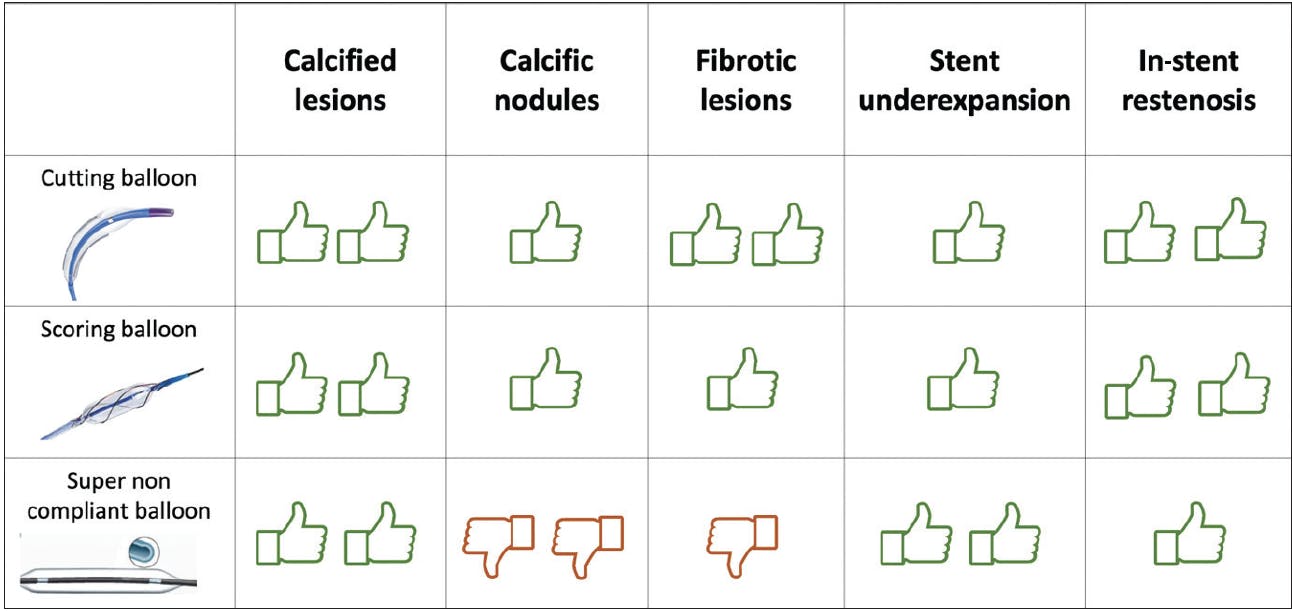
Figure 1. Estimated performance of each specialty balloon according to the specific anatomic setting.
In-stent restenosis. The cutting balloon has been demonstrated to better prepare lesions in case of in-stent restenosis. The neointima is composed of new layers of intimal cells forming a rubbery membrane. The cutting balloon creates sagittal cuts that favor the extrusion of intimal hyperplasia through stent struts. Evidence from small intravascular ultrasound (IVUS)–guided PCI studies for in-stent restenosis suggest that the use of cutting compared to traditional balloons is associated with larger lumen gain, lower lumen loss, and preserved good angiographic result at follow-up.1 However, a randomized study comparing standard balloons versus cutting balloons for the treatment of in-stent restenosis failed to demonstrate superiority of the cutting balloon in terms of recurrent in-stent restenosis and major adverse cardiac events.2 Nevertheless, the presence of blades on the cutting balloon surface can potentially improve the intravascular diffusion of antiproliferative agents delivered with modern drug-coated balloons, thus favoring sustained long-term results. In this scenario, new studies are required.
Fibrotic plaque. According to the classification of coronary plaques made by Stary et al, fibrous plaques are typically rich in collagen or muscle cells and have a homogeneous aspect.3 Mature fibrous plaque affects all three coats of the arterial wall, and, particularly, a thinning of the tunica media is the most typical feature of the raised fibrous plaque; nevertheless, in extended fibrotic lesions, the media may be absent. The efficacy of traditional balloons for the treatment of fibrotic lesions remains low due to the presence of a high rate of recoil and unsatisfactory lesion preparation. Experimental models have demonstrated that traditional angioplasty with standard balloons in fibrotic lesions can hardly create dissections.4 Cutting balloons use atherotomes to score through the fibrosis, thus favoring a better lesion preparation.
Calcified lesions. The efficacy of a cutting balloon for the treatment of calcified lesions has been demonstrated in various studies. In moderate and severe coronary calcific stenosis, cutting compared to conventional angioplasty can achieve a larger size and better immediate minimal lumen area.5 Cutting can be used alone or in combination with other plaque-debulking devices. It has proven efficacy with rotational atherectomy, and optical coherence tomography (OCT) studies in severely calcified lesions suggest that calcium fracture is more often associated with rotational atherectomy followed by a cutting balloon compared with rotational atherectomy followed by conventional balloon predilation before stenting (Figure 2). Moreover, a greater stent expansion with the cutting balloon has been demonstrated.6 In calcified lesions, the cutting balloon can be advanced, but in some cases, a certain degree of resistance can be encountered; for this reason, we recommend an initial predilation with a noncompliant balloon to pave the way. When dealing with extensive and thick calcifications, we acknowledge the need of other technologies, such as rotational atherectomy and lithotripsy.
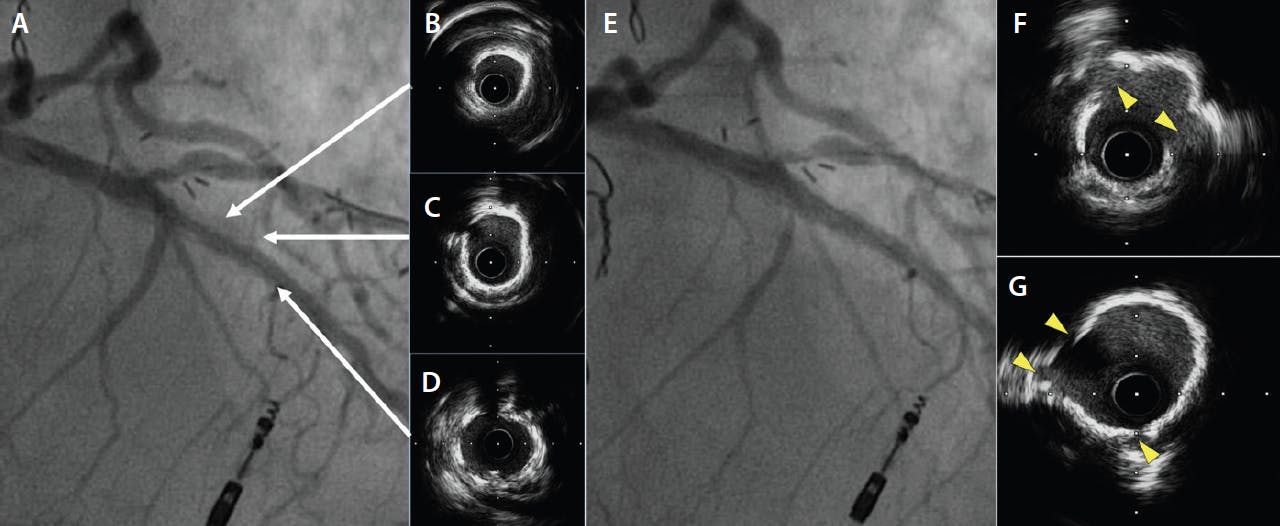
Figure 2. Severe calcified lesion of the mid left descending coronary artery not expandable after rotational atherectomy with a 1.5-mm burr (A). Baseline IVUS demonstrated deep circumferential calcium (B-D). The lesion was dilated with a super high-pressure balloon (OPN 3.0 at 35 atm) and with a 3- X 10-mm cutting balloon inflated at 26 atm. The angiographic result was satisfactory (E), and the postprocedure IVUS showed cuts on the calcium surface (yellow arrows) with nice lumen gain (F, G).
SCORING BALLOON
The scoring balloons consist of a double-lumen catheter with a semicompliant balloon surrounded by an external helical scoring edge. The expansion properties of the three rectangular spiral struts are influenced by a fixed distal end and a semiconstrained proximal end. The design of the scoring balloon favors a controlled and uniform balloon inflation, thus minimizing the risk of balloon slippage.
How I Use It
Thanks to the geometrical distribution of the helical scoring, the device has good flexibility and trackability that make it an ideal device for calcified lesions. Different from the cutting balloon, the scoring balloon is less noncompliant so that at high pressure, its diameter tends to increase. A careful evaluation of vessel dimensions is necessary to minimize the risk of complications; 0.5-mm undersizing is desirable to safely use the balloon at high pressure.
When I Do It
Because the profile of the scoring balloon is slightly better than cutting, we tend to use it in more challenging scenarios when cutting has low probability to be delivered. The performance of scoring balloons has been tested both in calcified lesions and in-stent restenosis.
In the presence of in-stent restenosis, the ISAR-DESIRE 4 study has demonstrated that the use of scoring balloons results in a lower rate of binary restenosis (18.5% vs 32.0%; P = .026) at 6-month angiographic follow-up without any impact on clinical follow-up. The potential mechanism of benefit is possibly related to the improved drug delivery, secondary to a better lesion preparation ensured by the use of a scoring balloon.7
In calcified lesions, the performance of scoring balloons has been investigated in the ISAR-CALC randomized trial.8 The trial compared the performance of super high-pressure noncompliant balloons versus scoring balloons in patients with severe calcified lesions. The OCT evaluation revealed that the super high-pressure balloon increased the minimum lumen diameter (2.83 ± 0.34 mm vs 2.65 ± 0.36 mm; P = .03) and reduced the diameter stenosis (11.6% ± 4.8% vs 14.4% ± 5.6%; P = .02) without difference in terms of angiographic success (100% vs 97.3%; P > .99). Nevertheless, procedural success was numerically higher in the super noncompliant balloon group, possibly related to a different deliverability of the two devices.8
VERY HIGH-PRESSURE BALLOON
The OPN balloon (SIS Medical AG) is a double-layer balloon with minimal dog-boning effect and an optimal resistance to deformation, which guarantees a preserved balloon diameter even at the highest inflation rates. The balloon can be inflated up to 35 atm with minimal risk of balloon rupture.
How I Use It
In the case of predilatation or for the treatment of in-stent restenosis, the OPN should be sized 0.5 mm smaller than the reference vessel diameter, and a slow inflation (at > 20 atm it is recommendable to approximately increase 5 atm every 10-20 seconds) is required to achieve adequate luminal gain. Use of supportive guidewires can be useful to ensure optimal deliverability. Considering the aggressive nature of this approach, we suggest the use of intravascular imaging to appropriately size the balloon.
When I Use It
Use of the OPN balloon can be considered in stent underexpansion and calcified lesions.
Stent underexpansion. In the case of an underexpanded stent with underlying circumferential calcium, the OPN can correct stent constriction. However, imaging is the key to ensuring adequate safety and understanding the underlying mechanism of failure. In the presence of fibrosis surrounding the stent, the OPN has limited efficacy. No data are available regarding the treatment of in-stent restenosis with use of the OPN.
Calcified lesions. As mentioned previously, the OPN balloon has demonstrated excellent efficacy in complex calcified lesions.7 The performance of the OPN is excellent in the presence of severe calcifications with concentric plaques and extended arch of calcium. On the contrary, its use in the presence of calcified nodules requires attention due to the nonnegligible risk of vessel rupture. The OPN balloon can be used in association with other plaque-debulking systems and can enhance the efficacy of other technologies, such as intravascular lithotripsy and rotational atherectomy.
CONCLUSION
Use of specialty balloons has dramatically changed the modern approach of operators to angioplasty. The use of cutting, scoring, and very high-pressure balloons can result in better PCI outcomes in selected cases, especially in combination with intravascular imaging. Future developments are required to better understand which patients can benefit most from the use of these devices.
1. Muramatsu T, Tsukahara R, Ho M, et al. Efficacy of cutting balloon angioplasty for in-stent restenosis: an intravascular ultrasound evaluation. J Invasive Cardiol. 2001;13:439-444.
2. Albiero R, Silber S, Di Mario C, et al. Cutting balloon versus conventional balloon angioplasty for the treatment of in-stent restenosis: results of the restenosis cutting balloon evaluation trial (RESCUT). J Am Coll Cardiol. 2004;43:943-949. doi: 10.1016/j.jacc.2003.09.054
3. Stary HC, Chandler AB, Dinsmore RE, et al. A definition of advanced types of atherosclerotic lesions and a histological classification of atherosclerosis. A report from the Committee on Vascular Lesions of the Council on Arteriosclerosis, American Heart Association. Circulation. 1995;92:1355-1374. doi: 10.1161/01.cir.92.5.1355
4. Faxon DP, Weber VJ, Haudenschild C, et al. Acute effects of transluminal angioplasty in three experimental models of atherosclerosis. Arteriosclerosis. 1982;2:125-133. doi: 10.1161/01.atv.2.2.125
5. Karvouni E, Stankovic G, Albiero R, et al. Cutting balloon angioplasty for treatment of calcified coronary lesions. Catheter Cardiovasc Interv. 2001;54:473-481. doi: 10.1002/ccd.1314
6. Amemiya K, Yamamoto MH, Maehara A, et al. Effect of cutting balloon after rotational atherectomy in severely calcified coronary artery lesions as assessed by optical coherence tomography. Catheter Cardiovasc Interv. 2019;94:936-944. doi: 10.1002/ccd.28278
7. Kufner S, Joner M, Schneider S, et al. Neointimal modification with scoring balloon and efficacy of drug-coated balloon therapy in patients with restenosis in drug-eluting coronary stents: a randomized controlled trial. JACC Cardiovasc Interv. 2017;10:1332-1340. doi: 10.1016/j.jcin.2017.04.024
8. Rheude T, Rai H, Richardt G, et al. Super high-pressure balloon versus scoring balloon to prepare severely calcified coronary lesions: the ISAR-CALC randomised trial. EuroIntervention. 202;17:481-488. doi: 10.4244/EIJ-D-20-01000
Advertisement
Advertisement