Advertisement
Advertisement
July/August 2022
Coronary Reaccess After TAVR
With proper technique and equipment, achieving coronary access through a transcatheter heart valve for coronary angiography or percutaneous coronary intervention post-TAVR is feasible.
Coronary reaccess after transcatheter aortic valve replacement (TAVR) is achievable with adequate understanding of the potential challenges and knowledge of the strategies to overcome them. Although the rate of percutaneous coronary intervention (PCI) after TAVR is quite low (2%-6%), failure occurs in up to 10% of these patients.1-3 The implementation of proper maneuvers may help with successful PCI in this context.
WHY I DO IT
The peculiar design of some transcatheter heart valves (THVs) and their position in relation to the coronary ostia can make coronary access particularly difficult.4 The challenge with coronary cannulation has been raised most often with the self-expandable CoreValve/Evolut valves (Medtronic)5; this issue has been less commonly reported so far with balloon-expandable valves.6
Furthermore, as increasingly younger patients with severe aortic stenosis are being offered TAVR, the number of patients requiring post-TAVR coronary angiography or PCI is expected to increase.7 Hence, the acquisition of specific operational skills to achieve coronary access through a THV is strongly advised, particularly for junior operators and those at non-TAVR centers.
MATERIALS
The necessary equipment includes:
- 5- to 6-F radial/femoral sheath
- 0.035-inch J-wire
- 5-F pigtail catheter
- Guiding catheters: Judkins right (JR) 3.5 or 4, Judkins left (JL) 3/3.5, extra backup (EBU) 3/3.5
- Catheter-adapted wire connector
- Coronary wire
- Coronary balloons
- Guide extension catheter
HOW I DO IT
The best way to learn and perform this technique is to follow a step-by-step approach (Figure 1).
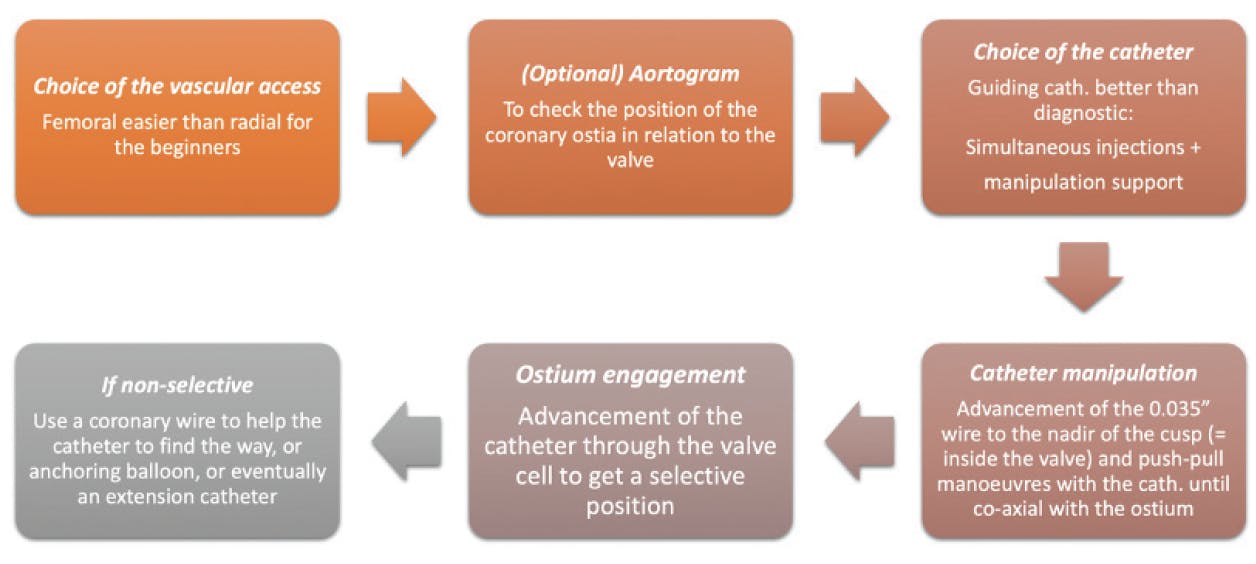
Figure 1. A systematic approach for achieving coronary reaccess after TAVR.
General Advice
For operators working in a TAVR center, our first piece of advice is to select patients with normal renal function. Then, immediately after a straightforward THV implantation procedure, obtain a control coronary angiogram from the operative femoral access. This will help the operator understand and become confident with the technique in a nonemergent setting.
Choose the Vascular Access
Although it may be obvious, it is important to use the access you are most confident with. In patients with very tortuous brachiocephalic vessels, any procedure will be difficult (of note, this is not related to the design of the valve in place), but a femoral approach will be easier as it may simplify the understanding of the technique, especially when performing the initial cases.
Obtain an Aortic Angiogram (Optional)
Aortic angiography performed with a pigtail catheter positioned in the aortic root, in the left anterior oblique projection, can be particularly useful for novice operators or when treating patients who have no available prior imaging, such as patients who have undergone TAVR at an outside center. The aortogram will allow the operator to obtain important information necessary for coronary reaccess, such as aortic root width, position of the coronary ostia, valve implantation depth, and the relationship of the anatomy with the different structures of the THV. It is fundamental that the operator understands the structure and design of the different THV types and their components.
Choose the Catheters
Either diagnostic or guiding catheters can be used in this context, but the choice of a guiding catheter offers advantages. First, because the injection will often be nonselective and the 0.035-inch wire is kept inside, the larger catheter lumen permits better visualization. In addition, keeping the 0.035-inch wire inside during the injection allows for more stability.
Regarding catheter shape, regular JR/JL and EBU catheters are usually adequate, and they should be used as first choice.
It is recommended to choose a single-size smaller left catheter (eg, EBU 3.0 instead of 3.5) given the interaction of the catheter bend with the valve struts, which creates a smaller effective space in the ascending aorta.
Manipulate the Catheter
First, use a Y-connector on the guiding catheter so that the operator can manipulate both the catheter and the 0.035-inch wire without losing blood and having continuous monitoring of blood pressure and the possibility to perform small contrast injections to check the catheter tip position.
Second, be sure that the 0.035-inch wire is advanced into the THV structure and is not between the THV and the aortic wall. Once inside, push the wire down to the nadir of the cusp.
Third, with push-and-pull maneuvers, try to align the catheter in both the superior-inferior and anterior-posterior planes with the THV cell strut closest to the coronary ostium to achieve a coaxial position. Once alignment with small contrast injections has been checked, attempt to maneuver through the cell strut with the catheter to selectively engage the coronary. In case of a nonselective engagement, diagnostic angiography may still be adequately performed. If angioplasty is needed, our recommendation is not to waste too much time and contrast trying to selectively engage the coronary. Instead, advance a coronary wire distally into the vessel to help the catheter achieve a better position. Even if the catheter remains nonselective, its position through the metallic THV frames is likely stable enough, as the valve strut usually provides enough support to perform PCI and deliver a stent. If more support is required, the operator can use an inflated balloon as an anchor to get more selective.
Despite these maneuvers, the guiding catheter sometimes remains too far or too high in relation to the ostium because of the patient’s anatomy, a high valve implantation, or a bad alignment between the valve commissures and the coronary ostia.8 In the first case, the operator can switch the guiding catheter to one with a longer tip. If this approach fails or the guide is not coaxial (eg, too high), the most important step is to place a coronary wire into the coronary to allow the use of a guide extension catheter, which will enable better coronary engagement.
ANATOMIC CONSIDERATIONS
Coronary access can be challenging in the case of a valve-in-valve setting, where the jailed leaflets of the first valve are pushed up by the struts of the second prosthesis, creating a so-called “neo-skirt.” This can lead to sinus sequestration, making coronary cannulation impossible.
It is important to take care of the commissural alignment during THV implantation to allow for an easier coronary access. This is possible with specific valve types such as the supra-annular CoreValve/ Evolut valves and the Acurate Neo/Neo2 valves (Boston Scientific Corporation), but unpredictable with the balloon-expandable Sapien prosthesis (Edwards Lifesciences).9,10
CONCLUSION
Coronary angiography and PCI after TAVR are feasible in most cases. Features that could increase the risk of failure are THV type (ie, supra-annular valve with a long stent and small cell design) and its implantation depth.4 A systematic approach is strongly advised to achieve successful catheterization in the presence of THVs, and the combination of guiding catheters, coronary wires, and, eventually, anchoring balloons and extension catheters may help in the case of initial nonselective engagement.
1. Zivelonghi C, Pesarini G, Scarsini R, et al. Coronary catheterization and percutaneous interventions after transcatheter aortic valve implantation. Am J Cardiol. 2017;120:625-631. doi: 10.1016/j.amjcard.2016.10.046
2. Blumenstein J, Kim WK, Liebetrau C, et al. Challenges of coronary angiography and intervention in patients previously treated by TAVI. Clin Res Cardiol. 2015;104:632-639. doi: 10.1007/s00392-015-0824-5
3. Chetcuti S, Kleiman N, Matthews R, et al. TCT-743 percutaneous coronary intervention after self-expanding transcatheter aortic valve replacement. J Am Coll Cardiol. 2016;68(18 suppl):B300-B301.
4. Barbanti M, Costa G, Picci A, et al. Coronary cannulation after transcatheter aortic valve replacement: the RE-ACCESS study. JACC Cardiovasc Interv. 2020;13:2542-2555. doi: 10.1016/j.jcin.2020.07.006
5. Boukantar M, Gallet R, Mouillet G, et al. Coronary procedures after TAVI with the self-expanding aortic bioprosthesis Medtronic CoreValve™, not an easy matter. J Interv Cardiol. 2017;30:56-62. doi: 10.1111/joic.12363
6. Ferreira-Neto AN, Puri R, Asmarats L, et al. Clinical and technical characteristics of coronary angiography and percutaneous coronary interventions performed before and after transcatheter aortic valve replacement with a balloon-expandable valve. J Interv Cardiol. 2019;2019:3579671. doi: 10.1155/2019/3579671
7. Faroux L, Guimaraes L, Wintzer-Wehekind J, et al. Coronary artery disease and transcatheter aortic valve replacement: JACC state-of-the-art review. J Am Coll Cardiol. 2019;74:362-372. doi: 10.1016/j.jacc.2019.06.012
8. Tarantini G, Nai Fovino L, Scotti A, et al. Coronary access after transcatheter aortic valve replacement with commissural alignment: the ALIGN-ACCESS study. Circ Cardiovasc Interv. 2022;15:e011045. doi: 10.1161/CIRCINTERVENTIONS.121.011045
9. Tang GHL, Zaid S, Fuchs A, et al. Alignment of transcatheter aortic-valve neo-commissures (ALIGN TAVR): Impact on final valve orientation and coronary artery overlap. JACC Cardiovasc Interv. 2020;13:1030-1042. doi: 10.1016/j.jcin.2020.02.005
10. Bieliauskas G, Wong I, Bajoras V, et al. Patient-specific implantation technique to obtain neo-commissural alignment with self-expanding transcatheter aortic valves. JACC Cardiovasc Interv. 2021;14:2097-2108. doi: 10.1016/j.jcin.2021.06.033
Advertisement
Advertisement