Advertisement
Advertisement
July/August 2022
Pacing Over the Wire in Minimalistic TAVI
A review of the LV pacing technique in four steps, special considerations, and materials required.
Direct pacing over the left ventricular (LV) guidewire has been proposed to streamline transcatheter aortic valve implantation (TAVI) procedures and reduce possible complications related to conventional right ventricular (RV) pacing. It is a safe and reliable technique with simple key steps, which are explained in this short review.
WHY I DO IT
Cardiac pacing is still necessary during TAVI procedures, either as rapid pacing to ensure transient cardiac standstill during transcatheter heart valve (THV) deployment, balloon valvuloplasty, and pre-/postdilatation or as backup pacing in case of intraprocedural high-degree conduction disturbances. Traditional transvenous RV temporary pacing requires the use of a dedicated pacing lead inserted through an additional venous access, thereby increasing the cost and duration of the procedure and the risk of vascular complications and cardiac tamponade.
Conversely, the “pacing over the wire” technique takes advantage of the electroconductive property of the LV guidewire, which is part of each TAVI procedure; modern LV guidewires have a preshaped distal tip that enhances their stability and minimizes the risk of myocardial injury. As shown by Faurie et al in the EASY TAVI trial,1 this technique can help streamline TAVI procedures by reducing procedural steps and improving efficiency (saving time and materials) and safety.
HOW I DO IT
The LV pacing technique uses the LV guidewire as a pacing lead, connected to an external pacemaker (pulse generator) via two alligator clamps. The setup process is very simple and can be summarized in four procedural steps:
1. The LV guidewire has to be placed in the LV cavity in contact with the myocardium, with a catheter (either the THV delivery catheter or any coronary diagnostic/guiding catheter) inserted on it; this will play the role of insulation (Figure 1). Wire pacing will not work without this insulation provided by a catheter mounted on the wire.
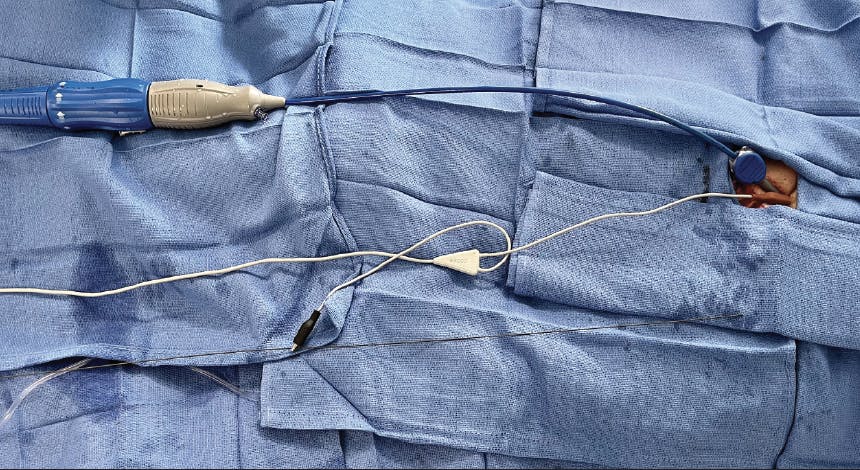
Figure 1. The TAVI delivery catheter is introduced on top of the LV wire and acts as an insulator.
2. One alligator clip should be attached to the patient’s subcutaneous tissue to act as a grounding anode. This connection can be obtained with different methods:
- With interposition of a fine-gauge needle (eg, 21 gauge) of adequate length (eg, 5 cm) penetrating the subcutaneous tissue of the patient and secured to the skin with a Tegaderm (3M) patch; this method can be performed at any time during the procedure but involves the risk of inadvertent puncture
- Directly at the entry site of the delivery catheter, biting the skin with the alligator clamp at one edge of the skin incision; this approach is simpler and safer, preventing any risk of operator puncture
3. The remaining alligator clip, which acts as a cathode, should be attached to the portion of the LV guidewire located at the external tip of the catheter.
4. Finally, a nonsterile operator should connect the electric cable to an external pulse generator and test the cardiac capture at different voltages and rates to confirm the efficacy of the pacing. At this stage, the system is ready to be used.
SPECIAL CONSIDERATIONS
The initial skepticism about this technique was essentially related to the reliability of cardiac pacing and the risk of capture loss during crucial procedural maneuvers. In this regard, the EASY TAVI trial compared LV and RV pacing in 303 patients with aortic stenosis undergoing TAVI and demonstrated a similar efficacy (84.9% vs 87.1%; P = .6) and safety (100% vs 99.3%; P = .99) of stimulation.1
Nevertheless, sometimes it can be difficult to reach a stable LV pacing, despite a proper setup of the system. In these situations, some useful tips and tricks might help.
- First, make sure that the alligator clip attached to the patient holds enough tissue. If in doubt, resort to the other connection method with a needle engaged into the patient’s skin. Check the connection of the second clip to the wire.
- Check the programming of the external pacemaker (should be VVI) at a pacing rate greater than the patient’s spontaneous heart rate. Be aware of a higher threshold to ensure proper LV pacing with this technique. Our advice is to use an external pacemaker that can deliver enough ventricular output (up to 20 V or 25 mA), as shown in Figure 2. By default, the ventricular output should be put at its maximal value.
- Gently modify the LV guidewire position to improve its contact with the LV endocardium (even if proper stimulation can be generally achieved with the wire in the mid LV cavity).
- Finally, try to scratch the proximal part of the LV guidewire (where the alligator clip is attached) with a scalpel to remove the external coating and expose the metallic core of the wire. This should further enhance its electroconductive property.
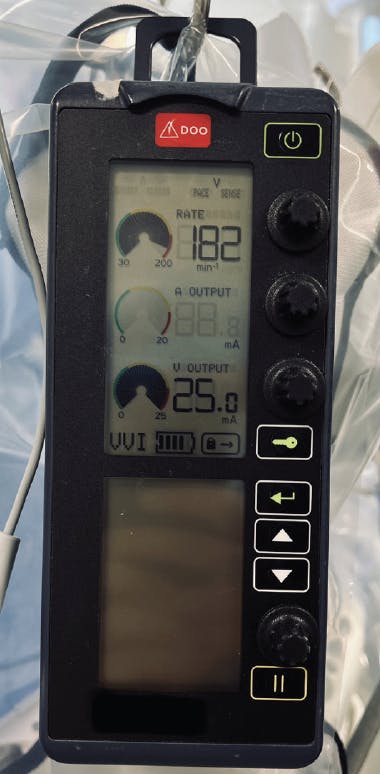
Figure 2. The external pacemaker programmed in VVI mode stimulating at 182 beats per minute with the maximum output energy (25 mA).
In the situation of a high-degree atrioventricular block after THV implantation during a TAVI procedure, the delivery catheter must be pulled back in the ascending aorta, above the THV leaflets, keeping the LV wire in contact with the LV myocardium. That way, it is possible to keep pacing with this technique while replacing it by a regular, longer-term RV pacing system.
MATERIALS
As compared with RV pacing, LV pacing does not require a dedicated pacing lead and related venous access. All the tools necessary to this technique are:
- The LV stiff guidewire, integral to all TAVI procedures; any currently commercially available guidewire can be used (eg, Safari and Amplatz Super Stiff guidewires [Boston Scientific Corporation], Confida guidewire [Medtronic], Lunderquist guidewire [Cook Medical]), although some minor differences in electroconductive capacity have been reported2
- A means of insulation surrounding the LV guidewire to isolate it from the blood and ensure that electrical impulses reach the LV myocardium; any diagnostic or guiding catheter, balloon catheter, or the THV delivery catheter itself can serve this purpose
- An electric cable ending with two alligator clips
- A fine-gauge needle and a Tegaderm patch to assist the connection of the anode to the patient’s subcutaneous tissue (optional, if the connection is not directly performed)
- An external pacemaker that generates high-energy output (generally > 20 V), routinely used during a TAVI procedure
COMPLICATIONS
As compared with traditional RV pacing, this technique prevents the risk of vascular complications associated with the additional venous access, including bleeding, pseudoaneurysm, arteriovenous fistula, thrombosis, and infection and reduces the risk of myocardial perforation and cardiac tamponade. In fact, modern preshaped LV guidewires are less traumatic than the RV pacing lead and, more importantly, obtain contact with the thicker LV muscular wall. The EASY TAVI trial1 revealed a trend toward lower vascular and pericardial complications, although it was not powered to detect a statistically significant difference in clinical outcomes. There are potential complications related to this technique, including, rarely, the inability to obtain stable and reliable LV pacing and patient discomfort related to electrical pain at the anode connection site, mainly related to high voltage output. This can be solved by progressively reducing the ventricular output of the pacemaker, looking for a trade-off between discomfort and proper LV pacing.
1. Faurie B, Souteyrand G, Staat P, et al. Left ventricular rapid pacing via the valve delivery guidewire in transcatheter aortic valve replacement. JACC Cardiovasc Interv. 2019;12:2449-2459. doi: 10.1016/j.jcin.2019.09.029
2. Tamura Y, Tamura Y, Konami Y, et al. Comparison of left ventricular pacing performance among pre-shaped guidewires designed for transfemoral-approach transcatheter aortic valve implantation. Heart Vessels. 2022;37:460-466. doi: 10.1007/s00380-021-01938-4
Advertisement
Advertisement