Advertisement
Advertisement
September/October 2021
The Vessel Is Dissected and I Cannot Wire It!
Techniques for overcoming iatrogenic occlusive coronary dissection when gaining access to the true lumen is challenging.
Iatrogenic occlusive coronary dissection (IOCD) is a well-known complication of percutaneous coronary intervention (PCI) and represents the main causes of abrupt vessel closure.1 Restoring coronary flow by stenting can be easily achieved if a guidewire is already present in the distal true lumen, but it can be challenging if the distal wire position has been lost.
WHY I DO IT
In the setting of IOCD, the increasing pressure of the false lumen by an enlarging hematoma could cause external compression of the true coronary lumen, resulting in restricted coronary blood flow and eventually leading to coronary insufficiency. One of the main reasons for procedural failure during PCI for IOCDs is represented by the difficulty to advance a guidewire into the distal true lumen. Soft workhorse guidewires with a low tip load provide enhanced tactile and visual feedback, increasing the chance of successfully finding the true lumen. If antegrade wiring cannot be promptly accomplished, other techniques to gain access to the true lumen, derived from chronic total occlusion (CTO) interventions, have been described, including subintimal tracking and re-entry (STAR),2 limited antegrade subintimal tracking (LAST),3 and antegrade fenestration and re-entry (AFR).4 Intravascular ultrasound (IVUS)–guided re-entry is another option to deal with acute vessel closure and can be very effective,5 provided that significant expertise with IVUS interpretation exists.
HOW I DO IT
Antegrade Wiring
Guidewire selection is a critical key step for successful percutaneous management of IOCDs. In such situations, the ideal wire should have a soft tip, high torque control, excellent flexibility, and good trackability. It has been reported in a large series of consecutive IOCDs that the Suoh 03 guidewire (Asahi Intecc USA, Inc.) has a higher chance of navigating through the dissected segment following the true lumen, with a lower risk of advancement into the periadventitial space (Figure 1).6 The highly flexible tip of the Suoh 03 guidewire allows the operator to immediately recognize the progression of the wire into the subintimal space with an evident tip deflection, in a sort of “guidewire curling”; straight tip progression is strongly indicative of intraluminal tracking. Conversely, if true lumen wiring with the soft wires fails, CTO guidewires (with intermediate or high tip load) can be used to re-enter the distal true lumen. These wires can be advanced over a dual-lumen microcatheter to facilitate their delivery and enhance wire manipulation.
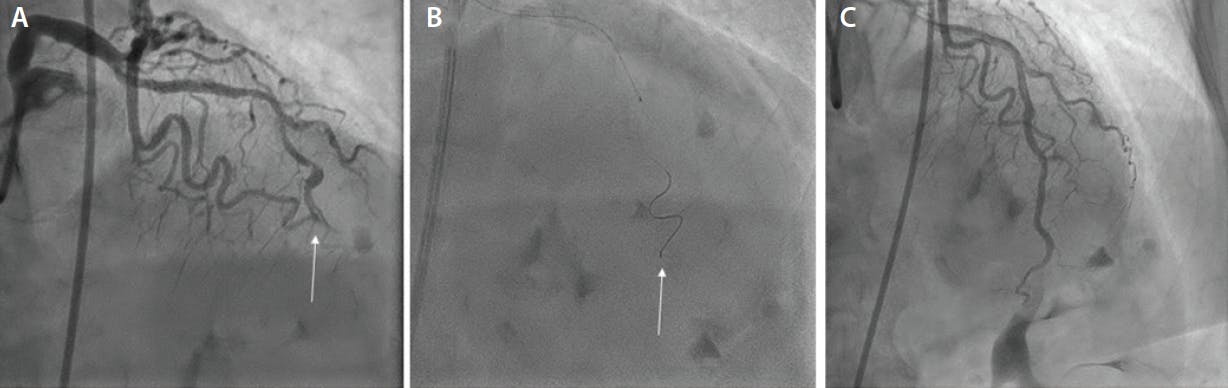
Figure 1. Wiring: long and occlusive spiral dissection of a very tortuous mid left anterior descending (white arrow) (A); successful Suoh 03 guidewire advancement supported by a microcatheter (white arrow) (B); and final result after multiple DES implantations (C).
STAR Technique
STAR was the first subadventitial technique described for CTO PCI.2 A dissection plane is created by advancing a polymer-jacketed wire (eg, Pilot [Abbott], Sion Black [Asahi Intecc USA, Inc.], Fielder [Asahi Intecc USA, Inc.]) with a J-loop configuration at its tip. The wire is forcefully pushed forward and tends to re-enter the true lumen distally, either after a spiral or sinusoidal course or at the site of a bifurcation, within one of the branches. This is because within a nondiseased segment or at the branching point, the endothelial inner layer offers less resistance than the adventitia. A modification of this technique is the so-called “contrast-guided STAR,” which is based on forceful injection of a small amount of contrast dye through a microcatheter into the subadventitial space to create a hydraulic recanalization of the vessel.7 These techniques have been successfully used to achieve true lumen re-entry in cases of abrupt vessel closure in non–CTO PCI.8
LAST Technique
In the LAST technique, the microcatheter is left in place within the subintimal space, in a segment where the tip is clearly adjacent to the true lumen of the vessel.3 After finding the optimal view to direct the wire, an attempt is made to probe and puncture the intima (penetration technique) toward the true lumen. The guidewire is usually a stiff wire (eg, Conquest or Confianza Pro 12 [Asahi Intecc USA, Inc.]), with a 90° curve 2 to 3 mm from the tip. With fine handling of the wire, re-entry within the true luminal space can be achieved.
AFR Technique
AFR was recently described as a technique for the antegrade treatment of CTOs.4 It consists of creating multiple fenestrations of the dissection flap, separating the false and true lumen to permit CTO recanalization. A guidewire is advanced in an antegrade fashion in the subadventitial space beyond the distal cap of the occlusion. A second low–tip load polymer-jacketed guidewire is then brought into close proximity with the first one, with its tip just proximal to the distal cap. A balloon sized 1:1 with the artery is subsequently advanced onto the first guidewire and inflated at nominal pressure at the level of the distal cap, creating transient fenestrations between the false and true lumen that can be effectively engaged with the second guidewire, thus achieving re-entry. This maneuver can be successfully applied to treat IOCD during standard PCI (Figure 2).9
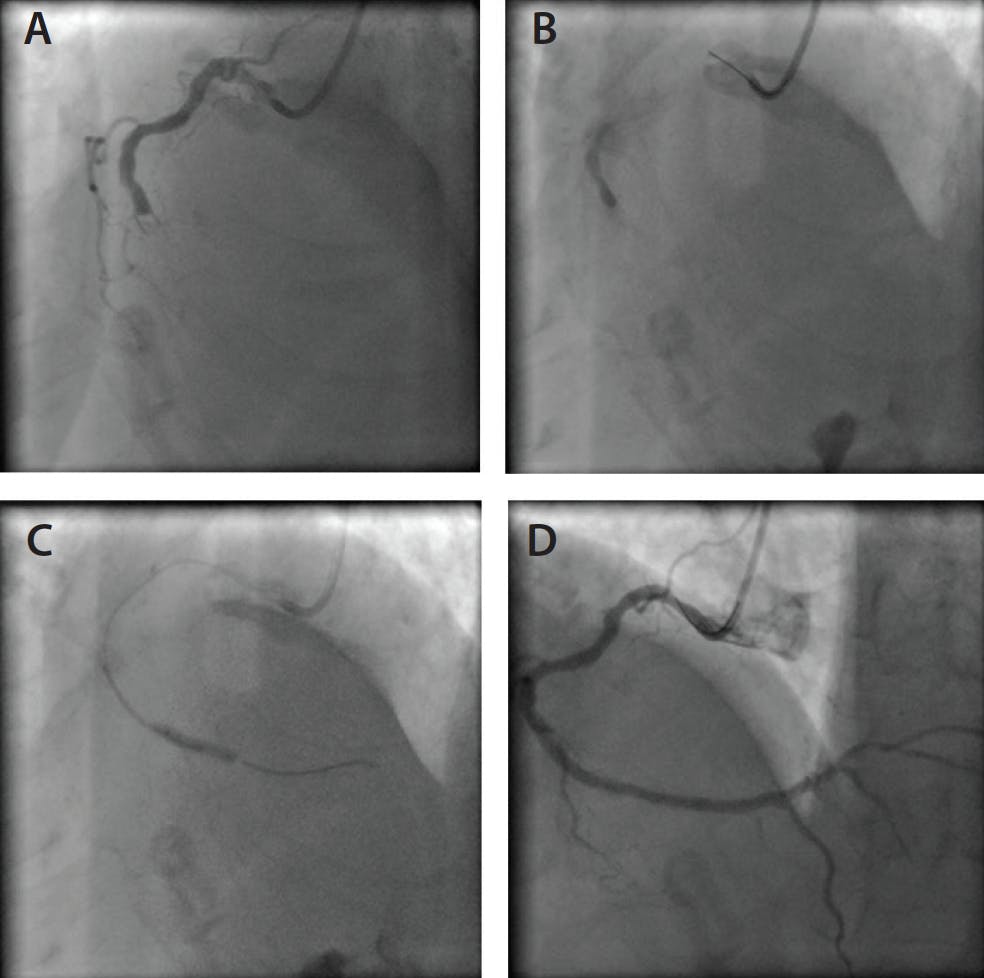
Figure 2. AFR technique: thrombotic occlusion of the middle right coronary artery (A); no reflow due to coronary wire dissection (B); progression of the polymer-jacketed wire in the true lumen across the fenestrations created by 3.5-mm balloon inflation-deflation (C); and final result after multiple DES implantations (D).
The Stingray System
Re-entry into the distal true lumen can be also achieved using the Stingray system (Boston Scientific Corporation).10,11 The Stingray is a low-profile balloon that has a flat shape with two exit ports for re-entry and a distal port for balloon delivery at the re-entry zone. After low-pressure inflation, the Stingray self-orients, wrapping around the vessel. A dedicated stiff wire (Stingray guidewire) or another high–tip load wire is then directed toward the side port of the Stingray balloon facing the true lumen to achieve re-entry. Successful Stingray-based re-entry has been reported in non-CTO scenarios and can be applied specifically in the context of acute vessel closure due to an IOCD.12
IVUS-Guided Re-Entry
IVUS-guided re-entry is another option to deal with acute vessel closure and can be very effective, provided that significant expertise with IVUS interpretation exists.5 The IVUS probe must be advanced into the subintimal space of the dissected vessel and, in most cases, a gentle dilatation with a 1.5- or 2-mm balloon is needed to allow smooth delivery of the IVUS probe. A second guide can be engaged into the same coronary ostium (the “ping-pong” technique), and a second guidewire supported by a microcatheter can be carefully advanced into the true lumen under live IVUS guidance. In case of a completely compressed true lumen, both identification and puncture of the true lumen may be very challenging.
COMPLICATIONS
Wiring
It is imperative to avoid creating new dissection planes or causing acute vessel occlusion when attempting to gain wire access to the true lumen. Antegrade contrast injection should be avoided as it can cause dissection propagation. The subintimal space represents the area of less resistance to wire advancement compared to diseased segments. Reiterated manipulations of the guidewire can enlarge the dissection plane, reducing the likelihood of successful intraluminal guidewire crossing.
STAR Technique
The “rescue STAR” technique has the disadvantages of an unpredictable site of re-entry, creation of extensive dissections, possible side-branch loss, and suboptimal run-off, which have all been linked to higher rates of restenosis on follow-up. According to these considerations, this technique should be used as a bailout strategy when standard approaches to re-entering the true lumen have failed, and its application in the left anterior descending artery is not recommended.
LAST Technique
When performing the LAST technique, the operator advances a tapered stiff guidewire from the subintimal space to the true lumen, which carries an increased risk of coronary perforation. Furthermore, repeat manipulation of a stiff wire with a 90° bend tip can also enlarge the dissection plane, thus increasing the external compression of the true lumen by an enlarging hematoma.
AFR Technique
This technique is associated with the risk of propagating the dissection plane by the advancement of a polymeric guidewire through the fenestrations; thus, it should only be considered in bailout treatment of coronary dissections when standard approaches have failed.
The Stingray System
Advancement of the Stingray balloon followed by attempts to re-enter into the distal true lumen can create a large hematoma surrounding the vessel. Sometimes, the hematoma can cause distal true lumen compression even after successful re-entry and stent implantation. In such cases, the use of a cutting balloon may be useful to decompress the hematoma and restore antegrade flow.
IVUS-Guided Re-Entry
This technique requires significant expertise with IVUS interpretation and, due to its complexity and the possibility of widening the antegrade dissection, it should be considered a last resort and used as a bailout procedure.
CONCLUSION
Confidence with features of coronary guidewires and with subintimal space is of utmost importance in the successful management of IOCD.
1. Black AJ, Namay DL, Niederman AL, et al. Tear or dissection after coronary angioplasty. Morphologic correlates of an ischemic complication. Circulation. 1989;79:1035-1042. doi: 10.1161/01.cir.79.5.1035
2. Colombo A, Mikhail GW, Michev I, et al. Treating chronic total occlusions using subintimal tracking and reentry: the STAR technique. Catheter Cardiovasc Interv. 2005;64:407-411. doi: 10.1002/ccd.20307
3. Lombardi WL. Retrograde PCI: What will they think of next? J Invasive Cardiol. 2009;21:543.
4. Carlino M, Azzalini L, Mitomo S, Colombo A. Antegrade fenestration and re-entry: a new controlled subintimal technique for chronic total occlusion recanalization. Catheter Cardiovasc Interv. 2018;92:497-504. doi: 10.1002/ccd.27470
5. Huang WC, Teng HI, Hsueh CH, et al. Intravascular ultrasound guided wiring re-entry technique for complex chronic total occlusions. J Interv Cardiol. 2018;31:572-579. doi: 10.1111/joic.12518
6. Gasparini GL, Sanz Sanchez J, Gagnor A, Mazzarotto P. Effectiveness of the “new rope coil” composite core Suoh 0.3 guidewire in the management of coronary artery dissections. Catheter Cardiovasc Interv. 2020;96:E462-E466. doi: 10.1002/ccd.28851
7. Carlino M, Godino C, Latib A, et al. Subintimal tracking and re-entry technique with contrast guidance: a safer approach. Catheter Cardiovasc Interv. 2008;72:790-796. Published correction appears in Catheter Cardiovasc Interv. 2009;73:127. doi: 10.1002/ccd.21699
8. Carlino M, Al-Lamee R, Ielasi A, et al. Treatment of iatrogenic occlusive coronary dissections: a novel approach. EuroIntervention. 2011;7:106-111. doi: 10.4244/EIJV7I1A18
9. Merella P, Lorenzoni G, Gasparini GL, et al. Antegrade fenestration and re-entry for bailout treatment of iatrogenic coronary dissection. Cardiovasc Revasc Med. 2019;20:172-173. doi: 10.1016/j.carrev.2018.08.014
10. Brilakis ES. Manual of Coronary Chronic Total Occlusion Interventions: A Step-by-Step Approach. 2nd ed. Elsevier; 2017.
11. Azzalini L, Carlino M, Brilakis ES, et al. Subadventitial techniques for chronic total occlusion percutaneous coronary intervention: the concept of “vessel architecture.” Catheter Cardiovasc Interv. 2018;91:725-734. doi: 10.1016/j.carrev.2018.08.014
12. Martinez-Rumayor AA, Banerjee S, Brilakis ES. Knuckle wire and stingray balloon for recrossing a coronary dissection after loss of guidewire position. JACC Cardiovasc Interv. 2012;5:e31-e32. doi: 10.1016/j.jcin.2012.05.015
Advertisement
Advertisement