Advertisement
Advertisement
September/October 2021
Transcaval Aortic Valve Replacement
A step-by-step guide, including how to manage transcaval-specific complications.
By Giorgio A. Medranda, MD; Adam B. Greenbaum, MD; and Toby Rogers, MD, PhD
The novel and innovative transcaval approach has been developed to bypass suboptimal iliofemoral anatomy while avoiding the invasiveness and morbidity associated with other alternative access options in transcatheter aortic valve replacement (TAVR).1-4 This article details the transcaval technique in TAVR.
WHY I DO IT
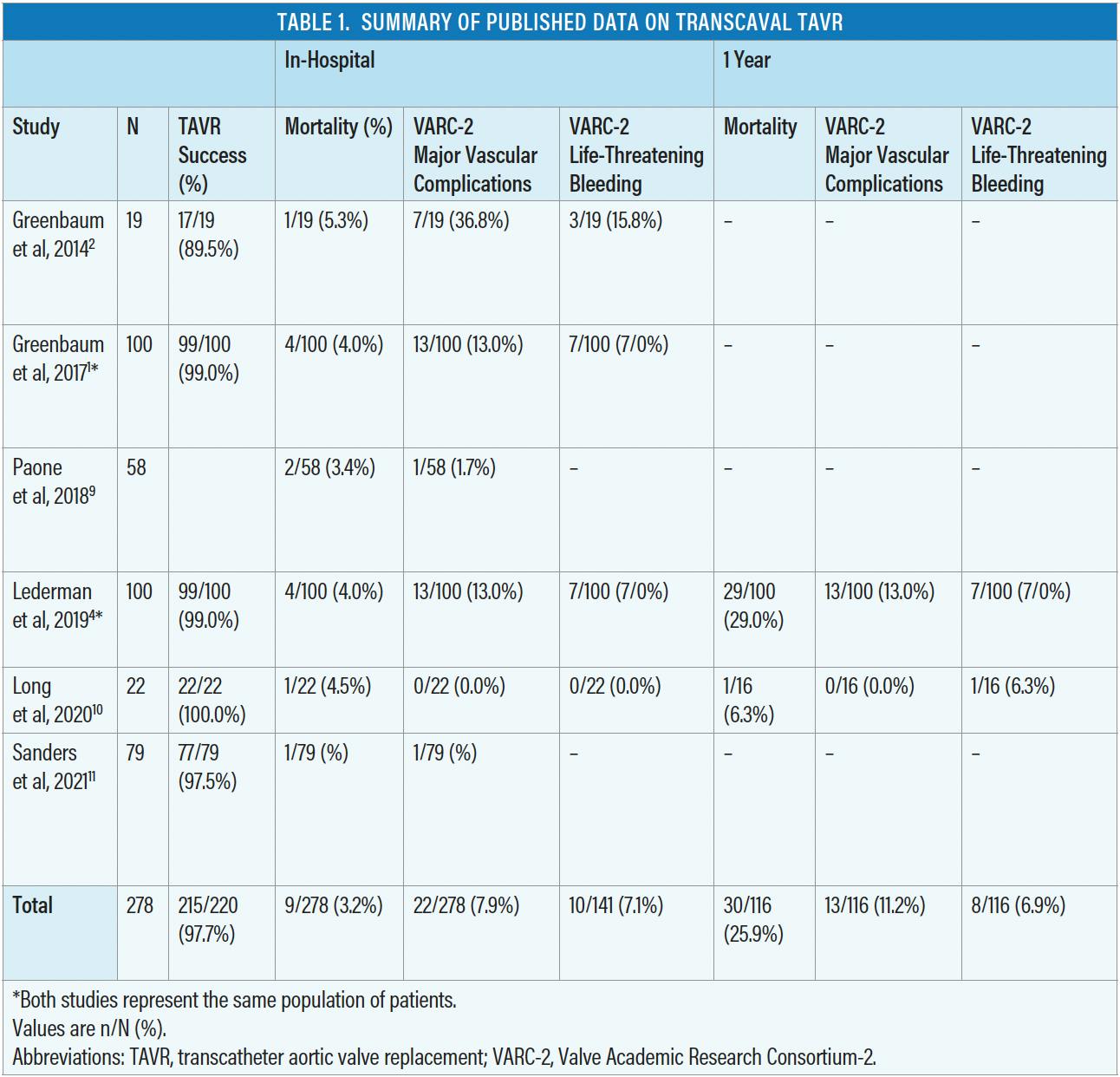
The transfemoral approach remains the preferred and default access strategy in contemporary TAVR. However, despite refinements in design and deliverability over the last decade, there remains a minority of patients with small or diseased iliofemoral arteries who are not eligible for transfemoral TAVR.5,6 Transthoracic access is largely obsolete in contemporary TAVR practice due to unacceptably high complication rates. Initial data on alternative extrathoracic access (transcarotid, subclavian, transaxillary) suggest that these approaches are safe and feasible in this population; however, some require surgical cutdown, increase operator radiation exposure, and may be associated with higher stroke rates.7,8 The transcaval approach utilizes the transfemoral vein to offer a nonsurgical, fully percutaneous option that retains transfemoral ergonomics in limiting operator radiation exposure for patients who are ineligible for conventional transfemoral TAVR (Table 1).1-4,9-11
ANATOMY
Contrast-enhanced multidetector CT (MDCT) planning is essential to ensure procedural success and plan bailout strategies. First, a target entry point for the caval-aortic tract is identified. The target must be free of calcium on the rightward side of the abdominal aortic wall, and ideally at least 15 mm below the lowest renal artery and 15 mm above the aorto-iliac bifurcation (Figure 1). The target crossing location is defined relative to key bony landmarks, specifically the vertebrae and iliac crests, that can then be used to “coregister” the target on fluoroscopy in the cath lab. Patency and typical takeoff of the celiac and superior mesenteric arteries must be confirmed in case the inferior mesenteric artery is jeopardized. Finally, the aorta is sized in advanced to plan bailout strategies with aortic balloon tamponade and/or covered stent deployment in the event of closure device failure.
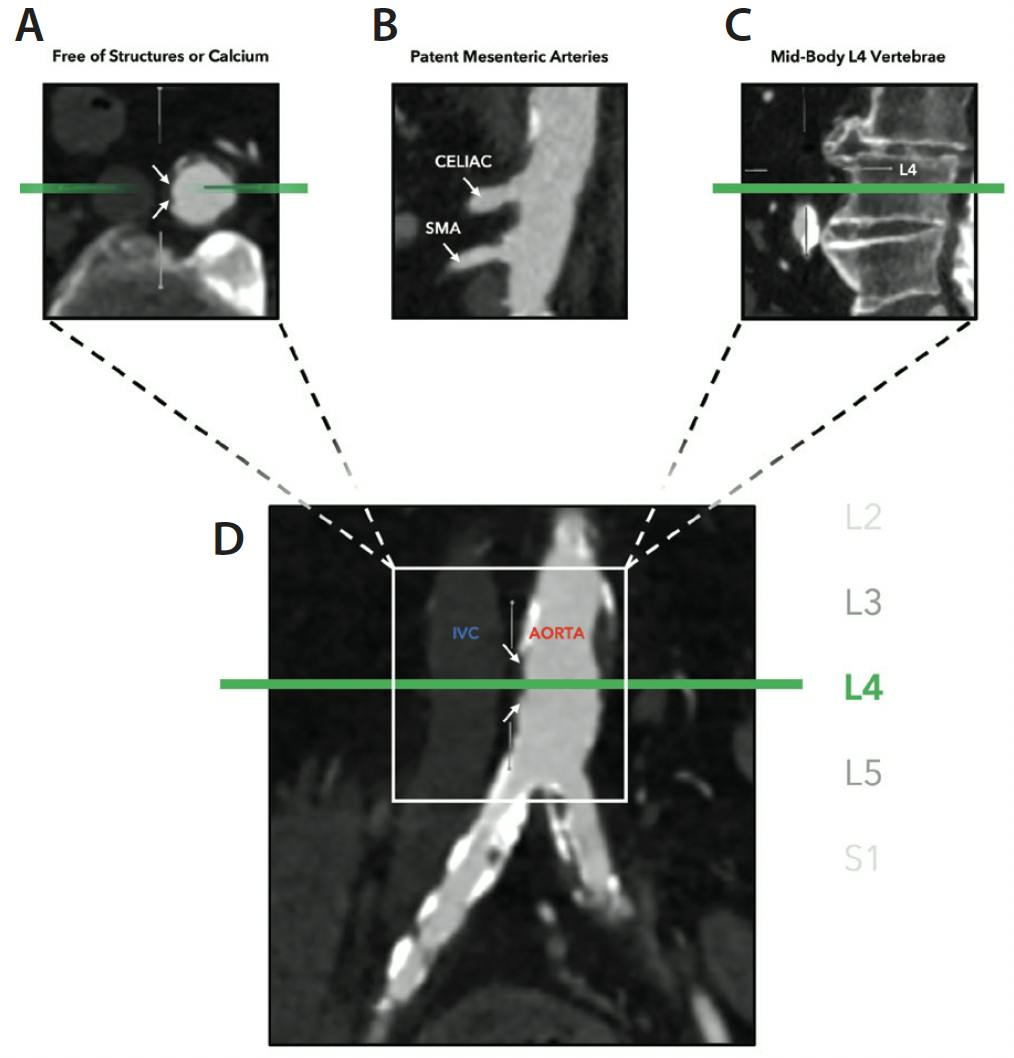
Figure 1. Transcaval TAVR planning on preprocedural CT. Transverse plane of the target caval-aortic crossing (green line), which is free of interposed structures or calcium (white arrows) (A). Sagittal plane of patent celiac and superior mesenteric arteries (white arrows) (B). Sagittal plane of the target caval-aortic crossing (green line) in the midbody of the L4 vertebrae (C). Coronal plane of the target caval-aortic crossing (green line, white arrows) in the midbody of the L4 vertebrae (D).
MATERIALS
Specific equipment are required for transcaval access and closure:
- Two Perclose ProGlides (Abbott)
- 0.014-inch Astato XS 20 wire (Asahi Intecc USA, Inc.)
- 135-cm, 0.014-inch Finecross MG coronary microguide catheter (Terumo Interventional Systems) or equivalent 0.014-inch microcatheter
- 90-cm, 0.035-inch NaviCross support catheter (Terumo Interventional Systems) or equivalent 0.035-inch microcatheter
- 100-cm, 6-F JR4 guiding catheter
- 7-F renal, 55-cm-length renal double curve or internal mammary guiding catheter
- Amplatz GooseNeck snare (Medtronic) sized by MDCT
- 0.035-inch Lunderquist Extra-Stiff guidewire (Cook Medical)
- 8.5-F Agilis NXT SML Curl sheath (Abbott) or equivalent deflectable/steerable sheath
- 0/8 Amplatzer Duct Occluder 1 (Abbott)
- 0.014-inch workhorse coronary wire (eg, balance middle weight)
- 7-F, 45° TorqVue delivery kit, specifically device loader and cable (Abbott)
- Balloons for aortic tamponade and covered stents for bailout
HOW I DO IT
Vascular Access
Performing a transcaval TAVR requires three vascular access sites: one large-bore venous access to deliver the transcatheter heart valve (usually the right femoral vein), a second venous access for transvenous pacing for the TAVR implant, and an arterial access (either left or right common femoral artery, for delivery of the snare, pigtail aortography during the TAVR implantation, and bailout aortic balloon tamponade and covered stent deployment, if necessary). The femoral vein is typically preclosed using two Perclose ProGlides. Alternatively, at the conclusion of the procedure, large-bore venous hemostasis can be achieved using a figure-of-eight suture or manual compression. Common femoral arterial access is then achieved using the ultrasound-guided micropuncture technique. Once all access sites have been successfully achieved, and before achieving transcaval access, full-dose heparin is administered to achieve an activated clotting time > 250 sec.
Caval-Aortic Access
Assembling the coaxial crossing system consists of loading a 0.014-inch guidewire (Astato XS 20) inside a 0.014-inch microcatheter (Finecross), which is then loaded into a 0.035-inch braided microcatheter (NaviCross). The whole system is then loaded into a 7-F renal-length guiding catheter in the inferior vena cava (IVC) aiming for the target crossing location. Optimal position is confirmed in orthogonal projections (defined using MDCT). The back end of the guidewire is clamped to an electrosurgery pencil set to “pure cut” mode at 50W. Care must be taken to ensure no short circuits are created by wet towels or wire loops. Through the arterial access, a 6-F JR4 guiding catheter is advanced to the target crossing location, and a GooseNeck snare is deployed to serve as a fluoroscopic bullseye. The snare is sized approximately 5 mm larger than the diameter of the abdominal aorta. The guidewire is electrified and advanced into the aorta and snared. The guidewire and snare are advanced to the aortic arch. The wire converter and microcatheter are then sequentially advanced into the aorta through the caval-aortic tract. The 0.014-inch guidewire and microcatheter are then withdrawn and exchanged for a 0.035-inch Lunderquist Extra-Stiff guidewire, over which the TAVR introducer sheath is advanced from the femoral vein into the descending aorta. The sheath should always be sutured in place to prevent inadvertent withdrawal during the TAVR portion of the procedure. TAVR is then performed in exactly the same way as with a transfemoral arterial approach.
Caval-Aortic Closure
First, heparin is fully reversed with protamine. The aortic pigtail catheter is withdrawn to just below the transcaval crossing location. Through an 8.5-F Agilis NXT SML Curl sheath, a 10/8 Amplatzer Duct Occluder 1 is deployed by first withdrawing the TAVR sheath back into the IVC, carefully positioning the aortic disc of the occluder against the aortic wall, and then passively releasing the neck of the occluder in the aortocaval tract. A brief drop in blood pressure is commonly observed but is usually tolerated. Pressors that would raise arterial pressure to suprasystemic levels should be avoided. Digital subtraction angiography using 10 mL at 10 mL/sec is then performed. There are four angiographic patterns of closure: type 0, complete occlusion; type 1, patent fistula with a tunnel around the occluder; type 2, patent fistula with a cruciform appearance (the most common); and type 3, extravasation (Figure 2). If the patient remains hemodynamically stable with a closure pattern of 0, 1, or 2, the large-bore femoral venous access is closed using the “preclose” technique, figure-of-eight suture, or manual pressure. Figure 3 summarizes key steps of the transcaval technique.
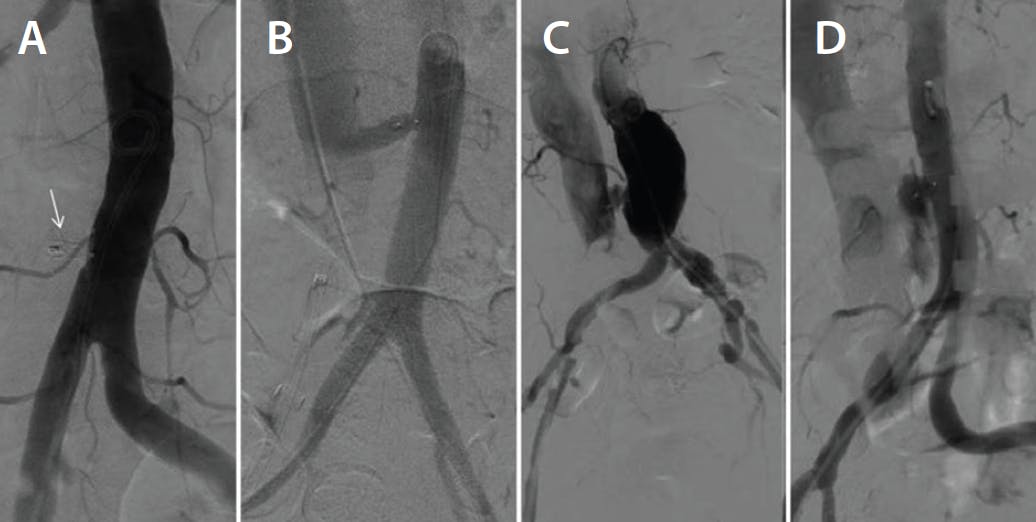
Figure 2. Transcaval closure patterns. There are four angiographic patterns of closure: complete occlusion around the closure device (white arrow) (A); patent fistula with a tunnel around the occluder (B); patent fistula with a “cruciform” appearance (C); and extravasation (D). Reproduced with permission from Lederman RJ et al. How to perform transcaval access and closure for transcatheter aortic valve implantation. Catheter Cardiovasc Interv. 2015;86:1242-1254.
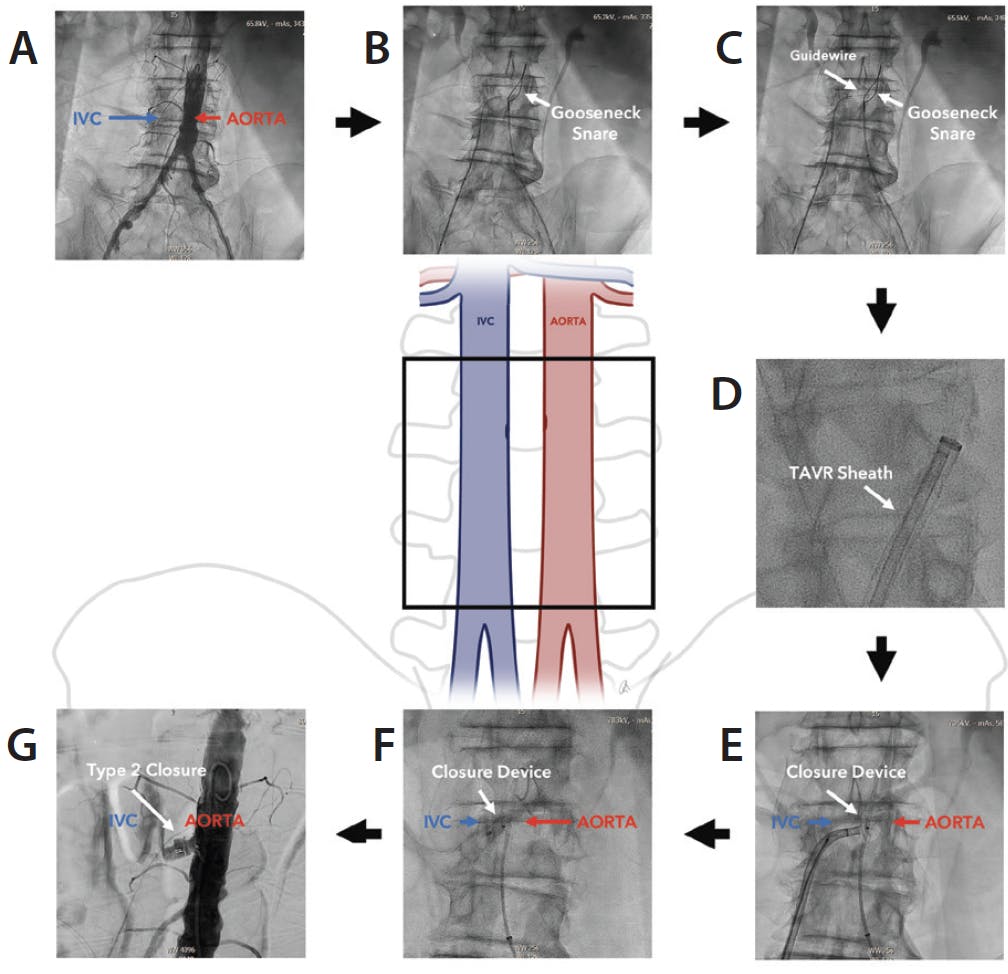
Figure 3. Transcaval technique. Abdominal aortogram (A); 7-F renal guiding catheter in the IVC and GooseNeck snare in the abdominal aorta (B); caval-aortic puncture using an electrified guidewire (C); caval-aortic crossing of the TAVR sheath (D); caval-aortic closure using a 10/8 Amplatzer (E, F); final abdominal angiogram demonstrating angiographic type 2 closure (G).
COMPLICATIONS
Hemodynamic compromise is rare but can occur for three main reasons. The first is bleeding/extravasation, which is identified using digital subtraction angiography. This can occur if there is inadvertent withdrawal of the sheath from the aorta into the retroperitoneal space (but not into the IVC). In this case, the sheath should be further pulled back into the IVC, allowing the blood to flow from the aorta to the cava. The sheath dilator (or a new sheath if an expandable sheath is in place) can then be readvanced to the aorta, and closure can be performed as usual. If bleeding and extravasation occurs after closure, management includes volume administration (intravenous fluids or blood) and aortic balloon tamponade at the level of the occluder (for three cycles of 5 minutes without further heparin administration), which usually achieves hemostasis. If this fails, deploying a covered stent is the next step. Self-expanding covered stents are preferred because they are less traumatic and achieve better sealing around the occluder.
Second is the inability to tolerate the acute left-to-right transcaval shunt secondary to underlying cardiomyopathy or pulmonary vascular disease, although this is vanishingly rare. Balloon tamponade and/or covered stenting may be required.
Third is the usual complications related to the TAVR deployment (eg, annular rupture, left ventricular apical perforation), and they should be managed accordingly.
SUMMARY
Transcaval TAVR is a safe and effective alternative access option in patients with suboptimal iliofemoral anatomy that avoids the invasiveness and morbidity associated with other alternative access options.
1. Greenbaum AB, Babaliaros VC, Chen MY, et al. Transcaval access and closure for transcatheter aortic valve replacement: a prospective investigation. J Am Coll Cardiol. 2017;69:511-521. doi: 10.1016/j.jacc.2016.10.024
2. Greenbaum AB, O’Neill WW, Paone G, et al. Caval-aortic access to allow transcatheter aortic valve replacement in otherwise ineligible patients: initial human experience. J Am Coll Cardiol. 2014;63(Pt A):2795-2804. doi: 10.1016/j.jacc.2014.04.015
3. Halabi M, Ratnayaka K, Faranesh AZ, et al. Aortic access from the vena cava for large caliber transcatheter cardiovascular interventions: pre-clinical validation. J Am Coll Cardiol. 2013;61:1745-1746. doi: 10.1016/j.jacc.2013.01.057
4. Lederman RJ, Babaliaros VC, Rogers T, et al. The fate of transcaval access tracts: 12-month results of the prospective NHLBI Transcaval Transcatheter Aortic Valve Replacement study. JACC Cardiovasc Interv. 2019;12:448-456. doi: 10.1016/j.jcin.2018.11.035
5. Patel JS, Krishnaswamy A, Svensson LG, et al. Access options for transcatheter aortic valve replacement in patients with unfavorable aortoiliofemoral anatomy. Curr Cardiol Rep. 2016;18:110. doi: 10.1007/s11886-016-0788-8
6. Fanaroff AC, Manandhar P, Holmes DR, et al. Peripheral artery disease and transcatheter aortic valve replacement outcomes: a report from the Society of Thoracic Surgeons/American College of Cardiology Transcatheter Therapy Registry. Circ Cardiovasc Interv. 2017;10. doi: 10.1161/CIRCINTERVENTIONS.117.005456
7. Mylotte D, Sudre A, Teiger E, et al. Transcarotid transcatheter aortic valve replacement: feasibility and safety. JACC Cardiovasc Interv. 2016;9:472-480. doi: 10.1016/j.jcin.2015.11.045
8. Ciuca C, Tarantini G, Latib A, et al. Trans-subclavian versus transapical access for transcatheter aortic valve implantation: a multicenter study. Catheter Cardiovasc Interv. 2016;87:332-338. doi: 10.1002/ccd.26012
9. Paone G, Eng M, Kabbani LS, et al. Transcatheter aortic valve replacement: comparing transfemoral, transcarotid, and transcaval access. Ann Thorac Surg. 2018;106:1105-1112. doi: 10.1016/j.athoracsur.2018.04.029
10. Long A, Mahoney P. Comparative intermediate-term outcomes of subclavian and transcaval access for transcatheter aortic valve replacement. J Invasive Cardiol. 2020;32:463-469.
11. Sanders JA, Vaidyanathan A, Sayeed H, et al. Comparison of deep sedation and general anesthesia with an endotracheal tube for transcaval transcatheter aortic valve replacement: a pioneering institution’s experience. J Cardiothorac Vasc Anesth. 2021;35:2607-2612. doi: 10.1053/j.jvca.2020.12.031
Advertisement
Advertisement