Advertisement
Advertisement
We introduce the stent-in-valve implantation (SIVI) technique to address malpositioning or malexpansion of a transcatheter heart valve (THV), which involves the placement of a bare-metal stent (instead of a second valve) into the inflow portion of the first valve prosthesis.
WHY I DO IT
Even though transcatheter aortic valve replacement has emerged as a pillar in the therapy of patients with severe aortic stenosis, prosthesis migration or even embolization remains an unresolved issue that, in particular, concerns self-expanding THVs.1 Depending on the position and function of the malpositioned THV, the most common bailout measure is the implantation of a second prosthesis as a valve-in-valve (ViV) when the first THV has contact with the annulus. However, ViV implantation is an off-label approach that is afflicted with an increased risk of coronary obstruction, impaired future coronary access, enhanced thrombogenicity, and prosthesis-patient mismatch,2-4 not to mention the cost factor.
The SIVI approach constitutes an alternative technique to the classical ViV implantation in the event of device malpositioning or malexpansion; it involves implantation of a bare-metal stent (instead of a second valve) into the inflow portion of the first THV. The main rationale for this novel concept is to avoid the inevitable double layer of prosthesis material that is inherent to ViV implantation and to preserve the integrity and function of the leaflets of the first implanted valve. This may bring about improved hemodynamics, reduced thrombogenicity, a lower risk of coronary obstruction, improved coronary access, and substantial cost savings. Contraindications for SIVI include insufficient contact of the malpositioned THV with the device landing zone, embolization or migration of the THV to the left ventricle, THVs with intra-annular leaflet position, and annular sizes exceeding the available stent diameter. For certain long stent-frame THVs, there may be an increased risk of coronary obstruction.
HOW I DO IT
For SIVI, we use two different commercially available cobalt chromium stents: AndraStent (Andramed GmbH) and Optimus (AndraTec GmbH). The stents have to be crimped manually onto a balloon catheter5 and are available in different sizes (Figure 1), whereby the final stent diameter is mainly determined by the balloon diameter that is used. With respect to the final stent length, some foreshortening has to be taken into account.
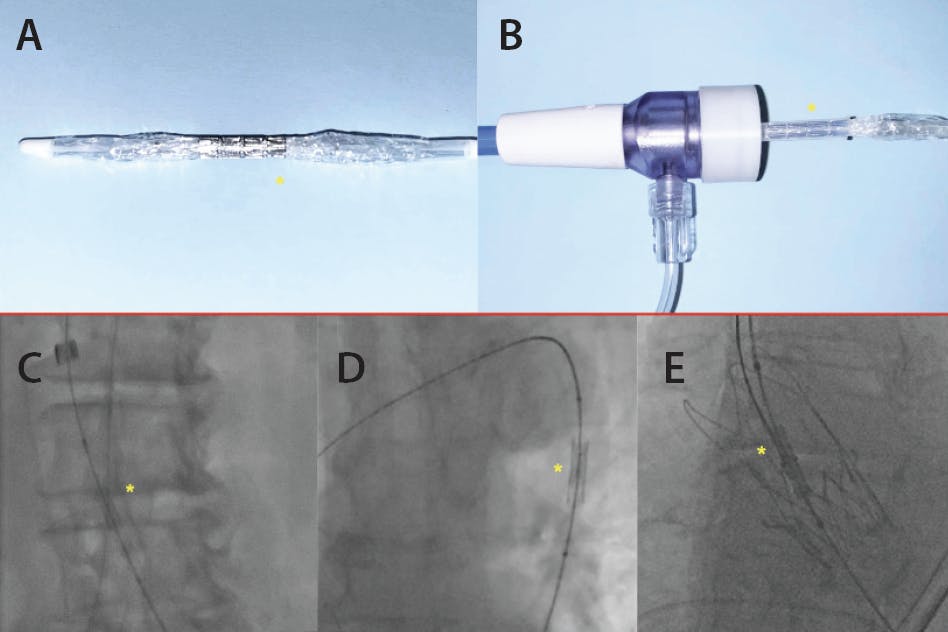
Figure 1. SIVI step-by-step. The stent (yellow asterisk) has to be crimped manually onto a balloon, which should be slightly inflated for improved stent retention (A). A plastic tube may be used as a cover to protect the stent from damage or dislocation during insertion into the introducer sheath (B). After the insertion, great care with thorough wire management is warranted for the advancement of the stent inside the introducer sheath (C), during the passage of the aortic arch (D), and when the stent-balloon assembly enters the prosthesis (E).
Even though there is no specific requirement regarding the balloon type used, in our experience, the most reliable retention of the stent during advancement on the one hand and secure disengagement of the stent after implantation on the other hand was achieved with the True Dilatation balloon (BD Interventional). In addition, the stent should be crimped after minimal inflation of the balloon to increase stent retention (Figure 1A).
The size of the introducer sheath should exceed the size of the balloon catheter by at least 2 F in consideration of the additional stent material. The insertion of the crimped stent into the hemostatic valve of the introducer sheath requires particular attention to avoid any damage or dislocation of the stent. For this purpose, the use of a plastic tube that covers the stent on the balloon may be helpful (Figure 1B). Likewise, the advancement of the stent should be done carefully under fluoroscopic control. Particularly, the passage of the aortic arch and positioning within the malpositioned THV requires meticulous wire management (Figure 1). The optimal position for SIVI depends on the position and design of the malpositioned THV (Figure 2). It is of utmost importance to ensure that the SIVI stent is below the prosthetic leaflets. Once a good position has been attained, the stent has to be deployed by inflation of the balloon during rapid ventricular pacing (Figure 3). Initially, the inflation of the balloon should be slow to allow for adjustment of the position, when necessary, but should be fast when at least 50% of the balloon inflation has been reached. Thereafter, the balloon must be deflated completely, and full disengagement of the balloon from the stent has to be verified by centralizing the guidewire. After careful retrieval of the balloon out of the THV-stent assembly, the result may be checked via angiography, hemodynamic measurements, and echocardiography. In the event of incomplete stent expansion, postdilatation may be considered.
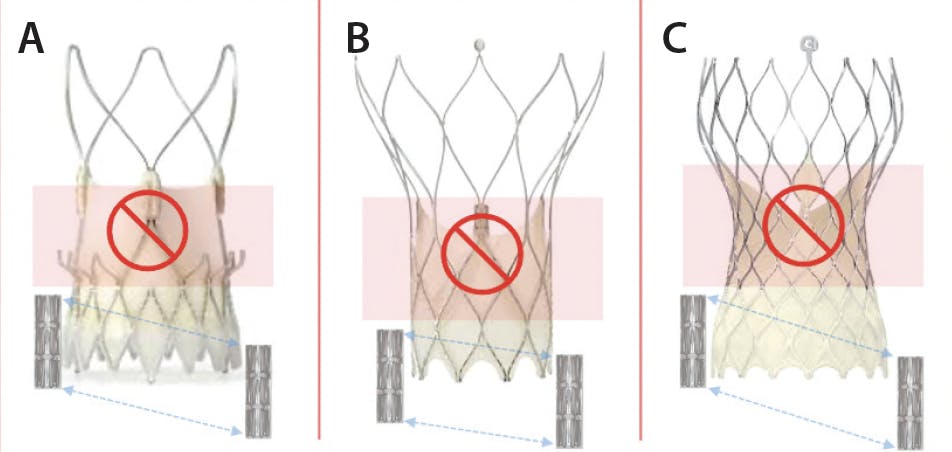
Figure 2. Suggested landing zones for SIVI. SIVI is only feasible in prostheses with a supra-annular leaflet position (Acurate Neo [A, Boston Scientific Corporation]; Portico [B, Abbott]; Evolut R [C, Medtronic]). The positioning of the stent must be beneath the prosthetic leaflets that are labeled in red. The intended degree of overlap depends on the position of the prosthesis and on the length and expected foreshortening of the stent; the range of possible positions is shown in each case.
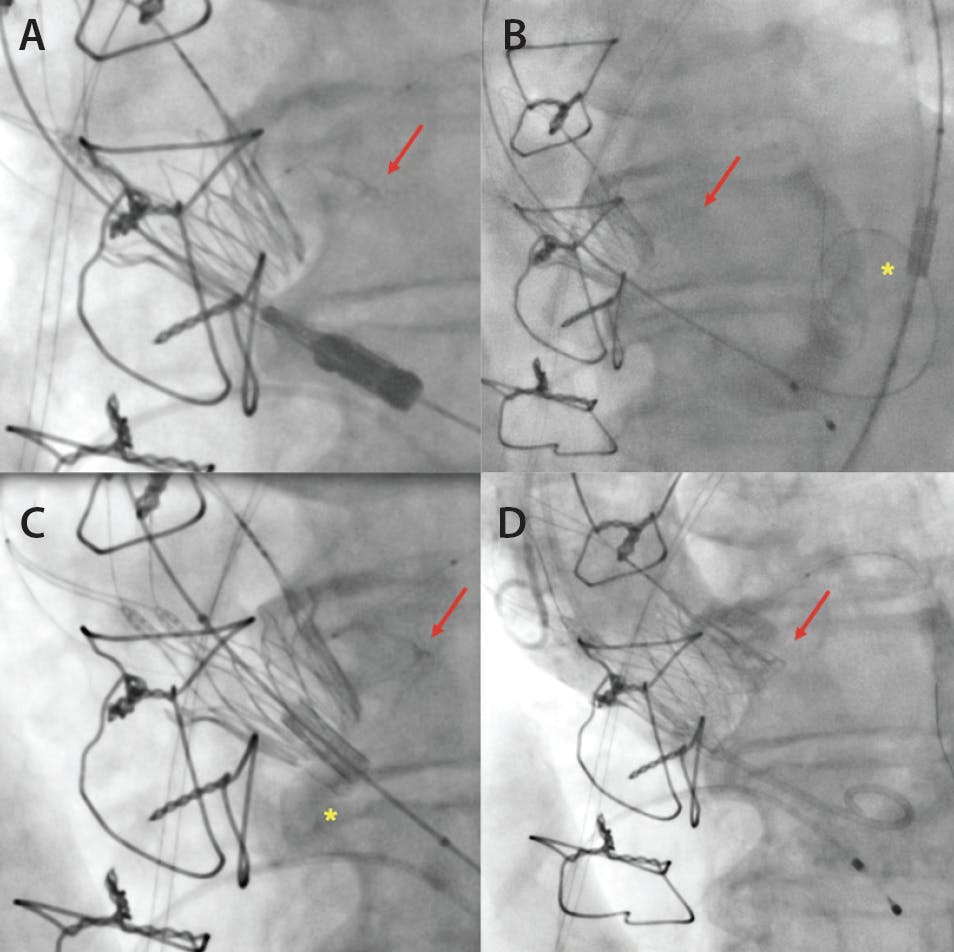
Figure 3. SIVI for a malpositioned valve in a surgical bioprosthesis. Malpositioned Acurate Neo valve in a Trifecta 21-mm bioprosthesis (Abbott) (red arrows; A). Panel B shows the advancement of a stent crimped on a balloon (asterisk), which is implanted in the inflow part of the Acurate Neo valve under rapid ventricular pacing (C). Final aortography shows a good result without aortic regurgitation (D).
CRITICAL APPRAISAL OF THE SIVI CONCEPT AND FIRST-IN-HUMAN RESULTS
SIVI is a novel bailout approach in the event of THV malpositioning or malexpansion that may be considered as an alternative to ViV implantation. In addition, it is crucial to note that SIVI is an off-label approach.
The proof of concept based on our initial experience with SIVI (N = 17) has been accepted for publication recently. Indications for SIVI were malpositioning (n = 11), malexpansion (n = 5), or both (n = 1), with concomitant paravalvular regurgitation (PVR) ≥ moderate (n = 16). SIVI was successful in 13 (76.5%) cases; failures were due to unsuccessful delivery of the stent (n = 2), persistent PVR ≥ moderate (n = 1), and high transprosthetic gradient in a patient with previous small surgical bioprosthesis (n = 1). Reduction of PVR was observed in all but one case.
We noted a learning curve regarding the safe delivery of the stent, as mentioned previously. However, a dedicated delivery system similar to that of contemporary balloon-expandable devices could address the issue of delivery failure that occurred in the early experience, whereas an additional sealing skirt might improve the reduction of PVR.
Potential benefits of the SIVI concept over bailout ViV implantation may be improved hemodynamics and reduced thrombogenicity due to the lower amount of implanted material and preservation of the leaflet function of the first implanted valve, a lower risk of coronary obstruction, improved coronary access, and, finally, a marked cost-efficiency. Its efficacy and safety need to be confirmed in larger studies with long-term follow-up, preferably with a dedicated device.
1. Kim WK, Schafer U, Tchétché D, et al. Incidence and outcome of peri-procedural transcatheter heart valve embolization and migration: the TRAVEL registry (TranscatheteR HeArt Valve EmboLization and Migration). Eur Heart J. 2019;40:3156-3165. doi: 10.1093/eurheartj/ehz429
2. Landes U, Webb JG, De Backer O, et al. Repeat transcatheter aortic valve replacement for transcatheter prosthesis dysfunction. J Am Coll Cardiol. 2020;75:1882-1893. doi: 10.1016/j.jacc.2020.02.051
3. Søndergaard L. Transcatheter aortic valve implantation: don’t forget the coronary arteries! EuroIntervention. 2018;14:147-149. doi: 10.4244/EIJV14I2A24
4. Compagnone M, Marchetti G, Taglieri N, et al. Long-term outcome of prosthesis-patient mismatch after transcatheter aortic valve replacement. Int J Cardiol. 2020;318:27-31. doi: 10.1016/j.ijcard.2020.06.033
5. Fiszer R, Bialkowski J, Chodor B, et al. Use of the AndraStent XL and XXL for the treatment of coarctation of the aorta in children and adults: immediate and midterm results. EuroIntervention. 2016;12:394-399. doi: 10.4244/EIJY15M06_03
Advertisement
Advertisement