Advertisement
Advertisement
September/October 2021
Performing Tip-to-Base LAMPOON
A step-by-step review of this technique to prevent LVOT obstruction from TMVR.
By Jaffar M. Khan, BM BCh, PhD; Adam B. Greenbaum, MD; Toby Rogers, MD, PhD; Christopher G. Bruce, MBChB; Vasilis C. Babaliaros, MD; and Robert J. Lederman, MD
Tip-to-base laceration of the anterior mitral leaflet to prevent outflow obstruction (LAMPOON) is the latest and simplest iteration of a transcatheter electrosurgical technique to lacerate the anterior mitral valve leaflet to prevent left ventricular outflow tract (LVOT) obstruction from transcatheter mitral valve replacement (TMVR).1-3 It may be applied in the setting of valve-in-valve or valve-in-ring TMVR. In a series of 21 patients, tip-to-base LAMPOON was successful in lacerating the anterior leaflet and preventing LVOT obstruction in all, with collateral aortic valve injury in two patients.2
WHY I DO IT
LVOT obstruction remains a common and often fatal complication of TMVR. The pathophysiology is displacement of the anterior mitral valve leaflet toward the interventricular septum. LAMPOON addresses the problem by lacerating the leaflet down the centerline and allowing it to splay away from the LVOT.4-6 LAMPOON typically requires initial basal traversal of the leaflet followed by laceration from the base to the tip. In the setting of a complete mitral ring or a mitral bioprosthetic valve, laceration is safe and feasible from the tip to the base because there is a bioprosthetic backstop preventing harmful aortoatrial extension of the laceration.
HOW I DO IT
Access
The procedure is optimally performed with transesophageal echocardiography (TEE) guidance and under general anesthesia. The procedure may be performed through a single femoral arterial and a single femoral venous access site. An 8-F sheath is inserted into the right femoral vein and preclosed with two Perclose ProGlide sutures (Abbott). A 6-F sheath is placed in either femoral artery. Pacing during valve deployment may be performed over the guidewire, and so an additional venous access is not required. An extra arterial access may be used for intra-aortic balloon pump support.
Septal Crossing
The 8-F venous sheath is exchanged for a deflectable sheath (Agilis medium curl [Abbott] or other per operator’s choice). Transseptal crossing is performed as per usual institutional technique. The transseptal puncture location is chosen on TEE and ideally in an inferior and posterior location on the fossa ovalis. Heparin is administered to achieve an activated clotting time > 300 seconds. The Agilis sheath is advanced across the septum into the left atrium.
Creating a Venoarterial Rail
The Agilis sheath is deflected to face the mitral valve orifice and a balloon-wedge endhole catheter is passed through the Agilis sheath across the mitral valve and retrograde into the LVOT or ascending aorta. A J-wire with a large proximal U bend or a tip-deflector wire may help in directing the balloon catheter around the left ventricular apex and back up toward the aorta. An Astato XS 20 guidewire (Asahi Intecc USA, Inc.) with a J tip is passed through the balloon catheter into the ascending aorta. A 6-F JR4 catheter from the femoral arterial sheath is used to position a (gooseneck or multiloop) snare in the ascending aorta. The tip of the Astato guidewire is then snared into the JR4 and held in place (Figure 1A).
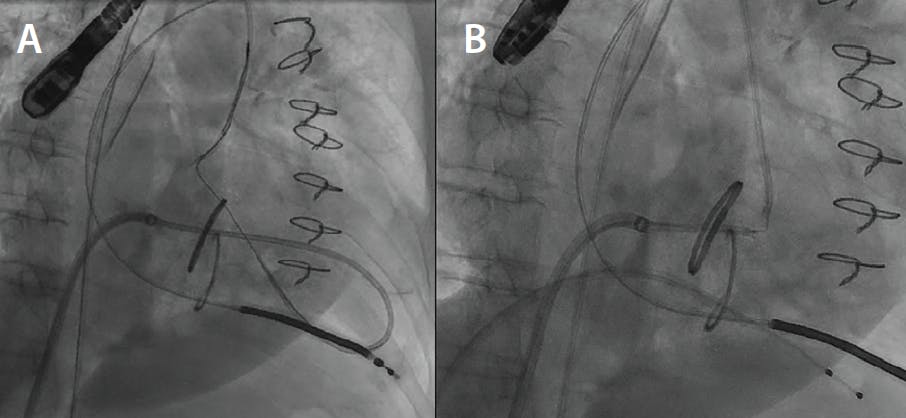
Figure 1. Tip-to-base LAMPOON in ring. A venoarterial loop is created with an Astato guidewire delivered through an Agilis medium curl sheath and balloon wedge and snared in the ascending aorta through a JR4 guide catheter (A). The flying V is positioned at the tip of the anterior mitral leaflet, insulated by a Piggyback microcatheter and two guide catheters (B).
Creating the Flying V
The balloon catheter is exchanged for a 6-F multipurpose or JR4 guide catheter through the steerable sheath. The midshaft of the Astato guidewire is unilaterally denuded with the blade of a scalpel to expose 3 to 5 mm of core wire. This segment is then kinked 180˚ using the blunt back side of the scalpel as a pivot so the denuded surface is at the inner edge of the kink, known as the “flying V.” A hubless locking microcatheter (Piggyback wire converter, Teleflex) is positioned immediately behind the flying V and locked in place. The snared tip of the Astato guidewire is then externalized while simultaneously introducing the flying V into the body and positioning it at the tip of the target anterior mitral leaflet (Figure 1B).
Video 1. Creating the Flying V. The guidewire is pinned between forefinger and thumb and denuded with a scalpel blade. The blunt back end of the scalpel is used as a pivot to kink the guidewire at the denuded segment.
Prepare for TMVR
The valve delivery system, balloon for septostomy, and delivery guidewire are prepared, and the valve is crimped.
Lacerate the Leaflet
The rotating hemostatic hubs on the catheters are tightened and additional torquers added to maintain the relationship between the catheters, microcatheters, and guidewire, ensuring only a few millimeters of guidewire are exposed at the flying V. The catheters are aspirated and flushed, and 60-mL syringes with 5% dextrose are attached. The transseptal steerable sheath is aligned at the tip of the anterior mitral leaflet (or between the bioprosthetic valve posts) in two-chamber or short-axis fluoroscopic projections, and on TEE. Dextrose is infused through the guide catheters while applying tension on both guides and guidewires during electrification at 70 W. The flying V is pulled toward the mitral bioprosthesis, often requiring slightly more tension from the venous side. The laceration is typically longer and slower than in traditional LAMPOON. Electrification should be stopped before the dextrose infusion runs out or if wire position is lost. The system is advanced off the leaflet to allow for TEE assessment of the laceration (Figure 2). Laceration is repeated if a deeper laceration is needed. Finally, the LAMPOON system is disassembled by loosening all hemostatic valves and torquers on the front end of the guidewire and by pulling the guidewire from the Piggyback end.
Video 2. Tip-to-base LAMPOON in ring, seen in the long axis view.
Video 3. Tip-to-base LAMPOON in valve, seen in the short axis view.
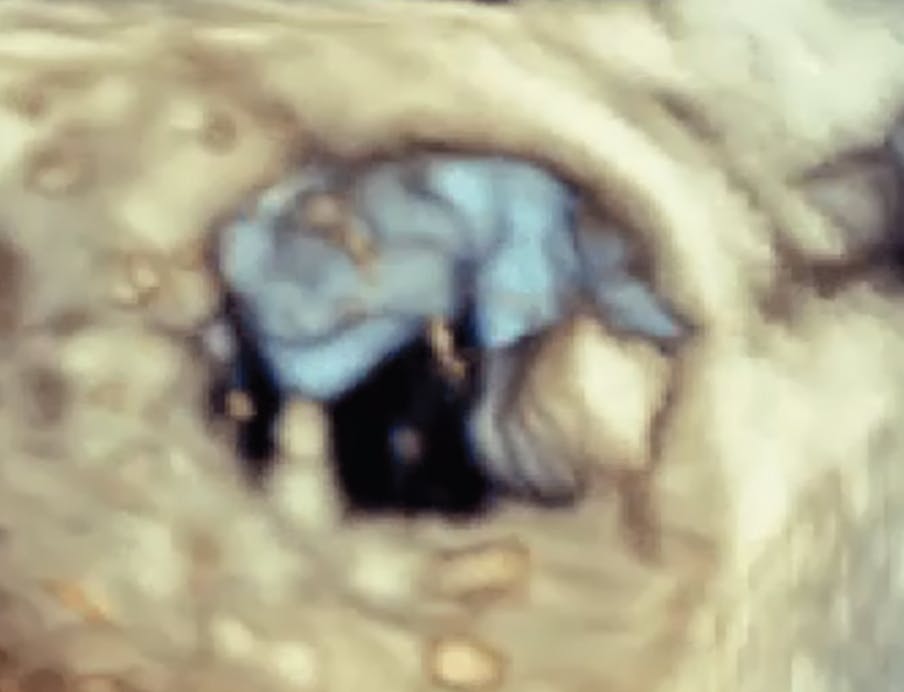
Figure 2. TEE laceration. The anterior mitral leaflet is lacerated down the centerline, as seen in this TEE surgeon’s view.
TMVR
TMVR can proceed as usual. The Agilis sheath already in the left atrium from the LAMPOON directs a stiff guidewire into the left ventricle. Balloon septostomy is then performed, the delivery sheath is introduced, and the transcatheter valve is delivered and deployed.
Final Assessment
Catheter and echocardiography gradients across the mitral valve and LVOT are measured. Valve stability and paravalvular leak are assessed.
Rescue LAMPOON
The same sequence can be used to treat LVOT obstruction after TMVR due to systolic anterior motion of a long anterior mitral leaflet that extends beyond the TMVR frame.7 In this case, the transcatheter heart valve frame acts as the backstop, and the tip of the native mitral leaflet is lacerated (Figure 3).
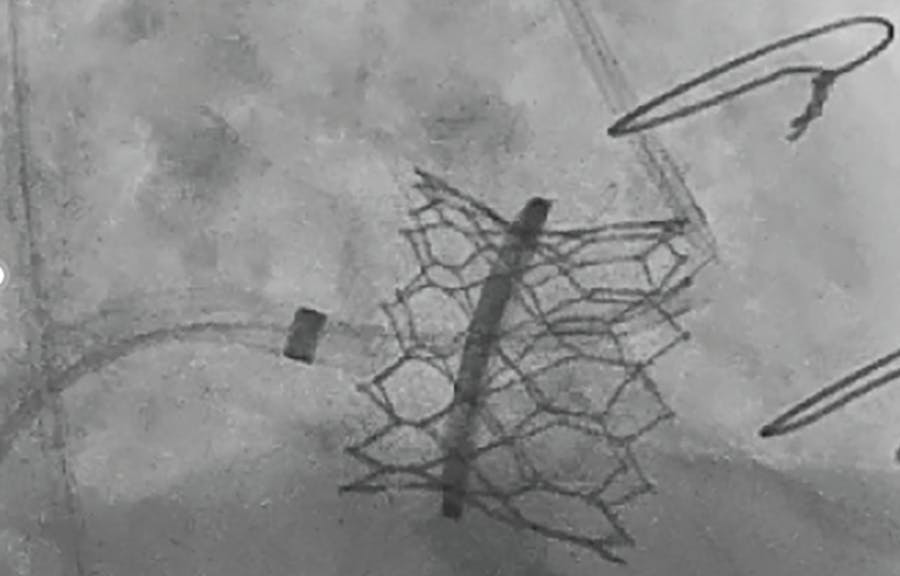
Figure 3. Rescue LAMPOON. The native anterior mitral leaflet is lacerated from the tip to the transcatheter heart valve frame. The flying V is insulated with a piggyback microcatheter and two guide catheters.
ANATOMY AND PATIENT SELECTION
The risk of LVOT obstruction can be predicted on multidetector contrast-enhanced CT. Postprocessing software that enables multiple user-defined centerlines and simulation of a virtual valve is ideally suited for neo-LVOT area prediction. Patients with a neo-LVOT of < 200 mm2 are at increased risk of LVOT obstruction. In addition, patients with long redundant anterior mitral valve leaflets are also at risk of LVOT obstruction from residual systolic anterior motion or transcatheter heart valve leaflet dysfunction from anterior mitral leaflet overhang. Patients are appropriate for tip-to-base LAMPOON if they have a previous bioprosthetic valve or a complete bioprosthetic ring and require TMVR but have increased risk of LVOT obstruction. The majority of these patients are high risk for redo surgery.
MATERIALS
All equipment used is commercially available. The key parts include a deflectable transseptal sheath such as an Agilis medium curl or Nagare sheath (Terumo Interventional Systems), a 300-cm, 0.014-inch guidewire (typically the Astato XS 20), a microcatheter (typically a Piggyback 145-cm microcatheter), a snare (25- or 30-cm Amplatz Gooseneck [Medtronic] or 18/30 EnSnare [Merit Medical]), and an electrosurgery unit with grounding pad and pencil.
COMPLICATIONS AND MANAGEMENT
The main avoidable complication of tip-to-base LAMPOON is damage to the aortic valve. This may occur if the guiding catheters and microcatheters slip during laceration, and the uninsulated guidewire contacts the aortic valve during laceration. This is prevented by ensuring the guidewire is appropriately covered by insulating guide catheters and avoiding excessive traction on the catheters that could inadvertently displace the flying V off the target mitral leaflet and onto the aortic valve. Furthermore, individuals with a surgical ring implanted in a very atrial position (ie, close to the aortic valve) should instead have traditional LAMPOON with initial basal traversal followed by base-to-tip laceration (Figure 4). Aortic valve damage could also potentially occur during exuberant guidewire snare retrieval and can be prevented by ensuring the guiding catheters protect the aortic valve during these maneuvers. After laceration, the patient may experience severe mitral regurgitation and hemodynamic compromise. This is uncommon for valve-in-valve LAMPOON but may be seen during valve-in-ring LAMPOON. This can be managed with pre-emptive placement of an intra-aortic balloon pump before laceration and treated with expedient TMVR. Mitral chord entrapment during LAMPOON loop formation can steer the laceration eccentrically and reduce the efficacy of splay. This is prevented by ensuring a chord-free trajectory with the balloon tip catheter on formation of the venoarterial rail. Finally, LVOT obstruction may still occur despite LAMPOON in the case of eccentric or inadequate laceration or obstruction from the transcatheter valve skirt. This may need to be treated emergently with intravenous fluids, negative inotropes, mechanical circulatory support with Impella (Abiomed, Inc.), and alcohol septal ablation.
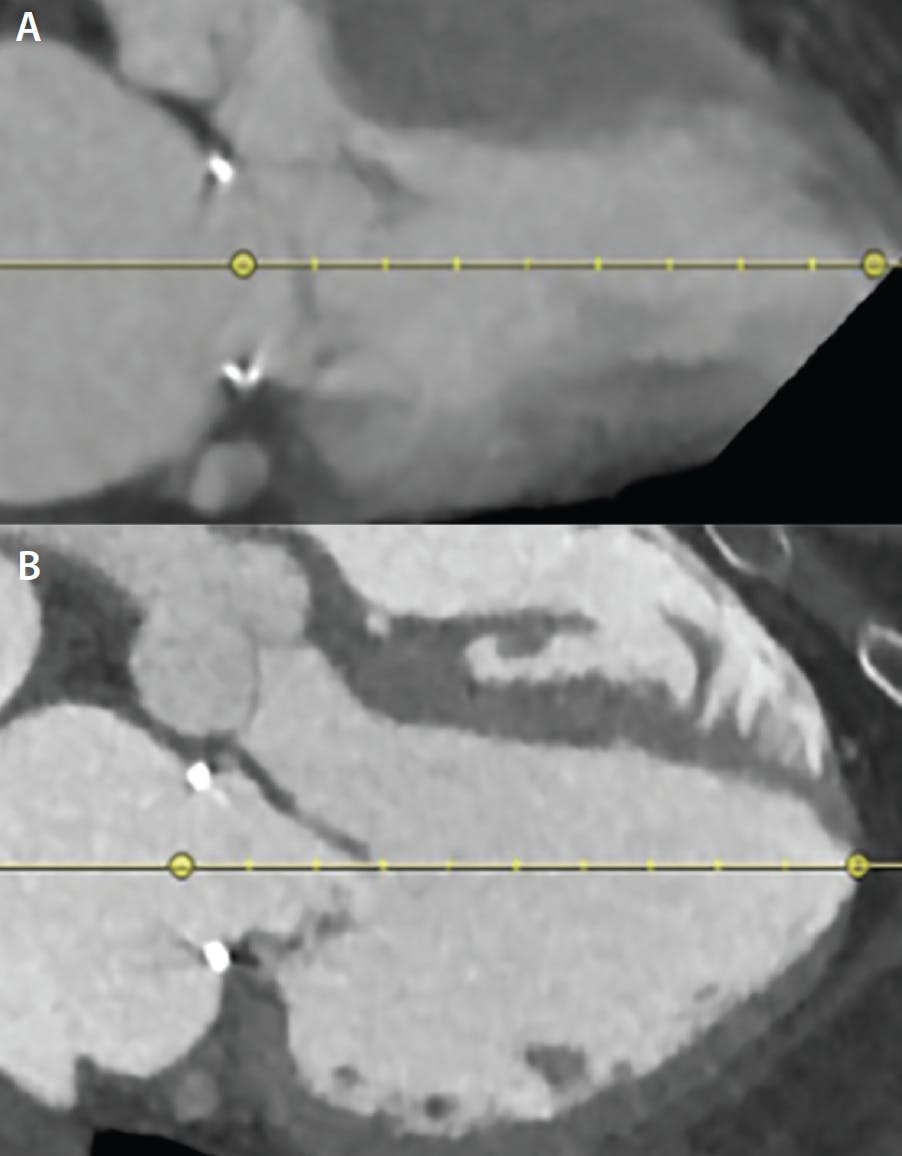
Figure 4. CT suitability for tip-to-base LAMPOON. The bioprosthetic ring is safely away from the aortic valve (A). There is no gap between the bioprosthesis and the aortic valve, making this patient unsuitable for tip-to-base LAMPOON (B). This patient had successful antegrade base-to-tip LAMPOON.
FUNDING: Supported by the Division of Intramural Research, National Heart, Lung, and Blood Institute, National Institutes of Health, USA (Z01-HL006040). NHLBI has a collaborative research and development agreement with Edwards Lifesciences on transcatheter modification of the mitral valve.
1. Case BC, Khan JM, Satler LF, et al. Tip-to-base LAMPOON to prevent left ventricular outflow tract obstruction in valve-in-valve transcatheter mitral valve replacement. JACC Cardiovasc Interv. 2020;13:1126-1128. doi: 10.1016/j.jcin.2020.01.235
2. Lisko JC, Babaliaros VC, Khan JM, et al. Tip-to-base LAMPOON for transcatheter mitral valve replacement with a protected mitral annulus. JACC Cardiovasc Interv. 2021;14:541-550. doi: 10.1016/j.jcin.2020.11.034
3. Case BC, Lisko JC, Babaliaros VC, et al. LAMPOON techniques to prevent or manage left ventricular outflow tract obstruction in transcatheter mitral valve replacement. Ann Cardiothorac Surg. 2021;10:172-179. doi: 10.21037/acs-2020-mv-25
4. Khan JM, Babaliaros VC, Greenbaum AB, et al. Anterior leaflet laceration to prevent ventricular outflow tract obstruction during transcatheter mitral valve replacement. J Am Coll Cardiol. 2019;73:2521-2534. doi: 10.1016/j.jacc.2019.02.076
5. Babaliaros VC, Greenbaum AB, Khan JM, et al. Intentional percutaneous laceration of the anterior mitral leaflet to prevent outflow obstruction during transcatheter mitral valve replacement: first-in-human experience. JACC Cardiovasc Interv. 2017;10:798-809. doi: 10.1016/j.jcin.2017.01.035
6. Khan JM, Rogers T, Schenke WH, et al. Intentional laceration of the anterior mitral valve leaflet to prevent left ventricular outflow tract obstruction during transcatheter mitral valve replacement: pre-clinical findings. JACC Cardiovasc Interv. 2016;9:1835-1843. doi: 10.1016/j.jcin.2016.06.020
7. Khan JM, Trivedi U, Gomes A, et al. “Rescue” LAMPOON to treat transcatheter mitral valve replacement-associated left ventricular outflow tract obstruction. JACC Cardiovasc Interv. 2019;12:1283-1284. doi: 10.1016/j.jcin.2018.12.026
Advertisement
Advertisement