Advertisement
Advertisement
September/October 2021
Circle Method for Bicuspid Screening
A simplified screening technique to identify correct sizing, positioning, and complications before balloon-expandable transcatheter aortic valve implantation in the bicuspid aortic valve.
By Jörg Kempfert, MD, and Melissa Fusari, MD
The bicuspid aortic valve (BAV) anatomy is the most common heart valve anomaly in the general population. When it comes to the severe aortic stenosis patient population, the prevalence of BAV can reach 2% to 6%—and even 20% within the surgical octogenarian patients.1
Although several registries have reported excellent outcomes of transcatheter aortic valve implantation (TAVI) using a balloon-expandable transcatheter heart valve (BETHV) in selected bicuspid anatomy,2-4 there was no clear information provided on how to size and position the BETHV in calcified complex cases until recently. Blackman and colleagues published an expert consensus guide on this important technical aspect, using the circle method to identify the algorithm for transcatheter heart valve (THV) size and position to limit catastrophic complications.5 The purpose of this article is to walk operators through this technique in detail and provide hands-on examples to learn how to correctly identify the BETHV size, how to determine a correct position, and predict complications from gated CT scan review (independently from the software that is used to reconstruct the anatomy of a bicuspid valve).
With this method, a circle representing the nominal expansion of the BETHV is inserted at specific levels from the left ventricular outflow tract (LVOT) to the sinotubular junction (STJ) to show the interaction between the balloon-expandable valve and the BAV anatomy, defined by the number of commissures and the presence/absence of the raphe, as described in the Sievers-Schmidtke classification.6 The technique is particularly helpful for visually identifying anatomic features such as excessive calcified raphe, bulky leaflets, or eccentric calcifications in the aortic valvular complex that can lead to major vascular complications.
It may be also beneficial in expanding indications for unexplored anatomies, such as a large annulus with a range outside tricuspid valve instructions for use (IFU), because it can show where sealing and anchoring can be achieved in the BAV, thus mitigating the risk of significant paravalvular leak or embolization.5
WHY I DO IT
Conventional sizing and positioning for BETHVs have been tested on the bench and in randomized trials that excluded the BAV anatomy. Over the years, the medical community has used BETHVs for bicuspid treatment in high-risk or inoperable patients without specific guidance on the peculiar anatomy. Small BAV series worldwide have shown mortality and complication rates comparable to those seen in standard tricuspid aortic stenosis.7,8 However, a bicuspid valve is a congenital aortic valve malformation with heterogeneous morphologic phenotype, and it leads to annulus-orifice mismatch, which is a situation never observed before. In the tricuspid anatomy, the annulus (as the virtual basal ring) and the orifice (as the perimeter of the free edges of the leaflets) have similar dimensions.9
Instead, in BAV, the orifice can be equal to, bigger than, or smaller than the annulus. The disparity between the annulus and the orifice is based on the uncommon leaflet span required to cover the two cups, leading to geometric mismatch.
This variance in the relationship between annulus and orifice is responsible for the inconsistency of the THV size in the BAVARD population.10 In this registry, BAV anatomy was divided into three groups (tube, flare, and taper) using the correlation between the intercommissural distance (ICD) taken at 4 mm and the projected diameter on the virtual basal ring. The taper group (orifice or ICD smaller than annulus) received a valve that was smaller than that suggested by IFU based on virtual basal ring.
The ICD and, more recently, the virtual raphe ring (as suggested by Tarantini et al11) have been used to justify a new sizing concept for some BAV with insufficient room in the supra-annular area. These measures are not applicable to a comprehensive screening in BETHV because of the poor standardization leading to high variability across operators.11 The unmet needs in both techniques are about what and where to measure BAV because of the following:
- Difficult projection of the ICD into the virtual basal ring in asymmetric BAV
- Unclear location for virtual raphe ring in BAV with raphe and BAV without raphe11
- Inadequacy to detect the risk of complications connected with balloon expansion in the aortic complex (ventricle septal defect, aortic rupture, sinus sequestration)
- Failure to predict the correct final position required by BETHV
The circle technique aims to address a size and position adequate for different configurations of the BAV.
HOW I DO IT
The circle method uses gated CT scan software (eg, 3mensio, Pie Medical Imaging) to project circles at different levels of the aortic valvular complex, from the LVOT to the STJ. The circle diameter mirrors the balloon-expandable valves that are currently commercially available. The choice of the circle size is based on these simple criteria: (1) if the orifice is bigger than or equal to the annulus, we will use the circle that corresponds to the valve size predicted by the virtual annulus ring (according to the IFU); (2) if the orifice is smaller than the annulus and/or there are excessive calcified leaflets and/or severe calcified raphe, we will use the circle corresponding to the valve predicted by the annulus and the circle corresponding to one size smaller than requested by IFU.
Video 1. Type 2 BAV with an annulus of 456 mm2 analyzed with 23- and 26-mm circles (annulus diameter mirrors ICD 24.9 mm; ICD 20 mm at 4 mm; orifice, 17-mm fibrotic leaflets; single calcification over one raphe at the commissure; second raphe not calcified). The circle method was used to decipher the anatomy. An annulus of 456 mm2 is compatible with a Sapien 3/Ultra 26 valve. Circles (sized to either 23 or 26 mm) are inserted at the annulus level to the STJ level. The interactions between the 26-mm circles and the anatomy show that a 23-mm BETHV will be preferred in this case; the 26-mm circles exceed 20% of the anatomy at 4 mm and 30% of the orifice, demonstrating a risk for complications should the larger valve size be chosen. Sealing with Sapien 3 is detected from 3 to 9 mm, and the orifice disappears at 14 mm. A 23-mm Sapien 3 was inserted in standard position (80/20) with no PVL.
Video 2. Type 0 BAV with an annulus of 555 mm2 with calcium in both commissures. The circle method was used to decipher the anatomy. An annulus of 555 mm2 is compatible with a 29-mm Sapien 3/Ultra. Circles (sized to either 26 and 29 mm) are inserted at the annulus level to the STJ level. The interactions between the 29-mm circles and the anatomy show that a 26-mm BETHV size will be preferred in this case, demonstrating a risk for complications (dissection/rupture) should the larger valve size be chosen. The 29-mm Sapien 3 was inserted with rupture at both commissures.
Video 3. Type 1 BAV with an annulus of 564 mm2 compatible with a 29-mm Sapien 3 valve. The circle method was used to decipher the anatomy. Circles (sized to either 26 and 29 mm) are inserted at the annulus level to the STJ level. The interactions between the 29-mm circles and the anatomy show that a 26-mm BETHV size will be preferred in this case, demonstrating a risk of sinus sequestration and left main occlusion should the larger valve size be chosen.
Video 4. Type 1 BAV with a large annulus of 790 mm2 (raphe between right/left coronary cusp connected with calcified leaflets; diameter at the annulus mirroring the ICD 33.4 mm; ICD 30 mm at 4 mm; sealing with 29-mm valve from 5 to 11 mm above the annulus). Circles (sized to 29-mm) are inserted at the annulus level to the STJ level. The interactions between the 29-mm circles and the anatomy show that the 29-mm Sapien 3 can be inserted in standard position.
Video 5.
The sizing algorithm for bicuspid valves recognizes that in the case of reduced supra-annular space because of a smaller orifice or calcium burden, it is necessary to verify with the first circle the sealing in the annulus, with special attention to the complications in the supra-annular space.5,11 The second circle ensures that all anatomic features (including size variations, anomalies, calcifications) are encompassed when simulating the balloon-expandable valve positioning. Valve sizing may need to be mitigated (ie, intentionally choosing a valve that is one size smaller because of landing zone specificities).
Some anatomic conditions are recurrent for bicuspid valves, such as an annulus that falls outside the IFU because it is too large or has eccentric calcifications in the supra-annular space adjacent to the right atrium or right ventricle. Nevertheless, TAVI with BETHV has been demonstrated to be feasible and safe, including in extra-large annuli.12
Sequential balloon sizing, which was previously used to evaluate the supra-annular structure for self-expandable devices, has shown some shortfalls when applied to balloon-expandable devices, and it is not broadly adopted due to limitations from confounding anatomic features (eg, STJ or LVOT smaller than the balloon).
To overcome the variability between operators in the measuring/positioning of the ICD or virtual raphe ring and their inability to predict calcium-related complications, as well as balloon sizing inadequacies, the supra-annular diameter is replaced with a circle. The circle is inserted every 3 mm in the aortic valvular complex to illustrate the interaction within the BETHV anatomy.
The circle is created (as desired) using any software (3mensio for example) and adjusted to be centered with the two commissures (Figure 1). In the first part of the evaluation, the circle will interrogate the LVOT, annulus, and supra-annular space up to approximately 6 to 9 mm. This is the highest level possible for sealing with the BETHV inner skirt depending on the size (Figure 2). The deployment location of the valve is predicted by the interaction between the balloon-expandable skirt and the commissures and leaflets. This justifies a slightly more supra-annular position if a smaller valve is chosen, as there would be a need for close contact with the commissures.

Figure 1. Example of 260-mm BETHV circles inserted in CT scan, from the annulus and then every 3 mm until the STJ and coronary ostia takeoff: annulus level (A); 3 mm above the annulus, interaction with commissures is shown through yellow arrows (B); 6 mm above the annulus, interaction with commissures is shown through yellow arrows (C); 9 mm above the annulus (D); 15 mm above the annulus—STJ level (E).
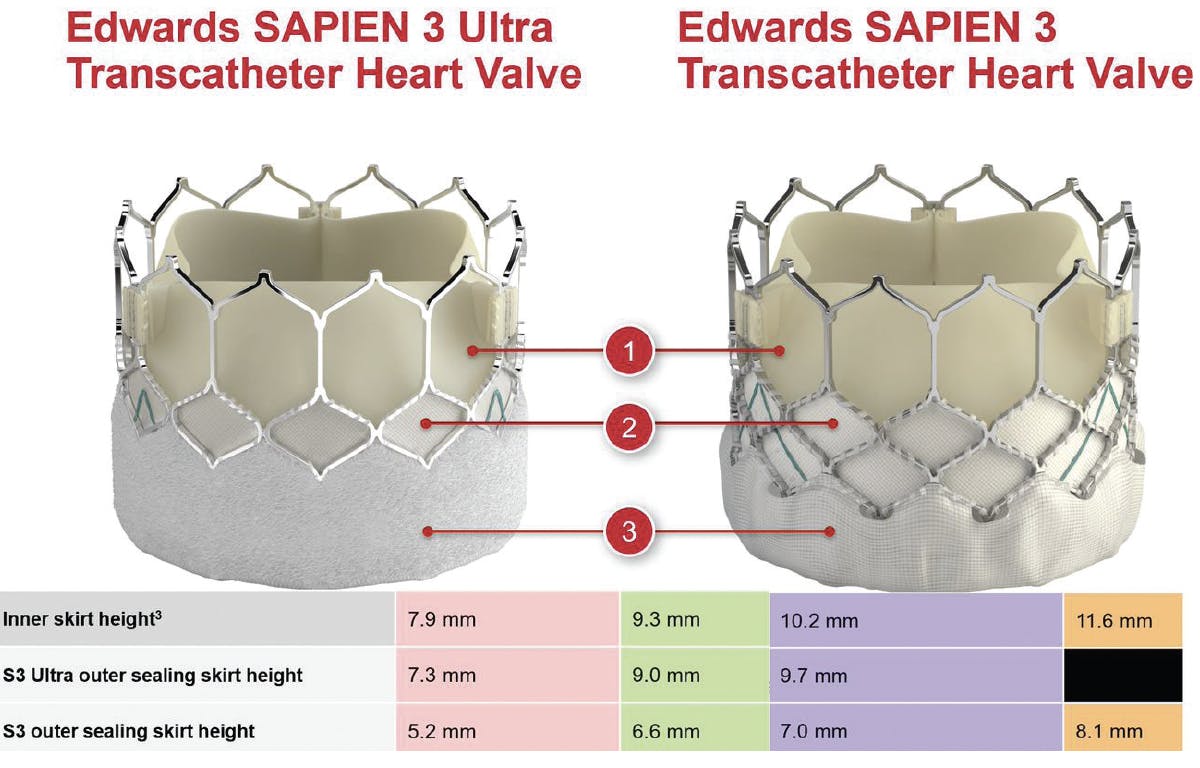
Figure 2. Sapien 3/Ultra skirt height.
In the Bavard registry, the ICD was inserted at 4 mm to have consistency in the measurement between operators. In the circle method, the scrolling and circle placement are more exhaustive, covering a larger portion of the anatomy. This is done to assess the extension and level of sealing at the commissures along with evaluation of possible complications connected with calcium protruding in the anatomy. Iatrogenic ventricular septal defect, eccentric BETHV deployment, and ruptures are more frequent in BAV and are correlated with this section of the supra-annular space.
In the second part of the evaluation, the circle travels the anatomy below and above the coronary arteries to predict coronary occlusion or sinus sequestration, potentially affecting the decision-making process for THV implant in this population because of the impact on the coronary perfusion. This evaluation involves the length and/or redundancy of the leaflets along with the location and/or diameter of the STJ.
Finally, reviewing the interaction between the circles and the average location of the calcium pieces from the LVOT to the STJ helps predict the overall calcium displacement postimplantation of the BETHV (Figure 3).
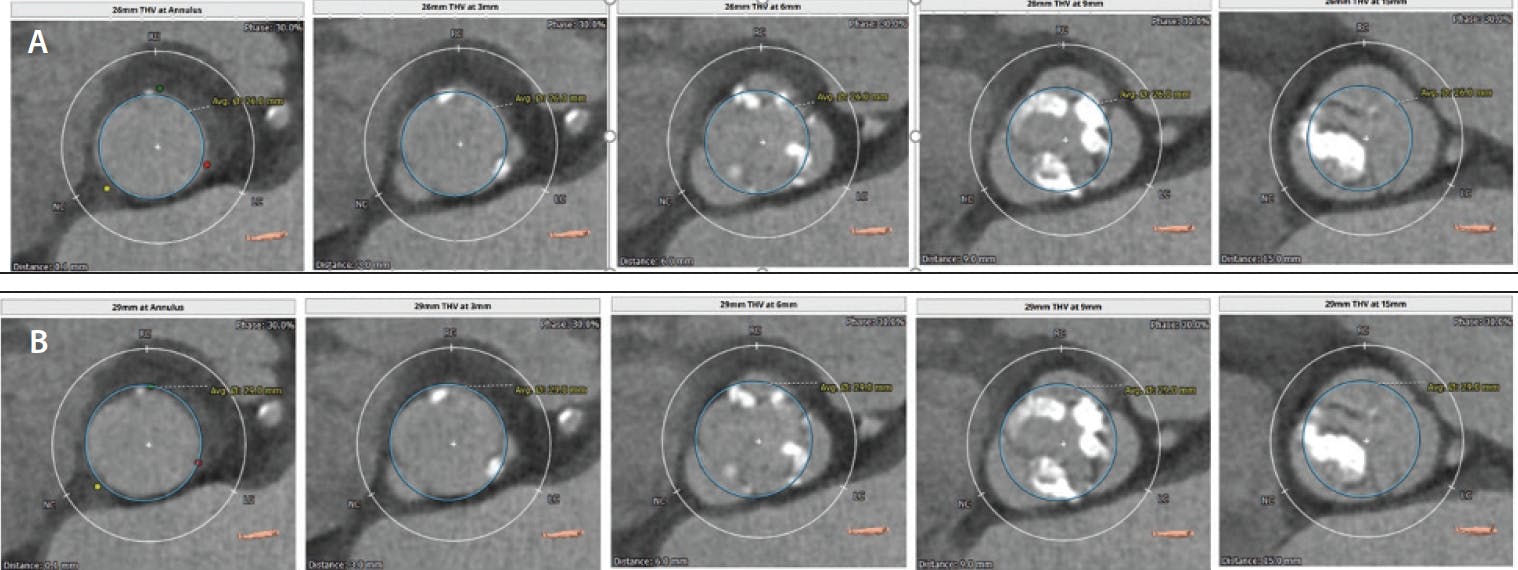
Figure 3. Circle method used to decipher between 26- (A) or 29-mm (B) THV sizing. Circles (sized to either 26 or 29 mm) are inserted at the annulus level and then at levels every 3 mm above the annulus, with a last assessment at the STJ. The interactions between the 29-mm circles and the anatomy/calcifications show that a 26-mm BETHV size will be preferred in this case; the 29-mm circles exceed the anatomy, and the calcification patterns clearly show a risk for complications should the larger valve size be chosen.
Bulky calcium in one leaflet can predict lateral malposition, while longitudinal malposition can be predicted in the case of excessive leaflet calcification attached to a severely calcified raphe, which would impair the upward movement of the cusp in systole.5
The relationship between the circle and the BAV aortic complex can be shown in a fixed report or in a short video clip, with the circle in the anatomy while scrolling from the LVOT to the STJ.
ANATOMY
All bicuspid patients included in the Sievers-Schmidtke classification should be screened for sizing optimization. The subpopulation that receives a greater benefit from the circle method has been described in the Makkar-Yoon classification,13 BAVARD registry classification,10 and the LIRA method14 and can be summarized in three groups: (1) the BAV taper subpopulation with an annulus bigger than the orifice, (2) the population with severely calcified raphe, connected or not with severely calcified leaflets, and (3) BAV with large annulus otherwise excluded from THV implant.
ADVANTAGES OF THE CIRCLE METHOD
There are many advantages of the circle method:
- It is an easy, fast, and reproducible method that can be applied to every CT scan from every platform.
- It provides preoperative insights into the interaction between the Sapien 3/Ultra valves (Edwards Lifesciences) and the sealing zone.
- It predicts calcium-related complications.
- It tailors the valve size to the anatomy (evaluation of the commissure’s interaction with the skirt for sealing, limiting aggressive oversizing).
- It adapts the position of the valve to the anatomy and the sealing zone in a large annulus.
- It predicts coronary occlusion at the implant or in a second implant after THV failure (silent sinus sequestration).
LIMITATIONS/COMPLICATIONS
The circle method can be applied only to a BETHV with a high radial force because it is based on the expansion of the valve to ensure adhesion to the commissures and leaflets.
The circle method is a qualitative method with no strict thresholds yet on how to size the valve. Operators must look at the circle and match it to the anatomy at every level of the aortic valvular complex to identify features that can confirm the size of the valve and the correct position for sealing and anchoring, as well as look at the anatomy responsible for complications.
The most common complication originating from inappropriate sizing with this method is paravalvular leakage. This happens when the choice of the valve size and the final position of the skirt do not match the sealing level at the annulus or above.
Aortic valve embolization in a stenotic BAV with an undersized valve in a taper configuration or extremely calcified leaflets has not yet been reported, but in cases of extremely long fibrotic leaflets, if the downsized valve is positioned in the LVOT, there is a chance of ventricular embolization due to overhanging and concentric forces on the annulus. Annulus rupture, ventricular septal defect, and fistula between the sinus of Valsalva and right cavity are rare when the valve is carefully chosen after this technique.
CONCLUSION
The circle method is an easy, fast, and reproducible visual method to assist the operator when contemplating TAVI in BAV anatomies using a BETHV. Through projecting circles (dimensioned according to the possible sizes of the THV to be used) onto the CT scans of the bicuspid aortic root, this method allows us to predict and avoid complications while guiding the operator toward the correct THV size and position. Although this technique will require further validation, it may help ensure a safe and efficient TAVI procedure in BAV patients.
1. Siu SC, Silversides CK. Bicuspid aortic valve disease. J Am Coll Cardiol. 2010;55:2789-2800. doi: 10.1016/j.jacc.2009.12.068
2. Makkar RR, Yoon SH, Leon MB, et al. Association between transcatheter aortic valve replacement for bicuspid vs tricuspid aortic stenosis and mortality or stroke. JAMA. 2019;321:2193-2202. doi: 10.1001/jama.2019.7108
3. Williams MR, Webb JG. The PARTNER 3 bicuspid registry for SAPIEN 3 transcatheter aortic valve replacement in patients at low surgical risk. Presented at: TVT 2021; July 20-22, 2021; Miami Beach, Florida.
4. Makkar RR, et al. Outcomes of transcatheter aortic valve replacement for bicuspid aortic valve stenosis in the low-surgical risk population. Presented at: EuroPCR; May 19, 2021; virtual presentation.
5. Blackman D, Gabbieri D, Del Blanco BG, Kempfert J, Laine M, Mascherbauer J, Parma R, Tchétché D. Expert consensus on sizing and positioning of SAPIEN 3/Ultra in bicuspid aortic valves. Cardiol Ther. Published online June 3, 2021. doi: 10.1007/s40119-021-00223-9
6. Sievers HH, Schmidtke C. A classification system for the bicuspid aortic valve from 304 surgical specimens. J Thorac Cardiovasc Surg. 2007;133:1226-1233. doi: 10.1016/j.jtcvs.2007.01.039
7. Kim WK, Renker M, Rolf A, et al. Annular versus supra-annular sizing for TAVI in bicuspid aortic valve stenosis. EuroIntervention. 2019;15:e231-e238. doi: 10.4244/EIJ-D-19-00236
8. Weir-McCall JR, Attinger-Toller A, Blanke P, et al. Annular versus supra-annular sizing for transcatheter aortic valve replacement in bicuspid aortic valve disease. J Cardiovasc Comput Tomogr. 2020;14:407-413. doi: 10.1016/j.jcct.2020.01.008
9. Manning WJ. Asymptomatic aortic stenosis in the elderly: a clinical review. JAMA. 2013;310:1490-1497. doi: 10.1001/jama.2013.279194
10. Tchetche D, de Biase C, van Gils L, et al. Bicuspid aortic valve anatomy and relationship with devices: the BAVARD multicenter registry. Circ Cardiovasc Interv. 2019;12:e007107. doi: 10.1161/ CIRCINTERVENTIONS.118.007107
11. Tarantini G, Fabris T. Transcatheter aortic valve replacement for bicuspid aortic valve stenosis: a practical operative overview. Circ Cardiovasc Interv. 2021;14:e009827. doi: 10.1161/CIRCINTERVENTIONS.120.009827
12. Armijo G, Tang GHL, Kooistra N, et al. Third-generation balloon and self-expandable valves for aortic stenosis in large and extra-large aortic annuli from the TAVR-LARGE registry. Circ Cardiovasc Interv. 2020;13:e009047. doi: 10.1161/CIRCINTERVENTIONS.120.009047
13. Yoon S-H, Kim W-K, Dhoble A, et al. Bicuspid aortic valve morphology and outcomes after transcatheter aortic valve replacement. J Am Coll Cardiol. 2020;76:1018-1130. doi: 10.1016/j.jacc.2020.07.005
14. Iannopollo G, Romano V, Buzzatti N, et al. Supra-annular sizing of transcatheter aortic valve prostheses in raphe-type bicuspid aortic valve disease: the LIRA method. Int J Cardiol. 2020;317:144-151. doi: 10.1016/j.ijcard.2020.05.076
Advertisement
Advertisement