Advertisement
Advertisement
September/October 2026
The Shock Team: A New Class I Recommendation
Why multidisciplinary shock teams are essential for early recognition, mechanical circulatory support device selection, and coordinated management of patients with cardiogenic shock.
By Patrick McBride, DO; Raymond Yau, MD; and Mir Babar Basir, DO
Multidisciplinary teams have become a central part of the delivery of high-quality medical care. Trauma teams, pulmonary embolism response teams, and rapid response teams are all examples of hospital systems focusing on improving care for acutely ill patients. Multidisciplinary cardiogenic shock (CS) teams are similarly essential to modern CS management. Such teams integrate complementary expertise across professions and enable coordinated decision-making and comprehensive care for patients with complex needs who are at high risk of morbidity and mortality. We therefore strongly agree with the European Society of Cardiology (ESC) providing a class I recommendation for the use of a multidisciplinary CS team in potential candidates for temporary mechanical circulatory support (MCS) to guide device selection (modality and type) based on patient and heart failure (HF) characteristics (Figure 1).1 CS carries a high mortality (30% to 50%) with minimal change in outcomes during the last several decades despite advancements in medical knowledge and MCS devices.2,3 Since the mid 2000s, the incidence of CS has only increased, emphasizing the need for improvement.4,5
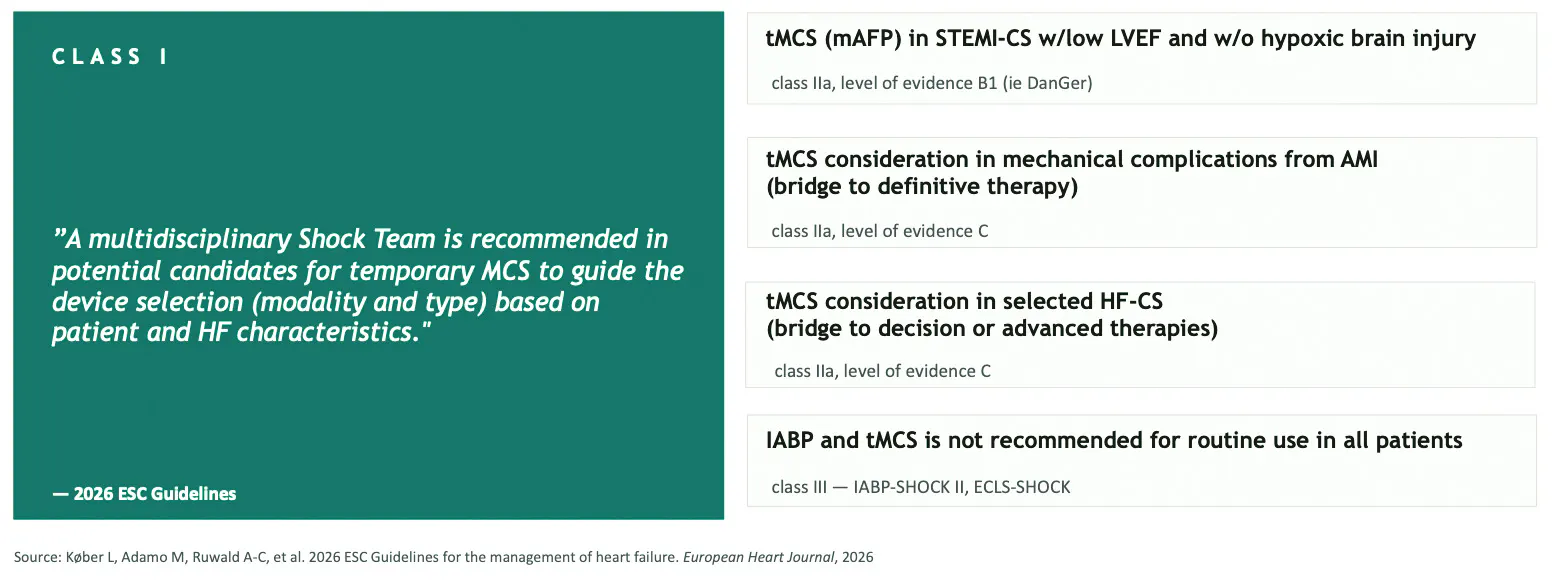
Figure 1. The 2026 ESC guidelines indicate that shock teams should be standard of care when utilizing MCS devices, with a class I recommendation. AMI, acute myocardial infarction; IABP, intra-aortic balloon pump; LVEF, left ventricular ejection fraction; mAFP, microaxial flow pump; tMCS, temporary mechanical circulatory support. Adapted from: Kober L, Adamo M, Ruwald A-C, et al. 2026 ESC guidelines for the management of heart failure. Eur Heart J. Published online August 28, 2026. doi: 10.1093/eurheartj/ehag100
EARLY RECOGNITION AND ESCALATION
CS frequently occurs in settings where the primary clinicians are not cardiologists. Early recognition therefore becomes an important variable in clinical trajectory and outcome for such patients. While it is necessary to disseminate knowledge to noncardiac clinicians, it is insufficient to expect these team members to carry the responsibility on their own. It is therefore essential to create a pathway for these patients to be evaluated and considered for escalation of care because early recognition and intervention have been shown to improve outcomes.6
NAVIGATING MCS DECISION-MAKING
The complexity of temporary MCS decision-making similarly requires balancing patient needs with technological capabilities and often requires insights from interventional cardiology, cardiac surgery, advanced HF, critical care physicians, and nurse coordinators. Understanding patient phenotype and hemodynamic insult becomes essential in choosing the right MCS for the right patient. MCS devices cannot be viewed as interchangeable; device selection often requires an understanding of the expected effects on preload, afterload, myocardial work, and ventricular unloading. Aside from the intended effects, understanding and having a contingency plan for managing complications is essential to creating positive outcomes for our patients.
WHAT RECENT TRIALS TELL US
Recent landmark studies have demonstrated the nuances of MCS device selection. While DanGer Shock demonstrated mortality benefit with the routine use of a microaxial flow pump in ST-segment elevation myocardial infarction (STEMI)–related CS compared to standard care, the trial importantly excluded patients who were comatose, those who presented with non-STEMI, and those who presented with shock > 24 hours, all of which frequently occur in CS patients. Similarly, use of MCS was associated with increased bleeding, limb ischemia, renal replacement therapy, and infection.7 The ECLS-SHOCK trial demonstrated that in patients with acute myocardial infarction–related CS, the risk of death from any cause was not different between those receiving extracorporeal life support (ECLS) versus standard of care, with no benefit in any subgroup and more complications with the use of ECLS.8 Nonetheless, ECLS utilization continues to increase, with a particular focus on the use of ECLS by cardiology-based teams.
THE CHALLENGE OF HF-RELATED SHOCK
When patients present with HF-related CS, the need for multidisciplinary CS teams becomes even more critical. The physiologic and hemodynamic consequences in individuals with acute-on-chronic decompensation are different than those with an acute insult. Patients frequently have biventricular dysfunction in conjunction with other chronic organ disease due to high venous pressures at baseline and a chronic low-flow state. The goal of MCS devices can be different. While myocardial recovery is almost always the goal, consideration of durable left ventricular assist device or transplant becomes paramount in patients who are unlikely to recover. Therefore, the decision to initiate MCS must be made with careful consideration.
THE SHOCK TEAM AS A CALL TO ACTION
For these reasons, although the evidence supporting shock teams is limited, we believe the class I recommendation is very appropriate. The shock team prevents reflexive, indiscriminate use of MCS and facilitates judicious application balancing risks and benefits. The need for a CS team doesn’t end once the device is implanted—management requires serial reassessment, close monitoring of potential complications, and the possible need for additional escalation.
Shock teams help turn individual expertise into coordinated lifesaving action! We hope the class I recommendation provided by the ESC will be followed by the American Heart Association and American College of Cardiology and will become a call to action for hospitals around the country to set up such teams in their hospitals and communities.
1. Kober L, Adamo M, Ruwald A-C, et al. 2026 ESC Guidelines for the management of heart failure. Eur Heart J. Published online August 28, 2026. doi: 10.1093/eurheartj/ehag100
2. Sinha SS, Rosner CM, Tehrani BN, et al. Cardiogenic shock from heart failure versus acute myocardial infarction: clinical characteristics, hospital course, and 1-year outcomes. Circ Heart Fail. 2022;15:e009279. doi: 10.1161/CIRCHEARTFAILURE.121.009279
3. Abraham J, Blumer V, Burkhoff D, et al. Heart failure-related cardiogenic shock: pathophysiology, evaluation and management considerations: review of heart failure-related cardiogenic shock. J Card Fail. 2021;27:1126-1140. doi: 10.1016/j.cardfail.2021.08.010
4. Osman M, Syed M, Patibandla S, et al. Fifteen-year trends in incidence of cardiogenic shock hospitalization and in-hospital mortality in the United States. J Am Heart Assoc. 2021;10:e021061. doi: 10.1161/JAHA.121.021061
5. Schrage B, Becher PM, Goßling A, et al. Temporal trends in incidence, causes, use of mechanical circulatory support and mortality in cardiogenic shock. ESC Heart Fail. 2021;8:1295-1303. doi: 10.1002/ehf2.13202
6. Basir MB, Schreiber TL, Grines CL, et al. Effect of early initiation of mechanical circulatory support on survival in cardiogenic shock. Am J Cardiol. 2017;119:845-851. doi: 10.1016/j.amjcard.2016.11.037
7. Møller JE, Engstrøm T, Jensen LO, et al; DanGer Shock Investigators. Microaxial flow pump or standard care in infarct-related cardiogenic shock. N Engl J Med. 2024;390:1382-1393. doi: 10.1056/NEJMoa2312572
8. Thiele H, Zeymer U, Akin I, et al. Extracorporeal life support in infarct-related cardiogenic shock. N Engl J Med. 2023;389:1286-1297. doi: 10.1056/NEJMoa2307227
Advertisement
Advertisement