Advertisement
Advertisement

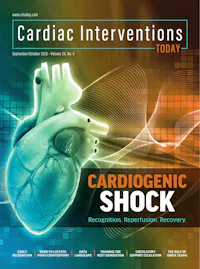
Cardiogenic shock (CS) continues to challenge clinicians with the need for urgent and consequential decision-making. However, the tide of change and innovation is well under way. Clinicians are routinely discussing the importance of hemodynamics, the nuances of bedside care, and perhaps most importantly, the value of true multidisciplinary collaboration and care. For the CS community, the task is not simply to expand therapeutic options, but to determine when, how, and for whom those therapies should be utilized. In this issue of Cardiac Interventions Today, we examine the continuum of contemporary shock care, from early recognition to escalation, and we highlight the training, resources, and leadership needed to translate contemporary advancements into thoughtful, patient-centered care.
Rebecca Chester, MD, and Christopher G. Low, MD, begin our issue by emphasizing the importance of early recognition, highlighting how the “golden” hours facilitate timely stabilization, treatment escalation, and access to advanced care.
Next, Srihari S. Naidu, MD, and his colleagues Chirag Mehta, MD, and Howard A. Cooper, MD, debate with Bernard S. Kadosh, MD, as to whether door-to-lactate clearance should serve as a standardized metric for contemporary CS care.
From assessment, the focus turns to treatment, as Jessica Maria Gonzalez, MD, and Aditya Bharadwaj, MD, discuss when and how to escalate mechanical circulatory support care in CS, including the role of hemodynamic guidance and the importance of a multidisciplinary shock team.
We then feature two panel discussions with CS experts. Aasim Afzal, MD; Allison Dupont, MD; and Rajan A.G Patel, MD, provide insights on contemporary data and the evidence guiding today’s care, from lessons learned from DanGer Shock, to the importance of shock protocols and phenotyping, to the priorities for future trials.
Helping to translate these advances into clinical practice Adnan Khalif, MD; Ajar Kochar, MD; and Balim Senman, MD, explore the core competencies, multidisciplinary training, and specialized expertise needed to prepare clinicians for contemporary CS care.
To close out our feature, Patrick McBride, DO; Raymond Yau, MD; and I examine the growing role of multidisciplinary shock teams in early recognition, mechanical circulatory support selection, and coordinated management of CS in light of the recent class I recommendation.
In our Today’s Practice column, Joel Sauer, MBA, reports data from the MedAxiom 2026 Cardiovascular Provider Compensation & Production Survey, highlighting trends in coronary, advanced imaging, and structural heart volumes and what they mean for cath lab capacity and planning.
Last, we interview Kimberly A. Skelding, MD, who shares her perspective on resilience and shared decision-making in interventional cardiology, advances and remaining gaps in radiation safety, the value of societal leadership, and more.
The contributions in this issue underscore that advancing CS care requires more than any single device, protocol, or trial. It demands timely recognition, repeated reassessment, individualized treatment, and teams prepared to act decisively while remaining responsive to evolving evidence and patient preferences. We hope this issue encourages readers to examine their own practice, strengthen collaboration across disciplines, and helps shape a future in which scientific progress translates into meaningful recovery for patients and their families.
Mir Babar Basir, DO
Guest Chief Medical Editor
Advertisement
Advertisement