Advertisement
Advertisement
May/June 2026
The Role of Cardiac CT for Successful TAVR Planning
CT-based annular sizing, access planning strategy, and risk stratification to optimize TAVR outcomes and reduce complications.
The standard of care for procedural planning in transcatheter aortic valve replacement (TAVR) is CT. Advances in imaging technology now allow acquisition of high-quality data using lower contrast volumes (≤ 40 mL) and reduced radiation doses. The primary objectives of the procedural CT scan are to (1) identify the optimal access route for valve delivery; (2) determine appropriate prosthesis size; and (3) evaluate for high-risk anatomic features, including angulated aortic root, risk of coronary obstruction, and potential for annular rupture and paravalvular leak (PVL). In cases where contrast administration is not feasible, a noncontrast electrocardiogram (ECG)-gated CT scan can still provide valuable information by assessing the distribution and severity of calcification at the annulus and along the vascular access pathway.
This article reviews the central role of CT in TAVR planning, including access evaluation, valve sizing, and procedural risk assessment.
ACCESS EVALUATION
Vascular complications after TAVR are associated with poor short- and long-term survival; therefore, a thorough evaluation prior to the procedure is critical.1 CT has a greater predictive value for vascular complications post-TAVR than invasive angiography and is the preferred method to assess access prior to TAVR.2 As part of preprocedural planning, CT allows for three-dimensional (3D) assessment of the access pathway, including arterial vessel size, tortuosity, calcium distribution, and prediction of access closure ability. Similarly, arterial vessel pathologies such as aneurysms, calcification, and dissection can be evaluated.3
Transfemoral access is the most common access for TAVR; however, CT can also be used to assess for alternative access, such as transaxillary/subclavian, transcaval, transcarotid, suprasternal, transapical, or direct aortic when femoral access is not feasible.4 Known risk factors for major transfemoral complications include high sheath-to-femoral artery ratio, large femoral artery depth, and severe iliofemoral artery calcification.5,6 An early study determined that a sheath-to-artery ratio > 1.05 was associated with higher rates of major vascular complications (30.9% vs 5.6%) and 30-day mortality (18.2% vs. 2.8%) compared to a ratio ≤ 1.05.7 When alternative access is chosen, the access route often depends on site experience and comfort with alternative access routes.
Although randomized studies have not been performed, the literature suggests lower stroke rates for transcaval (approximately 3%) and transcarotid (approximately 3%) access compared to transaxillary access (approximately 6%).8,9 Among the nonsurgical techniques, operators may be more familiar with percutaneous axillary techniques and equipment, as transcaval access requires experience with electrosurgery. For transcaval access, CT specifically helps with choosing a calcium-free window for electrocautery puncture that has a short distance between the inferior vena cava and aorta and is away from important arterial branches.8
PROSTHESIS SIZE SELECTION
Three-dimensional assessment of annular size on CT is highly accurate and most commonly used. Prior to the use of CT for determining annular sizing, two-dimensional echocardiography was used and associated with high rates of PVL.10,11 However, in cases where contrast cannot be administered for a CT scan, annular size can be assessed by 3D transesophageal echocardiography and confirmed with balloon aortic valvuloplasty (BAV).12 Additionally, reports suggest that cardiac MRI may provide a similar comprehensive assessment for patients who are not able to tolerate large loads of contrast agents, although further data are needed to support these findings.13
ECG-gated contrast CT with multiphasic acquisition during 30% to 40% of the R-R interval (systole) is typically used to determine annulus and valve size.11 The standard method identifies the virtual basal ring by connecting the three hinge points of the aortic sinuses.14 Area measurements taken at end-diastole have been shown to be smaller by approximately 10%.15 CT characterization of annular calcification can also help with prosthesis size selection.11 Annulus area is used to determine prosthesis size for balloon-expandable valves, while annulus perimeter is typically used for self-expanding valves.
Patients with bicuspid aortic valves remain a challenge for transcatheter therapies. CT phenotypes and stratifies bicuspid valve disease into risk categories of low, intermediate, and high TAVR risk (Figure 1).16 Key factors to consider include raphe presence, length and calcification, leaflet distribution of calcium, and intercommissural distance.17 The coexistence of excessive leaflet calcium and a severely calcified raphe is the highest risk and associated with poor early outcomes, including moderate PVL or greater, aortic root injury, and 30-day mortality.18 Sizing can be challenging in the case of discordance of annulus size, left ventricular outflow tract (LVOT) size, and intercommissural distance. In tapered anatomies or those with long/calcified raphe, the default method of annular size estimate may lead to oversizing. In these situations, supra-annular sizing can be integrated into the decision regarding prosthesis size. The supra-annular approach identifies the plane where the prosthesis will anchor at the level of the raphe's maximum protrusion (ie, where the intercommissural distance is measured). This is typically 4 mm above the annular plane.17,18 BAV remains an important tool in understanding the tissue response in patients with bicuspid aortic valves. Key factors to consider include raphe presence, length and calcification, leaflet distribution of calcium, and intercommissural distance.17 The coexistence of excessive leaflet calcium and a severely calcified raphe is the highest risk and associated with poor early outcomes, including moderate PVL or greater, aortic root injury, and 30-day mortality.18 Sizing can be challenging in the case of discordance of annulus size, left ventricular outflow tract (LVOT) size, and intercommissural distance. In tapered anatomies or those with long/calcified raphe, the default method of annular size estimate may lead to oversizing. In these situations, supra-annular sizing can be integrated into the decision regarding prosthesis size. The supra-annular approach identifies the plane where the prosthesis will anchor at the level of the raphe’s maximum protrusion (ie, where the intercommissural distance is measured). This is typically 4 mm above the annular plane.17,18 BAV remains an important tool in understanding the tissue response in patients with bicuspid aortic valves.
RISK ASSESSMENT
Coronary Disease and Obstruction
CT can be used to evaluate coronary anatomy prior to TAVR. If proximal coronary disease is visualized, invasive angiography may be needed for further assessment. Approximately half of patients are spared from invasive angiography pre-TAVR based on cardiac CT scan. One study found that CT has a negative predictive value of 91%, suggesting that it may serve as a strong method to rule out coronary disease prior to TAVR.19 CT fractional flow reserve can identify the hemodynamic significance of coronary disease seen on CT and thus identify more patients who may not need invasive testing prior to TAVR.20
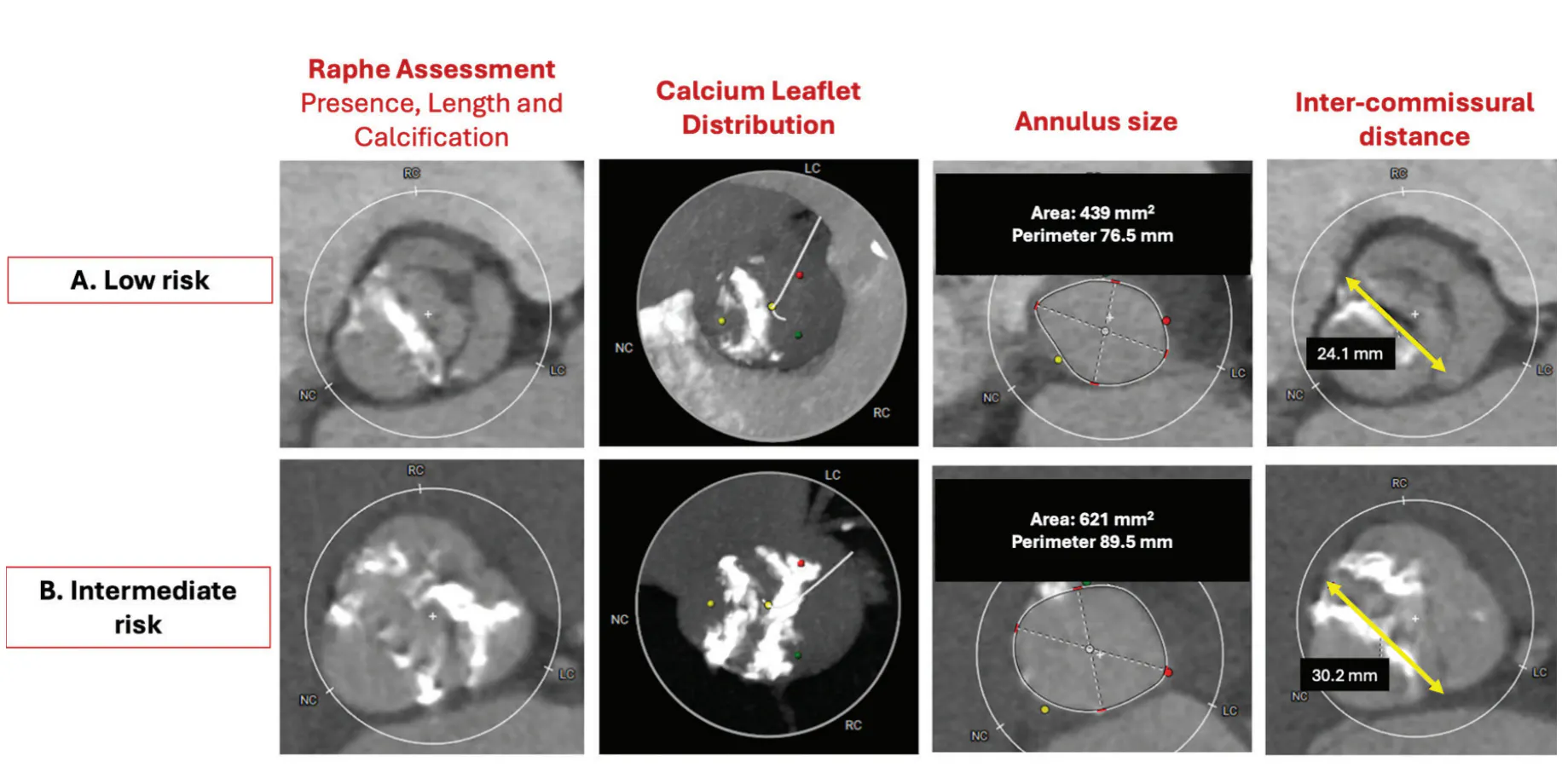
Figure 1. Key factors in planning TAVR for bicuspid valves include the presence, length, and calcification of the raphe; the distribution and severity of calcium; the intercommissural distance; and any discordance among annular size, LVOT dimensions, and intercommissural measurements. Low-risk TAVR anatomy: type I bicuspid valve with fusion of the left and right cusps, mild leaflet calcification, and a noncalcified raphe (A). Intermediate-risk TAVR anatomy: type I bicuspid valve with fusion of the left and right cusps, excessive leaflet calcification, and noncalcified raphe (B).
CT is also used to assess for risk of coronary obstruction. Coronary obstruction is a rare event, with rates of < 1% in large registries; however, when it occurs, it is associated with high morbidity and mortality.21-23 Data suggest that the risk of coronary obstruction is higher in those who receive a balloon-expandable rather than self-expanding valve (1.1% vs 0.4%).24 In native aortic valve disease, the main mechanisms of coronary obstruction are low coronary height (< 12 mm from the annulus plane), small sinuses of Valsalva (SOV, < 30-mm diameter), small sinotubular junction diameter, long native leaflet length, and bulky leaflet calcium. In one study by Ribeiro et al, 86% of patients with a coronary obstruction had a left coronary artery height < 12 mm, and SOV diameter was < 30 mm in 71.4% of patients with obstruction; further, 67.9% of patients with coronary obstruction had both left coronary artery height < 12 mm and SOV diameter < 30 mm.23 In cases where the CT scan predicts a high coronary occlusion risk, contrast or saline injection during BAV can help with assessing risk prior to valve deployment. Either leaflet modification or coronary protection are typically performed in high-risk patients.
Annular Rupture
Although annular rupture is a rare event occurring in < 1% of patients who undergo TAVR, it carries a high in-hospital mortality rate.25 As such, preprocedural CT assessment of annular and LVOT calcium must carefully balance the potential for annular rupture and PVL. Morphologic features of LVOT calcium that have been identified as higher risk for annular rupture include the presence of two or more nodules of calcification, one nodule extending > 5 mm in any direction in the LVOT, and calcium below the noncoronary cusp (Figure 2).26,27 Procedural- and device-related factors that increase risk in the presence of annular/LVOT calcium include oversizing (> 20% annular area), balloon postdilation, and use of balloon-expandable valves. In one study, > 20% annular area oversizing was present in 79% of patients who experienced rupture versus 29% in those who did not, and balloon postdilation was performed in 22.6% versus 0%, respectively.26,28 Recent data suggest that bespoke sizing may improve annular rupture risk—for example, adjusting oversizing of a balloon-expandable prosthetic valves by changing the volume used during inflation based on presence of LVOT calcification.29
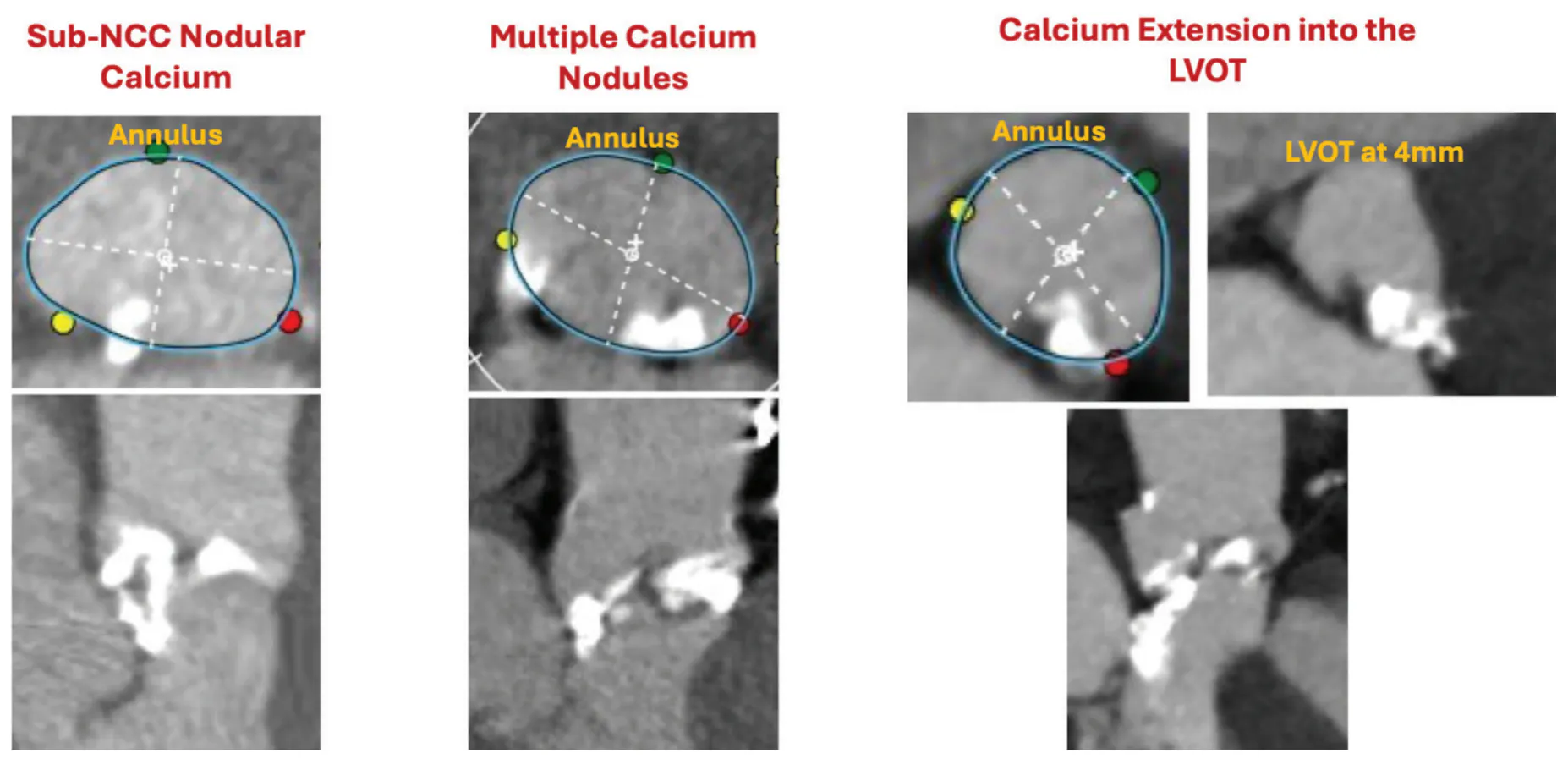
Figure 2. Morphologic LVOT calcium features associated with a higher risk of annular rupture include calcium located beneaththe noncoronary cusp, presence of two or more calcific nodules, and significant extension of calcium into the LVOT. NCC, noncoronary cusp.
Root Angulation
CT assessment of the annular plane determines the aortic root angulation and predicts the optimal valve deployment view.30 Horizontal aortic angulation can make accurate positioning and delivery of TAVR technically challenging. In the early experience with self-expanding valves, an angulation ≥ 48° was associated with lower procedural success compared to angulations < 48° (76.1% vs 96.4%). In addition to a higher likelihood of procedural failure, patients with higher degrees of angulation experienced higher rates of PVL and pacemaker placement when the procedure was completed.31 These findings did not extrapolate to balloon-expandable valves.32 However, higher degrees of angulation have been noted to be associated with increased 30-day mortality after the procedure (3.3% vs 0.4%), suggesting that the degree of angulation is still an important factor in the TAVR planning process even when using balloon-expandable valves.30
VALVE-IN-VALVE TAVR
Cardiac CT provides a unique opportunity to accurately identify the type and size of prior surgical prostheses, with most valves readily visualized using 3D segmentation. In addition to confirming prosthesis type, CT allows precise measurement of the internal diameter, which will confirm current valve size. Adjunctive tools such as the ViV Aortic application (Krutsch) further support valve-in-valve (ViV) decision-making. Compared with native TAVR, ViV procedures carry a higher risk of coronary obstruction, making careful preprocedural assessment critical. In this context, the valve-to-coronary distance is a key parameter, with measurements < 4 mm strongly predictive of coronary occlusion.33 The risk of sinus sequestration can also be evaluated by assessing the relationship between the prosthesis and the sinotubular junction.33,34 In selected cases, bioprosthetic valve fracture may be performed to mitigate patient–prosthesis mismatch, underscoring the importance of detailed evaluation of surrounding structures to minimize procedural complications.
With over a decade of TAVR experience, redo TAVR is becoming increasingly relevant. Similar to ViV procedures, preprocedural planning is primarily focused on preserving coronary flow. Comprehensive CT-based assessment—including evaluation of the index valve and determination of the relationship of the coronary risk plane and neoskirt plane—is essential, with dedicated tools such as the Redo TAV application (Krutsch) playing a key role in guiding procedural strategy.35
CONCLUSION
Comprehensive CT assessment is fundamental to contemporary TAVR planning, providing detailed anatomic characterization that guides procedural strategy and risk stratification. From access site evaluation and prosthesis sizing to prediction of complications such as coronary obstruction and annular rupture, CT enables a tailored and patient-specific approach. As experience with TAVR expands to more complex anatomies and reinterventions, the role of CT continues to evolve, further enhancing procedural safety and clinical outcomes.
1. Cepas-Guillén P, Avvedimento M, Ternacle J, et al. Vascular complications in patients undergoing transcatheter aortic valve replacement with contemporary devices. Can J Cardiol. 2025;41:1490-1502. doi: 10.1016/j.cjca.2025.03.034
2. Okuyama K, Jilaihawi H, Kashif M, et al. Transfemoral access assessment for transcatheter aortic valve replacement: evidence-based application of computed tomography over invasive angiography. Circ Cardiovasc Imaging. 2015;8:e001995. doi: 10.1161/CIRCIMAGING.114.001995
3. Blanke P, Weir-McCall JR, Achenbach S, et al. Computed tomography imaging in the context of transcatheter aortic valve implantation (TAVI) / transcatheter aortic valve replacement (TAVR): An expert consensus document of the Society of Cardiovascular Computed Tomography. J Cardiovasc Comput Tomogr. 2019;13:1-20. doi: 10.1016/j.jcct.2018.11.008
4. Feistritzer HJ, Dumpies O, Rosseel L, et al. Alternative access for TAVR: a state-of-the-art review and practical guide. JACC Cardiovasc Interv. 2025;18:2309-2325. doi: 10.1016/j.jcin.2025.08.029
5. Androshchuk V, Chehab O, Prendergast B, et al. Computed tomography derived anatomical predictors of vascular access complications following transfemoral transcatheter aortic valve implantation: a systematic review. Cath Cardiovasc Interv. 2024;103:169-185. doi: 10.1002/ccd.30918
6. Row HT, Edwards A, Beaudrie J, et al. Anatomy of risk: decoding the predictors of vascular access complications in transcatheter aortic valve replacement. Cath Cardiovasc Interv. 2025;105:725-734. doi: 10.1002/ccd.31397
7. Hayashida K, Lefèvre T, Chevalier B, et al. Transfemoral aortic valve implantation new criteria to predict vascular complications. JACC Cardiovasc Interv. 2011;4:851-858. doi: 10.1016/j.jcin.2011.03.019
8. Lederman RJ, Greenbaum AB, Khan JM, et al. Transcaval access and closure best practices. JACC Cardiovasc Interv. 2023;16:371-395. doi: 10.1016/j.jcin.2022.12.005
9. Sherwood M, Allen KB, Dahle TG, et al. SCAI expert consensus statement on alternative access for transcatheter aortic valve replacement. J Soc Cardiovasc Angiogr Interv. 2025;4:102514. Published correction appears in J Soc Cardiovasc Angiogr Interv. 2025;4:103798. doi: 10.1016/j.jscai.2024.102514
10. Ng AC, Delgado V, van der Kley F, et al. Comparison of aortic root dimensions and geometries before and after transcatheter aortic valve implantation by 2- and 3-dimensional transesophageal echocardiography and multislice computed tomography. Circ Cardiovasc Imaging. 2010;3:94-102. doi: 10.1161/CIRCIMAGING.109.885152
11. Jilaihawi H, Kashif M, Fontana G, et al. Cross-sectional computed tomographic assessment improves accuracy of aortic annular sizing for transcatheter aortic valve replacement and reduces the incidence of paravalvular aortic regurgitation. J Am Coll Cardiol. 2012;59:1275-1286. doi: 10.1016/j.jacc.2011.11.045
12. Khalique OK, Kodali SK, Paradis JM, et al. Aortic annular sizing using a novel 3-dimensional echocardiographic method: use and comparison with cardiac computed tomography. Circ Cardiovasc Imaging. 2014 7:155-63. doi:10.1161/CIRCIMAGING.113.001153
13. Jabbour A, Ismail TF, Moat N, et al. Multimodality imaging in transcatheter aortic valve implantation and post-procedural aortic regurgitation: comparison among cardiovascular magnetic resonance, cardiac computed tomography, and echocardiography. J Am Coll Cardiol. 2011;58:2165-2173. doi: 10.1016/j.jacc.2011.09.010
14. Piazza N, de Jaegere P, Schultz C, et al. Anatomy of the aortic valvar complex and its implications for transcatheter implantation of the aortic valve. Circ Cardiovasc Interv. 2008;1:74-81. doi: 10.1161/CIRCINTERVENTIONS.108.780858
15. Murphy DT, Blanke P, Alaamri S, et al. Dynamism of the aortic annulus: effect of diastolic versus systolic CT annular measurements on device selection in transcatheter aortic valve replacement (TAVR). J Cardiovasc Comput Tomogr. 2016;10:37-43. doi: 10.1016/j.jcct.2015.07.008
16. Yoon SH, Ahn JM, Ohno Y, et al. Predictors for paravalvular regurgitation after TAVR with the self-expanding prosthesis: quantitative measurement of MDCT analysis. JACC Cardiovasc Imaging. 2016;9:1233-1234. doi: 10.1016/j.jcmg.2015.10.011
17. Yao J, Wu D, Yan Y, et al. Redefining TAVR valve sizing: a validated multiplanar approach for both bicuspid and tricuspid valves. JACC Cardiovasc Interv. 2025;18:1748-1757. doi: 10.1016/j.jcin.2025.05.043
18. Iannopollo G, Romano V, Buzzatti N, et al. Supra-annular sizing of transcatheter aortic valve prostheses in raphe-type bicuspid aortic valve disease: the LIRA method. Int J Cardiol. 2020;317:144-151. doi: 10.1016/j.ijcard.2020.05.076
19. Phichaphop A, Sorajja P, Enriquez-Sarano M, et al. Feasibility of computed tomography as a gatekeeper for invasive angiography before TAVR: a pragmatic real-world experience. Circ Cardiovasc Interv. 2025;18:e015181. doi: 10.1161/CIRCINTERVENTIONS.125.015181
20. Ihdayhid AR, Sellers SL, Polsani V, et al. Feasibility and utility of anatomical and physiological evaluation of coronary artery disease with cardiac CT in severe aortic stenosis (FUTURE-AS registry). J Cardiovasc Comput Tomogr. 2026;20:148-156. doi: 10.1016/j.jcct.2025.12.012
21. Zahn R, Werner N, Gerckens U, et al. Five-year follow-up after transcatheter aortic valve implantation for symptomatic aortic stenosis. Heart. 2017;103:1970-1976. doi: 10.1136/heartjnl-2016-311004
22. Ojeda S, González-Manzanares R, Jiménez-Quevedo P, et al. Coronary obstruction after transcatheter aortic valve replacement: insights from the Spanish TAVI registry. JACC Cardiovasc Interv. 2023;16:1208-1217. doi: 10.1016/j.jcin.2023.03.024
23. Ribeiro HB, Webb JG, Makkar RR, et al. Predictive factors, management, and clinical outcomes of coronary obstruction following transcatheter aortic valve implantation: insights from a large multicenter registry. J Am Coll Cardiol. 2013;62:1552-1562. doi: 10.1016/j.jacc.2013.07.040
24. Khatri PJ, Webb JG, Rodés-Cabau J, et al. Adverse effects associated with transcatheter aortic valve implantation: a meta-analysis of contemporary studies. Ann Intern Med. 2013;158:35-46. doi: 10.7326/0003-4819-158-1-201301010-00007
25. Pasic M, Unbehaun A, Dreysse S, et al. Rupture of the device landing zone during transcatheter aortic valve implantation: a life-threatening but treatable complication. Circ Cardiovasc Interv. 2012;5:424-432. doi: 10.1161/CIRCINTERVENTIONS.111.967315
26. Okuno T, Asami M, Heg D, et al. Impact of left ventricular outflow tract calcification on procedural outcomes after transcatheter aortic valve replacement. JACC Cardiovasc Interv. 2020;13:1789-1799. doi: 10.1016/j.jcin.2020.04.015
27. Hansson NC, Nørgaard BL, Barbanti M, et al. The impact of calcium volume and distribution in aortic root injury related to balloon-expandable transcatheter aortic valve replacement. J Cardiovasc Comput Tomogr. 2015;9:382-392. doi: 10.1016/j.jcct.2015.04.002
28. Barbanti M, Yang TH, Rodès Cabau J, et al. Anatomical and procedural features associated with aortic root rupture during balloon-expandable transcatheter aortic valve replacement. Circulation. 2013;128:244-253. doi:10.1161/CIRCULATIONAHA.113.002947
29. Chavarria J, Falcao F, Dutra G, et al. Bespoke valve sizing avoids annular rupture in patients treated with a balloon-expandable transcatheter heart valve. Catheter Cardiovasc Interv. 2022;100:823-831. doi: 10.1002/ccd.30402
30. Veulemans V, Maier O, Bosbach G, et al. Novel insights on outcome in horizontal aorta with self-expandablenew-generation transcatheter aortic valve replacement devices. Catheter Cardiovasc Interv. 2020;96:1511-1519. doi: 10.1002/ccd.28961
31. Abramowitz Y, Maeno Y, Chakravarty T, et al. Aortic angulation attenuates procedural success following self-expandable but not balloon-expandable TAVR. JACC Cardiovasc Imaging. 2016;9:964-972. doi: 10.1016/j.jcmg.2016.02.030
32. Medranda GA, Musallam A, Zhang C, et al. The impact of aortic angulation on contemporary transcatheter aortic valve replacement outcomes. JACC Cardiovasc Interv. 2021;14:1209-1215. doi: 10.1016/j.jcin.2021.03.027
33. Ribeiro HB, Rodés-Cabau J, Blanke P, et al. Incidence, predictors, and clinical outcomes of coronary obstruction following transcatheter aortic valve replacement for degenerative bioprosthetic surgical valves: insights from the VIVID registry. Eur Heart J. 2018;39:687-695. doi: 10.1093/eurheartj/ehx455
34. Ochiai T, Oakley L, Sekhon N, et al. Risk of coronary obstruction due to sinus sequestration in redo transcatheter aortic valve replacement. JACC Cardiovasc Interv. 2020;13:2617-2627. doi: 10.1016/j.jcin.2020.09.022
35. Bapat VN, Fukui M, Zaid S, et al. A guide to transcatheter aortic valve design and systematic planning for a redo-TAV (TAV-in-TAV) procedure. JACC Cardiovasc Interv. 2024;17:1631-1651. doi: 10.1016/j.jcin.2024.04.047
Advertisement
Advertisement