Advertisement
Advertisement

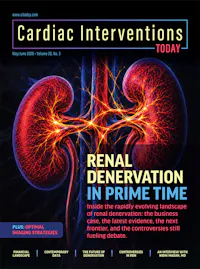
Renal denervation (RDN) is a paradigm-shifting, procedure-based therapy for hypertension. Many remember this technology making headlines over a decade ago when a 2014 study failed to meet its primary endpoint compared to sham. However, more rigorous randomized controlled studies have since evaluated this technology, with the most contemporary randomized controlled trials being positive in favor of RDN— resulting in approval for commercial use by the FDA.
In this edition of Cardiac Interventions Today, we cover current data shaping societal guidelines (which now include RDN), the financial landscape that makes this technology difficult to scale, and best practices from global experts in the field of RDN.
Aditi Ujjawal, MD; Eric A. Secemsky, MD; and Anna K. Krawisz, MD, kick us off by reviewing the contemporary evidence supporting RDN for uncontrolled and resistant hypertension, highlighting key clinical trial data, evolving guideline support, and emerging technologies.
Then, Catherine Vanchiere, MD; Tayyab Shah, MD; Maria Bonanni, CRNP; Debbie L. Cohen, MD; Jay S. Giri, MD, and Brian Fulton, MD, walk us through the RDN financial landscape, explaining how reimbursement and evolving coverage policies are defining access to RDN.
Shukri W. David, MD, and Herbert D. Aronow, MD, summarize the evolution of denervation technologies for hypertension, including ongoing advances in device design, alternative access, multiorgan denervation, and emerging applications beyond uncontrolled hypertension.
Finally, an esteemed group of experts weighs in on key contemporary RDN discussion points, with Joseph E. Ebinger, MD; Maria Carolina Delgado-Lelievre, MD; Atul Chugh, MD; Brian C. Bigelow, MD; Eric A. Secemsky, MD; and Joachim Weil, MD, discussing blood pressure targets, patient monitoring strategies, adoption barriers, and lessons from the European experience.
Along with the focus on RDN, the Cardiac Interventions Today editors assembled a series on optimal imaging strategies. First up, Yader Sandoval, MD, and Emmanouil S. Brilakis, MD, present five key concepts for CT-guided percutaneous coronary intervention (PCI): understanding how it’s defined, preprocedural planning, program implementation, barriers to adoption, and future directions. Harika Sai Dabbara, MD, and Lauren Sharan Ranard, MD, then tackle cardiac CT for transcatheter aortic valve replacement planning, focusing on its role in access evaluation, valve sizing, and procedural risk assessment.
In our Today’s Practice column, Jamie Warren, EdD, ponders why intravascular imaging remains underused in PCI despite strong evidence and guideline support, arguing that this points to operational and workflow barriers rather than clinical limitations.
Closing this issue is an interview with Dr. Nidhi Madan on building a rural structural heart program; advancing research in structural heart disease, imaging, and equity; and the evolving role of the structural interventionalist.
As RDN continues to permeate the United States market as an adjunctive treatment for hypertension, the topics covered in this issue will be increasingly important to ensure that the appropriate patients are treated, keep financial stewardship and solvency in mind when launching a program, and understand that this landscape continues to evolve, with new technologies coming to market and expanding indications/targets for denervation technologies. It is my goal that this edition will provide a blueprint for those just beginning a new RDN/hypertension program and offer clarity and foresight for future iterations of the technology for those already part of an established RDN program.
Taisei Kobayashi
MD Guest Chief Medical Editor
Advertisement
Advertisement