Advertisement
Advertisement
May/June 2026
From Protocol to Precision: Optimizing IVI Workflows in the Cardiac Cath Lab
Although most cath labs have the tools and clinical evidence to support intravascular imaging–guided PCI, underuse points to an operational, rather than clinical, barrier.
When interventional cardiologists use intravascular imaging (IVI) to guide percutaneous coronary intervention (PCI), patients have better outcomes, with fewer heart attacks and repeat procedures and lower mortality rates. These findings are well established through robust data, including a 2024 analysis of 20 randomized trials.1
Among Medicare patients who had PCI with imaging guidance, researchers found lower rates of 1-year death, heart attack, repeat procedures, and major cardiac events compared to patients who underwent PCI guided by angiography alone.2
In 2025, the American College of Cardiology (ACC), American Heart Association, and Society for Cardiovascular Angiography and Interventions published updated guidelines, giving IVI a Class I recommendation for complex PCI, defined as left main disease, bifurcation lesions, long lesions (> 28 mm), in-stent restenosis, heavily calcified vessels, small vessels, and acute coronary syndrome presentations.3 The European Society of Cardiology guidelines made the same designation in 2024.4
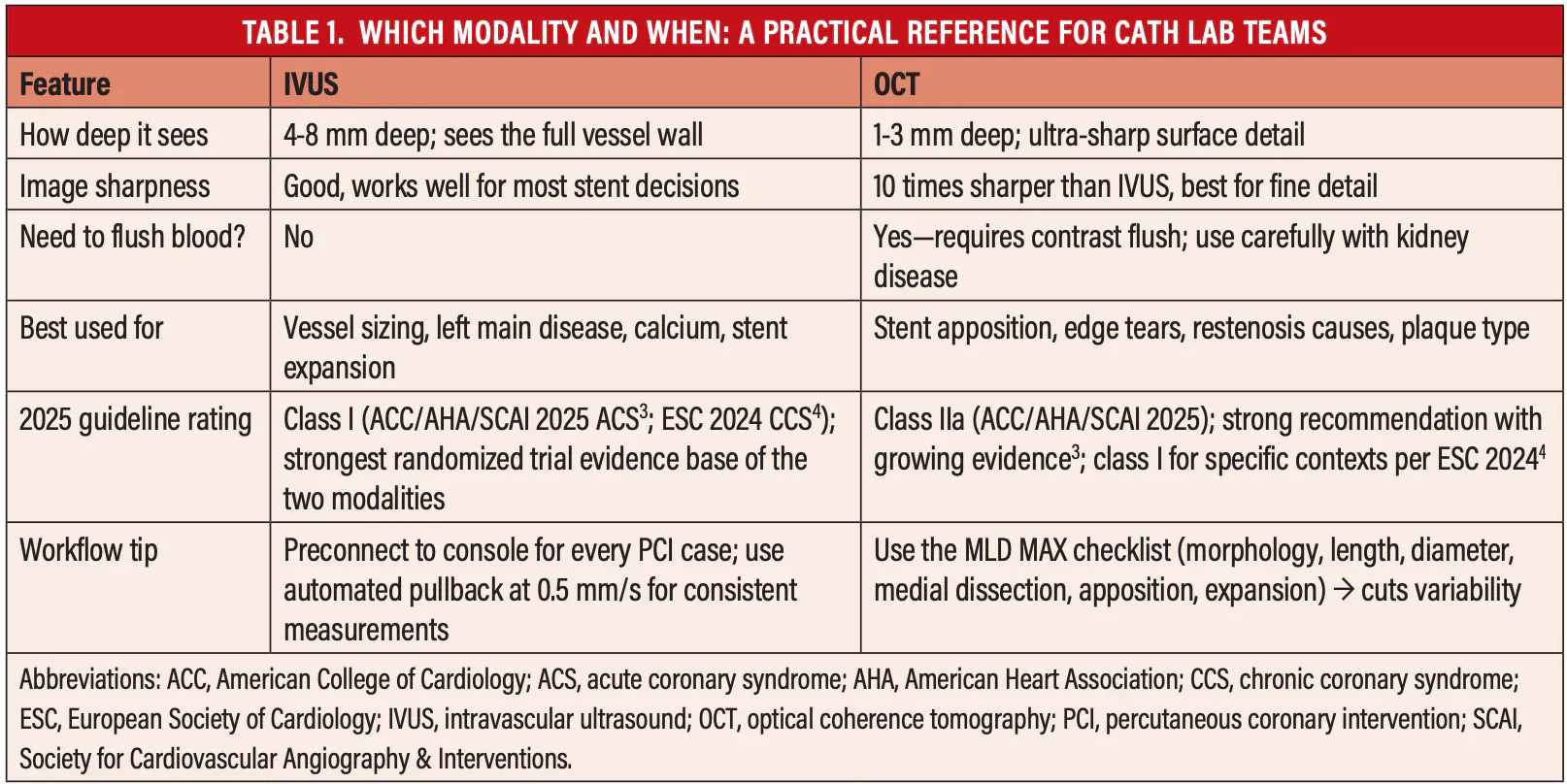
It’s important to be precise about the evidence, as the two modalities are not identical in their guideline standing. Intravascular ultrasound (IVUS) carries the stronger randomized trial evidence base, supported by decades of data across diverse patient populations. Optical coherence tomography (OCT) has a growing body of evidence and earns a Class IIa recommendation, with Class I status in specific contexts.5,6 Both are far better than angiography alone for complex cases. The distinction matters when building a protocol because it should inform your lab’s default modality selection.
BRIDGING THE GAP BETWEEN EVIDENCE AND PRACTICE
More than 85% of United States hospitals performing PCI have the equipment to perform IVI. Yet, even using 2020 as a baseline, before the most recent guideline upgrades, the median utilization rate across those hospitals was just 6.3%.7 More recent Medicare data show that IVI was used in only 10.5% of all PCI procedures, with a median operator use rate of 3.92%.2 Although the trend is moving in the right direction, there is still a significant gap between where we are and where the evidence says we should be.
In one of the largest analyses of IVI use variability to date conducted across the Veterans Affairs (VA) health care system, the biggest driver of whether a patient received imaging-guided PCI was not severity of sickness or lesion complexity. Notably, hospital-level factors accounted for 54% of the variability in IVI usage; physician-level factors accounted for 33%, and patient and lesion characteristics—what should drive the decision—accounted for just 1.1%.8
Although the VA population has specific characteristics that may not generalize to every practice setting, the directional finding is consistent with what many cath lab leaders already know anecdotally: whether a patient gets imaging-guided PCI is heavily influenced by institutional culture and physician habit rather than clinical need alone.
The barriers that repeatedly arise are familiar: “It slows down the case,” “I can see enough on angio,” and “I’m not comfortable interpreting it.”9,10 These are all operational and cultural arguments, not clinical arguments. Setup is slow because it’s not built into the workflow. Interpretation is uncomfortable because it’s not being adequately taught. Angiography “feels” sufficient because no one is showing operators what they’re missing. One interventional cardiologist said it plainly at Transcatheter Cardiovascular Therapeutics 2025: “Less than one-third of procedures are being done with these imaging modalities. … If you are not using an IVI modality, the PCI is not optimal.”8
This is not the first time the cath lab needed to close the gap between what the evidence says and what happens in practice.
Door-to-balloon time for ST-segment elevation myocardial infarction was all over the map until hospitals developed systems, including clear triggers, standardized workflows, and performance tracking.7 Radial access for PCI followed the same arc: once viewed as too technically demanding for broad adoption, it scaled rapidly once training became systematic and outcomes were tracked at the program level. IVI adoption will follow the same path when it gets the same infrastructure.
Table 1 provides a practical reference for modality selection—a necessary first step because IVUS and OCT serve overlapping but distinct clinical purposes.3,4 Establishing a lab-level default with clear criteria for switching reduces the cognitive load of in-the-moment decision-making and creates a consistent baseline for performance tracking.
Once modality selection is established, the greatest impact then lies in physical workflow. The LightLab Initiative is a structured quality improvement program supported by Abbott and designed to evaluate the use of a standardized step-by-step OCT protocol to guide treatment decisions during PCI. In the study, standardized use of MLD MAX (morphology, length, diameter, medial dissection, apposition, and expansion) improved procedural efficiency and reduced interoperator variability without adding procedure time.11 This is consistent with what’s seen in implementation science—structured checklists reduce variability regardless of the domain.
ELEMENTS OF A STANDARDIZED PROTOCOL
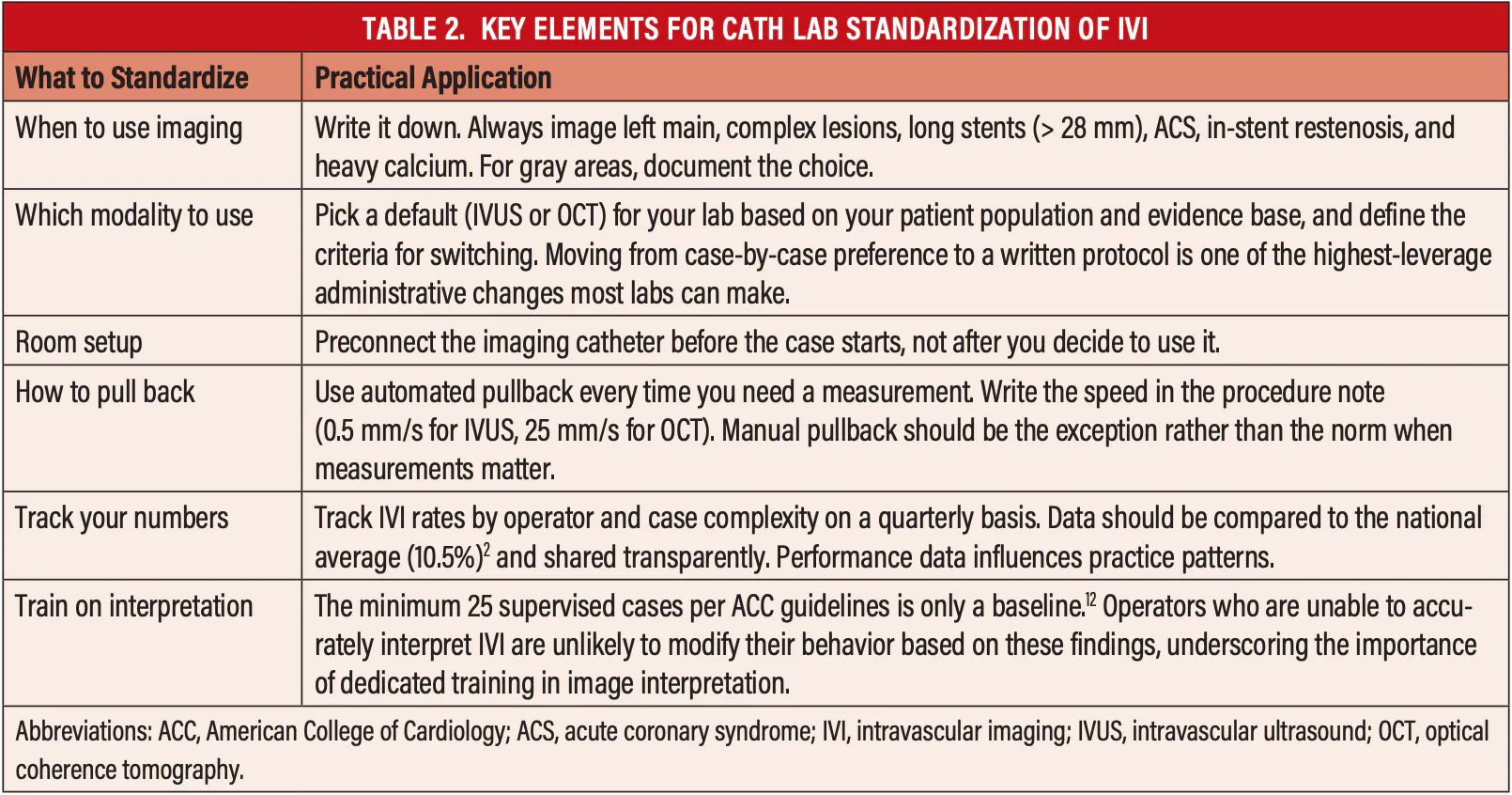
Table 2 lays out six key steps for standardization of IVI.2,12 While not complicated, they do require leadership investment and decision-making.
Importantly, tracking matters more than programs often realize. A 2025 study by Stein et al showed that IVI utilization rate meets the National Quality Forum’s standards of a formal performance measure at both the hospital and physician level.8 The necessary data are already captured in procedural documentation and can be extracted and shared.
Programs also often underinvest in training. The ACC recommends a minimum of 25 supervised IVI cases,7 but volume alone is not the solution if the operator can’t interpret the image. Image interpretation needs to be part of onboarding, credentialing review, and ongoing education, not just catheter setup.
THE ECONOMIC CASE FOR IVI ADOPTION
The concern that IVI adds catheter expense and procedure time is not supported at the program level; overall financial impact trends in the opposite direction.
A target vessel failure requiring repeat revascularization can cost tens of thousands of dollars per episode in downstream care. An unplanned readmission for stent thrombosis or myocardial infarction is even more expensive. IVI-guided PCI has been consistently associated with lower rates of both cost and procedure time.
Long-term data from the Premier Healthcare Database showed that IVUS use was tied to lower mortality at both 1 and 10 years.13 This is a strong value argument for any health system operating under value-based contracts or bundled payments. Reimbursement for IVI during PCI is established via CPT codes, and in most programs operating under typical United States fee-for-service arrangements, current rates are sufficient to cover adoption without running a loss. The real investment will be not equipment but rather training and workflow redesign—a one-time effort with durable return.
CONCLUSION
The evidence and guideline gaps have been addressed; the remaining challenge is operational. When the biggest predictor of whether a patient gets IVI-guided PCI is which hospital they go to rather than how complex their disease is, that is a fixable system problem. However, it will take leaders who are willing to build the infrastructure, measure the outcomes, and hold people to a standard.
1. Stone GW, Christiansen EH, Ali ZA, et al. Intravascular imaging-guided coronary drug-eluting stent implantation: an updated network meta-analysis. Lancet. 2024;403:824-837. doi: 10.1016/S0140-6736(23)02454-6
2. Fazel R, Yeh RW, Cohen DJ, et al. Intravascular imaging during percutaneous coronary intervention: temporal trends and clinical outcomes in the USA. Eur Heart J. 2023;44:3845-3855. doi: 10.1093/eurheartj/ehad430
3. Rao SV, O’Donoghue ML, Ruel M, et al; Peer Review Committee Members. 2025 ACC/AHA/ACEP/NAEMSP/SCAI guideline for the management of patients with acute coronary syndromes: a report of the American College of Cardiology/American Heart Association Joint Committee on Clinical Practice Guidelines. J Am Coll Cardiol. 2025;8:2135-2237. Published correction appears in J Am Coll Cardiol. 2025;85:1800. And J Am Coll Cardiol. 2025;86:2723. doi: 10.1016/j.jacc.2024.11.009
4. Vrints C, Andreotti F, Koskinas KC, et al; ESC Scientific Document Group. 2024 ESC Guidelines for the management of chronic coronary syndromes. Eur Heart J. 2024;45:3415-3537. Published correction appears in Eur Heart J. 2025;46:1565. doi: 10.1093/eurheartj/ehae177
5. Neumann FJ, Sousa-Uva M, Ahlsson A, et al; ESC Scientific Document Group. 2018 ESC/EACTS guidelines on myocardial revascularization. Eur Heart J. 2019;40:87-165. Published correction appears in Eur Heart J. 2019;40:3096. doi: 10.1093/eurheartj/ehy394
6. Lawton JS, Tamis-Holland JE, Bangalore S, et al. 2021 ACC/AHA/SCAI guideline for coronary artery revascularization: a report of the American College of Cardiology/American Heart Association Joint Committee on Clinical Practice Guidelines. Circulation. 2022;145:e18-e114. Published correction appears in Circulation. 2022;145:e772. doi: 10.1161/CIR.0000000000001038
7. Malik AO, Saxon JT, Spertus JA, et al. Hospital-level variability in use of intracoronary imaging for percutaneous coronary intervention in the United States. J Soc Cardiovasc Angiogr Interv. 2023;2:100973. doi: 10.1016/j.jscai.2023.100973
8. Stein EJ, Mesenbring E, Smith T, et al. Intravascular imaging as a performance measure for percutaneous coronary intervention. Circ Cardiovasc Interv. 2025;18:e014528. doi: 10.1161/CIRCINTERVENTIONS.124.014528
9. Chaturvedi A, Stone GW, Galo J, et al. Expert perspectives on the intravascular imaging guidance of PCI, diagnosis and treatment–beyond the guidelines: insights from the Cardiovascular Research Technologies 2025 meeting. Cardiovasc Revasc Med. 2025;76:40-47. doi: 10.1016/j.carrev.2025.06.010
10. Cardiovascular Business. New strategies for intravascular imaging and physiological assessments in the cath lab. December 23, 2025. Accessed March 9, 2026. https://cardiovascularbusiness.com/topics/clinical/interventional-cardiology/new-strategies-intravascular-imaging-and-physiological-assessments-cath-lab
11. Bergmark B, Dallan LAP, Pereira GTR, et al; LightLab Initiative investigators. Decision-making during percutaneous coronary intervention guided by optical coherence tomography: insights from the LightLab Initiative. Circ Cardiovasc Interv. 2022;15:872-881. doi: 10.1161/CIRCINTERVENTIONS.122.011851
12. Writing Committee; Bass TA, Abbott JD, Mahmud E, et al. 2023 ACC/AHA/SCAI advanced training statement on interventional cardiology (coronary, peripheral vascular, and structural heart interventions): a report of the ACC Competency Management Committee. J Thorac Cardiovasc Surg. 2023;166:e73-e123. doi: 10.1016/j.jtcvs.2023.04.024
13. Derbas LA. IVUS use and long-term PCI outcomes in the United States: insights from the Premier database. Presented at: Cardiovascular Research Technologies (CRT) 2024; March 8-11, 2024; Washington, DC.
Advertisement
Advertisement