Advertisement
Advertisement
July/August 2026
Operationalizing Radiation Safety in Cardiovascular Programs
Improving radiation safety in the cath lab and building sustainable cardiovascular programs through planning, technology, real-time monitoring, and team-based safety practices.
Radiation in cardiovascular procedural and diagnostic environments has long been recognized as an occupational hazard. Yet despite decades of technological advancement and growing awareness, the day-to-day reality in many catheterization (cath) labs, remains largely unchanged. Radiation dose is cumulative, variability is high, and safety practices are inconsistently applied.
For cardiovascular clinical teams and service line leaders, this goes beyond a safety concern; it is now an organizational, workforce, and strategic imperative. Addressing radiation burden systematically can improve clinician safety, strengthen recruitment and retention, enhance operational reliability, and ultimately support high-value cardiovascular care delivery.
AN OPERATIONAL PRIORITY
Historically, radiation safety has been viewed as an individual responsibility, emphasizing personal behaviors such as wearing protective lead, minimizing fluoroscopy time, and adhering to the ALARA (as low as reasonably achievable) principle. While essential, these practices are no longer enough in the context of today’s increasingly complex, high-acuity procedural environments. Relying solely on individual vigilance can create variability and make consistent safety performance difficult to sustain.
Cath labs focused on minimizing radiation dose operate as a coordinated system, where safety is embedded into case flow rather than relying on memory or habit. This shift prioritizes standardized processes, disciplined imaging strategies, real-time performance feedback, and shared team accountability. By designing an environment that makes the safest choice the default, programs can move from individual-dependent performance to reliable, system-driven radiation safety (Figure 1).
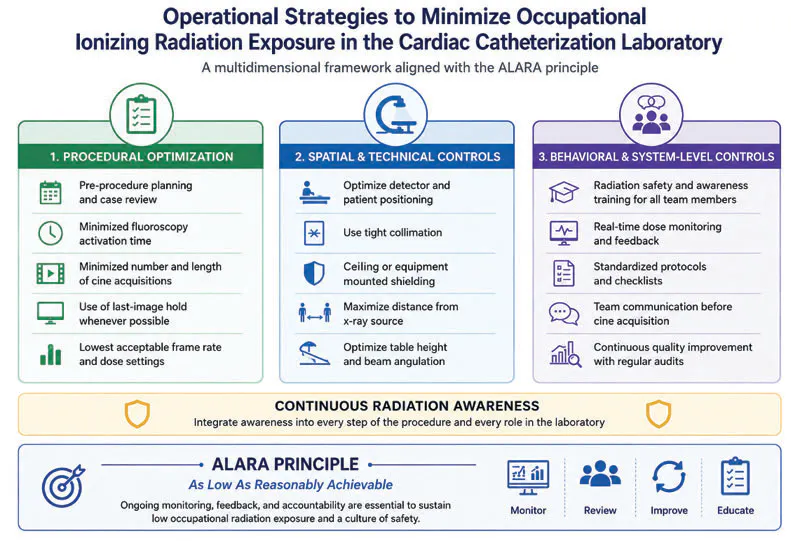
Figure 1. Operational strategies to minimize occupational ionizing radiation exposure in the cardiac cath lab. Image generated with assistance from ChatGPT.
This reframing is particularly important given the persistent nature of this occupational risk. Contemporary position statements highlight that cumulative radiation dose remains one of the most consequential long-term hazards for cardiologists and cath lab staff, with growing evidence linking chronic exposure to malignancy, cataracts, and potentially broader health effects.1
PREPROCEDURE PLANNING
Radiation reduction begins before the patient enters the procedural room. Although the procedure type contributes to higher fluoroscopic dose, inefficient planning and imaging strategy can further increase dose during intervention. Reviewing prior angiography, CT imaging, bypass graft anatomy, and access considerations before starting the case may help reduce unnecessary fluoroscopy and cine acquisition. In complex procedures, such as structural heart intervention and chronic total occlusion percutaneous coronary intervention (PCI), preprocedural planning can help define strategy, anticipate high-radiation imaging angles, and identify patients at increased risk for higher dose burden (eg, elevated body mass index, prior coronary artery bypass grafting, multivessel disease, left main intervention, planned atherectomy). Early recognition of these factors allows teams to proactively optimize imaging, shielding, and procedural strategy before substantial dose accumulation occurs.
OPTIMIZING ROOM SETUP
Cath lab radiation exposure is highly sensitive to room design and equipment positioning. Minor setup inefficiencies can significantly increase scatter radiation to operators and staff while also increasing patient dose. Keeping the image detector as close to the patient as possible is one of the simplest ways to reduce radiation dose because greater distance requires higher radiation output. Similarly, unnecessary magnification should be avoided whenever possible.
Standardizing room configuration can improve both radiation safety and workflow efficiency. Consistent equipment and shielding placement reduce unnecessary movement, communication delays, and fluoroscopy during repositioning. Monitor placement also matters, as poorly positioned displays may increase orthopedic strain and cumulative dose over time.
High-performing labs standardize shielding deployment during room setup rather than relying on ad hoc positioning after procedures begin. Ceiling- or table-mounted shields, table skirts, and radiation drapes are most effective when positioned consistently by case start. Variation in radiation dose across hospitals suggests that room setup, imaging practices, and shielding consistency meaningfully influence procedural dose.2
IMAGING PROTOCOLS
Contemporary imaging systems can substantially reduce radiation dose through thoughtful protocol selection and disciplined imaging practices. Dose reduction strategies include lower frame rates, pulsed fluoroscopy, low-dose acquisition settings, minimized magnification, limited unnecessary cineangiography, and consistent collimation. Narrowing the imaging field remains one of the simplest and most effective ways to reduce radiation exposure, often while improving image quality by decreasing scatter. Avoiding steep cranial and caudal projections when clinically feasible may further limit dose escalation, particularly in obese patients and prolonged PCI procedures.
TEAM-BASED SAFETY practices
Radiation safety in the cath lab extends beyond the operator. It involves the entire procedural team. Nurses, technologists, anesthesiology personnel, and imaging specialists all contribute to radiation safety performance. Reducing patient dose also reduces scatter radiation to staff.
Ensuring the team is familiar with scatter patterns, shield positioning, imaging angles, and the impact of distance from the radiation source remain essential. These considerations become even more important during structural heart and complex PCI procedures, where room crowding and prolonged case duration may increase cumulative radiation dose across multiple team members.3
Many programs now incorporate radiation-specific workflow practices, such as preprocedure shielding checklists, technologist prompts for collimation, cumulative dose notifications during prolonged cases, and designated “radiation champions.” These approaches help reinforce radiation safety as part of overall cath lab culture.
REAL-TIME MONITORING AND FEEDBACK
Real-time dose awareness can influence operator behavior by improving shielding use, imaging technique, and procedural efficiency. Real-time dosimetry feedback has been associated with approximately 60% reductions in staff radiation dose, largely through better use of existing shielding and behavior modification.4 Displaying cumulative air kerma and dose-area product during procedures may also prompt earlier recognition of escalating dose and adjustments in imaging technique, shielding, or procedural flow.
Additionally, reviewing high-dose cases can identify opportunities to improve efficiency, including unnecessary cine acquisition, prolonged fluoroscopy during equipment exchange, excessive magnification, suboptimal detector positioning, and inefficient procedural sequencing. Importantly, radiation dose is often concentrated among a relatively small number of high-risk procedures, highlighting the importance of identifying outliers and dose-intensive scenarios.5,6
Regular performance review strategies that incorporate education, benchmarking, audit and feedback, and defined performance goals may support more sustained improvement in radiation safety practices, particularly when integrated into broader cath lab quality initiatives.2
TECHNOLOGY ADOPTION AS A STRATEGIC INVESTMENT
Advances in imaging and shielding technologies provide a clear pathway to reducing radiation exposure, but adoption remains uneven. Technology investment can deliver meaningful clinical and operational benefits.
Newer-generation fluoroscopy systems can substantially reduce both operator and patient radiation exposure while maintaining procedural image quality. In parallel, novel shielding systems and lead-sparing technologies are potential alternatives to traditional lead aprons, which have long been associated with orthopedic and musculoskeletal strain among cath lab physicians and staff.5
Potential benefits extend beyond dose reduction and include reduced cumulative exposure, decreased orthopedic injury and fatigue, improved provider longevity and retention, and greater procedural consistency.
In this context, radiation safety becomes a strategic enabler of workforce sustainability.
WORKFORCE SUSTAINABILITY
Beyond procedural efficiency and dose reduction, radiation safety within interventional cardiology has important implications for workforce sustainability as well as recruitment and retention. Occupational exposure, orthopedic strain from prolonged lead use, and concerns related to pregnancy continue to influence career decisions for physicians and staff, particularly as procedural complexity and case duration increase. These challenges reinforce the need for organizations to view radiation safety as a strategic organizational priority rather than simply a regulatory requirement.
Practical Steps
1. Implement real-time dosimetry across procedural labs
2. Standardize fluoroscopy and shielding protocols
3. Track and report operator radiation dose trends
4. Invest in advanced radiation protection technologies
5. Establish multidisciplinary radiation safety governance
6. Integrate radiation metrics into quality programs
7. Address pregnancy and workforce policies proactively
8. Benchmark performance across labs
Leadership plays an essential role in creating safer and more sustainable procedural environments through investment in modern shielding technologies, transparent exposure monitoring, standardized safety practices, and clear pregnancy-related policies. Just as importantly, programs must foster a culture of shared accountability in which radiation safety is viewed as a team responsibility rather than an individual burden.
Radiation exposure should no longer be viewed as an unavoidable byproduct of cardiovascular care but rather as a reflection of how well procedural systems, processes, and safety practices are designed and managed. Organizations that prioritize radiation safety as a core operational capability may be better positioned to build stronger teams, safer working environments, and more sustainable cardiovascular programs for the future.
1. Lucà F, Picano E, Aschieri D, et al. Occupational hazards in cardiac catheterization laboratories: radiation and beyond–ANMCO position paper update 2026. Eur Heart J Suppl. 2026;28(suppl 6):vi304-vi314. doi: 10.1093/eurheartjsupp/suag063
2. Madder RD, Seth M, Frazier K, et al. Statewide initiative to reduce patient radiation doses during percutaneous coronary intervention. Circ Cardiovasc Interv. 2024;17:e013502. doi: 10.1161/CIRCINTERVENTIONS.123.013502
3. McNamara DA, Chopra R, Decker JM, et al. Comparison of radiation exposure among interventional echocardiographers, interventional cardiologists, and sonographers during percutaneous structural heart interventions. JAMA Netw Open. 2022;5:e2220597. doi: 10.1001/jamanetworkopen.2022.20597
4. Murat D, Wilken-Tergau C, Gottwald U, et al. Effects of real-time dosimetry on staff radiation exposure in the cardiac catheterization laboratory. J Invasive Cardiol. 2021;33:E337-E341. doi: 10.25270/jic/20.00521
5. Hirshfeld Jr JW, Ferrari VA, Bengel FM, et al. 2018 ACC/HRS/NASCI/SCAI/SCCT expert consensus document on optimal use of ionizing radiation in cardiovascular imaging—best practices for safety and effectiveness, part 2: radiologic equipment operation, dose-sparing methodologies, patient and medical personnel protection: a report of the American College of Cardiology Task Force on Expert Consensus Decision Pathways. J Am Coll Cardiol. 2018;71:2829-2855. doi: 10.1016/j.jacc.2018.02.018
6. Madder RD, Abiragi M, Madanat L, et al. Relative contribution of high-dose outliers to cumulative occupational radiation dose in the catheterization laboratory. J Soc Cardiovasc Angiogr Interv. 2026;5:104054. doi: 10.1016/j.jscai.2025.104054
Advertisement
Advertisement