Advertisement
Advertisement
July/August 2026 Supplement
Sponsored by Salus Scientific
The Occupational Wellness Company: The Salus Scientific Story
Moderator Kenneth Rosenfield, MD, talks with Todd Flohr, CEO and Co-Founder of Salus Scientific, on mission, innovation, and the future of occupational health.
For decades, occupational hazards in fluoroscopy-guided medicine were viewed as part of the job. Heavy lead aprons, chronic orthopedic strain, scatter radiation exposure, fatigue, and long-term wear and tear have a significant impact on physicians, nurses, and technologists who spend their careers caring for patients.
At Salus Scientific, that mindset is being challenged.
Built around the belief that safety should never come at the expense of workflow, Salus Scientific has emerged as one of the fastest-growing voices advocating for occupational wellness in fluoroscopy suites. From the GLiFT™ endoskeleton system to the AeroShield™ enhanced radiation protection device (ERPD), the company’s mission is centered on protecting the health care workers inside the lab while optimizing workflow and preserving patient-centered care.
Dr. Kenneth Rosenfield sat down with CEO and Co-Founder Todd Flohr to discuss his background, the company’s origins, the growing focus on occupational health, and why the future of interventional medicine must include better protection for health care professionals.
Dr. Rosenfield: Todd, let’s start with your background. What led you into health care and ultimately to founding Salus Scientific?
Todd: Health care has been part of my life from the very beginning. I grew up in East Tennessee, and my father was a physician. Professionally, I spent years working in the medical device industry in cardiovascular sales and leadership roles, which gave me the opportunity to work very closely with physicians and clinical teams in labs all around the country.
What became impossible to ignore was how many occupational hazards were simply being accepted as “normal.” You would walk into first-class cath labs filled with incredible technologies designed to protect the patient, but the people delivering the care were often sacrificing their own health in the process.
That disconnect stayed with me.
Dr. Rosenfield: What was the original vision behind Salus Scientific?
Todd: Salus was founded around a very personal problem. One of our founding physicians, Dr. Bill Buchanan, experienced a shoulder injury and developed chronic orthopedic pain from years of wearing heavy lead. He created the original GLiFT™ concept to transfer the weight of lead from the shoulders, neck, and back to the iliac crest. He came to me and said, “I think we could help a lot of people.” That desire to help clinicians resonated deeply with me and that was really the start of the company. We even chose a name for the company, Salus, after the Roman mythological goddess of safety, health, and well-being.
What started as a solution for one physician quickly became something much bigger. We realized this wasn’t an isolated issue—it was an industry-wide problem affecting entire clinical teams.
Today, we at Salus think about occupational wellness holistically: radiation exposure, orthopedic burden, workflow disruption, fatigue—these are all connected challenges. Our goal is to take a system-based approach to occupational wellness; whether that includes GLiFT™, full-room protection with AeroShield™, live dosimetry, or other solutions. We can approach a lab manager or director and say, “no matter your needs or budget, we have solutions that will work for you.”
Dr. Rosenfield: I’ve personally used GLiFT™ for about 12 months now. Honestly, if not for GLiFT™, I would not still be practicing in the lab or doing procedures. It’s dramatically relieved the stress on my back and neck. Most importantly, it has completely changed my work trajectory, enabling me to continue treating patients. Without GLiFT™, I would not be able to work in the cath lab anymore.
Todd: Hearing stories like that is exactly why we do this. Extending careers, improving quality of life, and allowing clinicians to continue practicing at a high level—that’s the mission.
Dr. Rosenfield: Salus’ message is “Engineering Safer Labs, Without Compromise.” What does that mean to you?
Todd: For years, the industry has forced clinicians into tradeoffs. If you wanted more protection, you often had to sacrifice workflow, patient access, visibility, ergonomics, efficiency, or all of the above! In many cases, the protection systems themselves became literal barriers to adoption because they complicated procedures. We at Salus fundamentally reject the idea that safety and performance have to compete with each other.
So, you’ll notice that with anything we develop, and I’ll take AeroShield™ as an example, we think of it as a foundation of a house. Each lab is different and thus requires a different setup. We started the design of our AeroShield™ system to be able to accommodate the needs of different specialties, procedures, and rooms. The goal is to minimize the tradeoffs, to keep the solid foundation of the house while also providing the flexibility to customize.
Everything we build starts with one central question: Can this be used in every case, every day, by every operator, without slowing the team down? If the answer is no, adoption will suffer. And protection only matters if it’s consistently used.
That philosophy continues to shape every technology we develop.
Dr. Rosenfield: That’s so important, engineering a system that can be used in every case without disrupting workflow. As alluded to previously, occupational health has become a much bigger conversation recently. From a professional societal perspective, Society for Cardiovascular Angiography and Interventions (SCAI) certainly has led the charge and other societies are following suit, and I think awareness has finally caught up with reality. We as clinicians and our staff have quietly dealt with neck and back pain; I myself have had multiple back operations. The recent SCAI survey showed almost two-thirds of interventional cardiologists develop some sort of major orthopedic issue in their careers. We all know why. The data are there, and we can’t ignore it anymore. It’s now become a workforce sustainability issue, and health care systems are beginning to understand this. Many physicians are retiring early, and nurses and techs are leaving the lab because of occupational health concerns.
Todd: Exactly. When experienced clinicians are going out on disability like you did for several months due to orthopedic injury, everybody loses: Patients lose top-level care, hospitals lose revenue, and teams and trainees lose mentors and leaders. This occupational wellness topic is becoming central to the future of procedural medicine.
Dr. Rosenfield: I wanted to talk briefly about something I participated in that I think captures you and the Salus mission perfectly. You invited me to speak at an educational symposium in late April at Eastern Tennessee State University (ETSU), Radiologic Science Program (Figure 1). There were over 90 attendees, including students, faculty, physicians, and administration. I gave a talk about radiation safety in the lab, and you sponsored the event and even donated GLiFTs™ to five graduates. Your father was in the audience as well. What did that event mean to you?
Todd: It was a great event and thank you for speaking. I grew up in Eastern Tennessee and that community played a major role in shaping my values and early career. My father has done so much for patients and the community there, so seeing him in the audience meant a lot to me. As someone who grew up with a dad as a dedicated physician, I understand the importance of preserving that workforce. If we can help younger physicians think differently about protecting themselves early in their careers, that has the potential to impact decades of health and longevity. And being able to promote this in my home ground was very rewarding.
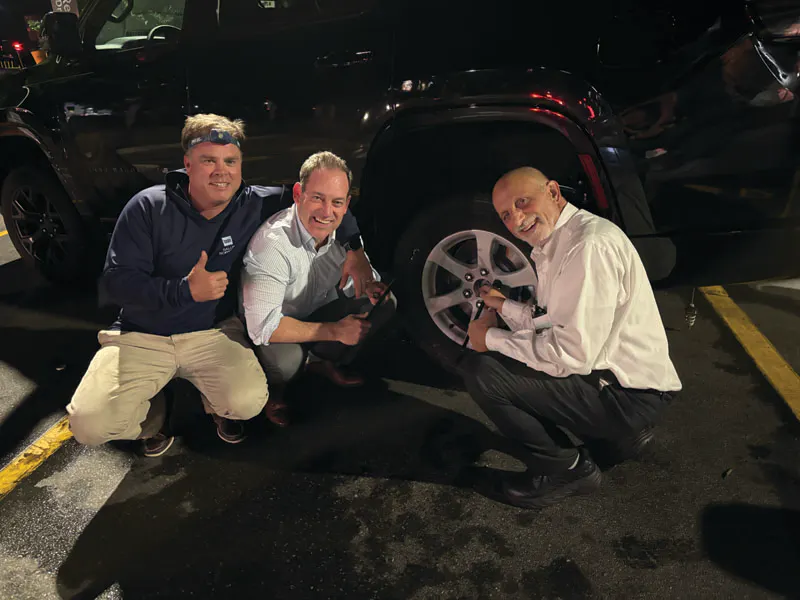
Figure 1. Changing lives, changing tires. Todd Flohr, Kenny Rosenfield, and Mike Lankford, VP Sales at Salus, fixing a flat after a speaking event to medical students at ETSU.
Dr. Rosenfield: I’ll just touch on one more topic. Salus emphasizes high quality and integrity frequently in their messaging and brand. Why is that so important in radiation protection solutions?
Todd: Because trust matters. When someone puts on protective equipment or installs a protection system in their lab, they are trusting that it will perform exactly as is intended every single day. That responsibility is enormous. At Salus, we believe quality cannot be compromised for speed or cost-cutting, and marketing claims must be accurate and 100% credible. We focus heavily on engineering, validation, material science, and long-term durability because health care workers deserve products they can truly rely on.
Dr. Rosenfield: Looking ahead, what do you hope the future of the fluoroscopy suite looks like?
Todd: I firmly believe the future lab is one where protecting health care professionals is simply built into the environment and not treated as an afterthought. The next generation of labs should simultaneously reduce radiation exposure, reduce orthopedic burden, improve ergonomics, preserve workflow, and support long-term clinician wellness. I hope we reach a point where younger health care professionals entering medicine no longer accept chronic pain, excessive fatigue, or injury as “part of the job.” We can do better than that…we owe it to our health care workers. At Salus Scientific, as industry partners, we intend to be the leaders in that change.
Dr. Rosenfield: Thanks for your time. Speaking on behalf of my colleagues in the lab and as one of those health care providers who has experienced the health consequences of occupational exposure, I am very excited to see the Salus protective solutions disseminated to labs around the country and the world.
Disclosures
Dr. Rosenfield: Scientific advisory board, Philips, Radiaction, and Salus Scientific; equity or stock options in Radiaction and Salus Scientific.
Advertisement
Advertisement