Advertisement
Advertisement
July/August 2026 Supplement
Sponsored by Salus Scientific
AeroShield™ Elite: Passive Protection Without Compromise
Delivering meaningful scatter radiation protection for the entire team with seamless workflow integration in the fluoroscopy suite.
With both an aging population and the advent of technologies to treat more complex disease, fluoroscopy-guided procedures have increased in recent years and with it an increase in radiation exposure for lab personnel. Physicians and staff have had to make a difficult tradeoff: protection from scatter radiation versus procedural performance. Traditional shielding systems often provide incomplete coverage, require constant repositioning, and frequently interfere with workflow, patient access, and communication among the care team. In many labs, there is significant variability in radiation safety practices, and this lack of consistency means protection becomes highly dependent on individual behavior.
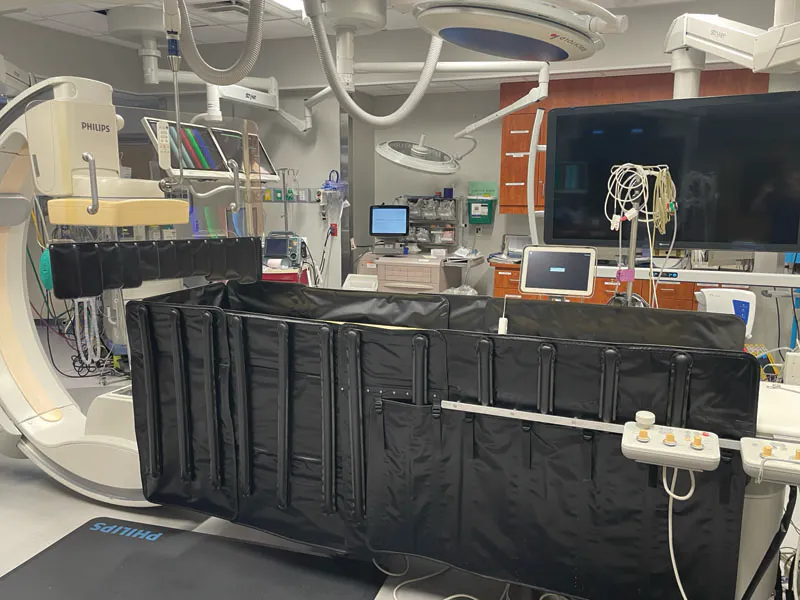
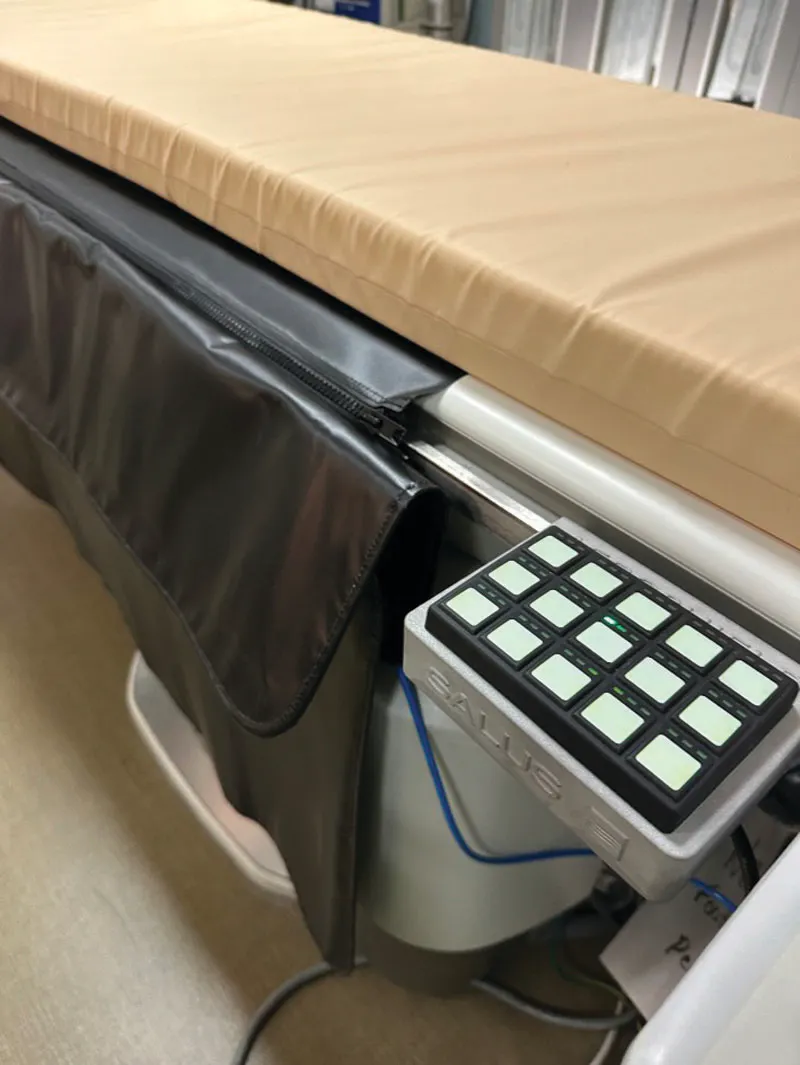
A new category of Enhanced Radiation Protection Devices (ERPDs) is aiming to change that paradigm, among them the AeroShield™ Elite system from Salus Scientific, which was developed with a simple but ambitious goal: deliver meaningful best-in-class scatter radiation dose reduction while integrating seamlessly into the fluoroscopy suite operations. Rather than relying on staff to constantly adjust shielding or change procedural behavior, AeroShield™ was engineered as a passive protection platform, designed to work continuously in the background without disrupting workflow.
AEROSHIELD™ ALIGNS WITH ALARA+
AeroShield™ aligns with the broader shift in fluoroscopy suite safety. In March 2026, nine leading medical societies, including SCAI, ACC, and HRS, called for the adoption of ALARA+, “as low and as light as reasonably achievable,” expanding the traditional ALARA principle beyond radiation dose along to include orthopedic strain, workflow design, and whole-team protection.1
That evolution is important because occupational safety can no longer depend solely on asking clinicians and staff to wear heavier lead, reposition shields perfectly, or absorb workflow penalties in the name of protection.
ALARA+ reframes the standard: Safety should be built into the lab environment, equipment, and daily procedural workflow.
ACC, American College of Cardiology; HRS, Heart Rhythm Society; SCAI, Society for Cardiovascular Angiography & Interventions.
Early formative clinical experience from Tallahassee Memorial Healthcare demonstrates that the combination of low scatter dose and effortless workflow integration may be the AeroShield™ system’s most important innovation.
RETHINKING RADIATION PROTECTION
Occupational exposure to scatter radiation remains one of the most persistent challenges in interventional medicine. Chronic exposure has been associated with increased risks of malignancy, cataracts, and orthopedic injury related to heavy lead apparel. Although under-table drapes and ceiling-mounted shields remain standard in many labs, adoption and effectiveness can vary significantly based on positioning, operator technique, and room setup.
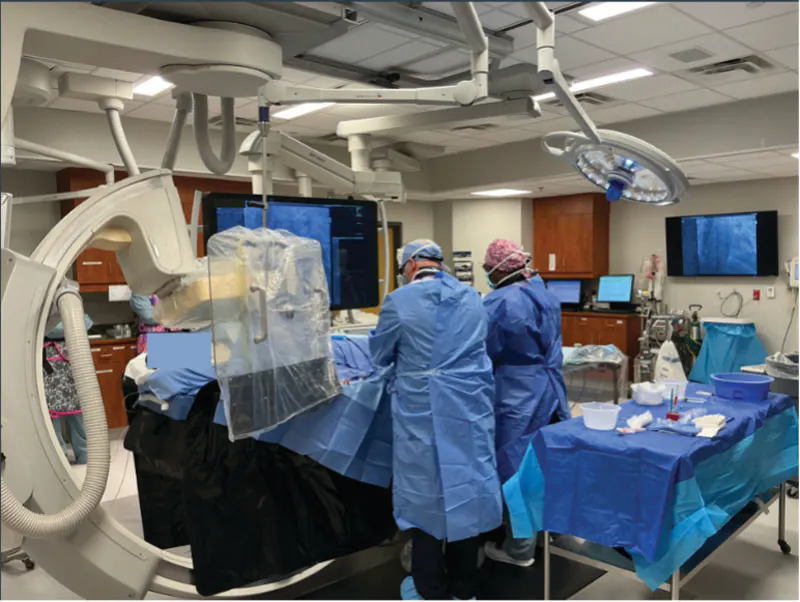
AeroShield™ approached this challenge by developing an inflatable table-mounted ERPD designed to create a protective barrier around the procedural field while preserving visibility, patient access, team movement, and freedom to move the C-arm into extreme angles without interference or damage to either. The system was intentionally designed to be passive, requiring minimal interaction once deployed.
“The vision was protection without compromise,” said William Dixon, MD, interventional cardiologist at Tallahassee Memorial. “We’ve seen technologies that have protected well but got in the way, or that were easy to use but didn’t provide enough meaningful protection. AeroShield™ was designed to eliminate that tradeoff, and after using it in our lab over the last 4 months, there is no tradeoff.”
Dr. Dixon noted that one of the most important aspects of the system is consistency. “If protection depends on someone remembering to move a shield every few minutes, compliance naturally varies,” he said. “Passive protection changes the equation because the protection is simply there throughout each case, for the entire case.”
EARLY FORMATIVE STUDY EXPERIENCE
Initial formative study experience at Tallahassee Memorial evaluated both scatter radiation reduction (from traditional shielding) and workflow integration during real-world procedures. According to investigators, the system demonstrated encouraging reductions in measured dose around the room, while maintaining procedural efficiency and patient access (Figure 1 and Survey Insights Sidebar).2
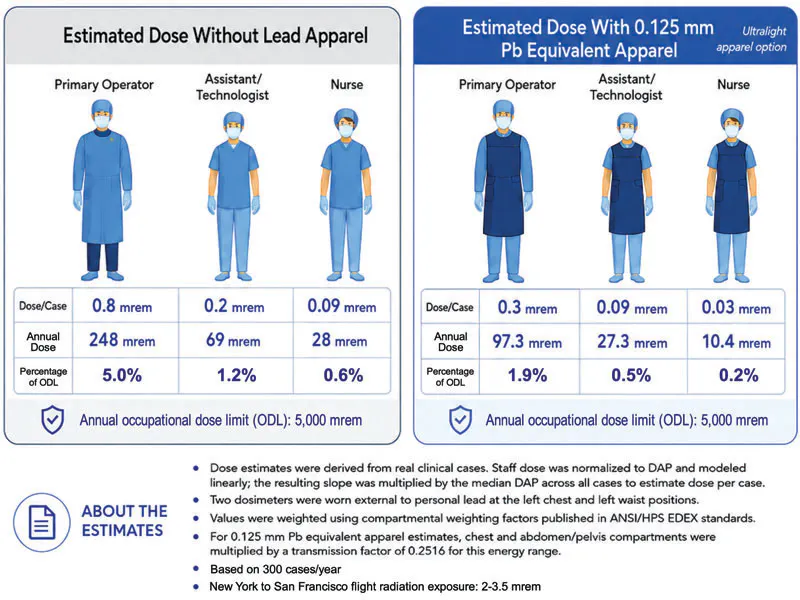
Figure 1. Scatter radiation protection performance around the lab with AeroShield™ (measured outside the lead and estimated with 0.125-mm light lead), including dose per procedure (normalized by dose area product), and annual exposure based on 300 cases.
Survey Insights on AeroShield™ From Tallahassee Memorial*:
- Procedural versatility—used in 100% of study cases consecutively
- 94%—no time lost in preprocedure prep (patient loading/draping)
- 94%—no time lost in room turnover efficiency (patient unloading/cleaning of system)
- 94% reported no impact on patient access/communication
- 100% likely to continue to use AeroShield™ in its current form
*19 surveys of MDs, RTs, and RNs.
But while the dosimetry data were important, clinicians repeatedly emphasized another finding: the absence of workflow disruption.
“The biggest compliment we can give a technology is that we stop thinking about it,” said Thaer Musa, interventional cardiologist at Tallahassee Memorial Healthcare. “After a very short learning curve, AeroShield™ simply has become part of the room. Within one or two cases, most of us, physicians and staff, were completely comfortable.”
Dr. Dixon added, “one of the things we noticed is that we’ve continued to use AeroShield™ in 100% of our cases, even after the Salus clinical team left after our study was complete. That’s a testament to full adoption.”
–Prashant Kaul, MD
Director of Interventional Cardiology | Piedmont Healthcare
–Bill Dixon, MD
Interventional Cardiology | Tallahassee Memorial Healthcare
Co-Host | Blue Collar ICs Podcast
A TEAM-BASED SOLUTION
One of the recurring themes from the Tallahassee experience was the system’s impact beyond the primary operator. Traditional shielding strategies often focus primarily on physician exposure, while other members of the care team may remain less protected depending on room positioning and movement.
AeroShield™ was designed to create a broader zone of passive protection throughout the procedural environment. For the radiologic technologists working with the system daily, that broader protection came without introducing operational complexity.
“It integrated into our room setup much easier than expected,” said Izabelle Pool, radiologic technologist at Tallahassee Memorial. “You’re not constantly adjusting it or thinking about it at all during the procedure. It just has become part of your natural workflow.”
“There’s always concern anytime something new comes into the lab,” said Chris Buzzard, Director of Invasive Cardiology Service Line at Tallahassee. “People worry about losing access to the patient or slowing the room down. But after the first few cases, most of these concerns disappeared.”
Eric Henry, a nurse in the lab, noted the psychological value of enhanced protection. “When we feel safer every single case, it really changes the atmosphere in the room,” he said. “We want to know that occupational safety is being prioritized, and we are so thankful that Tallahassee Memorial has put that front and center for us.”
–Christopher Buzzard
Director of Invasive Cardiology | Tallahassee Memorial HealthCare

–Eric Henry, RN
Tallahassee Memorial HealthCare
PASSIVE PROTECTION AND FULL ADOPTION
The concept of “passive protection” has become increasingly important in discussions around occupational safety. Many technologies demonstrate strong performance under ideal conditions but rely heavily on perfect usage patterns to achieve those results consistently.
As we look to the future of global safety in the fluoroscopy suite ERPDs will be defined not only by attenuation metrics, but by systems capable of achieving near-universal use with minimal compromise of the procedure, the workflow, or movement of the x-ray imaging system. In the early bench testing and initial clinical use, AeroShield™ appears to be one technology that integrates into the lab well, thus increasing its use and attendant staff protection.
1. Salavitabar A, Vora A, Althschul D, et al. ALARA+: summit on radiation and orthopedic risks in fluoroscopic laboratories. J Soc Cardiovasc Angiogr Interv. 2026;5:104166. doi: 10.1016/j.jscai.2025.104166
2. Dixon W. Early experience with a table-mounted inflatable enhanced radiation protection device (ERPD): the AeroShield™ system. Presented at CRT 26; March 7-10, 2026; Washington, DC.
Advertisement
Advertisement