Advertisement
Advertisement
March/April 2024
Current and Future TAVR Devices for Aortic Insufficiency
An outline of current experience with off-label TAVR for aortic insufficiency, as well as an overview of emerging dedicated TAVR devices for aortic insufficiency.
Surgical aortic valve replacement is the gold standard treatment for management of patients with symptomatic severe aortic insufficiency.1 A treatment gap remains for patients at high surgical risk due to the unavailability of less invasive treatment options. The morbidity and mortality of untreated severe, symptomatic aortic insufficiency is substantial, with reports in the literature of a > 70% mortality rate observed at 5 years in those with New York Heart Association (NYHA) class III or IV symptoms. As the global population continues to age, the need for a less invasive option for these patients has become increasingly important.2
The transcatheter aortic valve replacement (TAVR) technologies that were originally developed for treating aortic stenosis (AS) have been tried; however, the outcomes are unsatisfactory in pure aortic insufficiency, with high rates of valve embolization, need for a second valve, and paravalvular leak (PVL). Traditional TAVR bioprostheses are designed to rely on calcium for valve anchoring. The absence of calcium in pure, native aortic insufficiency complicates valve deployment and anchoring, leading to suboptimal procedural success rates. Therefore, dedicated TAVR devices for aortic insufficiency are needed and currently undergoing clinical investigation. In the United States, there remains no approved device, whereas the Trilogy transcatheter heart valve (JenaValve Technology, Inc.) is indicated in Europe for aortic insufficiency. This article outlines the current experience with off-label TAVR for aortic insufficiency and provides an overview of emerging dedicated TAVR devices for aortic insufficiency.
OFF-LABEL TAVR FOR aortic insufficiency
Since the approval of TAVR for AS, clinicians have attempted to use the same devices off label in aortic insufficiency patients who have no surgical options. Off-label TAVR implantation in aortic insufficiency patients is technically more challenging because the noncalcified aortic valve can only be seen on fluoroscopy during contrast injections. In addition, the success rate of an anatomically correct implantation is significantly lower than what can be achieved when using the same TAVR devices in AS patients. Although the initial off-label TAVR registries in aortic insufficiency patients mostly reported on the outcomes with the use of early generation TAVR devices, even more contemporary AS TAVR technologies underperform in aortic insufficiency patients. In a multicenter, international registry of 201 aortic insufficiency patients (PANTHEON), device success at 30 days was reported to be only 76.1%. Valve embolization or migration still occurred in 12.4% of patients, and this was associated with a higher incidence of the composite endpoint of mortality and heart failure hospitalization at 1 year, as well as all-cause mortality. Interestingly, self-expanding and balloon-expandable valve platforms demonstrated similar safety and efficacy. Similar to the observations in previous reports, there was a high rate of moderate or greater PVL (9.5%) and new permanent pacemaker implantation (22.3%).3
DEDICATED TAVR DEVICES FOR aortic insufficiency
The suboptimal results with off-label TAVR in aortic insufficiency patients has fueled the development of TAVR technologies with design features that address the specific needs of valve implantation in these patients. Two dedicated TAVR devices are currently under clinical investigation for aortic insufficiency in the United States, the Trilogy transcatheter heart valve and the J-Valve system (JC Medical) (Figure 1). Both devices started out with transapical delivery platforms, but transfemoral implantation is now possible.
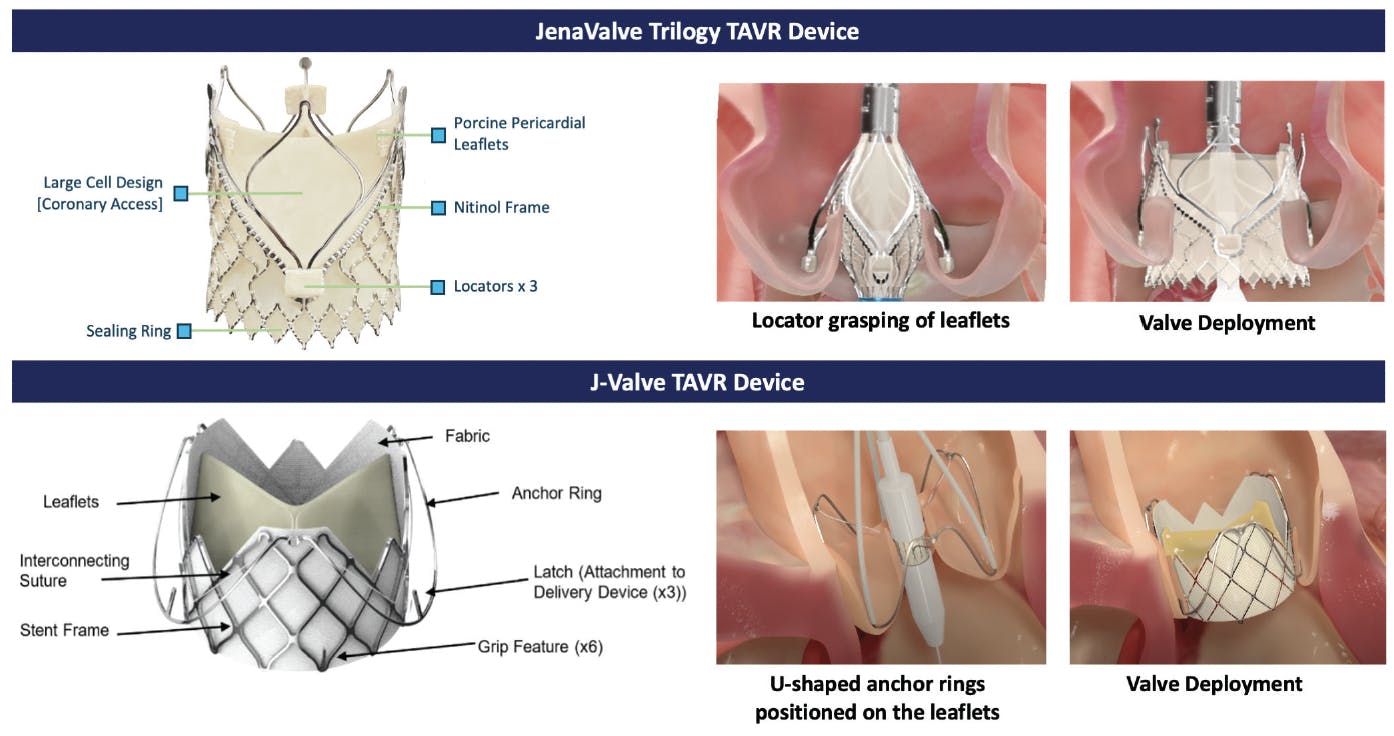
Figure 1. Dedicated transfemoral TAVR devices for aortic insufficiency. The Trilogy (upper panel) and J-Valve (lower panel) devices are both self-expanding valves. Trilogy has three locators directly connected to the nitinol frame that grasp onto the native leaflets and aid with anchoring. J-Valve has three anchor rings for grasping of the native leaflets that are connected to the valve frame via sutures.
(Device images courtesy of JenaValve Technology, Inc. and JC Medical.)
Trilogy Transcatheter Heart Valve
The Trilogy transcatheter heart valve utilizes a self-expanding nitinol frame with porcine pericardial leaflets. It has three locators that clip onto the native leaflets and facilitate commissural alignment. The valve additionally has three large open cells promoting ease of coronary access. The valve is currently available in three sizes (23, 25, and 27 mm), allowing treatment of aortic annular perimeters between 66 and 90 mm.
Trilogy received CE Mark approval for the treatment of patients with aortic insufficiency and AS in 2021. The initial European experience with this device recently reported a 98% device success rate in 58 patients. The mean age of the patients in this cohort was 76.5 years, with a mean Society of Thoracic Surgeons score of 4.2%. None of the patients experienced a valve embolization, and there were no conversions to open heart surgery. The device demonstrated excellent hemodynamics, with a mean gradient of 4.3 ± 1.6 mm Hg and absence of moderate or severe PVL. The 30-day mortality rate was 1.7%. The rate of new permanent pacemaker implantation was 19.6%.4 Although this study enrolled a small number of patients, it demonstrates that the specific design features associated with this TAVR device allow for safe and effective transfemoral, transcatheter treatment of pure aortic insufficiency in patients at high surgical risk.
The ALIGN-AR trial (NCT 04415047) is a United States pivotal study that examined the Trilogy system. It was a prospective, multicenter, single-arm study that completed enrollment of 180 high-surgical-risk patients with symptomatic and greater than moderate aortic insufficiency in August 2022. The preliminary results of the study, presented at TCT in 2023, were very similar compared with those reported from the German registry described previously.5 The primary endpoint of 1-year all-cause mortality was 7.8% and met the prespecified performance goal. Device success was achieved in 96.7% of patients in this study. The mortality and stroke rates at 30 days were 2.2% each. The device demonstrated excellent hemodynamics with large effective orifice areas (average, 2.9 cm2) and low mean gradients (average, 3.9 mm Hg). Although moderate or greater PVL rates were very low at 0.6% in ALIGN-AR, newly implanted permanent pacemakers were required in 24% of patients. TAVR in this patient cohort was associated with improvement in NYHA functional class and quality-of-life scores at 1 year compared with baseline. The patients in this trial will be followed for 5 years.
J-Valve
The J-Valve device is a self-expanding valve composed of a nitinol frame and bovine pericardial leaflets. The valve has three nitinol anchor rings (a locating feature) designed to conform to the native aortic sinuses and capture the native leaflets. The valve cannot be recaptured after device deployment and is deployed without the use of rapid pacing. The valve is available in five sizes and can be used to treat annular perimeters between 57 and 104 mm. J-Valve is currently an approved device for use for both AS and aortic insufficiency by the National Medical Products Administration of China but is still an investigational device in the United States.
The largest published experience is with transcatheter transapical implantation of the J-Valve in China. In 134 patients, the procedural success rate was 96.3%. The five conversions to surgery were due to valve embolization (n = 2), coronary obstruction (n = 1), valve migration (n = 1), and moderate PVL (n = 1). In terms of safety, there was one stroke, one major vascular complication, and 12 patients (9.3%) with third-degree atrioventricular block requiring permanent pacemaker implantation. This experience included patients with both bicuspid (select morphologies, n = 9) and tricuspid aortic valves (n = 125). Notably, the authors found no significant difference in clinical outcomes observed based on valve morphology.6
Data with the transfemoral system have been published from a multicenter, North American registry in which 27 patients were treated with J-Valve under a compassionate use protocol. The access was transfemoral in 78% of the patients, and there was an 81% procedural success rate overall (n = 22 of 27) that increased to 100% in the last 15 consecutive patients enrolled after modification of the valve design and anatomic eligibility criteria. At 30 days, the investigators observed one death, one stroke, and three new pacemakers, and 88% of patients experienced NYHA functional class I or II symptoms. None of the patients had moderate or greater aortic insufficiency at 30 days.7 Currently, J-Valve is enrolling patients in an early feasibility study (NCT 06034028) assessing the treatment of high-surgical-risk aortic insufficiency patients with their transfemoral delivery system.
GOING FORWARD
The early results using dedicated TAVR devices for the management of pure aortic insufficiency in patients at high surgical risk are encouraging. However, aortic insufficiency patients are heterogeneous, and the optimal management of specific subsets of this population will require further investigation. For instance, patients with left ventricular assist device (LVAD)–associated aortic insufficiency are desperately in need of percutaneous therapy. These patients have not been included in the studies with the dedicated aortic insufficiency TAVR devices discussed previously. However, the technical feasibility of using the Trilogy device in LVAD-associated aortic insufficiency has been demonstrated in case reports,8 and data are being collected in a global, multicenter registry. Other patient groups that will require further study include patients with bicuspid aortic valves or those with significant valve degeneration from healed endocarditis. It appears feasible that bicuspid aortic insufficiency patients with trileaflet valves and modest commissural fusion are treatable with Trilogy and J-Valve, but further studies will be needed. Similarly, because capture of the native leaflets is an important component of valve anchoring with these devices, we need to understand what degree of leaflet degeneration in the process of healed endocarditis still allows for successful TAVR implantation. A subset of aortic insufficiency patients has larger annuli than what can be treated currently with Trilogy. J-Valve expands on this sizing limitation. Lastly, longer-term follow-up is required to evaluate valve durability. Understanding valve durability will be important to expand access to patients at lower surgical risk. In addition to that, randomized clinical trials will have to demonstrate that TAVR with dedicated devices for aortic insufficiency is noninferior to surgery.
SUMMARY
Off-label TAVR for aortic insufficiency should be a last resort used for inoperable patients until dedicated TAVR devices receive commercial approval. The ALIGN-AR trial and European registry data with the CE Mark–approved Trilogy device have demonstrated that transfemoral TAVR with a dedicated device is safe and effective. Other dedicated TAVR devices such as J-Valve are currently under investigation. Hopefully, all of these research efforts will soon provide clinicians with percutaneous treatment options for patients with native aortic insufficiency.
1. Vahanian A, Beyersdorf F, Praz F, et al. 2021 ESC/EACTS guidelines for the management of valvular heart disease: developed by the task force for the management of valvular heart disease of the European Society of Cardiology (ESC) and the European Association for Cardio-Thoracic Surgery (EACTS). Eur Heart J. 2021;43:561-632. doi: 10.1093/eurheartj/ehab395
2. Dujardin KS, Enriquez-Sarano M, Schaff HV, et al. Mortality and morbidity of aortic regurgitation in clinical practice. Circulation. 1999;99:1851-1857. doi: 10.1161/01.cir.99.14.1851
3. Poletti E, Backer OD, Scotti A, et al. Transcatheter aortic valve replacement for pure native aortic valve regurgitation. JACC Cardiovasc Interv. 2023;16:1974-1985. doi: 10.1016/j.jcin.2023.07.026
4. Adam M, Tamm AR, Wienemann H, et al. Transcatheter aortic valve replacement for isolated aortic regurgitation using a new self-expanding TAVR system. JACC Cardiovasc Interv. 2023;16:1965-1973. doi: 10.1016/j.jcin.2023.07.038
5. Thourani VH. Initial outcomes of the JenaValve trilogy transcatheter aortic valve replacement system in high-risk patients with symptomatic severe native aortic regurgitation. Presented at: Transcatheter Cardiovascular Therapeutics annual meeting; October 23-26, 2023; San Francisco, California.
6. Liu L, Chen S, Shi J, et al. Transcatheter aortic valve replacement in aortic regurgitation. Ann Thorac Surg. 2020;110:1959-1965. doi: 10.1016/j.athoracsur.2020.03.112
7. Garcia S, Ye J, Webb J, et al. Transcatheter treatment of native aortic valve regurgitation. JACC Cardiovasc Interv. 2023;16:1953-1960. doi: 10.1016/j.jcin.2023.05.018
8. Ranard LS, Kaple R, Khalique OK, et al. First transfemoral implantation of a novel transcatheter valve in an LVAD patient with aortic insufficiency. JACC Case Rep. 2021;3:1806-1810. doi: 10.1016/j.jaccas.2021.08.026
Advertisement
Advertisement