Advertisement
Advertisement

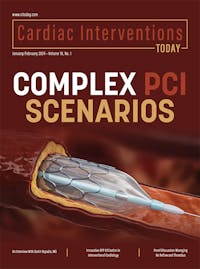
The evolution of percutaneous coronary intervention (PCI) has been remarkable. The field has grown from simple balloon angioplasty in the 1970s to now being able to treat a wide array of complex coronary anatomies with a variety of technologies. In this edition of Cardiac Interventions Today, we highlight many challenges during PCI that can arise and techniques to treat them.
We begin our coverage of complex PCI with a review of provisional versus two-stent bifurcation PCI. Moemen Eltelbany, MD; Charlene L. Rohm, MD; Lindsey Cilia, MD; and Leah Raj, MD, provide us with a review of approaches to treating complex bifurcation lesions, including provisional stenting, T stent, crush techniques, and the culotte technique. Kathleen Kearney, MD, and Taishi Hirai, MD, go on to discuss the pros and cons of atherectomy and intravascular lithotripsy, paying particular attention to the pros and cons, as well as situations when one technology might be better than another.
Next, Molly Silkowski, DO, and Anbukarasi Maran, MD, provide an up-to-date assessment of coronary perforation, including a look at balloon tamponade, thrombin, and multiple technological management tools.
We also have engaged a panel of experts to discuss management of no reflow and thrombus. Blake Charlton, MD; Jesse A. Kane, MD; Kalaivani Mahadevan, MD; and Jasleen Tiwana, MD, share their clinical scenarios, treatment approaches, challenges, and more.
Mahmoud Khalil, MD; Hossam Albeyoumi Mohammed, MD; Lindsey Cilia, MD; Khaldoon Alaswad, MD; and Michael Megaly, MD, detail mechanical circulatory support use in cardiogenic shock and complex PCI and provide simplified algorithms for their use.
We close our cover focus coverage with a piece on hemodynamic collapse in the cardiac catheterization lab. Alexander G. Truesdell, MD; Ilan Vavilin, MD; Jonathan Boeddiker, RT(R); Brittany Steinmetz, RT(R); Megan Terek, MD; and Eric Rothstein, MD, explain how successful management relies on advance preparation, prevention, anticipation, awareness, and teamwork.
Our Today’s Practice article by Ginger Biesbrock, DSC, explores how the integration of advanced practice providers into interventionally focused care teams can provide support for physicians and other care team members.
We close this issue with an interview with Samir R. Kapadia, MD, who discusses in-progress and anticipated cardiovascular innovations, current research in mitral and tricuspid interventions, and insight into stroke prevention during TAVR.
The current landscape of complex coronary interventions is a testament of the ongoing development and pursuit for innovation to further improve patient outcomes percutaneously. We hope this edition of Cardiac Interventions Today will serve as a review of the important challenges we will need to be prepared to handle when treating patients with complex coronary disease.
Rhian E. Davies, DO, MS, FACC, FSCAI
Guest Chief Medical Editor
Advertisement
Advertisement