Advertisement
Advertisement
March/April 2023
An Interview With Vijay Kunadian, MBBS, MD
The United Kingdom’s first female Professor of Interventional Cardiology discusses her passion for addressing the unmet needs of underserved populations with cardiovascular disease, updates on the SENIOR-RITA and TWILIGHT trials, and why research is vital to providing the best care for patients.

While your research interests and clinical expertise are vast, the unmet needs of older adults and women with heart disease are a throughline of your work. Why are you specifically interested in the health of these populations?
Older adults are underrepresented in clinical trials (< 15% of trial participants). Given that our population is aging and a growing number of patients are presenting with cardiovascular disease (CVD), it is absolutely essential that we undertake clinical research studies involving this patient cohort to determine the best care. Similarly, women have traditionally been underdiagnosed, undertreated, and underrepresented in clinical studies. For women, CVD is the leading cause of mortality, but it is mostly preventable through appropriate care. However, the underdiagnosis, undertreatment, and underrepresentation indeed lead to preventable worse outcomes. Thus, my passion is to improve the health and well-being of our underserved population.
On the topic of women’s heart health, you’ve made great strides in raising awareness about the high rate of CVD in women—one example being your work with The Lancet commission to reduce the global burden of CVD in women by 2030.1 Although the broad steps to addressing this have been laid out, what can physicians do on a practical, personal level to address this global health problem?
The key is not to ignore the symptoms in female patients. Female patients often have additional characteristics that represent cardiac symptoms such as breathlessness, nausea, weakness, fatigue, and jaw pain, but chest pain is still the most predominant symptom they would present with, similar to men. Given that CVD is the leading cause of mortality and morbidity globally for women, timely diagnosis and appropriate treatment will go a long way in reducing the global burden of CVD in women.
You are renowned for your cardiovascular research, with several clinical trials ongoing and more concluded. SENIOR-RITA, for which you are United Kingdom (UK) Chief Investigator, seeks to be an important piece of the puzzle for frail, older adults with non–ST-segment elevation myocardial infarction (NSTEMI). In what ways could the findings from this trial practically impact the field and patients? What is your call to action for those who want to support this trial?
We are finishing enrollment for the SENIOR-RITA trial, with > 1,500 participants recruited from approximately 52 National Health Service sites across the UK, making it the world’s largest trial in older adults presenting with NSTEMI. This has been achieved despite the challenges posed by the pandemic, in addition to existing challenges with recruitment of older adults into clinical research. Fifty percent of patients presenting with non–ST-segment elevation acute coronary syndrome (ACS) are > 70 years of age. To date, there are five small, randomized trials with an overall sample size of 1,313 that provide conflicting results. Frail and comorbid patients have been excluded from research so far. SENIOR-RITA is inclusive of such patients, with our oldest patient aged 103 years. Our trial will inform the best management strategy for older adults with NSTEMI. In particular, we evaluate subgroups such as frail patients and those with multimorbidity. Additionally, approximately 50% of our patients are female.
While we’re waiting on data from SENIOR-RITA and other studies, what general best practices do you follow now for older adults with ACS?
The best practice is to offer older adults the same care we provide for younger patients, with guideline-recommended management of coronary artery disease risk factors including hypertension, diabetes, and hypercholesterolemia.
Another key trial is TWILIGHT, which studied ticagrelor with and without aspirin in high-risk patients after percutaneous coronary intervention (PCI). How would you summarize the most impactful findings from the trial and its sub-analyses? What are the unanswered questions that still remain?
Yes, I had the privilege to be on the Steering Committee and also serve as National Lead for the TWILIGHT trial. The key finding is that we can now give 3 months of dual antiplatelet therapy (aspirin plus ticagrelor) followed by P2Y12 monotherapy (ticagrelor) to high-risk patients undergoing PCI with reduced bleeding events and without affecting the ischemic outcomes. The findings were applicable to all subgroups, including diabetes, age, sex, body mass index, high bleeding risk, diabetes/chronic kidney disease, anemic patients, and those with prior coronary artery bypass grafting. A question that remains is: Can we reduce bleeding and ischemic outcomes further? There are some novel agents being studied that might address these unmet needs.
What other in-the-works projects are you most excited about right now?
We just completed enrollment for the AEGIS-II trial recruiting over 18,000 patients worldwide. I am the UK National Lead and a Steering Committee member for this study. We are also about to commence the COMPLETE-2 trial for which I am UK National Lead. We have a few more very exciting interventional cardiology studies in the pipeline that seek to further improve the outcomes for our patients with ACS.
One among several societal and professional positions you hold is Research and Development Group Lead for the British Cardiovascular Intervention Society. How would you describe the value that performing clinical research adds to a physician’s work delivering patient care?
As far as I am concerned, research is vital to provide best care to our patients. Research saves lives! Institutions that participate in research have the best outcomes. My strategy is to offer every patient who comes through our door an opportunity to take part in a clinical study if they are eligible. In the UK, the National Institute for Health and Care Research (NIHR) provides so much support to ensure that our patients are given opportunities to take part in research. Our clinical work helps us identify the unmet needs in our patients and then help us design clinical studies addressing these needs. This makes our work so much more rewarding. All of my own investigator-led research questions were initiated by what I saw in the cath lab, clinic, wards, and coronary care unit. SENIOR-RITA is one of them. As a trainee, I did not do interventions in many older adults because they were referred to our colleagues who care for the elderly. But now, approximately 50% of our cath lab lists consist of older adults. There was a clear lack of evidence that stimulated me to undertake the NIHR ICON1 study and the British Heart Foundation SENIOR-RITA trials.
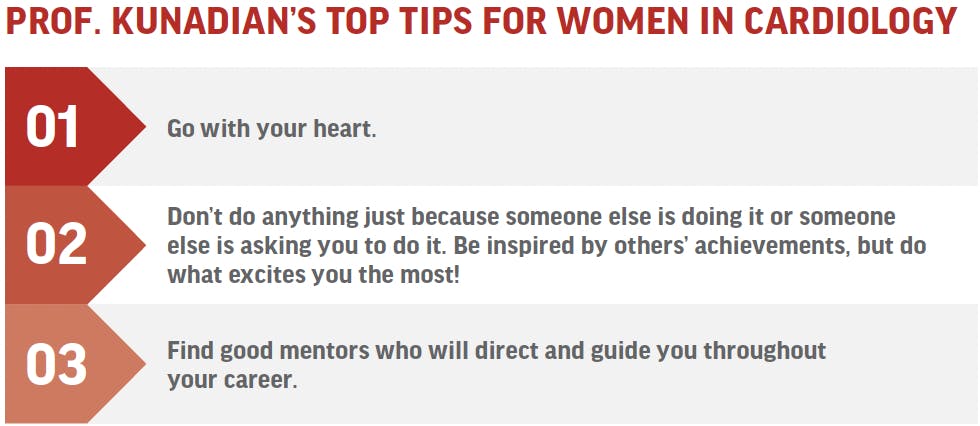
You are significantly invested in the training and mentoring of the next generation of interventional cardiologists—your position as the UK’s first female Professor of Interventional Cardiology is one of many leadership roles you hold. Along with your technical knowledge and clinical expertise, what are some of the professional insights or personal advice you pass on to students and early career physicians?
You really need to be good at what you do. That is why we spend so many years training in interventional cardiology. Make the most of the time during your training and the time you spend with your senior colleagues, because this is a precious opportunity to learn what will help you down the line. When I was training in the Northeast of England, I was the only female trainee in interventional cardiology. I would spend a lot of time doing cases as second operator. There is no shortcut in medicine, cardiology, or intervention. From my experience, if you make the most of the opportunity during your training, be it clinical or academic, then this will definitely pay forward in the future. As part of my research project during my early days, I would analyze thousands of angiograms, and I think that really made me a better operator. I was delighted to learn from British Cardiovascular Intervention Society/National Institute for Cardiovascular Outcomes Research that my patients have better-than-expected outcomes after PCI procedures despite the majority of my case load being in the ACS and out-of-hour context.
How do you ensure work/life balance and combat burnout with increased responsibilities of speaking, being a mentor/role model, research efforts, and clinical practice?
Yes, interventional cardiology, academia, and other teaching responsibilities are indeed so attractive, and one can easily get carried away doing too much. It is important to step back for self-care, and I do a lot of that. It is also really important to have personal time to recharge and do the things outside of work that you love most—this enables you to be at your best in your work too.
1. Vogel B, Acevedo M, Appelman Y, et al. The Lancet women and cardiovascular disease commission: reducing the global burden by 2030. Lancet. 2021;397:2385-2438. doi: 10.1016/S0140-6736(21)00684-X
Advertisement
Advertisement
Interested in reading more interviews?
To read more interviews with thought leaders in the interventional cardiology field, check out our Profiles & Perspectives hub.
Read More