Advertisement
Advertisement
July/August 2023
An Interview With Joost Daemen, MD, PhD
Dr. Daemen discusses the merits of intracoronary imaging and physiology for PCI, the FAST trials of vFFR lesion subsets and indications, and predictions for the future of renal denervation.

Along with your day-to-day clinical work, you have a robust academic research practice. How would you describe your approach to research? What are your current objectives?
I try to address contemporary and clinically relevant issues in pragmatic study designs. Despite a wealth of randomized controlled trials and guidelines in the field of cardiovascular research, there remains room for improvement. Whereas in some areas there is a need for new technologies (eg, renal denervation [RDN], easier ways to measure coronary physiology), in other areas there is room for improvement in the way we treat patients with existing tools and techniques (eg, coronary calcification, intravascular imaging). Working in close collaboration with colleagues from all over the world, fellows, biostatisticians, and biomedical engineers is extremely motivating and critical to remain successful in maintaining a relevant and dynamic research pipeline. My ambition is to keep working on generating evidence to further improve the care of patients with (complex) coronary artery disease and hypertension.
At this year’s iPCI meeting, which you codirected, you focused on optimizing percutaneous coronary intervention (PCI) with intracoronary imaging and physiology, a topic you have also explored in various clinical trials. What are your predictions for innovations in this field in the next few years?
There has been tremendous progress in the armamentarium of modalities to better appreciate coronary anatomy and physiology. Unfortunately, most patients across the globe are still treated based on conventional angiography, which has proven to be notoriously unreliable in studying plaque volume, composition, and physiologic lesion significance. Conversely, the remaining patients are often subject to selective tools and techniques that are not necessarily used in a proper way.
My prediction is that a significant proportion of elective diagnostic coronary angiograms will be replaced by high-resolution (photon-counting) CT scans, allowing visualization of the full epicardial coronary artery tree, physiologic lesion assessment, and characterization of disease extent to guide heart teams in recommending the best treatment modality. For stable patients with proven coronary artery disease or those presenting with unstable symptoms (suspected or ischemia), conventional coronary angiography with visual assessment of plaque extent, vulnerability, and physiologic importance will slowly disappear. Fully integrated angiography-based physiology and updated intravascular imaging solutions will allow physicians to get automated and highly accurate ad hoc measurement of disease severity, calcium and lipid volumes. Artificial intelligence will allow better integration of add-on technologies and automated treatment recommendations.
You and colleagues recently published a study on optical coherence tomography (OCT)–derived predictors of stent expansion in calcified lesions.1 Can you summarize what the study revealed about how OCT assessment pre- and post-PCI should inform decision-making?
This study was designed to supplement and substantiate current treatment recommendations on how pre‐PCI OCT assessment can be used to recognize calcified lesions that require more aggressive lesion preparation. The objective was to identify specific OCT‐based predictors of absolute and relative stent expansion in calcified lesions. In one of the largest studies on the topic to date, we concluded that among individual calcium characteristics, calcium length appeared to be the sole independent predictor of absolute stent expansion. Moreover, we were not able to link previously proposed calcium quantification parameters such as the presence of calcific nodules, calcium thickness, and calcium arc > 180° to absolute and relative stent (under)expansion. These findings question the need for up-front use of expensive dedicated calcium modification strategies in case of specific calcium features. Instead, we suggest dedicated use of pre- and post-PCI intravascular imaging to assess plaque morphology (including calcium) along with the effect of lesion preparation and stent expansion.
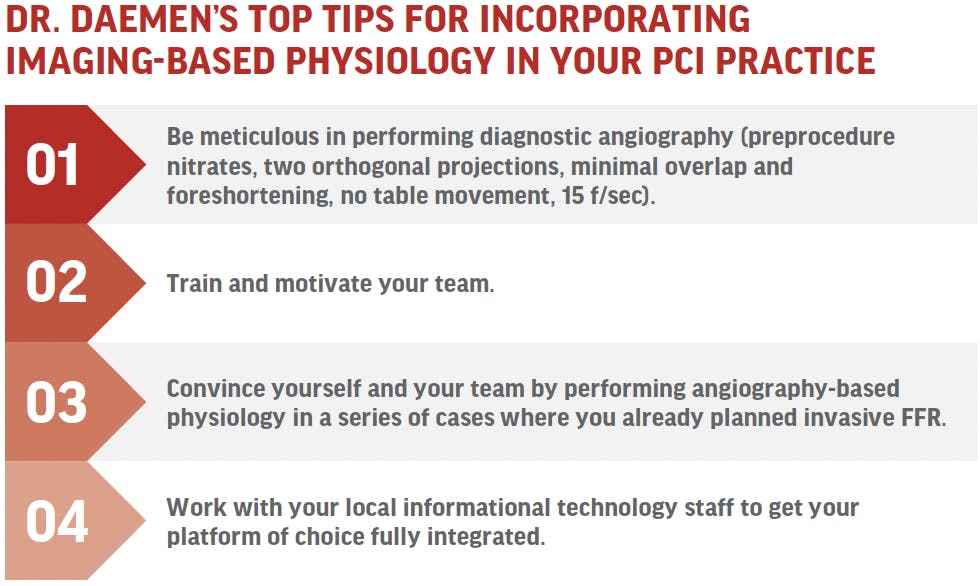
You have also been interested in angiography-based fractional flow reserve (vFFR) and are Principal Investigator of the FAST STEMI II trial, which will study the use of vFFR for assessing intermediate nonculprit lesions in patients with ST-segment elevation myocardial infarction (STEMI). What were the origins of this trial, and can you summarize its aims? How has your involvement in the other “FAST” trials guided this particular trial?
There is substantial evidence on the superiority of fractional flow reserve (FFR) compared to angiography-guided PCI in patients presenting with stable angina. Conversely, outcome trials on the use of physiology in patients presenting with acute myocardial infarction are less convincing. Similar conclusions can be drawn with respect to angiography-based physiology.
Over the past few years, angiography-based FFR technologies including (but not limited to) vFFR (Caas, Pie Medical Imaging) have emerged as promising new tools for functional lesion assessment, without the need for dedicated pressure wires and/or hyperemic agents. After initial validation studies in patients presenting with chronic coronary syndrome or non-STEMI (NSTEMI), they might carry significant potential for physiological lesion assessment in patients presenting with STEMI.
The aim of the prospective, multicenter, observational FAST STEMI II trial is to study the diagnostic performance of acute-setting vFFR for the physiological assessment of intermediate nonculprit lesions in STEMI patients, with acute-setting FFR as the reference standard. Secondary analyses will cover the impact of coronary flow reserve and index of microcirculatory resistance on the potential discrepancies between acute-setting vFFR, FFR, and non-hyperemic pressure ratios.
With a series of trials studying the diagnostic performance of vFFR in a variety of lesion subsets and clinical indications, the FAST study pipeline is rapidly expanding. In the meantime, as of June 2023, we have enrolled > 1,000 patients in the prospective, international, multicenter FAST III outcome trial randomizing patients with intermediate coronary artery lesions to either a vFFR-guided treatment strategy or an FFR-guided approach.
Another focus of yours in recent years is RDN for uncontrolled hypertension. While we are waiting on an FDA evaluation in the United States, RDN devices have been approved in the European Union for some time. In your experience, who are the patients most likely to benefit from this procedure?
This is the million-dollar question. Up to six randomized controlled trials have demonstrated a significant blood pressure–lowering effect of RDN as compared to sham in patients both on and off hypertensive medication. Unfortunately, within the currently available body of evidence (including large real-world registry data), no consistent predictors of response have been identified. Considering the strong relation between blood pressure and future adverse cardiac events (10% risk reduction for each 5 mm Hg decrease in systolic blood pressure), it is imperative to say RDN could be an appealing treatment option for a broad spectrum of patients with difficult-to-control hypertension. From a cost-economic perspective, my personal belief is that patients with the highest risk of future adverse events (diabetes, previous stroke, coronary artery disease) may have the largest benefit.
If RDN devices are approved in the United States, where do you want to see the research for RDN head next globally? If they are not?
I strongly believe a large international outcome trial in patients at high cardiovascular risk may be needed to provide a definite answer to the question of whether RDN significantly reduces the clinical sequelae of hypertension compared to standard of care therapy.
If you could dedicate a year to focus solely on one area of medicine you are not yet trained in, what would it be and why?
That’s a tough one. I was thinking about statistics or learning more about artificial intelligence, but in the end, I would pick psychology. It is fascinating to see the differences in mentality, work ethic, happiness, and motivation among the many people I work with. Success rarely is driven by an individual but rather is the result of a team of people with the same goal and enthusiasm. I guess it is impossible to know enough about how the human brain works and why we make certain decisions.
1. Ziedses des Plantes AC, Scoccia A, Neleman T, et al. Optical coherence tomography-derived predictors of stent expansion in calcified lesions. Catheter Cardiovasc Interv. 2023;102:25-35. doi: 10.1002/ccd.30687
Advertisement
Advertisement
Interested in reading more interviews?
To read more interviews with thought leaders in the interventional cardiology field, check out our Profiles & Perspectives hub.
Read More