Advertisement
Advertisement
July/August 2023
A How-To Guide for Using Intravascular Imaging to Determine Calcium Modification
Intravascular imaging, including IVUS and OCT, offers accurate, real-time visualization and evaluation of coronary artery calcification that is pivotal in pre-PCI planning and post-PCI evaluation.
By Moemen Eltelbany, MD; Lindsey Cilia, MD; and Alexander Truesdell, MD
Since the clinical introduction of intravascular ultrasound (IVUS) in the 1980s and optical coherence tomography (OCT) in the 2000s for use in coronary arteries, an increasing number of studies have demonstrated clinical benefits of intravascular imaging (IVI) over angiography for percutaneous coronary intervention (PCI), particularly in complex lesion subsets such as calcified coronary
Coronary artery calcification is associated with worse clinical outcomes and decreased procedural success compared to noncalcified coronary artery intervention.4 Hence, diagnosis and assessment of coronary artery calcification using IVI is pivotal in pre-PCI planning and post-PCI evaluation. IVI as an adjunct to angiography offers key clinical benefits, including more accurate vessel sizing and larger minimal stent area, which have been associated with lower rates of mortality, major adverse cardiac events, and target vessel failure.5 IVI has demonstrated utility in preintervention lesion assessment, intraintervention lesion preparation and stent deployment, and postintervention assessment of endpoints and complications. Yet, contemporary estimates suggest IVI is used to guide and optimize PCI in < 15% of cases—likely due to a combination of widely varied training experience, outcomes data limited to specific (vs all-comer) lesions, and variable perceptions regarding impact on procedural time and cost.6
KEY TECHNICAL DIFFERENCES BETWEEN IVUS AND OCT
IVUS is an ultrasound-based imaging modality with transducers mounted on intravascular catheters that emit ultrasound pulses to create real-time, cross-sectional images. OCT catheters emit and receive near-infrared light waves that are then similarly converted into cross-sectional images. Both modalities offer characterization of intracoronary pathology, plaque morphology, and vessel wall architecture that is above and beyond coronary angiography. OCT provides higher resolution compared to IVUS, which may be advantageous for the detection of stent malapposition and underexpansion, intimal and medial dissections, and measurement and characterization of coronary calcium.7
ROLE OF IVUS IN CALCIFIED VESSELS
Although both IVUS and OCT are useful adjuncts to PCI, IVUS is better suited for use in chronic kidney disease or chronic total occlusions given that no contrast injections are required. An IVUS-based calcium scoring system has been developed that includes four elements, with one point given for each element present. They include (1) lesions with a superficial calcium arc > 270° for ≥ 5-mm length, (2) presence of 360° circumferential superficial calcium, (3) presence of a calcified nodule, and (4) vessel diameter < 3.5 mm.8 More than 30% of lesions with a calcium arc > 270° are associated with calcific nodules. Superficial calcifications are a predictor of negative lesion remodeling, which is an important factor for stent expansion. These lesion characteristics are strongly associated with a higher risk for stent underexpansion and worse long-term hard clinical outcomes. If the calcium score is ≥ 2, calcium modification via orbital or rotational atherectomy or intravascular lithotripsy (IVL) is recommended to optimize PCI.8 The total calcium volume—including calcium thickness, angle, and length—affects multiple factors beyond stent expansion, such as stent length and selection of optimal disease- and calcium-free landing zones. Finally, it is worth noting that prevention of calcium-related stent underexpansion and other suboptimal PCI endpoints is preferred over post-PCI intervention.
ROLE OF OCT IN CALCIFIED VESSELS
OCT is superior to IVUS in determining not only the presence or absence of calcium but also the thickness, depth, and eccentricity of calcified lesions. Multiple contemporary OCT scoring systems have been advocated to guide PCI in calcified coronary arteries. One such system is the “rule of 5,” in which a calcium arc > 50%, calcium thickness > 0.5 mm, and length of calcium > 5 mm have been shown to be strongly associated with stent underexpansion.9 The acronym MLD MAX was similarly developed to guide the use of OCT during PCI. MLD MAX highlights six important elements related to the optimal performance of PCI.10 MLD represents pre-PCI lesion assessment, where M refers to lesion morphology, L to lesion length, and D to vessel diameter based on the distal reference segment. MAX represents the criteria to best assess optimal post-PCI results and include M for medial dissection, A for stent apposition, and X for stent expansion. The high resolution of OCT enables better detection of post-PCI complications, including edge dissections and underexpansion, compared to angiography and IVUS. OCT-based optimization has therefore been significantly associated with improved post-PCI outcomes.
ROLE OF IVI IN GUIDING CALCIFIED LESION PREPARATION
The presence of significant coronary calcifications increases the risk of stent underexpansion, which is one of the major predictors of stent failure. The recently developed IVUS- and OCT-based calcium scoring systems help facilitate an algorithmic approach to PCI planning based on the identification, measurement, and characterization of coronary calcification. In cases of lesions with high lipid content and some fibrotic lesions without significant calcium, direct stenting or predilation with a compliant balloon may be an appropriate strategy. With mild-to-moderate calcification, noncompliant balloon angioplasty may be an adequate initial option for lesion preparation. With severe calcification, up-front use of specialty balloons, atherectomy devices, or IVL for calcium fracture and lesion modification is recommended. Best use of IVI involves serial pre-, intra-, and postintervention imaging to evaluate the effectiveness of calcium fracture and lesion modification prior to definitive stent implantation.
Although multiple devices with different mechanisms of action are currently in use to modify coronary calcium, there is a lack of head-to-head comparative data. McInerney et al developed a user-friendly imaging-based algorithm for calcium modification (Figure 1), with initial device recommendations guided by specific IVI features.11
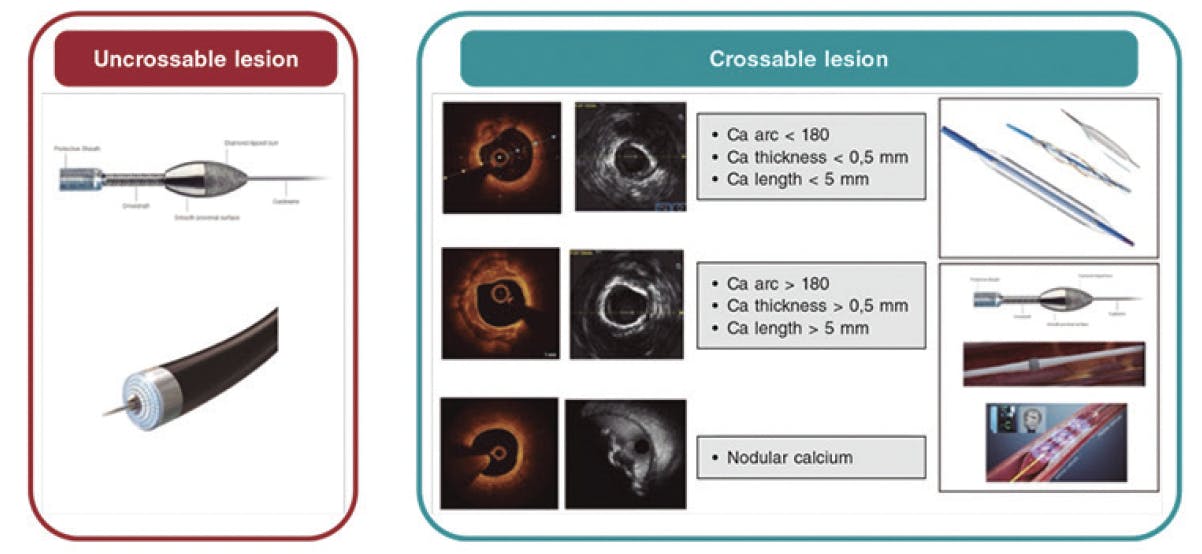
Figure 1. Calcium modification algorithm: IVI for lesion assessment is advised prior to undertaking plaque modification. Uncrossable lesions usually require rotational atherectomy or excimer laser coronary angioplasty; crossable lesions with eccentric calcification and without high-risk features for stent underexpansion can be treated using noncompliant, cutting, or scoring balloons. Concentric calcification or calcium with high-risk features for stent underexpansion can be treated with atherectomy techniques or IVL. Nodular calcium can be modified using atherectomy techniques, with emerging evidence that IVL may also be effective. Postplaque modification IVI is key for proper plaque modification assessment. Ca, calcium. Reprinted with permission from McInerney A, Escaned J, and Gonzalo N. Calcified coronary artery disease: pathophysiology, intracoronary imaging assessment, and plaque modification techniques. REC Interv Cardiol. 2022;4:216-227. doi: 10.24875/RECICE.M22000291.
Although algorithms serve as useful guides, selection of the most appropriate lesion modification strategy is a complex process, based not only on the imaging characteristics of the calcified lesion but also on local device availability and operator and center experience and expertise.12 Future efforts should target consensus pathways to guide the best selection of appropriate therapies.
CONCLUSION
IVI offers more accurate and real-time visualization and evaluation of coronary artery calcification compared to angiography. Extensive coronary calcification significantly impacts PCI outcomes, with higher risks of stent underexpansion, decreased procedural success, and increased mortality. The routine application of IVI, including IVUS and OCT, has robust and accruing evidence that may soon prompt an upgrade in United States coronary revascularization guidelines. The application of IVUS and OCT calcium scoring systems may add more objectivity to the evaluation of coronary calcification and drive more algorithmic approaches to lesion preparation using different atherectomy devices. Finally, there is an unmet need for further physician education and greater emphasis on integrating IVI into PCI workflow and cath lab culture.13,14
1. Gao XF, Ge Z, Kong XQ, et al. 3-year outcomes of the ULTIMATE trial comparing intravascular ultrasound versus angiography-guided drug-eluting stent implantation. JACC Cardiovasc Interv. 2021;14:247-257. doi: 10.1016/j.jcin.2020.10.001
2. Hong SJ, Kim BK, Shin DH, et al. Effect of intravascular ultrasound-guided vs angiography-guided everolimus-eluting stent implantation: the IVUS-XPL randomized clinical trial. JAMA. 2015;314:2155-2163. doi: 10.1001/jama.2015.15454
3. Ali ZA, Maehara A, Genereux P, et al. Optical coherence tomography compared with intravascular ultrasound and with angiography to guide coronary stent implantation (ILUMIEN III: OPTIMIZE PCI): a randomised controlled trial. Lancet. 2016;388:2618-2628. doi: 10.1016/S0140-6736(16)31922-5
4. Barbato E, Shlofmitz E, Milkas A, et al. State of the art: evolving concepts in the treatment of heavily calcified and undilatable coronary stenoses - from debulking to plaque modification, a 40-year-long journey. EuroIntervention. 2017;13:696-705. doi: 10.4244/EIJ-D-17-00473
5. Mintz GS, Bourantas CV, Chamié D. Intravascular imaging for percutaneous coronary intervention guidance and optimization: the evidence for improved patient outcomes. JSCAI. 2022;1. doi: 10.1016/j.jscai.2022.100413
6. Truesdell AG, Alasnag MA, Kaul P, et al. Intravascular imaging during percutaneous coronary intervention: JACC state-of-the-art review. J Am Coll Cardiol. 2023;81:590-605. doi: 10.1016/j.jacc.2022.11.045
7. Maehara A, Matsumura M, Ali ZA, et al. IVUS-guided versus OCT-guided coronary stent implantation: a critical appraisal. JACC Cardiovasc Imaging. 2017;10:1487-1503. doi: 10.1016/j.jcmg.2017.09.008
8. Zhang M, Matsumura M, Usui E, et al. Intravascular ultrasound-derived calcium score to predict stent expansion in severely calcified lesions. Circ Cardiovasc Interv. 2021;14:e010296. doi: 10.1161/CIRCINTERVENTIONS.120.010296
9. Shlofmitz E, Sosa FA, Ali ZA, et al. OCT-guided treatment of calcified coronary artery disease: breaking the barrier to stent expansion. Curr Cardiovasc Imaging Rep. 2019;12:32. doi: 10.1007/s12410-019-9509-1
10. Shlofmitz E, Croce K, Bezerra H, et al. The MLD MAX OCT algorithm: an imaging-based workflow for percutaneous coronary intervention. Catheter Cardiovasc Interv. 2022;100 suppl 1:S7-S13. doi: 10.1002/ccd.30395
11. McInerney A, Escaned J, Gonzalo N. Calcified coronary artery disease: pathophysiology, intracoronary imaging assessment, and plaque modification techniques. REC Interv Cardiol. 2022;4:216-227. doi: 10.24875/RECICE.M22000291
12. Truesdell AG, Khuddus MA, Martinez SC, Shlofmitz E. Calcified lesion assessment and intervention in complex percutaneous coronary intervention: overview of angioplasty, atherectomy, and lithotripsy. US Cardiol Rev. 2020;14:e05. doi: 10.15420/usc.2020.16
13. Sung JG, Sharkawi MA, Shah PB, et al. Integrating intracoronary imaging into PCI workflow and catheterization laboratory culture. Curr Cardiovasc Imaging Rep. 2021;14:6. doi: 10.1007/s12410-021-09556-4
14. Flattery E, Rahim HM, Petrossian G, et al. Competency-based assessment of interventional cardiology fellows’ abilities in intracoronary physiology and imaging. Circ Cardiovasc Interv. 2020;13:e008760. doi: 10.1161/CIRCINTERVENTIONS.119.008760
Advertisement
Advertisement