Advertisement
Advertisement
January/February 2022
Calcium Modification: It’s All In the Preparation
Exploring the “why, when, where, and how” of calcium modification therapies and techniques.
Coronary calcification continues to present many difficulties to interventional cardiologists performing percutaneous coronary interventions (PCI). Moderate to severe coronary calcification is found in up to 30% of patients, and risk factors for its development include age, male sex, hypertension, hyperlipidemia, diabetes, and chronic kidney disease.1-3 Coronary calcification results in reduced vessel compliance and causes a number of difficulties during PCI, particularly in relation to stent underexpansion, which is one of the most important predictors of stent failure—both thrombosis and restenosis.4-6 Furthermore, patients with coronary artery calcification more frequently experience adverse outcomes after PCI, including death and stent failure.2,3,7,8 Optimizing results is therefore of paramount importance, and calcium modification prior to PCI is an important step in this process to ensure adequate stent expansion. Having now outlined the “why,” in this article we also attempt to answer the “when, where, and how” of calcium modification by examining the various modalities in the interventional cardiologist’s armamentarium and outline a simplified algorithm based on intracoronary imaging findings for choosing between techniques and assessing their effectiveness.
IMAGING FOR CALCIUM DETECTION
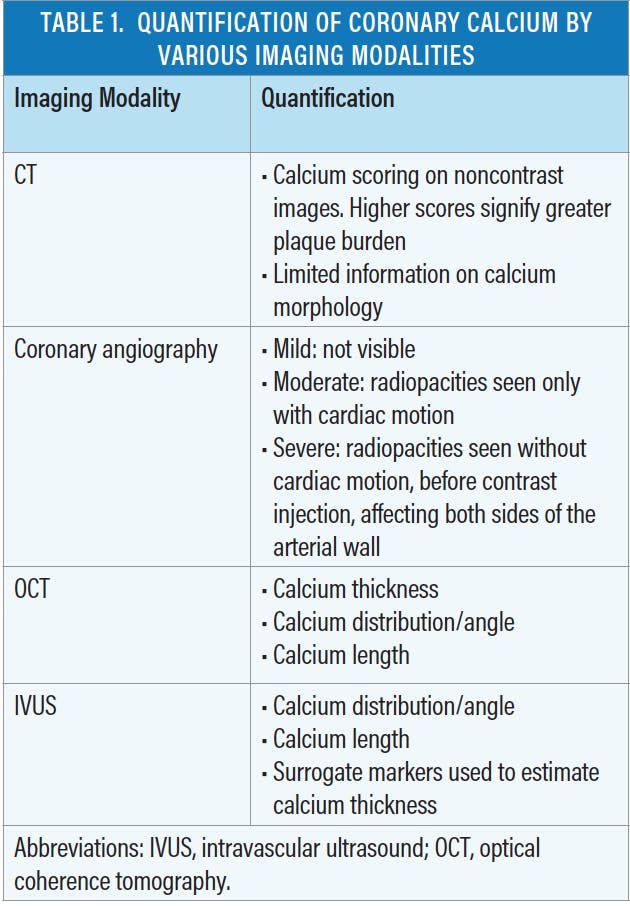
The first step in the treatment of calcified coronary artery disease (CAD) is recognizing its existence. Table 1 summarizes widely available imaging techniques for the detection and quantification of coronary calcium. CT coronary angiography (CTCA) is increasingly being used prior to invasive coronary angiography and is highly sensitive and specific for the detection of calcium.9 Although it is a noninvasive technique, CTCA does have an associated radiation dose to the patient, as well as the use of contrast medium with its inherent risks. Calcium scoring can be performed on noncontrast studies, and increased score correlates with increased plaque; however, its utility in procedure planning is limited. Invasive coronary angiography is known to have a low sensitivity but high specificity for the detection of coronary calcium, although its sensitivity increases with increasing calcium severity.10,11 Intracoronary imaging using both intravascular ultrasound (IVUS) and optical coherence tomography (OCT) have increasingly become the mainstay for assessment of coronary calcium and provide added information such as detailed morphological assessment of the calcification and assessment of the result of calcium modification techniques, and they can also aid in planning and guiding the PCI with selection of proximal and distal landing zones, stent diameter, and length.12 Software allowing coregistration of intracoronary images with angiography are also available and significantly simplify their interpretation.13 In our practice, the use of calcium modification techniques is based upon the findings by intracoronary imaging, and so its importance in the assessment of coronary calcium cannot be overemphasized.
In practical terms, coronary calcium can be subdivided into three morphologic subtypes based on intracoronary imaging findings. Figure 1 depicts different calcium patterns as seen on OCT and IVUS. Eccentric calcification extends across two quadrants or less and thereby has an arc of < 180°, concentric calcification has an arc of > 180°, and nodular calcification presents as an eruptive calcium protrusion into the lumen. Depth and length of calcium are also important predictors of PCI result. Fujino et al demonstrated that a calcium arc > 180°, depth > 0.5 mm, and length of > 5 mm as determined by OCT had an increased risk of stent underexpansion.14 Although both OCT and IVUS can assess calcium length, OCT provides a better assessment of calcium depth due to the ability of light to penetrate calcium. Ultrasound, being unable to penetrate calcium, creates an acoustic shadow, thereby hindering depth assessment. However, surrogate markers can be used to determine the calcium thickness by IVUS with the presence of posterior reverberations being correlated with thinner calcium sheets (< 0.5 mm), while significant shadowing suggests thicker calcification (> 1 mm).11 Recently, an IVUS-specific scoring system was found to be useful in predicting stent underexpansion using four criteria: (1) a calcium arc > 270° for a length of 5 mm, (2) the presence of 360° calcium, (3) the presence of a calcified nodule, and (4) an adjacent vessel diameter < 3.5 mm.15 A score of 2 suggests that calcium modification should be undertaken.
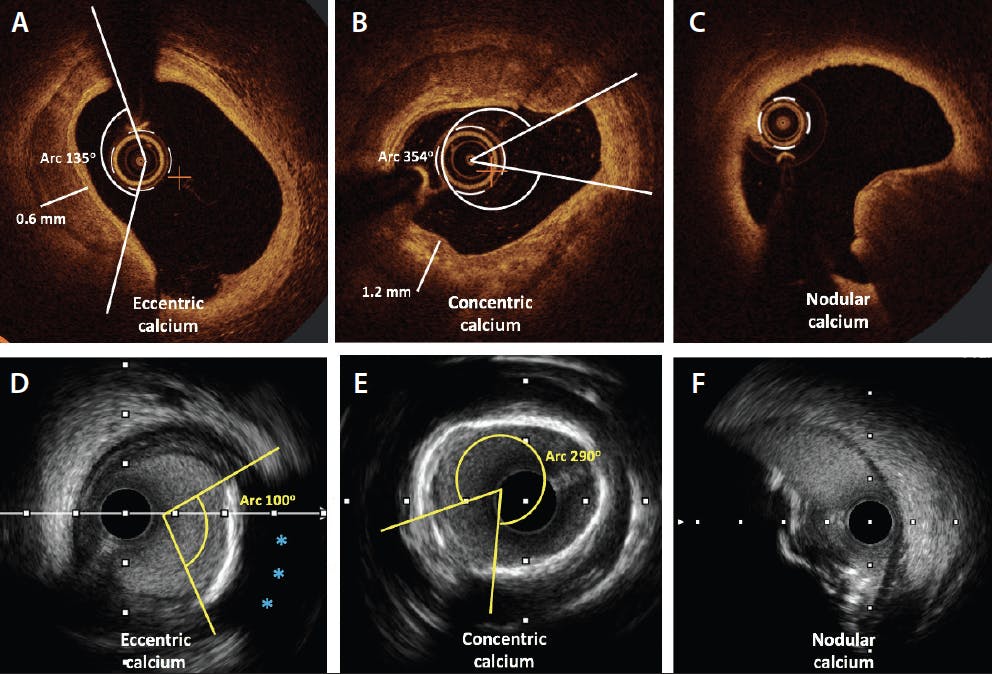
Figure 1. Coronary calcium patterns as seen on intracoronary imaging. Coronary calcium patterns by OCT (top panel). Eccentric calcification with a calcium angle < 180°; light passes through the calcium, allowing an accurate assessment of calcium depth (0.6 mm) (A). Concentric calcification with a calcium angle > 180° and affecting more than two quadrants and with a depth of 1.2 mm (B). Calcified nodule protruding into the lumen (C). Coronary calcium patterns by IVUS (bottom panel). Eccentric calcification with a calcium angle < 180°; because ultrasound cannot penetrate calcium, a dark acoustic shadow is seen behind the calcium, hindering depth assessment (blue asterisks) (D). Concentric calcification by IVUS with a calcium angle > 180° and affecting more than two quadrants (E). Calcified nodule protruding into the lumen as seen by IVUS (F).
CALCIUM MODIFICATION
A number of calcium modification techniques, including balloon-based technologies, ablative techniques, and more recently a lithotripsy-based technique, are at the disposal of the interventional cardiologists. Our practice has been to determine which calcium modification technique to use based on intracoronary imaging findings. A simplified calcium modification algorithm is presented in Figure 2. We use balloon-based therapies in eccentric calcification and ablative- or lithotripsy-based therapies in concentric and nodular calcification. Excimer laser coronary angioplasty (ELCA) has had variable results for calcium modification. Although it does have some utility for uncrossable lesions, given this niche role, we have not discussed ELCA in this article. Increasingly, calcium modification techniques are seen as being complementary, and combinations of techniques are often advocated when treating coronary calcium. This avoids aggressive use of any one technique and in theory may avoid complications. Postcalcium modification imaging is recommended to assess results and determine if further modification is required prior to stenting. The next section summarizes available calcium modification techniques and discusses their mechanisms of action.
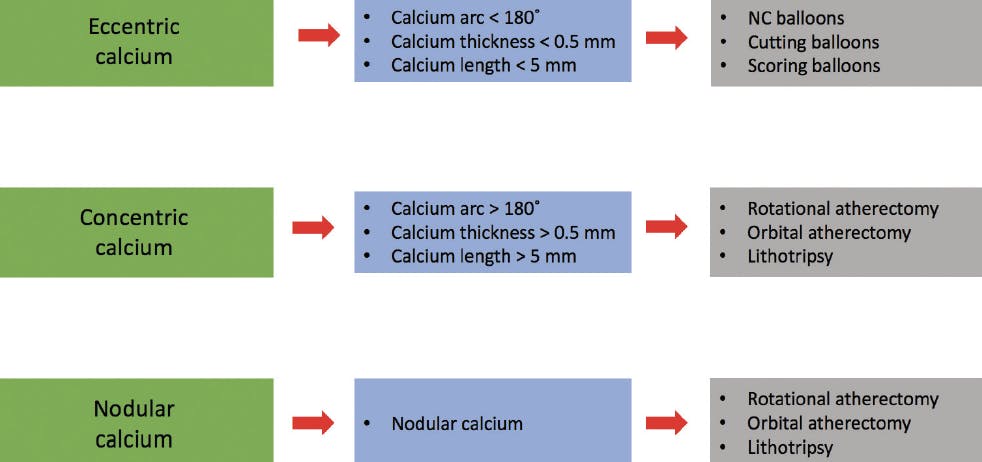
Figure 2. Calcium modification algorithm based on intracoronary imaging findings.
NC, noncompliant.
Eccentric Calcification Therapies
Specialized balloon-based technologies. Specialized balloon-based technologies include cutting and scoring balloons and are generally used in eccentric calcium. Cutting balloons consist of a number of microblades mounted on a balloon, and scoring balloons consist of a semicompliant balloon around which several nitinol wires are wrapped. Both make incisions into the calcium and improve vessel compliance, allowing dilation. Their designs allow them to grip the calcium, resulting in less slippage—also known as “melon seeding”—which avoids dissection of the adjacent vessel. However, in the presence of severe calcification, cutting balloons have been found to have less procedural success than rotational atherectomy (RA), although they do have utility when used as an adjunct to RA.16,17
Very-high-pressure balloons consist of a twin-layered, noncompliant balloon with a rated burst pressure of approximately 35 atm. Data on their use are limited to observational studies and in a retrospective analysis of > 300 undilatable lesions by Secco et al—high angiographic success (> 90%) was reported with their use.18 This technology has its place as an adjunct to other techniques, and in the aforementioned series, 10% required adjunctive RA. As with all balloon therapies, caution must be exercised to avoid perforation, which occurred in approximately 1% in this retrospective study, although all were solved by stenting.18
Concentric and Nodular Calcification
Lithotripsy. Shockwave intravascular lithotripsy (IVL) (Shockwave Medical, Inc.) consists of a balloon-based delivery system containing a number of emitters that generate short electric sparks. These sparks produce a vapor bubble that expands and creates an acoustic pressure wave that fractures calcium as it propagates through the vessel wall.19 Although the balloon itself is dilated to only 4 atm, each short-lived pulse delivers an equivalent of approximately 50 atm of pressure. To date, IVL has been predominantly used in concentric calcification, and a pooled analysis of the DISRUPT CAD series of nonrandomized studies demonstrated overall procedural success in > 90% of lesions.20 Recently presented OCT data suggest that IVL can be effective in concentric, eccentric, and nodular calcification.21
Rotational atherectomy. RA, performed with the Rotablator system (Boston Scientific Corporation), uses a diamond-tipped burr rotating at very high speeds (140,000-160,000 rpm) and resulting in differential ablation of calcified lesions. RA was previously used for aggressive debulking of the calcium, which led to a number of complications, including no-reflow (from embolization of particulate matter) and vessel perforation. However, modifications to RA technique such as shorter RA runs, the use of a pecking motion at the lesion, smaller burr sizes, and the combination of adjunctive, complementary techniques have resulted in less aggressive debulking and less complications. Both the ROTAXUS and PREPARE-CALC studies demonstrated improved acute results after RA in calcified lesions versus conventional therapy; however, at 9-month angiographic follow-up, the ROTAXUS study found greater late lumen loss (LLL) in the RA arm versus the conventional treatment arm.22,23 One theory for this might be that aggressive debulking caused in exuberant healing after RA, accounting for the greater LLL. Additionally, more contemporary studies are required to examine the longer-term outcomes of RA when less aggressive debulking is employed. In our practice, we use RA for uncrossable and undilatable lesions or concentric calcification and frequently combine RA with other modification techniques.
Orbital atherectomy. Orbital atherectomy (OA), such as the Diamondback 360 OA system (Cardiovascular Systems, Inc.), consists of an eccentrically mounted, diamond-coated crown that uses centrifugal force to orbit (at 80,000 or 120,000 rpm), resulting in preferential calcium sanding while flexing away from elastic healthy tissue. As with RA, distal embolization can occur; therefore, atherectomy runs should be 30 seconds with rest periods between each run to allow clearance of embolized debris. The nonrandomized ORBIT I and II studies examined the safety and effectiveness of OA and found reduction in diameter stenosis to 50% in > 98% of lesions.24,25 There are currently no randomized trials comparing OA to other forms of calcium modification; however, a small OCT study suggested deeper calcium modification with OA versus RA, and a meta-analysis by Goel et al suggested no difference between OA and RA in terms of procedural complications and 30-day events, including death and stent failure.26,27 Therefore, our practice is to use OA in preference to RA in larger vessels with concentric or nodular calcification due to the wider rotational orbit and deeper calcium modification achieved with OA.
Future directions
Our aging population means that as interventional cardiologists, we will be increasingly tasked with percutaneously treating more and more complex CAD. This will require proficiency in using all types of calcium modification techniques, an understanding of which tools are most appropriate in a given patient, and familiarity with intracoronary imaging use to guide the procedure. Head-to-head comparisons between calcium modification tools are lacking and should be a focus of future research in patients where true equipoise exists regarding which tool to use. Increasingly, a combination of calcium modification techniques are being used in clinical practice, and again, studies are required to determine which combinations have synergistic effects in specific morphologic subtypes. Lastly, as lifelong learning and continuous upskilling are fundamental parts of being an interventional cardiologist, educational events, mentoring and proctoring on the use of these tools is essential for their safe adoption in everyday practice.
CONCLUSION
Calcified CAD continues to present a barrier to successful PCI. Its presence is associated with not just poorer acute outcomes but also increased adverse events at follow-up. Stent underexpansion is one of the most powerful predictors of stent failure and more frequently occurs in the presence of significant coronary calcification. Identifying the presence of coronary calcium is key in planning a PCI procedure and choosing an appropriate calcium modification technique. Although a number of imaging modalities can detect calcium, greater understanding of calcium morphology, length, and depth through the use of intracoronary imaging greatly assists in choosing a calcium modification tool and also provides additional benefits in guiding the PCI. A number of technologies with different mechanisms of action are now available to modify coronary calcium, and some may be more appropriate for use in one morphologic subtype or other as outlined in our algorithm. It should be borne in mind that more than one technique may be required, and these tools should be considered complementary. Although all techniques have potential complications, most demonstrate good safety profile when used appropriately. Repeat imaging is essential to confirm adequate modification or the need for a second complementary technique.
1. Mori H, Torii S, Kutyna M, et al. Coronary artery calcification and its progression: what does it really mean? JACC Cardiovasc Imaging. 2018;11:127-142. doi: 10.1016/j.jcmg.2017.10.012
2. Genereux P, Madhavan MV, Mintz GS, et al. Ischemic outcomes after coronary intervention of calcified vessels in acute coronary syndromes. Pooled analysis from the HORIZONS-AMI (Harmonizing Outcomes With Revascularization and Stents in Acute Myocardial Infarction) and ACUITY (Acute Catheterization and Urgent Intervention Triage Strategy) trials. J Am Coll Cardiol. 2014;63:1845-1854. doi: 10.1016/j.jacc.2014.01.034
3. Bourantas CV, Zhang YJ, Garg S, et al. Prognostic implications of coronary calcification in patients with obstructive coronary artery disease treated by percutaneous coronary intervention: a patient-level pooled analysis of 7 contemporary stent trials. Heart. 2014;100:1158-1164. doi: 10.1136/heartjnl-2013-305180
4. Fujii K, Carlier SG, Mintz GS, et al. Stent underexpansion and residual reference segment stenosis are related to stent thrombosis after sirolimus-eluting stent implantation: an intravascular ultrasound study. J Am Coll Cardiol. 2005;45:995-998. doi: 10.1016/j.jacc.2004.12.066
5. Hong MK, Mintz GS, Lee CW, et al. Intravascular ultrasound predictors of angiographic restenosis after sirolimus-eluting stent implantation. Eur Heart J. 2006;27:1305-1310. doi: 10.1093/eurheartj/ehi882
6. Stefanini GG, Alfonso F, Barbato E, et al. Management of myocardial revascularisation failure: an expert consensus document of the EAPCI. EuroIntervention. 2020;16:e875-e890. doi: 10.4244/EIJ-D-20-00487
7. Konigstein M, Madhavan MV, Ben-Yehuda O, et al. Incidence and predictors of target lesion failure in patients undergoing contemporary DES implantation-individual patient data pooled analysis from 6 randomized controlled trials. Am Heart J. 2019;213:105-111. doi: 10.1016/j.ahj.2019.03.011
8. Guedeney P, Claessen BE, Mehran R, et al. Coronary calcification and long-term outcomes according to drug-eluting stent generation. JACC Cardiovasc Interv. 2020;13:1417-1428. doi: 10.1016/j.jcin.2020.03.053
9. Knez A, Becker A, Leber A, et al. Relation of coronary calcium scores by electron beam tomography to obstructive disease in 2,115 symptomatic patients. Am J Cardiol. 2004;93:1150-1152. doi: 10.1016/j.amjcard.2004.01.044
10. Mintz GS, Popma JJ, Pichard AD, et al. Patterns of calcification in coronary artery disease. A statistical analysis of intravascular ultrasound and coronary angiography in 1155 lesions. Circulation. 1995;91:1959-1965. doi: 10.1161/01.cir.91.7.1959
11. Wang X, Matsumura M, Mintz GS, et al. In vivo calcium detection by comparing optical coherence tomography, intravascular ultrasound, and angiography. JACC Cardiovasc Imaging. 2017;10:869-879. doi: 10.1016/j.jcmg.2017.05.014
12. Raber L, Mintz GS, Koskinas KC, et al. Clinical use of intracoronary imaging. Part 1: guidance and optimization of coronary interventions. An expert consensus document of the European Association of Percutaneous Cardiovascular Interventions. Eur Heart J. 2018;39:3281-3300. doi: 10.1093/eurheartj/ehy285
13. McInerney A, Escaned J, Gonzalo N. Online coregistration of intravascular ultrasound and optical coherence tomography. Minerva Cardiol Angiol. 2021;69:641-654. doi: 10.23736/S2724-5683.21.05519-8
14. Fujino A, Mintz GS, Matsumura M, et al. A new optical coherence tomography-based calcium scoring system to predict stent underexpansion. EuroIntervention. 2018;13:e2182-e2189. doi: 10.4244/EIJ-D-17-00962
15. Zhang M, Matsumura M, Usui E, et al. Intravascular ultrasound-derived calcium score to predict stent expansion in severely calcified lesions. Circ Cardiovasc Interv. 2021;14:e010296. doi: 10.1161/CIRCINTERVENTIONS.120.010296
16. Tang Z, Bai J, Su SP, et al. Aggressive plaque modification with rotational atherectomy and cutting balloon for optimal stent expansion in calcified lesions. J Geriatr Cardiol. 2016;13:984-991. doi: 10.11909/j.issn.1671-5411.2016.12.007
17. Amemiya K, Yamamoto MH, Maehara A, et al. Effect of cutting balloon after rotational atherectomy in severely calcified coronary artery lesions as assessed by optical coherence tomography. Catheter Cardiovasc Interv. 2019;94:936-944. doi: 10.1002/ccd.28278
18. Secco GG, Buettner A, Parisi R, et al. Clinical experience with very high-pressure dilatation for resistant coronary lesions. Cardiovasc Revasc Med. 2019;20:1083-1087. doi: 10.1016/j.carrev.2019.02.026
19. Kereiakes DJ, Virmani R, Hokama JY, et al. Principles of intravascular lithotripsy for calcific plaque modification. JACC Cardiovasc Interv. 2021;14:1275-1292. doi: 10.1016/j.jcin.2021.03.036
20. Kereiakes DJ, Di Mario C, Riley RF, et al. Intravascular lithotripsy for treatment of calcified coronary lesions: patient-level pooled analysis of the disrupt CAD studies. JACC Cardiovasc Interv. 2021;14:1337-1348. doi: 10.1016/j.jcin.2021.04.015
21. Maehara A. Intravascular lithotripsy is effective in the treatment of calcified nodules: patient-level pooled analysis from the Disrupt CAD OCT sub-studies. Presented at: Transcatheter Cardiovascular Therapeutics (TCT) 2021; November 5, 2021.
22. Abdel-Wahab M, Richardt G, Joachim Buttner H, et al. High-speed rotational atherectomy before paclitaxel-eluting stent implantation in complex calcified coronary lesions: the randomized ROTAXUS (Rotational Atherectomy Prior to Taxus Stent Treatment for Complex Native Coronary Artery Disease) trial. JACC Cardiovasc Interv. 2013;6:10-19. doi: 10.1016/j.jcin.2012.07.017
23. Abdel-Wahab M, Toelg R, Byrne RA, et al. High-speed rotational atherectomy versus modified balloons prior to drug-eluting stent implantation in severely calcified coronary lesions. Circ Cardiovasc Interv. 2018;11:e007415. doi: 10.1161/CIRCINTERVENTIONS.118.007415
24. Parikh K, Chandra P, Choksi N, et al. Safety and feasibility of orbital atherectomy for the treatment of calcified coronary lesions: the ORBIT I trial. Catheter Cardiovasc Interv. 2013;81:1134-1139. doi: 10.1002/ccd.24700
25. Chambers JW, Feldman RL, Himmelstein SI, et al. Pivotal trial to evaluate the safety and efficacy of the orbital atherectomy system in treating de novo, severely calcified coronary lesions (ORBIT II). JACC Cardiovasc Interv. 2014;7:510-518. doi: 10.1016/j.jcin.2014.01.158
26. Goel S, Pasam RT, Chava S, et al. Orbital atherectomy versus rotational atherectomy: a systematic review and meta-analysis. Int J Cardiol. 2020;303:16-21. doi: 10.1016/j.ijcard.2019.12.037
27. Kini AS, Vengrenyuk Y, Pena J, et al. Optical coherence tomography assessment of the mechanistic effects of rotational and orbital atherectomy in severely calcified coronary lesions. Catheter Cardiovasc Interv. 2015;86:1024-1032. doi: 10.1002/ccd.26000
Advertisement
Advertisement