Advertisement
Advertisement
May/June 2021 Supplement
Funding for this supplement provided by CSI
Orbital Atherectomy in PCI for Calcific Disease: What Have We Learned and Where Are We Headed?
A data review on the role of orbital atherectomy in PCI for calcific coronary disease.

Advances in stent technology and cardiology training have led to broader adoption of percutaneous coronary intervention (PCI) in increasingly complex patients,1 yet calcific disease continues to hamper outcomes.2 Atherectomy is now widely available regionally, but practice heterogeneity and variability in the access to and utilization of technology dedicated toward vessel preparation in calcified coronary artery disease (CAD) persist. This article reviews the available data to guide our learning curve on orbital atherectomy (OA) as it applies to this space, identifies gaps in current knowledge, and suggests future studies that may impact practice patterns.
IMPLICATIONS OF CALCIFIC DISEASE IN OUTCOMES OF PCI
Advances in stent design and operator experience have reduced in-stent complications, with definite or probable stent thrombosis in less than 1% of the non–acute coronary syndrome population at 2 years3 and in approximately 1% of all cases in the Medicare population,4 yet 10% of PCI in the National Cardiovascular Data Registry was performed for in-stent restenosis (ISR).5 ISR can be challenging to manage and is associated with a major adverse cardiac event (MACE) rate of approximately 30% in less than 1 year.6 This is why adequate vessel preparation is so critical. In a pooled analysis from randomized trials using contemporary drug-eluting stents (DESs), moderate-to-severe calcium was a major predictor of target lesion failure between 30 days to 1 year, observed at a rate of 2.1%.7 Although the rate of probable or definite stent thrombosis at 1 year was fortunately only 0.6% in the same pooled analysis, other studies have implicated severe calcification as a significant risk factor,8 likely linked to stent underexpansion. Limitations in practice for calcium management are numerous; among them are operator training and experience with atherectomy and concerns about time and cost. Lack of definitive data is also cited in the face of these other concerns for those who have not adopted atherectomy in their practice.
ATHERECTOMY: DATA, TRIALS, AND TRIBULATIONS
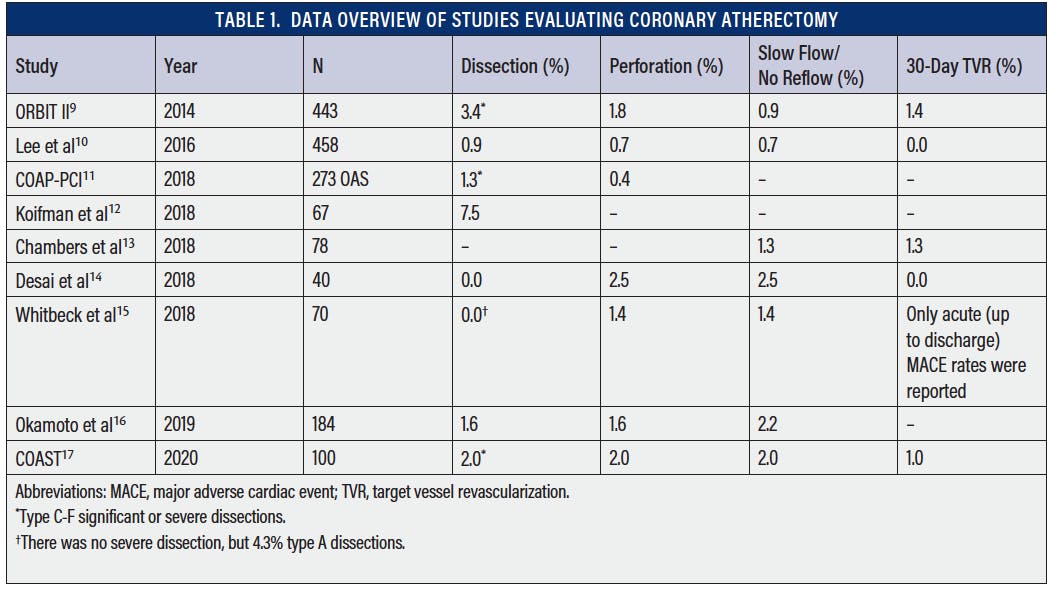
The constant conundrum facing the interventional cardiologist regarding device selection is a balance of risks and benefits of applying a technology. Of course, device utilization is impacted by operator training in best practices, but case selection, complication management, and practice environment all color that risk-benefit assessment. Additionally, our practice patterns emphasize the short-term outcomes for the patient, and a lack of disease-based registries or consistent definitions in disease characteristics such as calcium burden make the application of data more complicated than the surface layer of results. In the case of atherectomy, successful stent implantation may be possible without additional calcium modification, but the question remains: do we improve long-term patient outcomes in cases of calcific disease with atherectomy? Unfortunately, these questions may never be fully answered in randomized trials as those who stand to gain the most from device therapies are often not enrolled when the operator does not see equipoise, and crossover to the intervention arm clouds results. Despite these limitations, several trials have identified the relative efficacy and safety profile of atherectomy use, and this article focuses on the recent data exhibiting clinical outcomes after OA (Table 1).9-17
Rotational atherectomy (RA) was early to the market and used in the first studies evaluating atherectomy as an adjunct to PCI in calcific CAD. The ROTAXUS trial randomized patients to DES implantation with or without the aid of RA but failed to show a clinical benefit with regard to early restenosis or clinical outcomes at 2 years.18,19 A more recent follow-up trial that randomized 200 patients to RA versus cutting/scoring balloon as vessel preparation demonstrated improved procedural success with RA, but again clinical events were not significantly different nor were they powered for detection in this analysis.20 Notably, there was 16% crossover, and while patients with severe calcification were included, the core laboratory found that 25% of cases fit criteria for moderate calcification. These early trials are important in emphasizing key characteristics for interventional trials—challenges with anatomic definitions, crossover to the interventional strategy, and power to detect clinical events in stable ischemic heart disease patients and the current DES platforms.
OA is the more recent addition to the market (Diamondback 360® Coronary Orbital System, Cardiovascular Systems, Inc.), and is thus building on a different mechanism of action, using centrifugal forces and orbital motion of the burr to fracture calcium and perform differential sanding.21-23 ORBIT I was the introductory study and first evaluated 50 elective PCI patients in 2008 across nine operators and two sites, in lesions ≤ 25 mm in length with mild-to-severe calcium to establish baseline safety and efficacy data.24 Procedural success, defined as ≤ 20% residual stenosis after stent placement, was 97%, with 2 minor and 1 major dissections noted without clinical consequence and one perforation after stent placement. Of note, only 6 patients underwent angioplasty after OA prior to stent placement, while some did have angioplasty and intravascular ultrasound (IVUS) performed prior to OA. Still, in-hospital MACE was low, including only 6% (2 patients) and 12% at 6 months. This led the way for ORBIT II, evaluating 443 consecutive patients with severely calcified coronary lesions across 49 sites.9 Of note, 11% of patients in ORBIT II received bare-metal stents. Severe calcification was defined as fluoroscopic visualization without cardiac motion on both sites of the vessel, length > 15 mm, or ≥ 270° arc on IVUS cross-sectional imaging. The efficacy endpoint of stent implantation with < 50% residual stenosis after stent implantation and freedom from in-hospital MACE was met in 88.9% of participants, with successful stent delivery and < 50% stenosis in 97.7% of cases and low rates of in-hospital Q-wave myocardial infarction (MI) (0.7%), cardiac death (0.2%), and target vessel revascularization (TVR) (0.7%). Follow-up at 3 years was completed in 360 (81.3%) patients, demonstrating a cumulative event rate of MACE of 23.5%, cardiac death of 6.7%, MI of 11.2%, and TVR of 10.2%. Target lesion revascularization at 3 years was 7.8%, as compared with 13.8% and 16.7% in the ROTAXUS trial in the RA and control treatment arms, respectively.9,18,19,25 In contrast with current practice for many operators, the minority of lesions were treated with angioplasty after OA prior to stent placement (still only up to 42% in ORBIT II), whereas 52% had postdilatation after stent placement.9 In total, these data indicate OA may improve management of severely calcific disease with an acceptable safety profile in a patient population that has been poorly represented in trials but are yet limited by lack of a control arm. Recognizing that multiple facets of PCI have changed over time and other patient selection factors differ across studies, these data are encouraging in that calcific CAD can and should be treated in patients with an indication for PCI.
APPLYING DATA TO THE REAL WORLD: DOES IT WORK WHERE IT REALLY COUNTS?
Given the confines of the trial setting and the often lower overall risk profile of patients, subsequent registries shed insight into understanding outcome data in the broader population with real-world use. Lee et al published a study of 458 consecutive patients with severely calcified CAD who underwent OA-assisted PCI.10 This retrospective review of 458 consecutive patients showed low rates of 30-day MACE (1.7%), with 0.9% stent thrombosis, 1.1% MI, 0% TVR, and 1.3% all-cause mortality, indicating significant overlap in these presenting events. Perforation, dissection, and no reflow were all < 1% each, indicating an acceptable safety profile in real practice, although generalizable in the context where operators are likely highly trained in device utilization and managing complications in complex PCI.
Meraj et al performed a prospective registry to evaluate outcomes related to PCI using OA versus RA in 907 patients across five tertiary care hospitals.11 OA was associated with lower rates of the primary endpoint of in-hospital MI (primary endpoint of 6.7% vs 13.8% in RA) and similar procedural safety outcomes in the 546 cases compared after propensity score matching. A recent meta-analysis of seven retrospective studies comparing rates of MI and vascular complications also noted a stronger association of periprocedural MI after RA versus OA but a lower risk of dissection or perforation.26 Although these data are subject to selection bias based on angiographic features and operator preferences despite propensity matching, they do support future study regarding the best use for OA in treating calcified CAD.
Imaging Versus Angiographic Classification of Calcification
The definition of significant calcification by angiography and variable definitions used in studies to date are significant limitations of the current data. In ORBIT II, calcification burden was defined by IVUS in only 8% of cases, with the remaining patients included on the basis of angiographic criteria. A substudy evaluating IVUS in ORBIT II found that there was a reduction in the number of stents used in those with IVUS; 3-year MACE rates were not statistically different but were higher in the no-IVUS cohort (24.2% vs 14.3% in the IVUS group; P = .26).27 As this substudy was limited to 35 patients who underwent IVUS prior to OA, this may favor lesions that were more amenable to imaging prior to OA. However, taken in the context of contemporary data supporting IVUS as a tool to improve PCI outcomes,28 it is likely that coupling intracoronary imaging with atherectomy would further improve PCI outcomes in treating calcified lesions.
LOOKING AHEAD: WHAT QUESTIONS REMAIN?
The current data have established a platform for OA in treating calcified CAD but are limited in terms of patient selection and how that applies to the operator making a rapid decision that has real consequences to the patient: should atherectomy be used in this patient? Frequently, this is not realized until a poor stent result is recognized and is much more challenging to recover (Figure 1). The evaluation of treatment strategies for severe calcific coronary arteries (OA vs angioplasty technique) prior to implantation of DES in the ECLIPSE trial will aid in answering these questions. Currently enrolling with a target of 2,000 patients, this randomized trial is comparing vessel preparation with OA and balloon pre-dilatation to that with conventional and/or specialty balloon preparation, with a primary outcome of target vessel failure at 1 year (composite of cardiac death, target vessel–related MI, or ischemia-driven revascularization). An imaging cohort using optical coherence tomography in 500 patients will also assess minimal stent area as another primary endpoint, as well as secondary outcomes of procedural and strategy success. Importantly, the study population is expanded to include acute coronary syndrome patients provided they are stabilized > 48 hours after ST-segment elevation MI and excludes patients with severe heart failure symptoms or left ventricular ejection fraction < 25%.
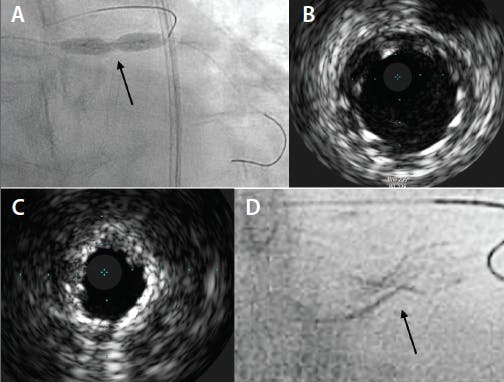
Figure 1. A 70-year-old man with IVUS-guided sizing for a 5.0-mm stent based on the proximal vessel. There was poor expansion (arrow) despite high-pressure inflation with a 5.0-mm noncompliant balloon catheter (A). IVUS of the proximal stent showed adequate apposition and expansion (B). IVUS corresponding to the waist demonstrated a diameter of 2.4 mm (C). Cineography of the stent demonstrated a severely underexpanded section (arrow) (D).
The ECLIPSE trial is well positioned to inform whether the practice of using OA or "vessel preparation with balloon angioplasty only" provides the best outcomes. This study far outpaces the aforementioned studies evaluating RA and OA in terms of size; the inclusion of an imaging cohort, evaluating crossover to the alternative strategy, and use of current-generation DESs will lend further insight as to how the vessel preparation strategy affects clinical and procedural outcomes.
CONCLUSION
Early data evaluating the safety and efficacy of OA are promising. Although patient selection and best practices for technique remain paramount for improving clinical outcomes, many cases should not be undertaken without additional calcium modification and vessel preparation, and training in these tools is imperative for the modern interventional cardiologist. Studies using better-defined classification schemes based on intracoronary imaging to define calcific burden and assess procedural outcomes will better showcase the risks and benefits of OA and further guide use of the full complement of tools aimed at treating calcific CAD.
1. Kataruka A, Maynard CC, Kearney KE, et al. Temporal trends in percutaneous coronary intervention and coronary artery bypass grafting: insights from the Washington Cardiac Care Outcomes Assessment Program. J Am Heart Assoc. 2020;9:e015317.
2. Généreux P, Madhavan MV, Mintz GS, et al. Ischemic outcomes after coronary intervention of calcified vessels in acute coronary syndromes. Pooled analysis from the HORIZONS-AMI (Harmonizing Outcomes With Revascularization and Stents in Acute Myocardial Infarction) and ACUITY (Acute Catheterization and Urgent Intervention Triage Strategy) TRIALS. J Am Coll Cardiol. 2014;63:1845-1854.
3. Chau KH, Kirtane AJ, Easterwood RM, et al. Stent thrombosis risk over time on the basis of clinical presentation and platelet reactivity: analysis from ADAPT-DES. JACC Cardiovasc Interv. 2021;14:417-427.
4. Dhruva SS, Parzynski CS, Gamble GM, et al. Attribution of adverse events following coronary stent placement identified using administrative claims data. J Am Heart Assoc. 2020;9:e013606.
5. Moussa ID, Mohananey D, Saucedo J, et al. Trends and outcomes of restenosis after coronary stent implantation in the United States. J Am Coll Cardiol. 2020;76:1521-1531.
6. Radke PW, Kaiser A, Frost C, Sigwart U. Outcome after treatment of coronary in-stent restenosis: results from a systematic review using meta-analysis techniques. Eur Heart J. 2003;24:266-273.
7. Konigstein M, Madhavan MV, Ben-Yehuda O, et al. Incidence and predictors of target lesion failure in patients undergoing contemporary DES implantation-Individual patient data pooled analysis from 6 randomized controlled trials. Am Heart J. 2019;213:105-111.
8. Huisman J, van der Heijden LC, Kok MM, et al. Impact of severe lesion calcification on clinical outcome of patients with stable angina, treated with newer generation permanent polymer-coated drug-eluting stents: a patient-level pooled analysis from TWENTE and DUTCH PEERS (TWENTE II). Am Heart J. 2016;175:121-129.
9. Chambers JW, Feldman RL, Himmelstein SI, et al. Pivotal trial to evaluate the safety and efficacy of the orbital atherectomy system in treating de novo, severely calcified coronary lesions (ORBIT II). JACC Cardiovasc Interv. 2014;7:510-518.
10. Lee MS, Shlofmitz E, Kaplan B, et al. Real-world multicenter registry of patients with severe coronary artery calcification undergoing orbital atherectomy. J Interv Cardiol. 2016;29:357-362.
11. Meraj PM, Shlofmitz E, Kaplan B, et al. Clinical outcomes of atherectomy prior to percutaneous coronary intervention: a comparison of outcomes following rotational versus orbital atherectomy (COAP-PCI study). J Interv Cardiol. 2018;31:478-485.
12. Koifman E, Garcia-Garcia HM, Kuku KO, et al. Comparison of the efficacy and safety of orbital and rotational atherectomy in calcified narrowings in patients who underwent percutaneous coronary intervention. Am J Cardiol. 2018;121(8):934-939.
13. Chambers JW, Warner C, Cortez J, et al. Outcomes after atherectomy treatment of severely calcified coronary bifurcation lesions: a single center experience. Cardiovasc Revasc Med. 2019;20:569-572.
14. Desai R, Mirza O, Martinsen BJ, Kumar G. Plaque modification of severely calcified coronary lesions via orbital atherectomy: single-center observations from a complex Veterans Affairs cohort. Health Sci Rep. 2018;1:e99.
15. Whitbeck MG, Dewar J, Behrens AN, et al. Acute outcomes after coronary orbital atherectomy at a single center without on-site surgical backup: an experience in diabetics versus non-diabetics. Cardiovasc Revasc Med. 201819(6S):12-15.
16. Okamoto N, Ueda H, Bhatheja S, et al. Procedural and one-year outcomes of patients treated with orbital and rotational atherectomy with mechanistic insights from optical coherence tomography. EuroIntervention. 2019;14:1760-1767.
17. Redfors B, Sharma SK, Saito S, et al. Novel micro crown orbital atherectomy for severe lesion calcification: Coronary Orbital Atherectomy System Study (COAST). Circ Cardiovasc Interv. 2020;13:e008993.
18. Abdel-Wahab M, Richardt G, Joachim Büttner H, et al. High-speed rotational atherectomy before paclitaxel-eluting stent implantation in complex calcified coronary lesions: the randomized ROTAXUS (Rotational Atherectomy Prior to Taxus Stent Treatment for Complex Native Coronary Artery Disease) trial. JACC Cardiovasc Interv. 2013;6:10-19.
19. de Waha S, Allali A, Büttner HJ, et al. Rotational atherectomy before paclitaxel-eluting stent implantation in complex calcified coronary lesions: two-year clinical outcome of the randomized ROTAXUS trial. Catheter Cardiovasc Interv. 2016;87:691-700.
20. Abdel-Wahab M, Toelg R, Byrne RA, et al. High-speed rotational atherectomy versus modified balloons prior to drug-eluting stent implantation in severely calcified coronary lesions. Circ Cardiovasc Interv. 2018;11:e007415.
21. Kini AS, Vengrenyuk Y, Pena J, et al. Optical coherence tomography assessment of the mechanistic effects of rotational and orbital atherectomy in severely calcified coronary lesions. Catheter Cardiovasc Interv. 2015;86:1024-1032.
22. Shlofmitz E, Martinsen BJ, Lee M, et al. Orbital atherectomy for the treatment of severely calcified coronary lesions: evidence, technique, and best practices. Expert Rev Med Devices. 2017:14:867-879.
23. Yamamoto MH, Maehara A, Kim SS, et al. Effect of orbital atherectomy in calcified coronary artery lesions as assessed by optical coherence tomography. Catheter Cardiovasc Interv. 2019;93:1211-1218.
24. Bhatt P, Parikh P, Patel A, et al. Orbital atherectomy system in treating calcified coronary lesions: 3-year follow-up in first human use study (ORBIT I trial). Cardiovasc Revasc Med. 2014;15:204-208.
25. Lee M, Genereux P, Shlofmitz R, et al. Orbital atherectomy for treating de novo, severely calcified coronary lesions: 3-year results of the pivotal ORBIT II trial. Cardiovasc Revasc Med. 2017;18:261-264.
26. Doshi R, Thakkar S, Patel K, et al. Short term outcomes of rotational atherectomy versus orbital atherectomy in patients undergoing complex percutaneous coronary intervention: a systematic review and meta-analysis [published online ahead of print January 18, 2021]. Scand Cardiovasc J. https://doi: 10.1080/14017431.2021.1875139.
27. Shlofmitz E, Martinsen B, Lee M, et al. Utilizing intravascular ultrasound imaging prior to treatment of severely calcified coronary lesions with orbital atherectomy: an ORBIT II sub-analysis. J Interv Cardiol. 2017;30:570-576.
28. Gao XF, Ge Z, Kong XQ, et al; ULTIMATE Investigators. 3-year outcomes of the ULTIMATE trial comparing intravascular ultrasound versus angiography-guided drug-eluting stent implantation. JACC Cardiovasc Interv. 2021;14:247-257.
Advertisement
Advertisement