Advertisement
Advertisement
May/June 2021 Supplement
Funding for this supplement provided by CSI
Imaging and Treating the Complex Patient
Optimizing outcomes in complex PCI with orbital atherectomy.


Whether from a randomized controlled trial, observational registry, or meta-analysis, data have consistently demonstrated the benefit of intravascular imaging on clinical outcomes.1-3 The mechanism by which outcomes are improved is largely related to improved stent expansion when intravascular imaging is utilized.1 Coronary artery calcification (CAC) is the predominant barrier to adequate stent expansion when stent sizing has been appropriate. Atherectomy has historically been indicated for undilatable and uncrossable lesions, but this indication falls short of the complete role of atherectomy in modern percutaneous coronary intervention (PCI).4 In the presence of heavy calcification, lesion preparation should be used not just for successful stent delivery, but also importantly to facilitate adequate stent expansion via plaque modification.
INTRAVASCULAR IMAGING
Although intravascular ultrasound is an important intravascular imaging modality, in most cases where evaluation of coronary calcification is required, we prefer optical coherence tomography (OCT) due to its unique ability to readily assess important prognostic factors including calcium thickness and recognition of calcified nodules. Traditionally, CAC was classified based on its angiographic appearance, with calcium visualization on both sides of the lumen prior to contrast injection without motion considered to be severe calcification.5 We now know that there are inherent limitations to angiographic assessment of coronary calcium. Angiographic recognition of calcification does not guide optimal treatment strategies and is simply a prompt for the need for further investigation with intravascular imaging to define the calcium morphology. An angiogram cannot distinguish between deep wall calcification, superficial calcification, and calcified nodules. Treatment of CAC should be determined based on this calcium morphology, which can only be characterized with intravascular imaging.
In the LightLab Study, OCT findings led to changes in angiographic-based decisions in 88% of lesions, with a change in need for vessel preparation observed in 28% of cases.6 It is widely known that CAC is underrecognized with angiography.5 Beyond recognition of calcium and understanding of its morphology, baseline intravascular imaging allows for precise selection of the optimal stent diameter and length.7 After stent implantation, intravascular imaging can exclude significant edge dissection and severe malapposition while ensuring that adequate stent expansion has been attained.
CHARACTERIZATION OF CALCIUM
On baseline intravascular imaging, predominant calcium morphology should be characterized between concentric calcification, eccentric calcification, and calcified nodules.8 The St. Francis Calcium-OCT Score, commonly known as the “rule of 5s,” guides when orbital atherectomy should be considered (Figure 1). In the presence of CAC > 5 mm in length, an arc > 50% of a cross-section with a thickness > 0.5 mm indicates heavy calcification that is at increased risk for stent underexpansion without adequate lesion preparation.9 Because conventional balloon-based technology is often inadequate to create calcium fracture when calcium thickness exceeds 0.5 mm, adjunctive therapies are needed.10 Plaque modification with calcium fracture can be achieved with lesion preparation with orbital atherectomy (Figure 2).
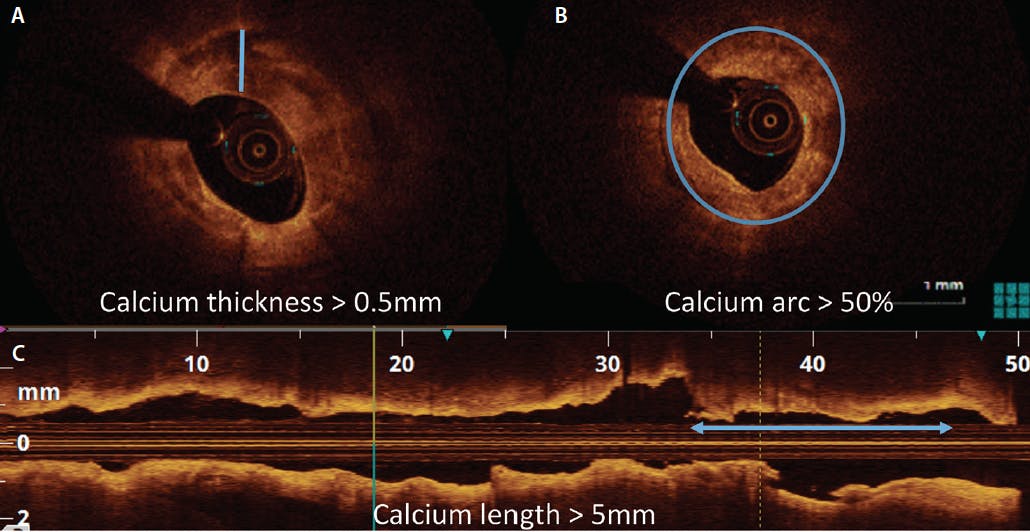
Figure 1. The St. Francis Calcium-OCT Score. Representative OCT demonstrating CAC with thickness > 0.5 mm (A), an arc of calcium > 50% of the cross-section (B), and length > 5 mm (C). In the presence of these three features, lesion preparation should be considered.
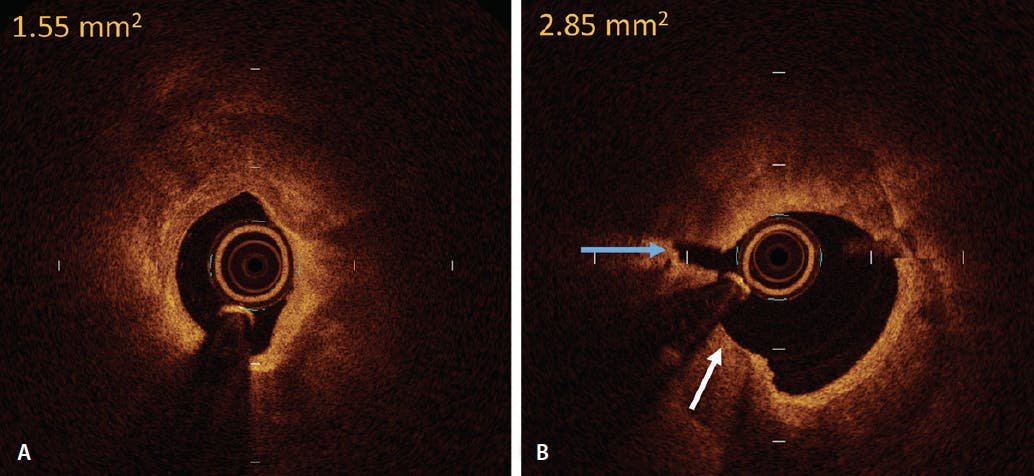
Figure 2. Baseline OCT with severe calcification and a lumen area of 1.55 mm2 (A). OCT after lesion preparation with orbital atherectomy demonstrating the dual mechanism of action with both smooth concentric ablation (white arrow) and calcium fracture (blue arrow), with an enlarged lumen of 2.85 mm2 (B).
ORBITAL ATHERECTOMY
Orbital atherectomy (Diamondback 360® Coronary Orbital Atherectomy System, Cardiovascular Systems, Inc.) utilizes a 1.25-mm diamond-coated crown that orbits at either 80,000 rpm (low speed) or 120,000 rpm (high speed) in a bidirectional fashion to modify calcified plaque.11 The unique dual mechanism of action utilizes differential sanding and pulsatile force that safely ablates superficial calcification while creating focused fractures in the calcified plaque, which enables expansion with stent implantation.12,13 During superficial calcium sanding, the small crown size permits continuous flow during ablation, with creation of particles < 2 µm in size.12 Yamamoto et al demonstrated that orbital atherectomy is associated with greater calcium modification in lesions with larger lumen area as compared with rotational atherectomy, with calcium fracture behind the stent attained in 82% of cases.14 This is an important concept, as the universal orbital atherectomy crown size can be used to treat calcified plaque in a wide range of coronary vessel sizes, including the left main coronary artery.15,16
Calcified Nodules
A calcium nodule is defined as an eruptive accumulation of nodular calcification protruding into the lumen.17 Calcium nodules are often underrecognized, as they cannot be appreciated by angiography. However, calcified nodules are not an uncommon entity, and are seen in as many as 6% of cases and over 48% of calcified lesions.18,19 It is important to detect calcium nodules prior to stent implantation because they do not behave similarly to severe concentric CAC. Treatment of calcified nodules with other adjunctive lesion preparation modalities, including rotational atherectomy, intravascular lithotripsy, and specialty balloons is not ideal due to the eccentric protruding nature of these nodules. Orbital atherectomy uniquely allows for significant plaque modification of calcified nodules with debulking of the nodule with lumen enlargement (Figure 3).
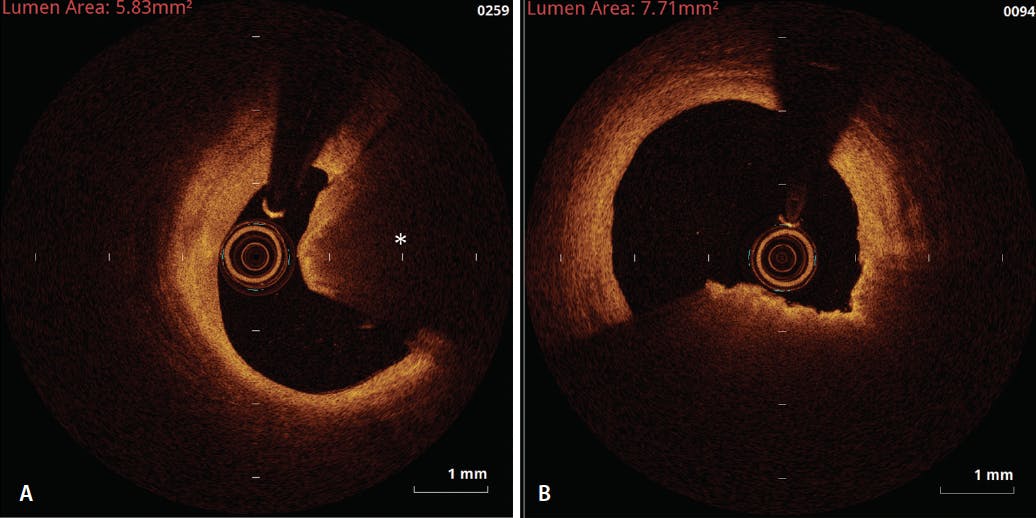
Figure 3. Baseline OCT demonstrating a protruding calcified nodule (*) (A). OCT after lesion preparation with orbital atherectomy demonstrates reduction in the nodule size with enlargement of the lumen area (B).
CONCLUSION
Intravascular imaging not only guides when orbital atherectomy is needed but also demonstrates where orbital atherectomy should be applied in a vessel. Orbital atherectomy should be performed until the operator appreciates a change in tactile resistance and no longer hears audible pitch variation during treatment of the target region. After orbital atherectomy, intravascular imaging should be performed. By documenting fracture prior to stent implantation with intravascular imaging, one can have a higher level of confidence they will achieve adequate stent expansion.
When treating calcium with PCI, adequate lesion preparation can enhance the likelihood of procedural success. Maximizing stent expansion with implantation can help to minimize future restenosis. Inadequate lesion preparation for de novo calcified lesions prior to stent implantation represents a lost opportunity, as any future treatment of in-stent restenosis is associated with outcomes worse than with de novo disease.20 De novo calcification should be addressed with lesion preparation upfront when indicated and guided by intravascular imaging. Results from the large-scale, multicenter, randomized controlled ECLIPSE trial (NCT03108456) and its prespecified OCT substudy will provide substantial insights on the impact of orbital atherectomy and optimal techniques and lesion selection.
1. Zhang J, Gao X, Kan J, et al. Intravascular ultrasound versus angiography-guided drug-eluting stent implantation: the ULTIMATE trial. J Am Coll Cardiol. 2018;72:3126-3137. doi: 10.1016/j.jacc.2018.09.013
2. Shlofmitz E, Torguson R, Zhang C, et al. Impact of intravascular ultrasound on outcomes following PErcutaneous Coronary InterventioN in Complex Lesions (iOPEN Complex). Am Heart J. 2020;221:74-83. doi: 10.1016/j.ahj.2019.12.008
3. Kuku KO, Ekanem E, Azizi V, et al. Optical coherence tomography-guided percutaneous coronary intervention compared with other imaging guidance: a meta-analysis. Int J Cardiovasc Imaging. 2018;34:503-513. doi: 10.1007/s10554-017-1272-2
4. Levine GN, Bates ER, Blankenship JC, et al. 2011 ACCF/AHA/SCAI guideline for percutaneous coronary intervention. A report of the American College of Cardiology Foundation/American Heart Association Task Force on Practice Guidelines and the Society for Cardiovascular Angiography and Interventions. J Am Coll Cardiol. 2011;58:e44-122. doi: 10.1016/j.jacc.2011.08.007
5. Mintz GS, Popma JJ, Pichard AD, et al. Patterns of calcification in coronary artery disease. A statistical analysis of intravascular ultrasound and coronary angiography in 1155 lesions. Circulation. 1995;91:1959-65. doi: 10.1161/01.cir.91.7.1959
6. Bezerra H. Analysis of changes in decision-making process during optical coherence tomography-guided percutaneous coronary interventions: insights from the LightLab Initiative. Presented at the PCR e-Course of the European Association of Percutaneous Cardiovascular Interventions (EAPCI); June 25-27, 2020; virtual presentation.
7. Shlofmitz E, Shlofmitz RA, Galougahi KK, et al. Algorithmic approach for optical coherence tomography-guided stent implantation during percutaneous coronary intervention. Interv Cardiol Clin. 2018;7:329-344. doi: 10.1016/j.iccl.2018.03.001
8. Shlofmitz E, Ali ZA, Maehara A, et al. Intravascular imaging-guided percutaneous coronary intervention: a universal approach for optimization of stent implantation. Circ Cardiovasc Interv. 2020;13:e008686. doi: 10.1161/CIRCINTERVENTIONS.120.008686
9. Fujino A, Mintz GS, Matsumura M, et al. A new optical coherence tomography-based calcium scoring system to predict stent underexpansion. EuroIntervention. 2018;13:e2182-e2189. doi: 10.4244/EIJ-D-17-00962
10. Fujino A, Mintz GS, Lee T, et al. Predictors of calcium fracture derived from balloon angioplasty and its effect on stent expansion assessed by optical coherence tomography. JACC Cardiovasc Interv. 2018;11:1015-1017. doi: 10.1016/j.jcin.2018.02.004
11. Shlofmitz E, Martinsen BJ, Lee M, et al. Orbital atherectomy for the treatment of severely calcified coronary lesions: evidence, technique, and best practices. Expert Rev Med Devices. 2017;14:867-879. doi: 10.1080/17434440.2017.1384695
12. Shlofmitz E, Shlofmitz R, Lee MS. Orbital atherectomy: a comprehensive review. Interv Cardiol Clin. 2019;8:161-171. doi: 10.1016/j.iccl.2018.11.006
13. Yamamoto MH, Maehara A, Kim SS, et al. Effect of orbital atherectomy in calcified coronary artery lesions as assessed by optical coherence tomography. Catheter Cardiovasc Interv. 2019;93:1211-1218. doi: 10.1002/ccd.27902
14. Yamamoto MH, Maehara A, Karimi Galougahi K, et al. Mechanisms of orbital versus rotational atherectomy plaque modification in severely calcified lesions assessed by optical coherence tomography. JACC Cardiovasc Interv. 2017;10:2584-2586. doi: 10.1016/j.jcin.2017.09.031
15. Lee MS, Shlofmitz E, Park KW, et al. Orbital atherectomy of severely calcified unprotected left main coronary artery disease: one-year outcomes. J Invasive Cardiol. 2018;30:270-274.
16. Lee MS, Shlofmitz E, Shlofmitz R. Outcomes of orbital atherectomy in severely calcified small (2.5 mm) coronary artery vessels. J Invasive Cardiol. 2018;30:310-314.
17. Lee T, Mintz GS, Matsumura M, et al. Prevalence, predictors, and clinical presentation of a calcified nodule as assessed by optical coherence tomography. JACC Cardiovasc Imaging. 2017;10:883-891. doi: 10.1016/j.jcmg.2017.05.013
18. Yamamoto MH, Maehara A, Song L, et al. Optical coherence tomography assessment of morphological characteristics in suspected coronary artery disease, but angiographically nonobstructive lesions. Cardiovasc Revasc Med. 2019;20:475-479. doi: 10.1016/j.carrev.2018.07.011
19. Morofuji T, Kuramitsu S, Shinozaki T, et al. Clinical impact of calcified nodule in patients with heavily calcified lesions requiring rotational atherectomy. Catheter Cardiovasc Interv. 2021;97:10-19. doi: 10.1002/ccd.28896
20. Shlofmitz E, Iantorno M, Waksman R. Restenosis of drug-eluting stents: a new classification system based on disease mechanism to guide treatment and state-of-the-art review. Circ Cardiovasc Interv. 2019;12:e007023. doi: 10.1161/CIRCINTERVENTIONS.118.007023
Advertisement
Advertisement