Advertisement
Advertisement
March/April 2021
TAVR and SAVR Durability: When Will We Have the Answer?
Reviewing the recent data on structural valve deterioration and bioprosthetic valve failure after TAVR and SAVR.
By Ole De Backer, MD, PhD; Ivan Wong, MD; and Lars Søndergaard, MD, DMSc
Transcatheter aortic valve replacement (TAVR) is currently an established therapy for older patients with symptomatic, severe aortic valve stenosis across all surgical risk categories.1-3 There is also growing evidence for TAVR in treating younger patients with lower surgical risk profiles.4 The long-term durability of transcatheter heart valves (THVs) becomes increasingly important as TAVR expands to younger and lower-risk patients with longer life expectancies because their life expectancies would likely exceed the durability of the THV.
Although all THVs are bioprosthetic valves, surgical aortic prostheses used in surgical aortic valve replacement (SAVR) can either be mechanical or biological in nature. Mechanical aortic valves, while more durable, require lifelong oral anticoagulation with an increased risk for bleeding complications. Meanwhile, there is also good experience with transcatheter valve-in-valve (ViV) procedures in the case of aortic bioprosthetic dysfunction. As a result, there has been an increased use of surgical aortic bioprostheses even in younger patients.
DEFINITIONS OF SVD AND BVF
The biologic tissue from both surgical and transcatheter aortic bioprostheses is prone to structural valve degeneration. Structural valve degeneration is a multifactorial process mediated by calcification of the connective tissue, leading to valve dysfunction and eventually valve failure. The definition of long-term durability of both surgical and transcatheter aortic bioprostheses has been inconsistent over time. Standardized definitions of structural valve deterioration (SVD) and bioprosthetic valve failure (BVF) are now endorsed by the European Association of Percutaneous Cardiovascular Interventions (EAPCI), European Society of Cardiology (ESC), and European Association for Cardio-Thoracic Surgery (EACTS).5
The term SVD includes permanent intrinsic changes of the valve (ie, leaflet tear, calcification, pannus deposition, flail, fibrotic leaflet) leading to degeneration and/or dysfunction, which in turn may result in stenosis or intraprosthetic regurgitation. SVD can be detected using imaging studies or at the time of reoperation or autopsy and can arise in both symptomatic and asymptomatic patients. SVD can be characterized as hemodynamic dysfunction and/or morphological SVD (Figure 1).
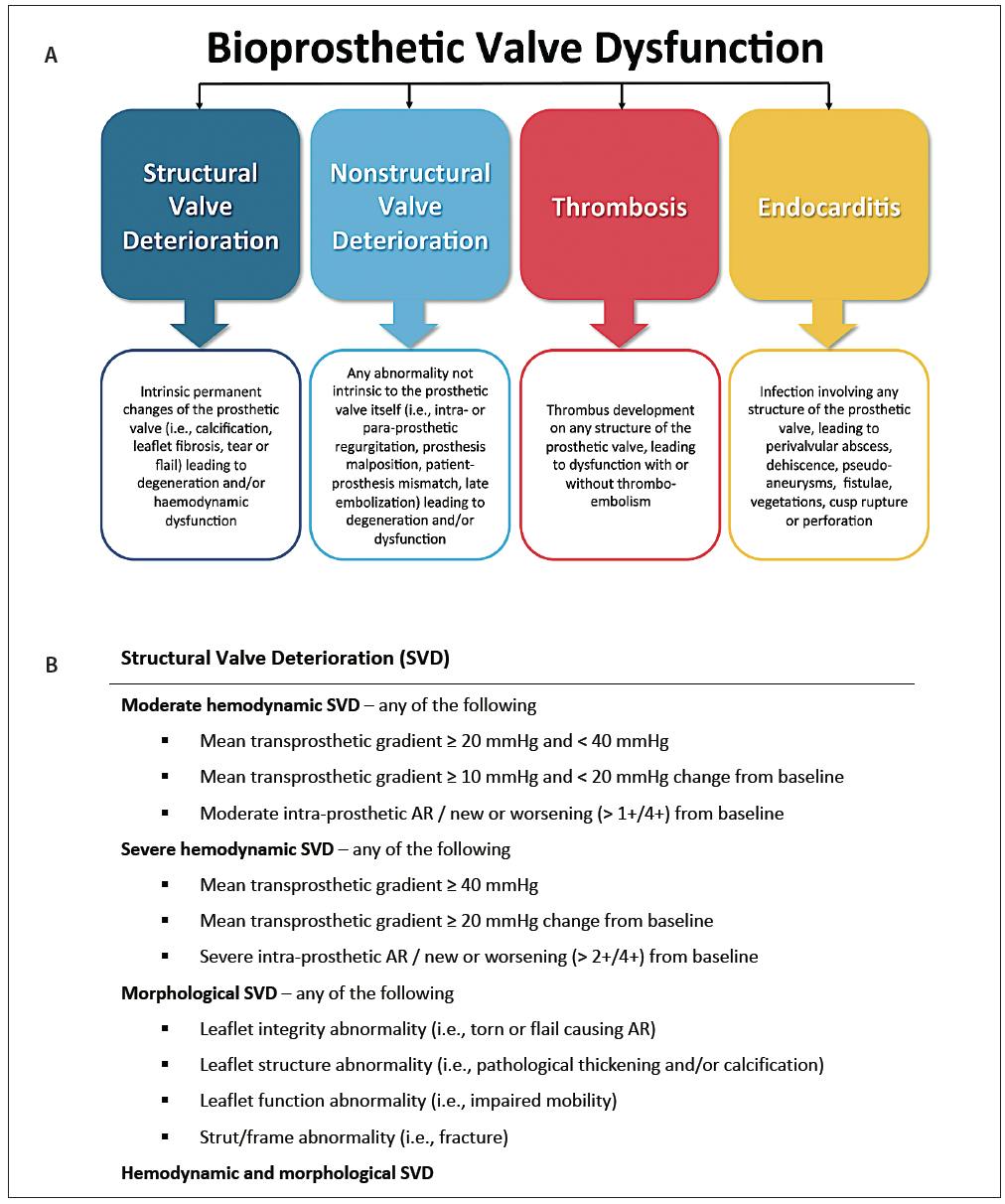
Figure 1. Causes of bioprosthetic valve dysfunction (A). SVD classification (B). Standardized definitions endorsed by the EAPCI, ESC, and EACTS. AR, aortic regurgitation. Adapted with permission from Capodanno D, Petronio AS, Prendergast B, et al. Standardized definitions of structural deterioration and valve failure in assessing long-term durability of transcatheter and surgical aortic bioprosthetic valves: a consensus statement from the European Association of Percutaneous Cardiovascular Interventions (EAPCI) endorsed by the European Society of Cardiology (ESC) and the European Association for Cardio-Thoracic Surgery (EACTS). Eur Heart J. 2017;38:3382-3390. doi: 10.1093/eurheartj/ehx303
The term BVF integrates severe SVD (ie, the etiology) with its clinical consequences—thereby avoiding overinterpretation of valve-related outcomes in asymptomatic patients with no clinical impact—and is recommended as the main outcome of interest in studies assessing the long-term performance of TAVR and SAVR. Importantly, BVF may occur in the setting of SVD but also as the consequence of pathophysiological processes unrelated to SVD, such as nonstructural valve dysfunction, thrombosis, or endocarditis. BVF includes any of the following: (1) bioprosthetic valve dysfunction at autopsy, very likely related to the cause of death, or valve-related death, defined as any death caused by bioprosthetic valve dysfunction in the absence of confirmatory autopsy; (2) aortic valve reintervention (ie, ViV TAVR, paravalvular leak closure, or SAVR); and (3) severe hemodynamic SVD.
SAVR DURABILITY
In general, studies on the performance or durability of surgical aortic bioprostheses during the first decade after SAVR have reported encouraging data, with most of the available studies showing rates of freedom from SVD of 85% or more at 10 years.6 However, a majority of these studies date back from before 2017 and did not use, or were not in line with, the EAPCI/ESC/EACTS standardized definitions of SVD.
Patient age at implantation is a well-established predictor of valve longevity after SAVR; the risk of SVD increases with younger age at valve implantation.7 As the mean age at the time of valve implantation increases, the actuarial freedom from SVD also increases. Other predictors of SVD after SAVR have been reported to be renal impairment, smoking, arterial hypertension, dyslipidemia, diabetes mellitus, and metabolic syndrome.8,9
In a recent systematic review, 167 studies and 12 FDA reports including 101,650 patients and 17 different surgical aortic biological valve types were analyzed. The authors concluded that there was a significant heterogeneity in the individual study definitions for SVD. Available data on surgical aortic bioprostheses did not provide a reliable benchmark for SVD at long-term follow-up.10 Hence, universal consensus with standard definitions will be necessary to provide accurate data on SVD after SAVR in the future, enabling reliable comparisons between studies, surgical valve platforms, and even with THVs.
TAVR DURABILITY
One of the major limitations of long-term THV durability assessment is the high-age and high-risk profile of the initial TAVR populations, conditioning a limited life expectancy and therefore a paucity of patients available at long-term follow-up.
THV durability data beyond 5 years were not available until recently. As shown in Table 1, few observational registries have attempted to report either actuarial or actual estimates of SVD or BVF (adjusted for the competing risk of all-cause mortality) in mixed TAVR populations. Unfortunately, a reliable assessment of long-term THV durability is almost impossible due to very high mortality rates. In addition, these data are typically self-reported with no external validation, which certainly limits their generalizability.
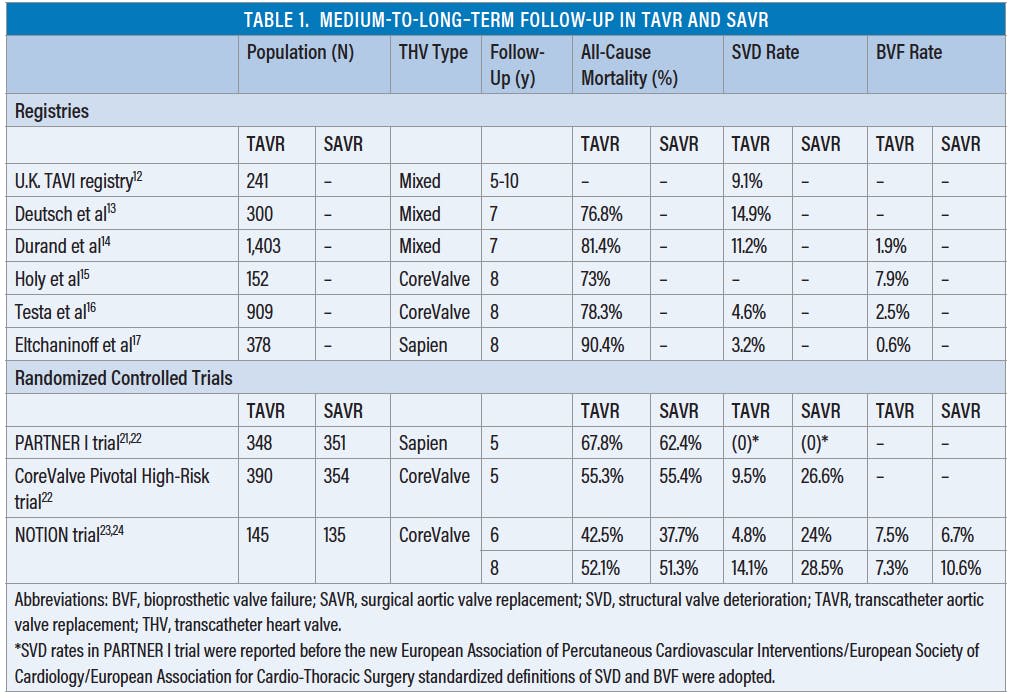
In summary, these registries report favorable medium- to long-term valve performance data for both self-expanding and balloon-expandable THVs.11-17 Interestingly, Deutsch et al reported an overall cumulative incidence of SVD of 14.9% at 7 years, based on a TAVR registry with first-generation THV devices. A comparison between the self-expanding CoreValve (Medtronic) and balloon-expandable Sapien (Edwards Lifesciences) platforms was also performed, demonstrating a more favorable outcome with the CoreValve in terms of SVD (CoreValve, 11.8% vs Sapien, 22.6%; P = .01).13 Whether the typically better hemodynamic valve performance with CoreValve—resulting in larger effective orifice area and less patient-prosthesis mismatch—as compared to the Sapien valve may be an explanation for this finding is only a hypothesis.18 The evaluation of other factors associated with SVD in THVs has been limited by the relatively small number of patients with long-term follow-up and the small number of SVD events.
DATA FROM RANDOMIZED TRIALS
Ideally, the durability of a given bioprosthetic aortic valve must be put into clinical perspective by directly comparing its performance with the performance of its surgical or transcatheter bioprosthetic counterpart used in a similar patient cohort.19 Longer-term follow-up data of randomized trials comparing TAVR and SAVR are summarized in Table 1.
The randomized PARTNER I trial compared TAVR using the balloon-expandable Sapien valve versus SAVR in high-surgical-risk patients with symptomatic severe aortic stenosis. No SVD requiring valve reintervention occurred in either group at 5 years. Unfortunately, SVD rates reported for the PARTNER I trial were reported before the standardized definitions of SVD and BVF were adopted. Moderate or severe aortic regurgitation caused by paravalvular regurgitation was more common in the TAVR group and was associated with lower survival. The final 5-year follow-up data showed equivalent outcomes after TAVR and SAVR. Longitudinal assessment of the PARTNER I trial also demonstrated that valve performance and hemodynamics were stable in both Sapien TAVR and SAVR in patients alive at 5 years.20,21 In the CoreValve United States Pivotal High Risk trial, high-risk patients were randomized to TAVR with the self-expanding bioprosthesis or SAVR. At 5 years, overall SVD was more common after SAVR than after TAVR (26.6% vs 9.5%; P < .001). Severe SVD and valve reinterventions were uncommon in both groups with rates lower than 3%. In addition, this study showed similar medium-term survival and stroke rates in high-risk patients after TAVR or SAVR.22
The NOTION trial was the first to provide comparative data regarding bioprosthetic valve durability for TAVR and SAVR from a randomized clinical trial conducted in patients with a lower surgical risk profile. As this trial enrolled patients who were at a lower surgical risk and younger as early as in the 2011-2014 period, a significant number of these patients were still alive at medium- to long-term follow-up (Table 1). Based on the standardized EAPCI/ESC/EACTS definitions, the rate of SVD at 6 years was higher after SAVR than after TAVR (24% vs 4.8%; P < .001), whereas BVF rates at 6 years were similar after SAVR and TAVR (6.7% vs 7.5%; P = .89).23 Recently presented 8-year follow-up data of the NOTION trial confirmed a higher rate of SVD after SAVR than after TAVR (28.5% vs 14.1%; P = .001), whereas BVF rates were similar after SAVR and TAVR (10.6% vs 7.3%; P = .34).24
In summary, current data from randomized controlled TAVR trials confirm that the medium- to long-term durability of transcatheter bioprosthetic valves is satisfactory and at least noninferior to surgical aortic bioprosthesis.
CONCLUSION
The long-term durability of THVs becomes increasingly important as TAVR expands to younger and lower-risk patients with longer life expectancies. Current data from registries as well as randomized controlled TAVR trials indicate that the medium- to long-term durability of THVs is satisfactory and at least noninferior to surgical aortic bioprostheses. However, randomized controlled TAVR trials in patients with longer life expectancy (including patients younger than 75 years) and longer-term follow-up of these trials will be necessary to confirm the noninferior durability of THVs as compared to their surgical counterparts.
1. Mack MJ, Leon MB, Thourani VH, et al. Transcatheter aortic-valve replacement with a balloon-expandable valve in low-risk patients. N Engl J Med. 2019;380:1695-1705. doi: 10.1056/NEJMoa1814052
2. Popma JJ, Deeb GM, Yakubov SJ, et al. Transcatheter aortic-valve replacement with a self-expanding valve in low-risk patients. N Engl J Med. 2019;380:1706-1715. doi: 10.1056/NEJMoa1816885
3. Thyregod HG, Steinbrüchel DA, Ihlemann N, et al. Transcatheter versus surgical aortic valve replacement in patients with severe aortic valve stenosis: 1-year results from the all-comers NOTION randomized clinical trial. J Am Coll Cardiol. 2015;65:2184-2194. doi: 10.1016/j.jacc.2015.03.014
4. Otto CM, Nishimura RA, Bonow RO, et al. 2020 ACC/AHA guideline for the management of patients with valvular heart disease: a report of the American College of Cardiology/American Heart Association joint committee on clinical practice guidelines. Circulation. 2021;143:e72-e227. doi: 10.1161/CIR.0000000000000923
5. Capodanno D, Petronio AS, Prendergast B, et al. Standardized definitions of structural deterioration and valve failure in assessing long-term durability of transcatheter and surgical aortic bioprosthetic valves: a consensus statement from the European Association of Percutaneous Cardiovascular Interventions (EAPCI) endorsed by the European Society of Cardiology (ESC) and the European Association for Cardio-Thoracic Surgery (EACTS). Eur Heart J. 2017;38:3382-3390. doi: 10.1093/eurheartj/ehx303
6. Rodriguez-Gabella T, Voisine P, Puri R, et al. Aortic bioprosthetic valve durability: incidence, mechanisms, predictors, and management of surgical and transcatheter valve degeneration. J Am Coll Cardiol. 2017;70:1013-1028. doi: 10.1016/j.jacc.2017.07.715
7. Johnston DR, Soltesz EG, Vakil N, et al. Long-term durability of bioprosthetic aortic valves: implications from 12,569 implants. Ann Thorac Surg. 2015;99:1239-1247. doi: 10.1016/j.athoracsur.2014.10.070
8. Le Tourneau T, Marechaux S, Vicentelli A, et al. Cardiovascular risk factors as predictors of early and late survival after bioprosthetic valve replacement for aortic stenosis. J Heart Valve Dis. 2007;16:483-488.
9. Nollert G, Miksch J, Kreuzer E, Reichart B. Risk factors for atherosclerosis and the degeneration of pericardial valves after aortic valve replacement. J Thorac Cardiovasc Surg. 2003;126:965-968. doi: 10.1016/s0022-5223(02)73619-2
10. Fatima B, Mohananey D, Khan FW, et al. Durability data for bioprosthetic surgical aortic valve: a systematic review. JAMA Cardiol. 2019;4:71-80. doi: 10.1001/jamacardio.2018.4045
11. Costa G, Criscione E, Todaro D, et al. Long-term transcatheter aortic valve durability. Interv Cardiol. 2019;14:62-69. doi: 10.15420/icr.2019.4.2
12. Blackman DJ, Saraf S, MacCarthy PA, et al. Long-term durability of transcatheter aortic valve prostheses. J Am Coll Cardiol. 2019;73:537-545. doi: 10.1016/j.jacc.2018.10.078
13. Deutsch MA, Erlebach M, Burri M, et al. Beyond the five-year horizon: long-term outcome of high-risk and inoperable patients undergoing TAVR with first-generation devices. EuroIntervention. 2018;14:41-49. doi: 10.4244/EIJ-D-17-00603
14. Durand E, Sokoloff A, Urena-Alcazar M, et al. Assessment of long-term structural deterioration of transcatheter aortic bioprosthetic valves using the new European definition. Circ Cardiovasc Interv 2019;12:e007597. doi: 10.1161/CIRCINTERVENTIONS.118.007597
15. Holy EW, Kebernik J, Abdelghani M, et al. Long-term durability and haemodynamic performance of a self-expanding transcatheter heart valve beyond five years after implantation: a prospective observational study applying the standardised definitions of structural deterioration and valve failure. EuroIntervention. 2018;14:e390-e396. doi: 10.4244/EIJ-D-18-00041
16. Testa L, Latib A, Brambilla N, et al. Long-term clinical outcome and performance of transcatheter aortic valve replacement with a self-expandable bioprosthesis. Eur Heart J. 2020;41:1876-1886. doi: 10.1093/eurheartj/ehz925
17. Eltchaninoff H, Durand E, Avinée G, et al. Assessment of structural valve deterioration of transcatheter aortic bioprosthetic balloon-expandable valves using the new European consensus definition. EuroIntervention. 2018;14:e264-e271. doi: 10.4244/EIJ-D-18-00015
18. Okuno T, Khan F, Asami M, et al. Patient-prosthesis mismatch following transcatheter aortic valve replacement with supra-annular and intra-annular prostheses. JACC Cardiovasc Interv. 2019;12:2173-2182. doi: 10.1016/j.jcin.2019.07.027
19. Søndergaard L. Durability of transcatheter bioprosthetic aortic valves. Eur Heart J. 2020;41:1887-1889. doi: 10.1093/eurheartj/ehz890
20. Mack MJ, Leon MB, Smith CR, et al. 5-year outcomes of transcatheter aortic valve replacement or surgical aortic valve replacement for high surgical risk patients with aortic stenosis (PARTNER 1): a randomised controlled trial. Lancet. 2015;385:2477-2484. doi: 10.1016/S0140-6736(15)60308-7
21. Daubert MA, Weissman NJ, Hahn RT, et al. Long-term valve performance of TAVR and SAVR: a report from the PARTNER I trial. JACC Cardiovasc Imaging. 2017;10:15-25. doi: 10.1016/j.jcmg.2016.11.004
22. Gleason TG, Reardon MJ, Popma JJ, et al. 5-Year outcomes of self-expanding transcatheter versus surgical aortic valve replacement in high-risk patients. J Am Coll Cardiol. 2018;72:2687-2696. doi: 10.1016/j.jacc.2018.08.2146
23. Søndergaard L, Ihlemann N, Capodanno D, et al. Durability of transcatheter and surgical bioprosthetic aortic valves in patients at lower surgical risk. J Am Coll Cardiol. 2019;73:546-553. doi: 10.1016/j.jacc.2018.10.083
24. Søndergaard L. Long-term follow-up of transcatheter and surgical bioprosthetic aortic valves in patients with severe aortic stenosis and lower surgical risk. Presented at: PCR Valves e-Course 2020; November 24, 2020.
Advertisement
Advertisement