Advertisement
Advertisement
January/February 2021
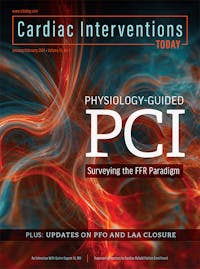
Physiology-Guided PCI: Surveying the FFR Paradigm
Plus: Updates on PFO and LAA Closure

Happy new year from Cardiac Interventions Today! I am Yuhei Kobayashi, an interventional cardiologist at Montefiore Medical Center and an Assistant Professor of Medicine at Albert Einstein College of Medicine. It is my pleasure to serve as Guest Medical Editor of this edition of Cardiac Interventions Today.
Our exploration of physiology-guided percutaneous coronary intervention (PCI) begins with a review of wire-based indices and current evidence supporting their use. Takeshi Nishi, MD, and Yuichi Saito, MD, discuss fractional flow reserve (FFR), instantaneous wave-free ratio, and other tools for pressure-wire based assessment of ischemia.
Tatsunori Takahashi, MD; Azeem Latib, MD; and Yuhei Kobayashi, MD, explore alternative methods for coronary physiologic assessments in the cardiac catheterization lab using angiography-based FFR and intravascular imaging-based FFR.
Completion of angiographically successful PCI does not always achieve optimized revascularization. Seung Hun Lee, MD; Doosup Shin, MD; Ki Hong Choi, MD; and Joo Myung Lee, MD, review post-PCI research and discuss the benefits of physiologic assessments for achieving optimization of revascularization and improving patient prognosis.
In our structural disease update, we explore treatment options for the prevention of stroke. Cameron McAlister, MD, and Jacqueline Saw, MD, discuss percutaneous left atrial appendage closure and review the latest literature, devices, and procedural considerations for stroke prevention in patients with nonvalvular atrial fibrillation.
Krishna S. Kallakuri, MD, and Rajeev L. Narayan, MD, discuss patent foramen ovale (PFO), an atrial septal defect that may be linked to cryptogenic stroke. They review updated trial data, available devices, and application of PFO closure for prevention and treatment.
Our Today’s Practice column outlines best practices for overcoming barriers to cardiac rehabilitation enrollment. Terri McDonald, RN, discusses the role of the cardiovascular provider, patient cost, and access considerations and how to optimize cardiac rehabilitation programs.
We conclude with an interview with Quinn Capers IV, MD, who explains the importance of diversity and how to recognize and counteract bias. He speaks on his experience leading the change to a radial-first cath lab at Ohio State, adapting to the COVID-19 pandemic, and more.
This year, I cannot wait to meet our interventional colleagues in person again. Let’s hope for the best. Meanwhile, we hope you find this issue of Cardiac Interventions Today an interesting and informative resource for your practice.
Yuhei Kobayashi, MD
Guest Chief Medical Editor
Advertisement
Advertisement