Advertisement
Advertisement
January/February 2021
Left Atrial Appendage Closure: An Update
Reviewing the latest literature, current devices, and procedural considerations for prevention of stroke in patients with nonvalvular atrial fibrillation.
By Cameron McAlister, MD, FRACP, and Jacqueline Saw, MD, FRCPC, FACC, FAHA, FSCAI, FSCCT
Percutaneous left atrial appendage closure (LAAC) has become an important tool for stroke prevention in patients with nonvalvular atrial fibrillation (AF). LAAC is an alternative to oral anticoagulation (OAC) and thus, is a particularly attractive option for patients at high risk for bleeding. In the early days of LAAC, concerns were raised about the safety of the procedure and long-term efficacy. However, improvements in operator technique, pre- and periprocedural imaging, and device development have improved safety and technical success rates. This article reviews the background of LAAC, provides an update on recent trial evidence and reviews the devices and technical approach.
BACKGROUND
AF is common, affecting 9% of patients aged 65 years or older in the United States and the prevalence is increasing.1 Data from the Framingham cohort suggest a one in four lifetime risk of AF in those older than 40 years.2 AF causes > 20% of all strokes and leads to more disabling symptoms, with higher mortality and higher health care costs compared to other causes of stroke.3 The mechanism of stroke in AF is most commonly related to embolism of thrombus formed in the left atrial appendage (LAA).4,5 Early data summarized in a 1990 meta-analysis, including 1,288 patients with nonvalvular AF, found 201 of 222 (91%) of left atrial thrombi resided in the LAA.4 A contemporary study that included 1,420 nonvalvular AF patients who underwent transesophageal echocardiography (TEE) prior to cardioversion found 87 patients with cardiac thrombi, with all 87 having LAA thrombi and only one had additional thrombus in the left atrium.5 Therefore, targeted local LAA mechanical therapy to remove the source of thromboembolism has been explored for decades.
Surgical obliteration of the LAA has been performed since the 1940s,6 particularly in the context of concurrent mitral valve intervention. The first percutaneous device (PLAATO, Appriva Medical Inc.) was implanted in 2001,7 and an early series showed promising results with successful deployment in 162 of 180 patients (90%) and lower than predicted stroke rate during follow-up (2.3% per year).8 Safety concerns were raised, with two deaths and six cases of pericardial tamponade, and the device was later taken off the market for financial reasons.
The first, and only, device registered for use in the United States is the Watchman device (Boston Scientific Corporation). The Watchman 2.5 device received FDA approval in 2015 based on the results of two randomized trials, PROTECT AF9 and PREVAIL,10 and their extended follow-up registries. PROTECT AF randomized 707 patients to Watchman or warfarin in a 2:1 ratio. After mean follow-up of 18 months, the Watchman device was noninferior to warfarin for the primary composite endpoint of stroke, systemic embolism, and cardiac death. In the Watchman group, technical success was 88%, and there was a relatively high rate of complications (4.8% pericardial tamponade) in this early experience. The PREVAIL trial subsequently randomized 407 patients to Watchman or warfarin in a 2:1 ratio to address the early safety concerns. Rates of the primary endpoint were low, and although numerically similar in the two groups (0.064 vs 0.063 over 18 months), the Watchman device did not meet the requirements for noninferiority. However, this study did show significant improvements in safety, with overall adverse event rates decreasing from 8.7% to 4.2% and pericardial effusions requiring surgical drainage decreasing from 1.6% to 0.4%. More recently, a meta-analysis of the two trials with 5-year follow-up data showed similar rates of all stroke and ischemic stroke, but significantly reduced rates of hemorrhagic stroke, disabling stroke, nonprocedure-related bleeding, and all-cause death with Watchman compared to warfarin.11
Outside of the United States, commonly used LAAC devices are the Amplatzer cardiac plug (ACP, Abbott) and the Amplatzer Amulet (Abbott). Although there are no randomized trial data currently published, registry data showed reasonable efficacy and safety when compared to predicted stroke and bleeding rates based on the CHA2DS2-VASc and HASBLED scores. Tzikas et al collected data from 1,047 consecutive patients in 22 centers and reported procedural success in 97.3%, with a 4.97% rate of procedural adverse events and an annual rate of stroke or systemic thromboembolism of 2.3%—a 59% risk reduction compared with predicted rates.12
The growing evidence for both the Watchman and Amplatzer devices resulted in societal guidelines giving a class IIb recommendation for LAAC in patients with contraindication to anticoagulation.13,14 However, questions have remained about procedural safety, postprocedure antithrombotic regimen, and the efficacy of LAAC compared to direct OAC (DOAC).
RECENT TRIAL EVIDENCE
Watchman
Aside from the randomized trials, large international registries have shown excellent results with the Watchman device. The 2-year outcomes from the EWOLUTION registry, a prospective cohort of 1,020 patients who underwent Watchman implantation in 47 European centers, were recently reported.15 In contrast to the randomized PREVAIL and PROTECT AF trials, only 27% of these patients were discharged on OAC. After 2 years, the observed stroke rate was 1.3 per 100 patient-years (83% reduction vs historic data), and nonprocedural major bleeding was 2.7 per 100 patient-years (46% reduction vs historic data). The National Cardiovascular Data Registry LAAO registry has collected data from 38,158 Watchman procedures performed by 1,318 physicians in the United States. Device deployment was successful in 93% and major in-hospital adverse events occurred in 2.16%, including pericardial effusion requiring intervention in 1.39% and major bleeding in 1.25%.16
Amulet
The Amulet is a second-generation Amplatzer LAAC device. Compared to the ACP, the Amulet device has more anchoring hooks, a deeper distal lobe, a more overriding disc, a longer waist, and a recessed end-screw to reduce exposed metal in the left atrium. Recent results from a global observation study including 1,088 patients were promising.17 Importantly, patients enrolled in this study had high bleeding risk or contraindication to anticoagulation and as such, 80.2% of patients were discharged with antiplatelet therapy and 61.8% were on single antiplatelet by 3 months. Implantation and follow-up TEE performed at 1 to 3 months were evaluated by a core laboratory. Implantation success was 99.1%, the procedural major adverse events rate was 4%, ischemic stroke rate was 2.2% per year (67% reduction compared to predicted from CHA2DS2-VASc score), and device-related thrombus (DRT) seen in only 1.6%.
Watchman Versus ACP/Amulet
A few observational studies were published comparing the Watchman to the ACP and Amulet devices. A meta-analysis of six studies including 614 patients showed overall low complication rates that were similar between the devices.18 Overall, higher rates of peridevice leak (PDL) were reported with Watchman on follow-up TEE, however, there were no differences in clinically significant PDL. A direct comparison of the two devices was also made from the multicenter LAARGE registry including 641 patients from 38 centers in Germany.19 In this study, procedural success was slightly lower with Watchman (96% vs 99%), but the rates of procedural complications, PDL, and stroke were similar. The Amulet IDE study, a large randomized trial comparing Watchman to Amulet, completed enrollment of 1,800 patients and the results are anticipated later this year.
Watchman FLX
The Watchman FLX (Boston Scientific Corporation) is the latest iteration of the Watchman device (Figure 1). It includes a number of modifications that, at least in theory, should improve both safety and efficacy. Compared to Watchman 2.5, the FLX has a closed distal end to lessen the likelihood of perforation and is fully recapturable. It covers a greater size range (five device sizes ranging from 20-35 mm) as well as more overlap between sizes, allowing for deployment in LAA ostia ranging from 14 to 31.5 mm. The FLX has 50% more anchors, which are now J-shaped rather than straight, resulting in three times greater holding strength according to the manufacturer. The new FLX is less tapered, allowing greater apposition with the LAA wall, and also has reduced metal exposure that may potentially reduce risk of DRT.
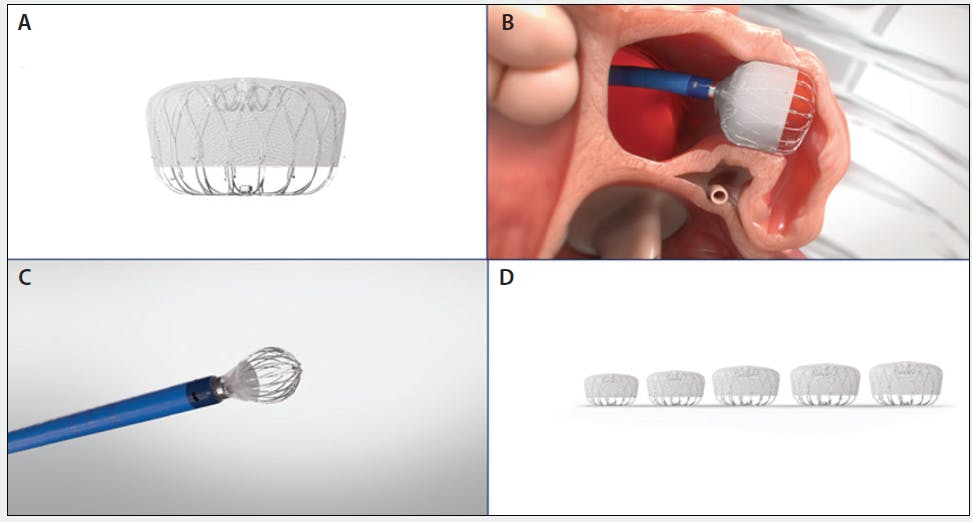
Figure 1. Illustration of the Watchman FLX device. Watchman FLX Device (A). Deployment of device within LAA (B). Delivery sheath with device shown in “FLX Ball” for positioning within LAA (C). Five different Watchman FLX sizes (D).
Early evidence for the Watchman FLX appears favorable. The PINNACLE FLX study enrolled 400 patients at 29 sites.20 Patients received a DOAC plus aspirin for 45 days, followed by clopidogrel plus aspirin through 6 months, and then aspirin indefinitely. The device was successfully deployed in 98.8% of cases and 100% of these were shown to have effective closure at 1 year. The rate of all-cause death, ischemic stroke, systemic embolism, or device/procedure-related events requiring open cardiac surgery or major endovascular intervention between implantation and either 7 days or discharge was 0.5%, and the rate of pericardial effusion was 1%. There were no cases of device embolization. At 1 year, there was a 6.6% rate of all-cause death and a 2.6% rate of stroke.
LAAC Versus DOAC
The initial randomized trials compared Watchman with warfarin, which was the standard OAC at the time. However, since then, DOACs were shown to be superior to warfarin and now have a class I indication for use in nonvalvular AF.13,14 A network meta-analysis that included 19 randomized controlled trials (RCTs) with a total of 87,831 AF patients receiving anticoagulants (warfarin or DOACs), antiplatelet therapy, placebo, or LAAC (specifically the Watchman device), showed that LAAC was superior to antiplatelet therapy or placebo, and comparable to DOACs in preventing mortality and stroke or systemic embolism.21 Although these results were encouraging, stronger evidence from a randomized trial was eagerly awaited. The PRAGUE-17 trial randomized 402 patients with high stroke risk (mean CHA2DS2-VASc, 4.7) to either LAAC or DOAC (95.5% apixaban).22 Choice of device was at the operator’s discretion; Amulet was implanted in 61.3%, Watchman 2.5 in 35.9%, and Watchman FLX in 2.8%. The recommended postprocedure antithrombotic regimen was aspirin plus clopidogrel for 3 months followed by aspirin monotherapy. Successful LAAC was achieved in 90% of those randomized and 96.8% of patients in whom implantation was attempted. At median follow-up of 19.9 months, the annual rates of the primary outcome (composite of stroke, transient ischemic attack [TIA], systemic embolism, cardiovascular death, clinically relevant bleeding, or procedure-related complications) were 10.99% with LAAC and 13.42% with DOAC. The rate of procedure-related adverse events was 4.5% and there were no differences in the rates of stroke/TIA, bleeding, or cardiovascular death. Thus, clinical outcomes with LAAC appear comparable to DOACs, however, larger randomized trials with longer follow-up are warranted. Both the CATALYST and CHAMPION AF studies were recently launched, comparing Amulet and Watchman, respectively, to DOAC in patients eligible for OAC.
PROCEDURAL CONSIDERATIONS
Both pre- and periprocedural cardiac imaging are of paramount importance in LAAC (Figure 2). Traditionally, the imaging technique of choice has been TEE due to its ability to obtain high-quality images of the LAA in real-time. However, there are some downsides to TEE, including the need for sedation or general anesthesia and more recently, reluctance to perform aerosolizing procedures during the COVID-19 pandemic. Cardiac CT has emerged as a reasonable or even preferable alternative to TEE in pre-LAAC planning. In fact, a number of studies have shown that LAA sizing on CT is more accurate23-25 and is exceptionally good at ruling out preexisting LAA thrombus.26,27 During the procedure, imaging guidance with intracardiac echocardiography (ICE) is increasingly used instead of TEE because general anesthesia can be avoided. Although manipulation of the ICE catheter to obtain good images may be difficult at times, overall success rates, laboratory time, and cost appear similar to TEE-guided procedures.28,29
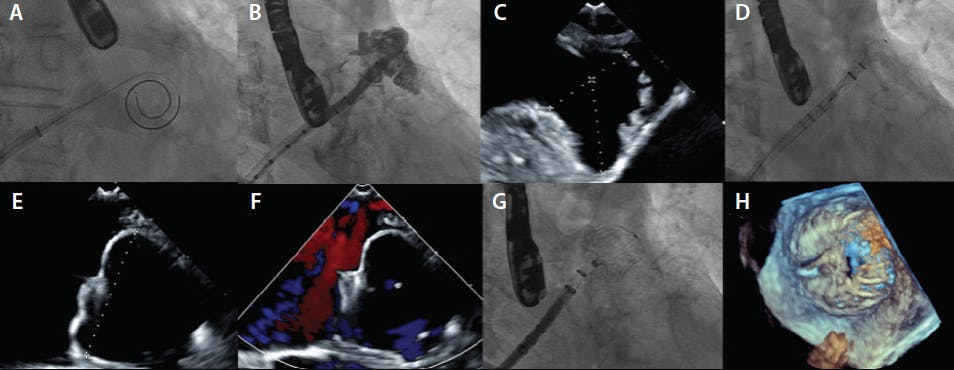
Figure 2. Procedural imaging—TEE and fluoroscopy. Crossing the interatrial septum using the VersaCross RF wire (A). Contrast injection of the LAA with pigtail catheter (B). Measurement of the LAA on TEE (C). Advancing the Watchman FLX into position (D). Measurement of the Watchman FLX at maximal diameter after deployment; should have 10%-30% compression (E). Color flow Doppler to rule out significant peridevice leak (F). Deployment of Watchman FLX in the LAA (G). Three-dimensional imaging on TEE (H).
A successful, efficient, and safe LAAC procedure often depends on the transseptal puncture, which is usually performed inferior and posterior at the fossa ovalis. Radiofrequency (RF) transseptal puncture needles have been available for some time and have been shown to improve rates of successful crossing with shorter time and with fewer adverse events than mechanical needle puncture.30-32 More recently, the VersaCross RF wire (Baylis Medical Company, Inc.) has provided further efficiency, serving as both a transseptal RF tip and an exchange wire rail.33
The specific steps of device deployment vary according to the device used and each manufacturer has specific implantation criteria for optimal deployment before release of the device (eg, PASS for Watchman, and CLOSE for Amulet). For the Watchman FLX device, after femoral venous access and transseptal puncture, the prepared access sheath is advanced over a supportive wire (eg, VersaCross or super-stiff wire) into the left atrium. A pigtail is inserted within the access sheath and used to navigate the sheath safely into the LAA. A “FLX Ball” is then created by retracting the access sheath over the deployment knob such that the self-expanding Watchman FLX device is twice the width of the access sheath. The whole device system can then be safely advanced or retracted and rotated either counterclockwise or clockwise to optimize position in the landing zone. Further deployment of the remainder of the Watchman FLX device is achieved by a combination of unsheathing (retracting) the access sheath and advancing the deployment knob. Satisfactory position is determined by the PASS criteria: position (device shoulder at or just distal to LAA ostium, without protruding by more than 50% of device height); anchor (stability of device checked by tug test); size (device is compressed by 10%-30%); seal (complete coverage of all lobes with no residual leak > 5 mm). If one of these criteria is not met, the device can be recaptured and repositioned an infinite number of times, or replaced with a different size if necessary.
DEVICE-RELATED THROMBUS
Aside from procedural complications, one issue that has caused some concern for LAAC is the occurrence of DRT after LAAC. Reported rates of DRT in registries were low, however, these studies were not subject to the same rigorous follow-up as randomized trials and may underestimate the true rate. The largest and most complete study of DRT assessed 1,739 patients from the device arms of the PROTECT AF and PREVAIL trials, as well as their continued access registries.34 All patients had TEE performed at 45 days and 12 months, and also at 6 months in the RCTs. Over a mean follow-up of 4.1 years, the rate of DRT was 3.74%. Patients with DRT had higher CHA2DS2-VASc scores, were more likely to be in permanent AF, and also had larger LAAs. In patients in whom DRT was identified, 26.2% had stroke or systemic embolism. The relative risk of stroke in patients with DRT compared to those without was 3.55. However, because it was such an uncommon finding, the majority (86.6%) of strokes in the study occurred in patients without DRT. This suggests that many strokes in patients after LAAC were caused by mechanisms other than left atrial thromboembolism. Nevertheless, the finding of DRT, though uncommon, should prompt clinicians to consider reintroducing anticoagulation,35 and designs of newer devices should aim to reduce the risk of DRT.
ANTITHROMBOTIC REGIMEN AFTER LAAC
The original randomized trials of Watchman versus warfarin prescribed a 45-day course of warfarin after LAAC, followed by 6 months of dual antiplatelet therapy (DAPT) and this remains the recommended regimen per the FDA. However, because many patients who undergo LAAC have an OAC contraindication, most real-world patients received a variable length of DAPT followed by single antiplatelet therapy (SAPT). In the ASAP study, 150 patients received 6 months of DAPT, the rate of DRT was 4%, and the thromboembolic event rate was 2.3% per year.36 In the EWOLUTION registry, 60.2% received DAPT and DRT rate was 2.3%, with no significant difference between antithrombotic regimens.15 In the retrospective ACP multicenter study (N = 1,047), 62.4% received DAPT and the DRT rate was 3.2%.12 In the prospective multicenter Amulet registry (N = 1,088), 54.3% received DAPT and the incidence of DRT was only 1.5%.17 In a large meta-analysis of 66 studies including 12,033 LAAC procedures, there was no difference in DRT incidence between patients who received short-term OAC and those treated with antiplatelet therapy after LAAC.37 Although less common, some patients received only SAPT after LAAC. Although data are limited, one study of 487 consecutive patients in eight centers in France included 171 patients treated with SAPT. Both OAC and DAPT exhibited lower hazard ratios for the incidence of DRT.38 A recent propensity-matched analysis of post-LAAC antithrombotic therapy compared patients from the PROTECT AF, PREVAIL, EWOLUTION, and ASAP studies.39 Although the rates of DRT were higher in patients on antiplatelet therapy compared with OAC (3.1% vs 1.4%), the rates of major nonprocedural bleeding and thromboembolism beyond 7 days were similar. To date, there are no randomized trials that have investigated the optimal antithrombotic strategy in LAAC patients.
CONCLUSION
With advancement in technology and operator experience, LAAC is an increasingly safe and effective tool in the prevention of stroke and systemic embolism in patients with nonvalvular AF. Currently, LAAC is primarily performed in patients at high risk of bleeding or with contraindications to OAC. Ongoing randomized trials comparing LAAC to DOAC will clarify if LAAC is efficacious in patients suited for OAC. New devices and design iterations should further refine this therapy, targeting the remaining challenges of PDL and DRT.
1. January CT, Wann LS, Alpert JS, et al. 2014 AHA/ACC/HRS guideline for the management of patients with atrial fibrillation: a report of the American College of Cardiology/American Heart Association Task Force on practice guidelines and the Heart Rhythm Society. Circulation. 2014;130:e199-267. doi: 10.1161/CIR.0000000000000041
2. Lloyd-Jones DM, Wang TJ, Leip EP, et al. Lifetime risk for development of atrial fibrillation: the Framingham Heart Study. Circulation. 2004;110:1042-1046. doi: 10.1161/01.CIR.0000140263.20897.42
3. Alkhouli M, Alqahtani F, Aljohani S, et al. Burden of atrial fibrillation-associated ischemic stroke in the United States. JACC Clin Electrophysiol. 2018;4:618-625. doi: 10.1016/j.jacep.2018.02.021
4. Blackshear JL, Odell JA. Appendage obliteration to reduce stroke in cardiac surgical patients with atrial fibrillation. Ann Thorac Surg. 1996;61:755-759. doi: 10.1016/0003-4975(95)00887-X
5. Cresti A, Garcia-Fernandez MA, Sievert H, et al. Prevalence of extra-appendage thrombosis in nonvalvular atrial fibrillation and atrial flutter in patients undergoing cardioversion: a large transoesophageal echo study. EuroIntervention. 2019;15:e225-230. doi: 10.4244/EIJ-D-19-00128
6. Madden JL. Resection of the left auricular appendix; a prophylaxis for recurrent arterial emboli. J Am Med Assoc. 1949;140:769-772. doi: 10.1001/jama.1949.02900440011003
7. Sievert H, Lesh MD, Trepels T, et al. Percutaneous left atrial appendage transcatheter occlusion to prevent stroke in high-risk patients with atrial fibrillation: early clinical experience. Circulation. 2002;105:1887-1889. doi: 10.1161/01.cir.0000015698.54752.6d
8. Bayard YL, Omran H, Neuzil P, et al. PLAATO (Percutaneous Left Atrial Appendage Transcatheter Occlusion) for prevention of cardioembolic stroke in non-anticoagulation eligible atrial fibrillation patients: results from the European PLAATO study. EuroIntervention. 2010;6:220–226.
9. Holmes DR, Reddy VY, Turi ZG, et al. Percutaneous closure of the left atrial appendage versus warfarin therapy for prevention of stroke in patients with atrial fibrillation: a randomised non-inferiority trial. Lancet. 2009;374:534-542. doi: 10.1016/S0140-6736(09)61343-X
10. Holmes DR, Kar S, Price MJ, et al. Prospective randomized evaluation of the Watchman Left Atrial Appendage Closure device in patients with atrial fibrillation versus long-term warfarin therapy: the PREVAIL trial. J Am Coll Cardiol. 2014;64:1-12. doi: 10.1016/j.jacc.2014.04.029
11. Reddy VY, Doshi SK, Kar S, et al. 5-year outcomes after left atrial appendage closure: from the PREVAIL and PROTECT AF trials. J Am Coll Cardiol. 2017;70:2964-2975. doi: 10.1016/j.jacc.2017.10.021
12. Tzikas A, Shakir S, Gafoor S, et al. Left atrial appendage occlusion for stroke prevention in atrial fibrillation: multicentre experience with the AMPLATZER Cardiac Plug. EuroIntervention. 2016;11:1170-1179. doi: 10.4244/EIJY15M01_06
13. January C, Wann LS, Calkins H, et al. 2019 AHA/ACC/HRS focused update of the 2014 AHA/ACC/HRS guideline for the management of patients with atrial fibrillation: a report of the American College of Cardiology/American Heart Association Task Force on clinical practice guidelines and the Heart Rhythm Society in collaboration with the Society of Thoracic Surgeons. Circulation. 2019;140:e125-e151. doi: 10.1161/CIR.0000000000000665
14. Hindricks G, Potpara T, Dagres N, et al. 2020 ESC Guidelines for the diagnosis and management of atrial fibrillation developed in collaboration with the European Association for Cardio-Thoracic Surgery (EACTS). Eur Heart J. Published online August 29, 2020. doi: 10.1093/eurheartj/ehaa612
15. Boersma LV, Ince H, Kische S, et al. Evaluating real-world clinical outcomes in atrial fibrillation patients receiving the Watchman left atrial appendage closure technology: final 2-year outcome data of the EWOLUTION trial focusing on history of stroke and hemorrhage. Circ Arrhythm Electrophysiol. 2019;12:e006841. doi: 10.1161/CIRCEP.118.006841
16. Freeman JV, Varosy P, Price MJ, et al. The NCDR left atrial appendage occlusion registry. J Am Coll Cardiol. 2020;13:1503-1518. doi: 10.1016/j.jacc.2019.12.040
17. Hildick-Smith D, Landmesser U, Camm AJ, et al. Left atrial appendage occlusion with the Amplatzer Amulet device: full results of the prospective global observational study. Euro Heart J. 2020;41:2894-2901. doi: 10.1093/eurheartj/ehaa169
18. Basu Ray I, Khanra D, Shah S, et al. Meta-analysis comparing Watchman and Amplatzer devices for stroke prevention in atrial fibrillation. Front Cardiovasc Med. 2020;7:89. doi: 10.3389/fcvm.2020.00089
19. Ledwoch J, Franke J, Akin I, et al. Watchman versus ACP or Amulet devices for left atrial appendage occlusion: a sub-analysis of the multicentre LAARGE registry. EuroIntervention. 2020;16:e942-949. doi: 10.4244/EIJ-D-19-01027
20. Doshi SK. Primary outcome evaluation of a next generation LAAC device: the PINNACLE FLX trial. Presented at: Heart Rhythm Society 2020; May 8, 2020.
21. Sahay S, Nombela-Franco L, Rodes-Cabau J, et al. Efficacy and safety of left atrial appendage closure versus medical treatment in atrial fibrillation: a network meta-analysis from randomised trials. Heart 2017;103:139-147. doi: 10.1136/heartjnl-2016-309782
22. Osmancik P, Herman D, Neuzil P, et al. Left atrial appendage closure versus direct oral anticoagulants in high-risk patients with atrial fibrillation. J Am Coll Cardiol. 2020;75:3122-3135. doi: 10.1016/j.jacc.2020.04.067
23. Saw J, Fahmy P, Spencer R, et al. Comparing measurements of CT angiography, TEE, and fluoroscopy of the left atrial appendage for percutaneous closure. J Cardiovasc Electrophysiol 2016;27:414-422. doi: 10.1111/jce.12909
24. Eng MH, Wang DD, Greenbaum AB, et al. Prospective, randomized comparison of 3-dimensional computed tomography guidance versus TEE data for left atrial appendage occlusion(PRO3DLAAO). Catheter Cardiovasc Interv. 2018;92:401-417. doi: 10.1002/ccd.27514
25. Rajwani A, Nelson AJ, Shirazi MG, et al. CT sizing for left atrial appendage closure is associated with favourable outcomes for procedural safety. Euro Heart J Cardiovasc Imaging. 2017;18:1361-1368. doi: 10.1093/ehjci/jew212
26. Romero J, Husain SA, Kelesidia I, et al. Detection of left atrial appendage thrombus by cardiac computed tomography in patients with atrial fibrillation: a meta-analysis. Circ Cardiovasc Imaging. 2013;6:185-194. doi: 10.1161/CIRCIMAGING.112.000153
27. Romero J, Cao JJ, Garcia MJ, Taub CC. Cardiac imaging for assessment of left atrial appendage stasis and thrombosis. Nat Rev Cardiol. 2014;11:470-480. doi: 10.1038/nrcardio.2014.77
28. Alkhouli M, Chaker Z, Alqahtani F, et al. Outcomes of routine intracardiac echocardiography to guide left atrial appendage occlusion. JACC Clin Electrophysiol. 2020;6:393-400. doi: 10.1016/j.jacep.2019.11.014
29. Akella K, Murtaza G, Turagam M, et al. Evaluating the role of transesophageal echocardiography (TEE) or intracardiac echocardiography (ICE) in left atrial appendage occlusion: a meta-analysis. J Interv Card Electrophysiol. Published online January 17, 2020. doi: 10.1007/s10840-019-00677-x
30. Winkle RA, Mead RH, Engel G, Patrawala RA. The use of a radiofrequency needle improves the safety and efficacy of transseptal puncture for atrial fibrillation ablation. Heart Rhythm. 2011;8:1411-1415. doi: 10.1016/j.hrthm.2011.04.032
31. Fromentin S, Sarrazin JF, Champagne J, et al. Prospective comparison between conventional transseptal puncture and transseptal needle puncture with radiofrequency energy. J Interv Card Electrophysiol. 2011;31:237-242. doi: 10.1007/s10840-011-9564-2
32. Hsu JC, Badhwar N, Gerstenfeld EP, et al. Randomized trial of conventional transseptal needle versus radiofrequency energy needle puncture for left atrial access (the TRAVERSE-LA study). J Am Heart Assoc. 2013;2:e000428. doi: 10.1161/JAHA.113.000428
33. Inohara T, Gilhofer T, Luong C, et al. VersaCross radiofrequency system reduces time to left atrial access versus conventional mechanical needle. J Interv Card Electrophysiol. Published online January 22, 2021. doi: 10.1007/s10840-020-00931-7
34. Dukkipati SR, Kar S, Holmes DR, et al. Device-related thrombus after left atrial appendage closure incidence, predictors, and outcomes. Circulation. 2018;138:874-885. doi: 10.1161/CIRCULATIONAHA.118.035090
35. Saw J, Nielsen-Kudsk JE, Bergmann M, et al. Antithrombotic therapy and device-related thrombosis following endovascular left atrial appendage closure. JACC Cardiovasc Interv. 2019;11:1067-1076. doi: 10.1016/j.jcin.2018.11.001
36. Reddy VY, Möbius-Winkler S, Miller MA, et al. Left atrial appendage closure with the Watchman device in patients with a contraindication for oral anticoagulation: the ASAP study (ASA Plavix feasibility study with Watchman left atrial appendage closure technology). J Am Coll Cardiol. 2013;61:2551-2556. doi: 10.1016/j.jacc.2013.03.035
37. Alkhouli M, Busu T, Shah K, et al. Incidence and clinical impact of device-related thrombus following percutaneous left atrial appendage occlusion: a meta-analysis. JACC Clin Electrophysiol. 2018;4:1629-1637. doi: 10.1016/j.jacep.2018.09.007
38. Fauchier L, Cinaud A, Brigadeau F, et al. Device-related thrombosis after percutaneous left atrial appendage occlusion for atrial fibrillation. J Am Coll Cardiol. 2018;71:1528-1536. doi: 10.1016/j.jacc.2018.01.076
39. Søndergaard L, Wong Y, Reddy V, et al. Propensity-matched comparison of oral anti-coagulation versus antiplatelet therapy after left atrial appendage closure with Watchman. JACC Cardiovasc Interv. 2019;12:1055-1063. doi: 10.1016/j.jcin.2019.04.004
Advertisement
Advertisement