Advertisement
Advertisement
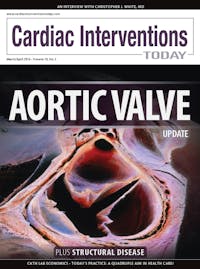
In this issue, we have an update on transcatheter aortic valve replacement (TAVR), with reviews covering case selection, current devices in use in United States practice, and next-generation TAVR platforms. We also cover challenging atrial septal defect closure, and in view of the recent Centers for Medicare & Medicaid Services coverage decision for the Watchman left atrial appendage closure device (Boston Scientific Corporation), look at next-generation left atrial appendage closure devices.
Robert P. Gooley, MBBS (Hons), and Ian T. Meredith, MBBS (Hons), PhD, begin our aortic valve coverage by addressing the question: “Who Is a TAVR Candidate in 2016?” They argue that with a shift in treated patients toward a lower-risk cohort, it is imperative that TAVR be performed in line with contemporary trial evidence or within a research framework that will advance the current evidence base.
Abdul Moiz Hafiz, MD, and Duane Pinto, MD, then discuss the CoreValve Evolut R device (Medtronic, Inc.) and how this self-expanding technology fits into the existing TAVR landscape. Although the design improvements in this device represent technologic advances, challenges remain.
Ramin S. Hastings, MD, and Isaac George, MD, examine another TAVR device: the Sapien 3 (Edwards Lifesciences). Their article reviews the features of the device, as well as the early data that have led to its approved use in the United States.
Our focus on the aortic valve also includes a discussion of European experiences with three next-generation valve systems and an update on the status of United States trials, courtesy of Brandon M. Jones, MD, and Amar Krishnaswamy, MD.
This issue also features two articles on structural disease. The first, by Martin W. Bergmann, MD, reviews fourth-generation left atrial appendage occlusion technology for stroke prevention. The second article by Victor-Xavier Tadros, MD, and Anita W. Asgar, MD, provides an update on atrial septal defect occlusion devices.
We also present content from two ongoing article series: Ask the Experts and Today’s Practice, as well as a Cath Lab Improvement article. In Ask the Experts, our distinguished panelists weigh in on whether all aortic stenosis patients older than 80 years should undergo TAVR rather than SAVR. Larry Sobal, MBA, and Suzette Jaskie then discuss the Triple Aim Initiative from the Institute for Healthcare Improvement in our Today’s Practice column. Finally, in our Cath Lab Improvement article, Donald R. Lilly, MD, and Stephen A. Lewis, MD, offer a comparison of internal and external peer review in evaluating cardiac catheterization laboratories.
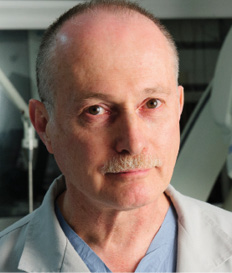
To close this issue, we present an interview with Christopher White, MD, in which he discusses regulatory issues, fellowship training, and the evolving role of interventional cardiologists.
As is always our mission, we hope to help synthesize the vast interventional literature in a timely and useful manner. If there are topics you would like to see covered in future issues, let us know.
Ted E. Feldman, MD, MSCAI, FACC, FESC
Chief Medical Editor
citeditorial@bmctoday.com
Advertisement
Advertisement