Advertisement
Advertisement
January/February 2016
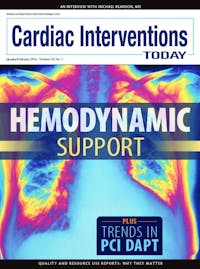
Hemodynamic Support & Trends in PCI DAPT
The use of circulatory support for complex interventions is growing, in part due to improvements in support technology and also due to the increasingly complicated patients we are all seeing. In this issue, we highlight the status of circulatory support. In addition, we have features on the use of dual-antiplatelet therapy (DAPT) after percutaneous coronary intervention (PCI), reports on coding and reimbursement, and a discussion of the growing importance of the heart team in structural interventions.
Ravi S. Hira, MD, and William Lombardi, MD, begin our hemodynamic support coverage by explaining the “who,” “when,” and “how” of hemodynamic support for patients undergoing PCI.
Next, we have a discussion about mechanical circulatory support devices by Dmitriy N. Feldman, MD, and Srihari S. Naidu, MD. In addition to the available devices, they review suggested guidelines and indications for percutaneous mechanical circulatory support.
We conclude our dialogue with an article by Sagar N. Doshi, MD. In it, he highlights the advantages and disadvantages of mechanical circulatory support during transcatheter aortic valve replacement.
Our supplementary focus on DAPT begins with a roundtable conversation about DAPT in STEMI. The roundtable features input from Peter B. Berger, MD; Paul A. Gurbel, MD; Charles Pollack, MD; and Marc Cohen, MD; and is moderated by Andrey Espinoza, MD.
Sammy Elmariah, MD, offers a review of data and implications of recent trials concerning the optimal duration of DAPT.
As part of our ongoing Coding & Reimbursement series, author Larry Sobal explores the quality and resource use reports (QRUR) and makes the case that all providers should have an intimate knowledge of them.
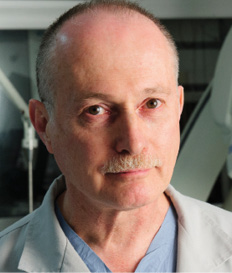
Finally, we conclude the issue by interviewing Michael Reardon, MD, who discusses whether the heart team concept is firmly established in contemporary practice, heart valve centers of excellence, and what future valvular heart disease guidelines might look like.
We always strive to synthesize the vast interventional literature and provide current and relevant reviews. Please let us know about topics you’d like to see covered in future issues.
Ted E. Feldman, MD, MSCAI, FACC, FESC
Chief Medical Editor
citeditorial@bmctoday.com
Advertisement
Advertisement