Advertisement
Advertisement
March/April 2015
An Interview With Sameer Gafoor, MD
Dr. Gafoor discusses his work at CardioVascular Center Frankfurt and some tips, tricks, and predictions for structural heart intervention.
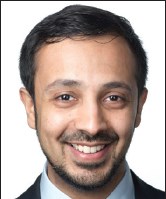
After your initial cardiology training in the United States, you went on to complete your fellowship at CardioVascular Center Frankfurt and now work as an attending physician there. What led you to this path, and what do you think are some of the differences between practicing in Germany versus the United States?
It has been an interesting journey. During my cardiology fellowship, I knew I wanted to focus on structural heart disease. After I finished my interventional fellowship, I searched for training programs. This was back when transcatheter aortic valve replacement (TAVR) and MitraClip (Abbott Vascular) were still in the study phase and were not yet used commercially. The few fellowship programs I found either had long wait lists, were filled internally, or did not offer much hands-on experience. I kept looking, and one of my mentors said, “Why don’t you think about Europe?” That’s where I started, and I contacted as many people as I could find email addresses for.
In the beginning, responses were disheartening. Many international fellowships were full for the next few years, or funding was not available. I kept trying and tried to stay positive. Eventually, I heard back from Dr. Sievert, and he was one of the first who didn’t say no. I kept asking and was kindly persistent, and he said I could come first to observe for a week. The lab in Frankfurt is unique in its breadth and depth of coronary, structural, and peripheral exposure. A normal day in his lab—not week, but day—consisted of three carotid, five peripheral, three coronary, three renal denervation, and three paravalvular leak procedures. That’s when I thought to myself, “I have to be here.”
I applied for funding to various state and private resources and finally received some. The next step was to obtain a German medical license, which required me to have a high level of proficiency in German. I took 6 months and studied full time, then passed the test and started working at the CVC Frankfurt. It was a long journey, and if someone had told me about all of the hurdles at the beginning I would have doubted myself, but I had a great support system from my family along the way.
After finishing this 1-year fellowship, I considered my options in the United States, but was not 100% satisfied with the job offers I had at the time. I remember discussing this with Dr. Sievert, and he casually mentioned that if I wanted, I could stay on. I had not even considered this as an option but jumped on this opportunity. Now, about 2 years later, I feel that I have learned so much more and have come much further in my development than I would have if I had left after my fellowship. Since then, the experience has been amazing, with great clinical experience and the ability to interact with new devices; however, more important than that has been the relationships and connections with people around the world.
In regard to your question about the differences between practicing in Germany and the United States, I would say that in Germany, there is more clinical volume concentrated in a few centers. In addition, there is quicker access to new technologies. This is due to a completely different regulatory pathway, which has advantages for some patients who may die before receiving a therapy that can be helpful. In addition, in Germany, there is close to universal health care and a less aggressive malpractice culture with a higher emphasis on self-responsibility. We can discuss this as a political issue; however, from a physician workflow perspective, there is very little to do in terms of prior authorization or insurance reimbursement issues. This has a significant impact on the daily life of physicians and their workflow.
Can you tell us about some of the latest emerging technologies or procedural techniques in structural intervention that you are particularly excited about?
The advantages of being connected to a first-in-man center in Europe is that it allows me to “live in the future” and take a look at what will be coming down the pipeline. This is an important point. Much of the TAVR field in the United States—and much of the United States TAVR data—is based on first-generation technology, which means first-generation sheaths, delivery systems, and valves. It also means having to overcome a first-generation learning curve and first-generation complications. When you are able to look at the second- or third-generation technology, which is repositionable, has smaller sheaths, is fully retrievable, and has paravalvular leak protection, these allow an entirely different approach to the lingering problems of aortic stenosis or even aortic regurgitation.
Durability is the main issue that keeps us from expanding at this time. However, the “appropriateness” of TAVR is a moving target; by the time a randomized clinical trial with long-term results has been published, the field (technology and technique) has already advanced one, two, or even three steps forward making the results often less relevant to a “final answer” to this question.
This is even more of an issue with the mitral valve. If an article is written about percutaneous mitral valve repair, it might only discuss one specific device, and if it does not perform well, readers (and press) often walk away saying, “Percutaneous mitral valve repair failed to meet the primary endpoint.” But this is false! One technology with one subset of patients did not meet that endpoint in this particular setting. There are 20 or so devices in clinical studies or deployment. Perhaps the answer is in one of them or a combination of them, which we decide based on patient anatomy. We have to answer these questions, and this will take time, but the technology is already pretty far along. We have percutaneous devices for leaflet repair, annuloplasty, chordal replacement, ventricular reconstruction, and mitral valve replacement. Within 10 years, I foresee this being a much more common therapy. This will delay or prevent the need for traditional cardiac surgery or may create the ideal hybrid approach. It is important to create an environment that fosters innovation and allows questioning and testing without prematurely crushing the momentum and technology for the physicians, device designers, engineers, and everyone working together to develop solutions for this problem.
In terms of left atrial appendage (LAA) closure, the Watchman device (Boston Scientific Corporation) has just been approved by the US Food and Drug Administration. This is a great step. At our center, we work with multiple different endocardial and epicardial devices with unique features, so the learning curve is already improving. We are also learning more about leaks and thrombus formation. It’s very important for patients to have the choice between chronic anticoagulation versus device implantation once all of the relevant information has been explained to them. In addition, taking a medication every single day for the rest of your life is not a small thing to consider.
Do you have any technical tips on how to perform LAA closure? What are the common complications you’ve seen, and how do you typically handle them?
Our center has a lot of experience performing LAA closure, not only with the Watchman device, but using four or five other devices and techniques. The transseptal technique is very important and should not be minimized. An inferior and posterior approach is key. The echocardiographer and interventionist should communicate with one another in order to combine imaging information; one helpful aid is the EchoNavigator (Philips Healthcare). The LAA must be checked in multiple echo planes. Also, remember to monitor for effusion before, during, and after the intervention.
As far as complications, there are usually three: transseptal puncture issues, device embolization, and pericardial effusion. For transseptal puncture issues, pericardiocentesis should be performed when needed, and although a device can be placed to close the hole, cardiac surgery is the default step. For device embolization, we can extract devices from the LA or peripheral arteries using snares and other techniques. Now, we generously oversize and check the release criteria prior to release. For pericardial effusion, it is important to watch carefully for this, even as far as 24 hours after the procedure, and remember to have good communication with the postprocedural care team.
What are your thoughts on the expansion of percutaneous treatments from mainly the aortic valve to all heart valves? How do you think this will progress over the next few years?
All of the valves have different percutaneous options for treatment as of this time. In addition to the aortic and mitral valves (for which there are many valve repair and replacement options), we have implantable pulmonary valves, and we also perform tricuspid valve repair and replacement. These technologies are allowing treatment for those who might have been considered inoperable before. However, we need to understand why and when to perform these procedures. If a patient has mitral regurgitation as well as aortic stenosis, the question becomes, how do I successfully treat both? The advantage of percutaneous therapy is that it allows a wait-and-see approach after each intervention. There are many different options for everyone, but patients don’t necessarily need 15 procedures, just the few right ones that will help them feel better and retain quality of life.
In terms of the future of TAVR in the United States, I think it will move toward use of local anesthesia or conscious sedation. However, this has already been the norm here in Germany—we perform all of our TAVR procedures with local anesthesia, and patients are ambulating the same day. We perform mitral valve repair with TEE and mild sedation. What does the future overall hold? More methods of percutaneous mitral valve replacement and repair will come forward and be successful. Structural heart procedures will be refined further, with new devices that have better protection against paravalvular leak, vascular injury, atrioventricular block, and stroke. More and more patients with multivalve disease will be treated, and physicians will begin to understand which combinations of procedures should be performed and when.
You recently accepted a position as the Medical Director of Structural Heart Disease at Swedish Medical Center in Seattle to start in August 2015. What was the reason for this move?
Swedish Medical Center in Seattle has a long history of being at the forefront of many therapies. They have very busy cardiology and cardiac surgical programs with great numbers, as well as outcomes, and there is a great patient experience. Also, the leadership is heavily invested and interested in the structural heart disease program. The cardiac program is one of the best there is, and I believe this will be a great opportunity.
I was looking for a place in the United States where I could bring experience with not only TAVR, but also mitral valve therapies, left atrial appendage closure, and heart failure therapies. The position allows the ability to do all of the above in a very high-volume center with an experienced team and with collaboration between cardiology and cardiac surgery. There is a fantastic research infrastructure that has high-level experience in large-scale clinical trials and independent projects. The Seattle Science Foundation is already known as a place for cadaver testing of medical devices and is located right at the Swedish Medical Center Cherry Hill campus.
Although this is all very exciting, two things brought it home for me. First, this position will allow me to continue my work in Frankfurt. It seems that every new device—whether structural or peripheral or coronary— seems to come through Dr. Sievert’s institution, and it is one of the few sites that companies trust for their first-in-man data. In addition, we at CVC have great conferences that bring together the best and brightest from around the world to share practical tips and clinical data (please see my Recommended Conferences sidebar). This continued relationship is a great way for Swedish Medical Center and I to continue to have hands-on involvement in the clinical and research side of this exciting field.
Second, my new position at Swedish Medical Center also includes being the Program Director of the Structural Heart Disease Fellowship Program. I feel exceptionally passionate about this, as I was in those shoes just a few years ago. Training a fellow is an immense responsibility because they put their lives on hold and move often across the country with their families in search of education and training that will help them do what they love. I want to honor that and make this a worthwhile and fun experience that allows them to grow. In addition, this will be a world-class fellowship program, with ties to national and international centers of excellence. I ask that every fellow that reads this reach out and apply because we need good people in structural heart disease. Your success is our success!
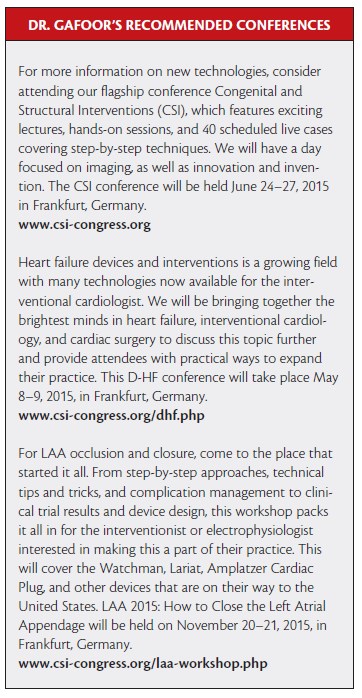
Sameer Gafoor, MD, is with the CardioVascular Center Frankfurt in Frankfurt, Germany. He has stated that he has no financial interests related to this article. Dr. Gafoor may be reached at sameergafoor@gmail.com.
Advertisement
Advertisement
Interested in reading more interviews?
To read more interviews with thought leaders in the interventional cardiology field, check out our Profiles & Perspectives hub.
Read More