Advertisement
Advertisement
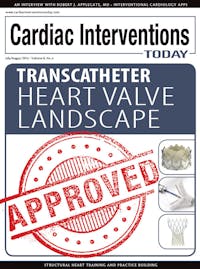
We begin our annual update on valvular and structural heart interventions with an overview of three devices currently at the forefront of valvular therapy, each having received US Food and Drug Administration approval within the last year. Prakash Balan, MD, JD; Tom C. Nguyen, MD; and Richard W. Smalling, MD, PhD, discuss the Sapien XT transcatheter heart valve (Edwards Lifesciences); myself; Michael H. Salinger, MD, FACC, FSCAI; Justin P. Levisay, MD, FACC, FSCAI; and Carl Tommaso, MD, FACC, MSCAI, review the MitraClip percutaneous mitral valve repair system (Abbott Vascular); and Steven J. Yakubov, MD, FACC, and Kyle Feldmann, MD, report on the CoreValve transcatheter aortic valve replacement (TAVR) system (Medtronic, Inc.). These articles examine the key features of each device, appropriate patient selection, the impact on clinical practice, and more.
Next, Jason H. Rogers, MD, FACC, FSCAI, answers the question, “How do I get training in structural heart disease intervention?” by providing helpful suggestions for those seeking to gain experience and proficiency in utilizing these groundbreaking therapies. In the same spirit, Marie-France Poulin, MD; Hussam Suradi, MD; and Clifford J. Kavinsky, MD, PhD, explain the steps for physicians who have mastered the aforementioned training and now wish to start their own structural heart disease practice. They outline the operator skill and interventional suite requirements, as well as how to assemble the optimal multidisciplinary team.
We then share an overview of first-year findings from the TVT registry. Eric L. Sarin, MD; Michael J. Mack, MD; Hanna A. Jensen, MD, PhD; and Vinod H. Thourani, MD, discuss the background and design of this registry, the data collected to date, and its future directions.
To bookend our coverage on the latest generation of device technology, Sameer Gafoor, MD; Luisa Heuer; Jennifer Franke, MD; Markus Reinartz, MD; Stefan Bertog, MD; Laura Vaskelyte, MD; Ilona Hofmann, MD; and Horst Sievert, MD, relay what you will need to know about the Watchman left atrial appendage closure device (Boston Scientific Corporation) in order to begin integrating this device into your practice, which is currently in the pipeline and we hope on its way toward regulatory approval.
Additionally, we have two articles that report on novel apps for interventional cardiologists. Justin P. Levisay, MD, FACC, FSCAI; Michael H. Salinger, MD, FACC, FSCAI; and myself suggest a wide array of helpful available apps that you might find useful in your practice, and Alia Noorani, MRCS, and Vinayak Bapat, FRCS (CTh), describe the background and utility of the Aortic and Mitral Valve in Valve apps (UBQO Ltd.) for physicians practicing TAVR.
In our Techniques department, Anas Safadi, MD, FACC, reviews some of the latest options for interventional treatment of pulmonary embolism, and in a challenging pediatrics case, David J. Miller, MD, details his use of left pulmonary stenting with the assistance of a deflectable guide catheter.
Finally, we have an interview with Robert J. Applegate, MD, about the recent CMS designation of interventional cardiology, as well as topics germane to TAVR, including the various access routes and the continuing evolution of these devices.
As is always our goal, we hope that you find Cardiac Interventions Today to be a useful way to keep up with the interventional cardiology literature. Let us know if there are topics you would like to read about in the future.
Ted E. Feldman, MD, MSCAI, FACC, FESC
Chief Medical Editor
Advertisement
Advertisement