Advertisement
Advertisement
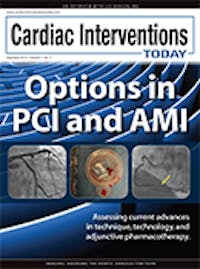
PCI has been established as best therapy for AMI for many years, but we continue to have advances in technique, technology, and adjunctive pharmacotherapy. In this issue, we touch on all three of these areas.
Both the pharmacological and mechanical management of STEMI hold equal importance, but both require careful consideration to determine the ideal treatment modality. Selecting the best antiplatelet regimen after PCI for STEMI patients has been complicated by the expanding numbers of options for therapy. Verghese Mathew, MD, FACC, FSCAI, reviews oral dual-antiplatelet therapy options and weighs the pros and cons of clopidogrel, prasugrel, and ticagrelor. For the mechanical side of STEMI treatment, Yalcin Hacioglu, MD, Zubair Ahmed, MD, Abdul Hakeen, MD, and Barry F. Uretsky, MD, outline the indications and outcomes of manual thrombus aspiration in primary PCI.
Next, Michelle Fennessy, RN, PhD, and John J. Lopez, MD, provide evidence for the effectiveness of a 24/7 in-house STEMI program and offer tips for reducing in-hospital door-to-balloon times.
Thanks to technological developments and improvements in antiplatelet regimens, stenting has also become a solid treatment option for STEMI patients. But which are truly better—bare-metal, or drug-eluting? Ander Regueiro, MD, and Manel Sabaté, MD, PhD, challenge the major myths that imply that bare-metal stents are inferior to drug-eluting technologies.
When a patient doesn't have immediate access to primary PCI, what is the best plan of action? Duane S. Pinto, MD, MPH, FACC, FSCAI, explains the “drip-and-ship” strategy as a viable option to extend the benefit of timely reperfusion therapy to a wider circle of STEMI patients. While femoral access has been the standard for STEMI treatment, Robert J. Applegate, MD, offers perspective on the possibility of the radial approach becoming the new go-to method. A growing body of data supports the option.
Performance measures are crucial for the assessment and improvement of quality of care. Peter M. Pollak, MD, and Henry H. Ting, MD, MBA, look at how to apply performance measures for STEMI and PCI in your practice.
For our imaging department, Paul T. Viatkus, MD, MBA, and Mayra Guerrero, MD, detail the differences among imaging modalities for assessing the aortic annulus for TAVR.
Finally, to close the issue, we have a featured interview with pediatric cardiologist, Lee Benson, MD, FRCP(C), FACC, FSCAI, who discusses stenting for coarctation, the long-term implications of the RESPECT trial's data on PFO closure, and the differences in device availability in Canada versus the United States and Europe.
Our objective is to synthesize the vast ocean of interventional literature into practical and concise reviews. We hope this issue helps you manage the ever-growing volume of cardiology literature, and the ubiquitous stack of journals we all try to deal with. Please let us know if there are other topics you would like to see reviewed.
Advertisement
Advertisement