Advertisement
Advertisement
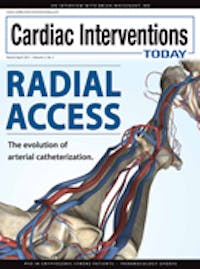
Radial artery access for catheterization and percutaneous coronary intervention (PCI) is being utilized with rapidly increasing frequency in the United States. We open our feature on radial access with an article by Adhir Shroff, MD, MPH, FACC, FSCAI, and Sunil V. Rao, MD, FACC, FSCAI, which covers three important topics in transradial access that must be addressed: an appropriate antithrombotic treatment strategy, the use of transradial access for treating ST-elevation myocardial infarction, and maintaining vessel patency by avoiding radial artery occlusion.
Nicholas R. Balaji, MD; Pinak B. Shah, MD; and Frederic S. Resnic, MD, MSc, continue with a guide to choosing the most suitable catheter for many of the common coronary diagnostic and interventional applications of transradial access. Martial Hamon, MD, FESC, then discusses common types of anatomic variations that may cause difficulty when using the radial approach to PCI.
Next, Ronald P. Caputo, MD, FACC, FSCAI, touches on one of the possible complications of transradial catheterization, forearm hematomas, with an explanation of potential mechanisms and tips for managing it once it occurs.
Alice Perlowski, MD; Michael H. Salinger, MD, FACC, FSCAI; Timothy McDonough, MD, FACC, FSCAI; and I describe the specific steps for using ultrasound imaging to assess radial artery patency and anatomic variations, helping to prevent potential complications.
Justin P. Levisay, MD, FACC, FSCAI, and Timothy A. Sanborn, MD, FACC, FSCAI, compare the incidence of bleeding complications with the transfemoral versus the transradial approach and how to employ preventative strategies to overcome such challenges.
To close our feature, Timothy A. Sanborn, MD, FACC, FSCAI, and Kimberly A. Skelding, MD, FSCAI, provide a timely discussion of the recently published RIVAL trial data and how this might impact interventionists' choice of access sites for coronary imaging and interventions.
Next, we have an update on pharmacology, which includes an article by John P. Vavalle, MD, and Robert A. Harrington, MD, who outline the current options for antithrombotic pharmacotherapy after PCI, and Matthew J. Sorrentino, MD, FACC, expands on this topic with an overview of interventional and pharmacological combination therapies that treat the many factors associated with cardiovascular events.
We also have a Structural Update from Scott Kasner, MD, lead neurologist investigator from the REDUCE trial, who looks at studies that seek to determine the best treatment for cryptogenic stroke in PFO patients as well as what research is still needed.
Also in this issue, we introduce our Ask the OCT Imaging Expert department. Maria D. Radu, MD; Lorenz Räber, MD; Patrick W. Serruys, MD, PhD; and Kari Saunamäki, MD, PhD, tell us about optical coherence tomography and how it can be used to discover atherosclerotic lipid pools and thereby better prevent myocardial infarction and death.
To wrap up this issue, we bring you an interview with Brian Whisenant, MD, the Medical Director of Intermountain Medical Center's Structural Heart Disease Program, in which he shares his thoughts on patent foramen ovale closure and the latest data on this controversial topic, as well as the importance of treating mitral regurgitation and practical applications for the latest imaging technologies.
This issue is packed with updates on several timely topics. I hope that it helps to keep you up-to-date in spite of the ever-growing volume of journal publications that come across our desks but are so hard to manage!
Ted E. Feldman, MD, FSCAI
Chief Medical Editor
citeditorial@bmctoday.com
Advertisement
Advertisement