Advertisement
Advertisement
January/February 2011
Chief Medical Editor's Page
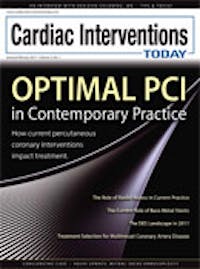
Optimal PCI in Contemporary Practice
This month, we cover several topics including stenting, transradial access, coronary sinus approach for percutaneous mitral annuloplasty, and the utility of simulation training. We begin with Jennifer A. Tremmel, MD, MS, who explains the growing role of transradial access in percutaneous coronary intervention (PCI) and how this technique leads to improved morbidity and mortality rates, procedure costs, and patient satisfaction.
Itsik Ben-Dor, MD; Ron Waksman, MD; Augusto D. Pichard, MD; Joseph Lindsay, MD; and Lowell F. Satler, MD, compare several studies in an effort to determine the usefulness of bare-metal stents in today™s practice and the indications for their optimal application.
Jeffrey S. Kunz, MD, and Mark A. Turco, MD, FACC, FSCAI, provide a counterpoint to the use of bare-metal stents by outlining the improvements being made to the current generation of drug-eluting stents. New designs, including thinner strut platforms and novel polymer coatings, will surely affect the efficacy and safety of PCI.
Next, Philippe Garot, MD, FESC, and Thierry Lefevre, MD, FESC, FSCAI, describe how to assess whether coronary artery bypass surgery or PCI is the better option for treating patients with multi-vessel coronary artery disease. The authors consider SYNTAX score, as well as other clinical and anatomical scales, as a risk stratification tool to determine the most appropriate treatment modality.
In this issue, we also have a Valve Update by Jan Harnek, MD, in which he offers data from several trials showing that a coronary sinus approach is a safe and efficacious treatment for functional mitral regurgitation. Michael S. Lee, MD, and Michael Wolfe, BS, present a Challenging Case of PCI accompanied by cardiogenic shock. This article provides a step-bystep analysis of how to manage such situations and explains why extracorporeal membrane oxygenation is a good option for providing hemodynamic support. Finally, Zaheed Tai, DO, FACC, FSCAI, shares Tips & Tricks for selectively engaging the left internal mammary artery using a right radial approach.
In our featured interview, Sheldon Goldberg, MD, tells us about simulation training and how it might best be used, as well as the next technological horizon for detecting vulnerable plaque to prevent myocardial infarction.
As always, we hope to summarize the current topics of interest from the ever-growing interventional literature. Our aim is to provide a synthesis of major areas of subject matter by experts who can share their insights and opinions. Let us know if there are topics you would like to read about in future issues.
Ted E. Feldman, MD, FSCAI Chief Medical Editor
citeditorial@bmctoday.com
Advertisement
Advertisement