Advertisement
Advertisement
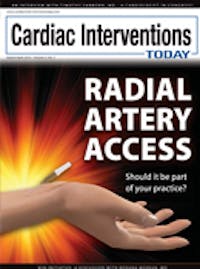
Radial access is gaining in both interest and application in catheterization laboratory practice in the United States. The gains are based not only on a growing database on the radial approach, but also due to the way patients react to radial versus femoral procedures. In this issue, we examine the state of the art for radial access procedures.
Our feature on radial artery access begins with Matthew L. Bilodeau, MD, PhD, and Daniel I. Simon, MD, FACC, FAHA, FSCAI, who provide an overview of how to obtain transradial access, a helpful listing of the equipment used with this technique, and the challenges and advantages operators must consider.
Next, John P. Vavalle, MD, and Sunil V. Rao, MD, discuss the role of radial access in reducing vascular complications during PCI, and therefore, producing a better overall procedural outcome.
Christopher Pyne, MD, FACC, and Tift Mann, MD, FACC, present a guide for those interested in transradial access training, which explains the elements of the learning curve that interventions must overcome.
Transradial access may provide advantages in many different procedural settings. In this technical overview, Ian C. Gilchrist, MD, FACC, FSCAI, describes the method of venous access from the forearm to reach the central venous system for either diagnostic or interventional procedures.
Ehab A. Eltahawy, MD, MPH, and Christopher J. Cooper, MD, present a detailed review that is focused on the unique vascular complications of transradial access and how they can be avoided.
In our Women's Health column, Roxana Mehran, MD, talks with us about the WIN Initiative and the steps they are taking to foster the growth of women operators in the field and their efforts to improve cardiovascular care for women worldwide. We also have an interview with Chris Cates, MD, an interventional cardiologist who wants to enter an unexpected arena in order to improve health care, the United States House of Representatives.
In our featured interview, Timothy Sanborn, MD, tells us about his practice at the NorthShore University HealthSystem, current door-to-balloon time initiatives, and what's next in the area of valvular and structural heart disease.
As always, we strive to synthesize the mass of information that comes to all of us each week in the ever-increasing number of journals and each day in the many email and web-based messages. Please let us know about any improvements we can make and topics you would like to hear about.
Advertisement
Advertisement